

Earlier this year, President Trump signed the “One Big Beautiful Bill” into law, reinforcing many provisions from the 2017 Tax Cuts and Jobs Act, along with other significant tax changes. As we approach the end of the year, here’s a summary of the law’s permanent and temporary changes — and what they mean for you.
Permanent Changes
The following provisions will become a permanent part of the tax code:
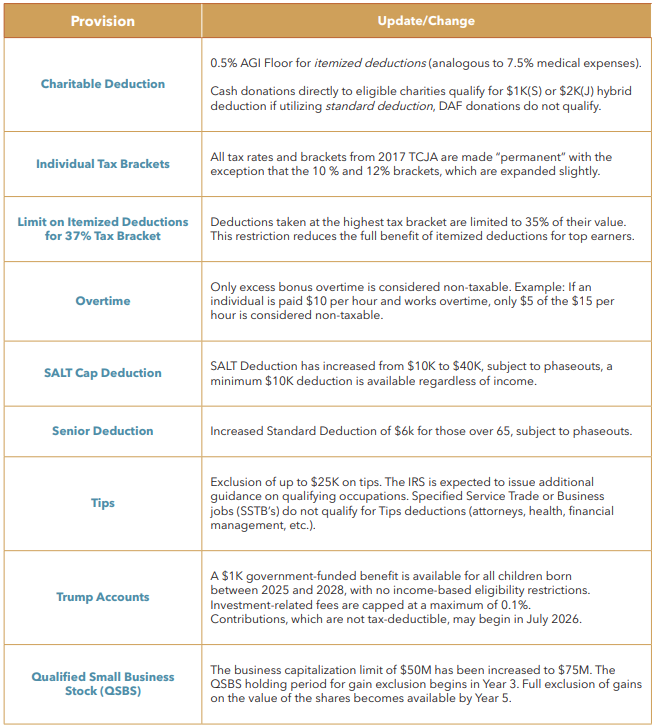
• Seven tax brackets remain, with a top rate of 37% and a bottom rate of 10%.
• The mortgage interest deduction remains at its current limit of $750,000 for joint filers ($375,000 for single filers).
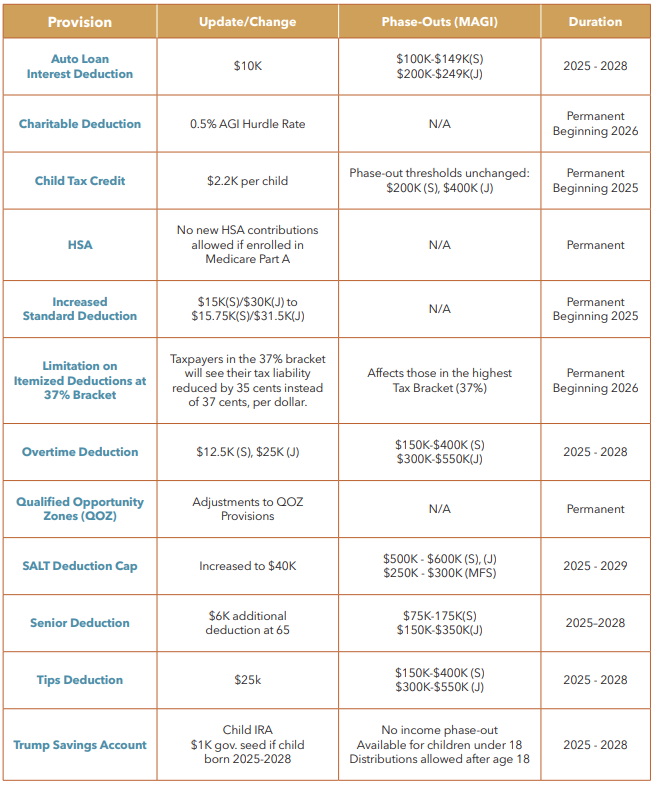
• The State and Local Tax (SALT) deduction will increase to $40,000 and then revert to $10,000 in 2030. The higher SALT cap will phase out for incomes over $500,000.
• The standard deduction increases to $15,750 for single filers and $31,500 for joint filers, indexed for inflation after 2025.
• Lifetime gift and estate tax exclusions increase to $15 million for single filers and $30 million for filers who are married and filing jointly, indexed for inflation going forward.
• Child Tax Credit will increase to $2,200 per child starting in 2025.
• Non-itemizers can claim a deduction for charitable contributions of up to $1,000 ($2,000 for couples) starting in 2026.

Temporary Provisions (4 Years)
The legislation includes some temporary deductions and credits that are valid for the 2025-2028 tax years only.
• Tip and overtime deductions: Workers can deduct up to $25,000 in qualifying tip income and $12,500 in overtime pay ($25,000 for joint filers). These deductions phase out with income over $150,000 ($300,000 for joint filers).
• Additional deduction for seniors:Those over the age of 65 will get an additional $6,000 deduction that begins to phase out at an income of $75,000 for single filers and $150,000 for joint filers. This is in addition to the $2,000 deduction for single filers and $3,200 for joint filers.
• Vehicle loan interest deduction: Auto buyers can deduct up to $10,000 of loan interest for purchased vehicles whose final assembly took place in the U.S. The deduction would apply for single taxpayers with adjusted gross income of $100,000 or less ($200,000 for people filing jointly).

Additional Provisions
• New savings account: Parents and relatives can now contribute up to $5,000 a year to a new savings account for minor beneficiaries, called Trump accounts. Initially acting like a non-deductible IRA, contributions can be made until the beneficiary reaches the age of 18. Then, the account would effectively convert to a traditional IRA. Additionally, parents of children born between Jan. 1, 2025, and Dec. 31, 2028, would qualify for $1,000 in federal money to start the account.
• Expanded 529 plan uses: Acceptable uses include miscellaneous expenses such as testing fees, tutoring outside the home, and educational therapies, as well as tax-free withdrawals for recognized postsecondary credential programs.
• Broader HSA eligibility: More health plan types and participant categories are included.
• Social Security taxes: The legislation did not eliminate taxes on Social Security benefits, which remain taxable up to 85% for individuals with income greater than $34,000, or $44,000 for a couple. However, the $6,000 deduction for those 65 and older may help offset taxes on Social Security benefits for some over the next four years.
Key Individual Tax Changes
As you review the new tax legislation, it may be the perfect time to review your financial planning needs as well. This includes revisiting your investment portfolio, assessing tax planning opportunities, reevaluating retirement goals, and managing your wealth transfer and legacy plans.
As we learn more about the Trump Savings accounts and other aspects of the bill, we will continue to communicate and educate.
This summary of the new legislation contains merely a portion of the items that may apply to your family. We are always happy to meet and discuss any of the above to ensure that you remain on track with your financial profile and your goals.

The CD Wealth Formula
We help our clients reach and maintain financial stability by following a specific plan, catered to each client.
Our focus remains on long-term investing with a strategic allocation while maintaining a tactical approach. Our decisions to make changes are calculated and well thought out, looking at where we see the economy heading. We are anticipating and moving to those areas of strength in the economy and in the stock market.
We will continue to focus on the fact that what really matters right now is time in the market, not out of the market. That means staying the course and continuing to invest, even when the markets dip, to take advantage of potential market upturns. We continue to adhere to the proven disciplines of diversification, periodic rebalancing, and forward-looking strategies, while avoiding reliance on stale retrospective data.
It is important to focus on the long-term goal, not on one specific data point or indicator. Long-term fundamentals are what matter. In markets and moments like these, it is essential to stick to the financial plan. Investing is about following a disciplined process over time.
Source: Kestra Investment Management


