

After setting new all-time highs in January, the S&P 500 has been down for five straight weeks and is nearing a 10% correction. The NASDAQ, Dow, and Russell 2000 already have crossed into correction territory, all down more than 10% from their highs.
While this feels significant, it’s important to remember that pullbacks like this are a normal part of investing and historically have occurred in most years.
Still, the drumbeat is hard to ignore:
• Stocks are having their worst month and worst quarter since 2022, and the Dow is set to end its 10-month winning streak.
• The VIX index, which measures short-term market volatility, is up more than 50% for the month.
• The price of gas in the U.S. is at $4 per gallon, and Brent Crude is up more than 55% for the month.
• Gold and silver prices have tumbled.
Market downturns can be unnerving. Investor sentiment feels much worse, and that is a good thing for the market. It doesn’t mean that we are at a bottom, but greater fear means that more bad news may be priced into the market.
Many find it difficult to stay the course as stocks are declining, but as we have already seen during this downturn, opportunities exist for investors.
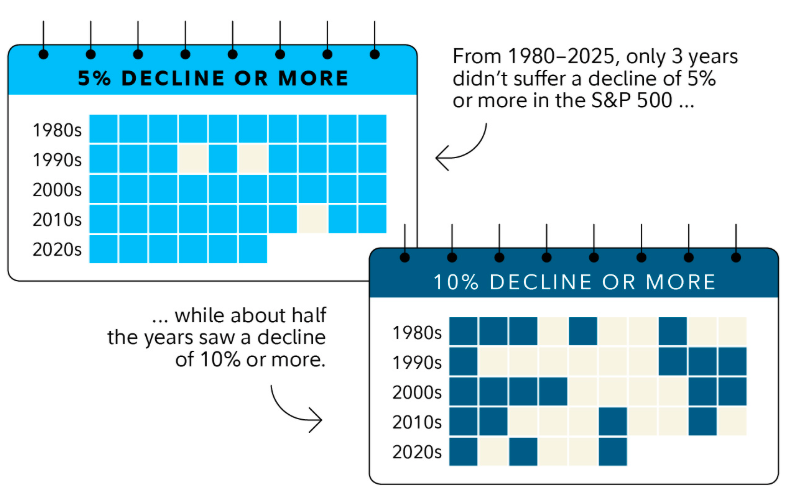
Corrections are a normal part of investing. Since 1980, the S&P has experienced a drop of 5% or more in 93% of calendar years and has experienced a decline of 10% or more in almost half of the years. Going back to 1928, pullbacks of 10% or more happen every 13 months on average, or almost once a year over the last 100 years.
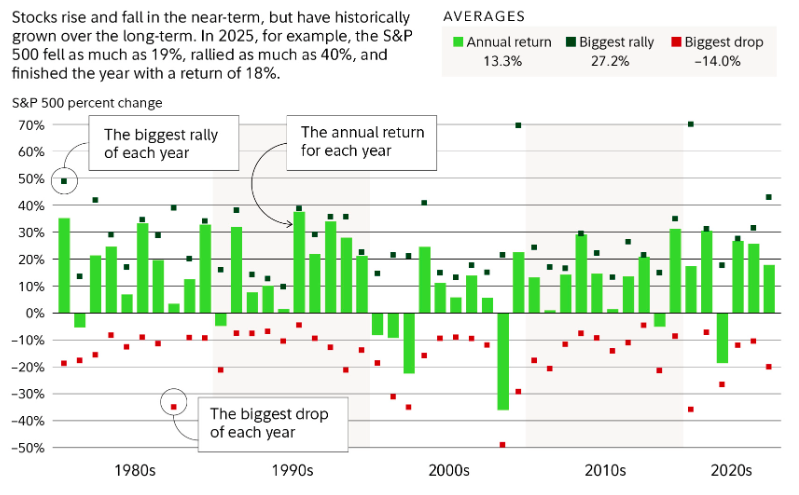
Despite the frequent declines in the market, the return for an average calendar year over the same period is a positive 13.3%. Historically, markets recover quickly from corrections.
The chart below reviews the largest drop from a market high in each year. Looking at the red dots, you can see it is common to experience significant market declines in any given year, yet the market still has often recovered and produced positive results. Since 1980, declines of at least double digits happened at some point in 24 years — and in 14 of those years, stocks went on to finish higher.
In such times of uncertainty, it is easy for investors to feel that this time is different and fear the worst. Markets can react to headlines and emotions in the short term, but over the longer term, stocks revert to fundamentals. If corporate profits are rising, stocks are going to rise, regardless of the noise.
In today’s economy, earnings continue to rise. AI demand has shown no signs of slowing. Airlines reported solid guidance, even with higher oil prices. The S&P 500’s forward 12-month earnings estimates hit another new high last week, as did profit margins. Earnings and profit margins are strong indicators for the stock market.
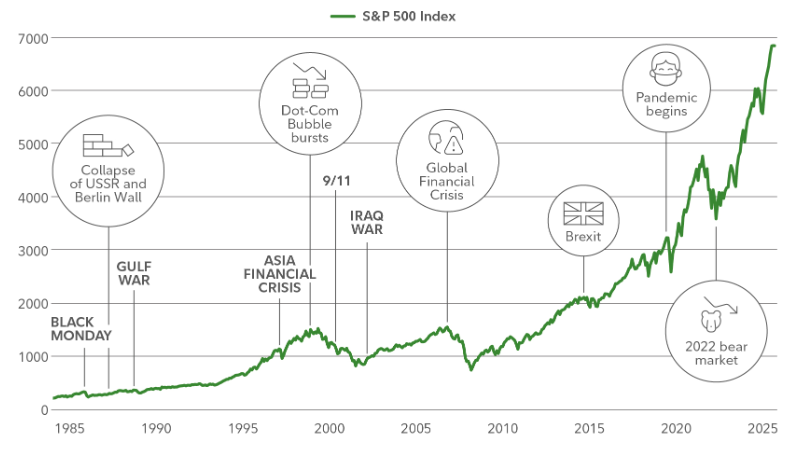
Psychologically, the raw emotions of the present are more powerful than the distant emotions of an uncertain future. In periods like this, the urge to act is strong. Doing something can feel like regaining control, but it often works against long-term outcomes.
Think of it like being on a ship in rough water. Focus on the waves, and you feel worse. Focus on the horizon, and you steady yourself. Investing works the same way.
“What if” fears about the stock market based on current news, such as questions about the war in Iran, can cause seasickness. Don’t just think about the next six months; look out beyond. As the horizon expands, volatility shrinks.
Remember, we are more motivated to avoid loss than to pursue gains. There is a tradeoff in every decision that is made. With a longer-term plan in place, focus on the details of the plan and your dreams.
When things are more volatile and uncertain, it feels like we have lost control. The need for control is very powerful, so we often take action to feel like we are in control. This is a natural reaction.
Unfortunately, taking action simply for the purpose of taking action can have unintended consequences — and financially, making rash decisions seeking control today can undermine the long-term strategy and lead to giving up control of your future.

The CD Wealth Formula
We help our clients reach and maintain financial stability by following a specific plan, catered to each client.
Our focus remains on long-term investing with a strategic allocation while maintaining a tactical approach. Our decisions to make changes are calculated and well thought out, looking at where we see the economy heading. We are anticipating and moving to those areas of strength in the economy and in the stock market.
We will continue to focus on the fact that what really matters right now is time in the market, not out of the market. That means staying the course and continuing to invest, even when the markets dip, to take advantage of potential market upturns. We continue to adhere to the proven disciplines of diversification, periodic rebalancing, and forward-looking strategies, while avoiding reliance on stale retrospective data.
It is important to focus on the long-term goal, not on one specific data point or indicator. Long-term fundamentals are what matter. In markets and moments like these, it is essential to stick to the financial plan. Investing is about following a disciplined process over time.
Sources: Carson, Fidelity, JP Morgan


