

After nine straight weeks of gains, markets sold off sharply at the end of last week. The Nasdaq finished down more than 4% on Friday, while the S&P 500 fell more than 2.5%. During its run, the S&P 500 had gained almost 20% before falling short of its first 10-week winning streak since 1985.
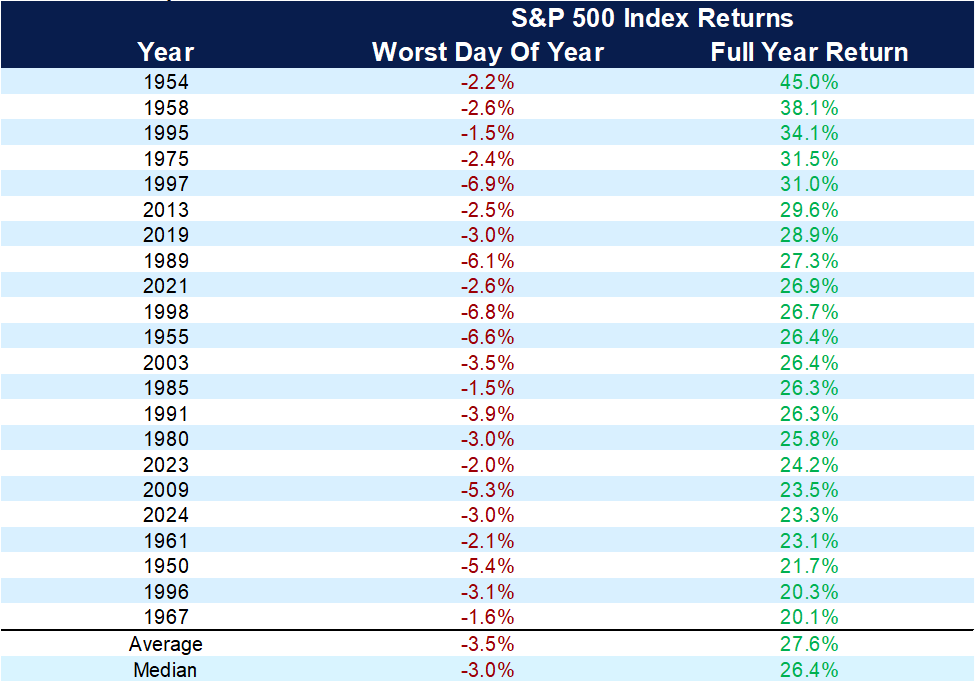
Friday was a reminder that even in strong years, difficult days can and will happen; markets don’t move in a straight line. The chart below shows that when the S&P 500 has been up more than 20% in a calendar year, the average worst day has been a decline of roughly 3%, with some pullbacks approaching 7%.
Large down days are a normal part of investing and occur more often than many investors realize.
Even Years That Gain 20% Have a Bad Day
Big Days Ahead for IPOs
On Friday, SpaceX is expected to become the first of three massively anticipated initial public offerings this year, with Anthropic and OpenAI expected to follow. Together, these three offerings are projected to carry a combined market capitalization of roughly $3.6 trillion — nearly five times the combined value of the 10 largest IPOs in history at the time they came public.
SpaceX’s IPO is unique in several ways. Rather than offering shares within a pricing range and allowing demand to determine the final offering price, the company is reportedly using a “take-it-or-leave-it” price of $135 per share. In addition, approximately 30% of the shares being offered are expected to be allocated to retail investors, well above the typical 5-10% allocation seen in most IPOs.
Largest Collection of Public Offerings Ever
Market cap at time of listing (billions)
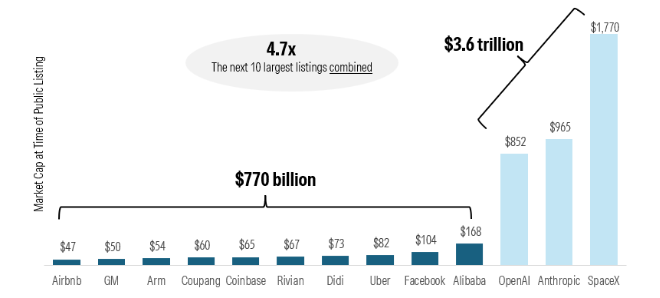
There is tremendous hype surrounding the SpaceX IPO, and it will be interesting to see how the market reacts. The offering is expected to be the largest IPO in history, with an estimated market capitalization of $2 trillion. (Market capitalization is the number of shares outstanding multiplied by share price.) That number would surpass Saudi Aramco’s 2019 offering, meaning Elon Musk is anticipated to become the world’s first trillionaire.
Despite the excitement, SpaceX reportedly lost nearly $5 billion last year, meaning much of the investment case rests on future potential rather than current profitability. That said, investors should remember that some of today’s most successful companies, including Amazon, operated at losses for many years before ultimately becoming highly profitable businesses.
History also suggests that chasing IPOs — particularly during the initial days after they begin trading — is rarely a prudent long-term investment strategy.
The odds are often stacked against new public investors. While many IPOs experience an initial “pop” driven by hype, limited share availability, and media attention, IPOs historically have tended to underperform the broader market over longer periods of time.
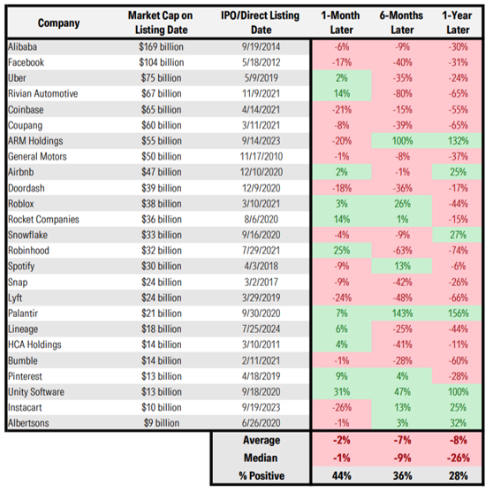
The table below highlights several well-known technology companies that went public and, on average, experienced drawdowns of roughly 60% from their IPO prices during the first year. Among the 25 largest IPOs since 2010, average returns after one month, six months, and one year have all been negative, with fewer than 30% posting positive returns one year after going public.
Buyer Beware
Large public offerings usually are better for sellers than buyers — at least initially
What Investors Should Keep in Mind
SpaceX, OpenAI, and Anthropic may eventually make their way into investor portfolios whether investors choose to purchase the stocks directly or not. The Nasdaq recently adopted a fast-entry rule that allows newly public mega-cap companies to join the Nasdaq-100 after just 15 trading days.
The S&P, however, has said it will maintain its existing eligibility requirements, including a 12 month waiting period and profitability standards before a company can be added to the S&P 500 Index.
SpaceX, OpenAI, and Anthropic may ultimately prove to be remarkable public companies. However, that does not necessarily mean they will be good investments at their IPO prices.
FOMO is a very real emotion in investing, and many investors fear they may be missing the next Tesla or Nvidia.
Facebook and Amazon are good examples. Facebook struggled after its IPO, falling nearly 50% within its first year as a public company before eventually becoming one of the best-performing and most profitable companies of the last decade.
The key distinction is that many of these IPOs may indeed be exceptional businesses, but they are already being valued as exceptional businesses from day one. The market will closely watch how SpaceX trades following its IPO on Friday, as it could help set the tone for technology stocks in the weeks ahead.

The CD Wealth Formula
We help our clients reach and maintain financial stability by following a specific plan, catered to each client.
Our focus remains on long-term investing with a strategic allocation while maintaining a tactical approach. Our decisions to make changes are calculated and well thought out, looking at where we see the economy heading. We are anticipating and moving to those areas of strength in the economy and in the stock market.
We will continue to focus on the fact that what really matters right now is time in the market, not out of the market. That means staying the course and continuing to invest, even when the markets dip, to take advantage of potential market upturns. We continue to adhere to the proven disciplines of diversification, periodic rebalancing, and forward-looking strategies, while avoiding reliance on stale retrospective data.
It is important to focus on the long-term goal, not on one specific data point or indicator. Long-term fundamentals are what matter. In markets and moments like these, it is essential to stick to the financial plan. Investing is about following a disciplined process over time.
Sources: Carson, CNBC, Morningstar


