

As 2026 draws to a close, now is an excellent time to review your financial plan and consider strategies that could enhance your tax, investment, retirement, and estate planning. Changes in your personal circumstances, financial goals, tax situation, and the broader economic environment can all create new planning opportunities.
As we near 2027, here are several year-end strategies you may want to consider and discuss with your CD Wealth team.
Income Tax Strategies
Traditional year-end planning focuses on deferring income into a future year and accelerating deductions into the current year.
• If you expect to earn more income next year or believe your tax rate may be higher, it may make sense to recognize certain income this year, while your tax rate may be lower. You also may benefit from waiting until next year to claim some deductions, when they could provide greater tax savings.
• If you expect your tax rate to be lower next year, consider delaying income when possible so it may be taxed at a lower rate. If you itemize deductions, consider grouping certain medical expenses into the same year to improve your chances of qualifying for a deduction. And consider making your January mortgage payment in December so you can deduct the interest on this year’s tax return.
Tax-Related Investment Strategies
Tax-loss harvesting is the strategy of selling securities at a loss to offset capital gains taxes, either in the current year or in future years. Securities must generally be sold by Thursday, Dec. 31, 2026, the last trading day of the year, to realize a capital gain or loss for 2026. Two strategies to consider:
• Harvesting losses by selling taxable investments. Remember that you must wait at least 31 days before repurchasing a holding sold at a loss to avoid the IRS wash-sale rule.
• Harvesting gains by selling taxable investments if you have a tax-loss carryforward available.
Also, make sure you have satisfied any Required Minimum Distribution (RMD) obligations:
• Failure to take an RMD may result in a 25% IRS penalty, reduced from the prior 50% penalty.
• If you own an inherited IRA, an RMD may be required separately for that account as well.
• If you inherited an IRA after 2019, the inherited IRA generally must be fully depleted by the end of the 10th year. If the original owner was already taking RMDs at the time of death, annual distributions may be required during years one through nine, in addition to depleting the account by year 10.
• Beneficiaries of Roth IRAs are generally not required to take annual RMDs. However, the 10-year rule still applies, and the account must be fully distributed by the end of the 10th year.
Retirement Planning Strategies
• Consider maximizing your IRA contributions. For 2026, eligible individuals can contribute up to $7,500 to Traditional and Roth IRAs combined, plus a $1,100 catch-up contribution for individuals age 50 or older, for a total of $8,600. Traditional IRA deductibility and Roth IRA eligibility remain subject to applicable income and retirement plan rules.
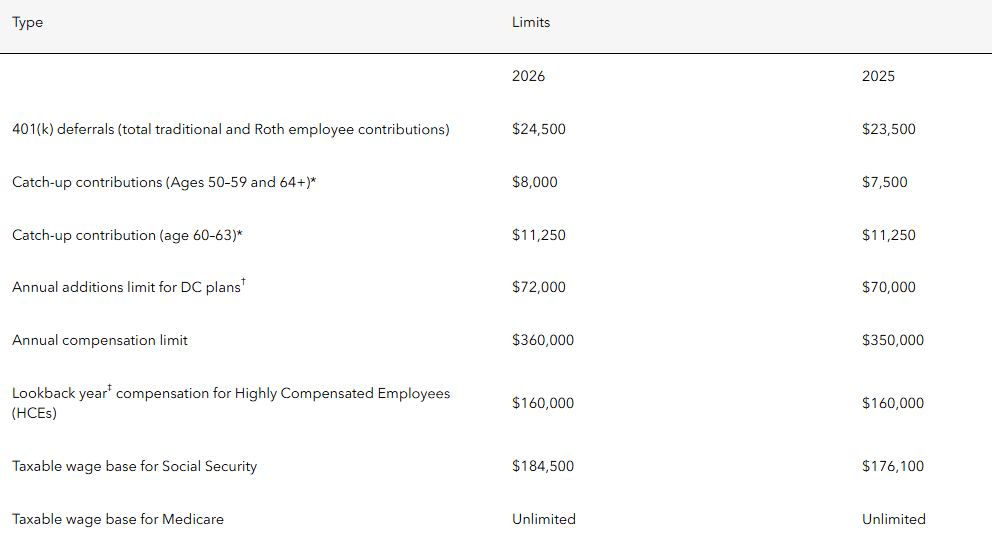
• Consider maximizing contributions to your 401(k) or other employer-sponsored retirement plan. The 2026 employee contribution limit is $24,500, plus an $8,000 catch-up contribution for eligible participants age 50 or older.
• Participants who turn 60 through 63 during 2026 may instead be eligible for an enhanced catch-up contribution of $11,250.
• Consider making contributions to a Roth 401(k) if your employer-sponsored plan allows and the strategy aligns with your overall tax plan.
• Consider establishing and funding a Roth IRA for children who have qualifying earned income. Contributions are subject to annual IRA contribution limits and cannot exceed the child’s earned income for the year.
Retirement Plan Contribution and Dollar Limits
Gifting and Charitable Planning Strategies
• Consider making gifts of up to $19,000 per person under the federal annual gift tax exclusion. You may give up to $19,000 this year to as many individuals as you choose without triggering federal gift taxes.
• Payments made directly to educational or medical institutions on behalf of a beneficiary do not count toward your annual exclusion amount or your lifetime estate and gift tax exemption.
• Consider establishing a donor-advised fund to receive an immediate income tax deduction while creating flexibility to support charitable organizations over time.

• If you already have a donor-advised fund, or if you are considering charitable giving, consider gifting appreciated assets held longer than one year. This strategy may allow you to receive a fair-market-value income tax deduction while avoiding capital gains tax on the appreciation.
• If you are age 70½ or older, consider making a Qualified Charitable Distribution (QCD) directly from an IRA to a public charity. The distribution is excluded from gross income, and you may give up to $111,000 as a tax-free gift from your IRA while potentially satisfying all or a portion of your RMD requirement.
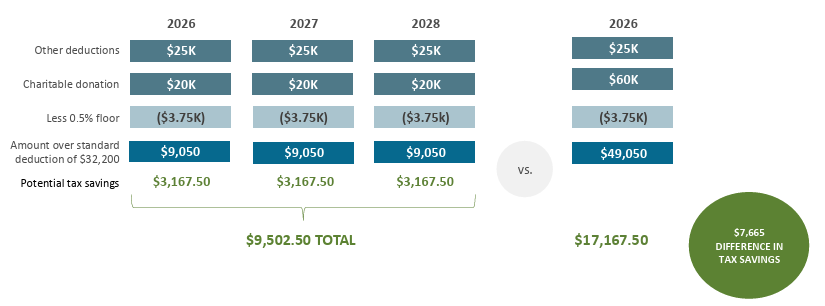
• Consider combining multiple years of charitable giving into a single year to exceed the standard deduction threshold. This strategy, commonly called “bunching,” may increase the tax benefit of your charitable contributions. The chart below illustrates how a bunching strategy can reduce taxes when implemented appropriately.
Bunching in 2026
Scenario: Donor has income of $750K, is in the 35% federal income tax bracket, files jointly as a married couple, and itemizes deductions.
Wrapping Up 2026, Planning for 2027
Discuss any major life events or changes in your financial circumstances with your CD Wealth team to ensure your financial plan continues to reflect your goals and priorities.
• Communicate with your CPA and provide updated capital gain, investment income, and other relevant information to assist with an accurate year-end tax projection.
• Review your Health Savings Account (HSA) contributions. For 2026, eligible individuals can contribute up to $4,400 for self-only coverage or $8,750 for family coverage, with an additional $1,000 catch-up contribution available for eligible individuals age 55 or older.
• Review beneficiary designations on retirement plans, IRAs, Roth IRAs, annuities, life insurance policies, and other applicable accounts to ensure they continue to reflect your intentions.
• Review your cybersecurity and identity-theft protections and consider whether additional safeguards may be appropriate for you and your family.
Year-end planning is most effective when your investment, tax, retirement, and estate strategies are considered together. Not every strategy listed above will apply to every individual or family, which is why personalized planning remains so important.
Please reach out to your CD Wealth team if you would like to discuss how any of these strategies may apply to your specific circumstances. We are happy to coordinate with your CPA, attorney, and other trusted advisors as we close out 2026 and prepare for 2027.

The CD Wealth Formula
We help our clients reach and maintain financial stability by following a specific plan, catered to each client.
Our focus remains on long-term investing with a strategic allocation while maintaining a tactical approach. Our decisions to make changes are calculated and well thought out, looking at where we see the economy heading. We are anticipating and moving to those areas of strength in the economy and in the stock market.
We will continue to focus on the fact that what really matters right now is time in the market, not out of the market. That means staying the course and continuing to invest, even when the markets dip, to take advantage of potential market upturns. We continue to adhere to the proven disciplines of diversification, periodic rebalancing, and forward-looking strategies, while avoiding reliance on stale retrospective data.
It is important to focus on the long-term goal, not on one specific data point or indicator. Long-term fundamentals are what matter. In markets and moments like these, it is essential to stick to the financial plan. Investing is about following a disciplined process over time.
Source: Fidelity


