

With the midterm election less than a month away, many investors are wondering whether they should make changes to their portfolios. Election years often generate headlines and market volatility that can make it feel like action is required.
That uncertainty is understandable. History, however, suggests that maintaining a disciplined approach can serve investors better than reacting to election outcomes.
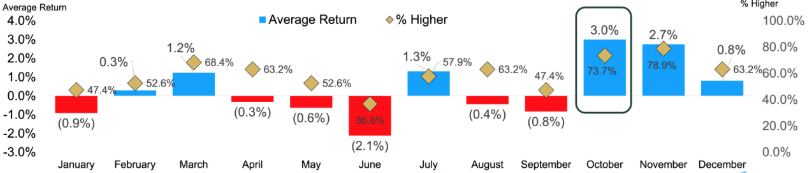
Historically, the fourth quarter of a midterm year has been one of the strongest quarters in the entire four-year presidential cycle. October has led the way, with an average gain of 3% and positive returns almost 75% of the time. November has followed closely, up almost 3% as well and finishing higher almost 80% of the time.
Granted, there are no guarantees that this will happen again. In 2018, during President Trump’s first midterm election, stocks fell almost 7% in October.
We continue to remain optimistic heading into the final months of the year, and not simply because of historical data.
S&P 500 Monthly Performance in Midterm Years (1950-2025)
While every election cycle is unique, the evidence suggests that markets have been remarkably resilient, regardless of the political outcome.
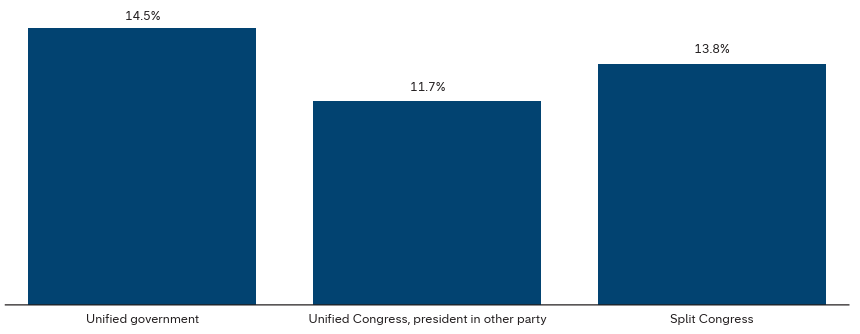
Since 1933, markets have averaged double-digit annual returns across a variety of political environments, including periods when a single party controlled both the White House and Congress, when government was divided, and when Congress was controlled by the president’s opposing party.
The reason is simple: While government policy does affect industries, business results drive the markets. Successful businesses adapt to changes in taxes, regulation, and leadership in Washington — and corporate earnings, innovation, productivity, and economic growth historically drive market returns.
Market Returns Under Different Political Arrangements
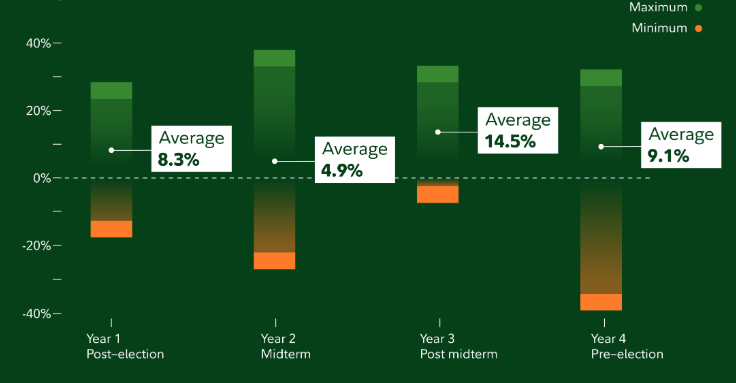
The second year of a presidential term historically has produced the lowest average returns of the four-year cycle. By contrast, the year following midterm elections has delivered the highest average returns. One explanation is that investors often spend much of the election year focused on uncertainty surrounding taxes, regulation, spending priorities, and other policy issues. Once the election is decided, some of that uncertainty disappears, allowing markets to refocus on fundamentals.
So far this year, the S&P 500 has significantly outperformed the historical average for the second year of a presidential cycle, gaining more than 14% to date. Investors have generally remained optimistic as strong corporate earnings expectations have helped offset concerns surrounding geopolitical tensions, higher energy prices, inflation, and interest rates.
Stock Market Returns and the Election Cycle
Average S&P 500 Index 12-month returns, November to November, 1950-present
Elections can create anxiety and foster the belief that investors need to take immediate action. News coverage intensifies, polls shift, forecasts change, and market predictions evolve rapidly. Yet there is little evidence that reacting to election headlines improves long-term investment outcomes.
Instead, it is more productive to focus on the factors you can control:
1. Review your financial goals.
2. Evaluate whether your risk tolerance has changed.
3. Assess your portfolio allocation and consider rebalancing if needed.
4. Avoid emotional or impulsive investment decisions.
While election outcomes can influence taxes, regulations, spending priorities, and public policy, history suggests they have rarely been the primary driver of investment returns.
There may be short-term volatility associated with elections, but abandoning a carefully constructed financial plan because of uncertainty surrounding the results often represents a much greater risk to long-term success than which party wins in November.
As always, our focus remains on helping our clients build and maintain portfolios aligned with their goals, time horizons, and risk tolerance. Elections will come and go, but disciplined investing, thoughtful financial planning, and a long-term perspective remain among the most reliable drivers of financial success.

The CD Wealth Formula
We help our clients reach and maintain financial stability by following a specific plan, catered to each client.
Our focus remains on long-term investing with a strategic allocation while maintaining a tactical approach. Our decisions to make changes are calculated and well thought out, looking at where we see the economy heading. We are anticipating and moving to those areas of strength in the economy and in the stock market.
We will continue to focus on the fact that what really matters right now is time in the market, not out of the market. That means staying the course and continuing to invest, even when the markets dip, to take advantage of potential market upturns. We continue to adhere to the proven disciplines of diversification, periodic rebalancing, and forward-looking strategies, while avoiding reliance on stale retrospective data.
It is important to focus on the long-term goal, not on one specific data point or indicator. Long-term fundamentals are what matter. In markets and moments like these, it is essential to stick to the financial plan. Investing is about following a disciplined process over time.
Sources: Carson, Fidelity, CNBC, Capital Group


