

Last week, the Federal Reserve raised its target range for the federal funds rate by 25 basis points, to 3.75%–4.00%, marking its first increase since July 2023. The Federal Open Market Committee approved the decision unanimously, 12–0.
“Inflation remains elevated,” the Committee said. “Today’s policy action will support a timelier return to the Committee’s 2 percent goal.” Fed officials’ latest projections suggest another quarter-point increase could follow before the end of the year.
When the Federal Reserve decides to raise interest rates, it typically reflects confidence that the U.S. economy remains on solid footing. Higher interest rates are intended to make borrowing more expensive, helping to cool economic activity and reduce inflationary pressures. By slowing demand for goods and services, the Fed seeks to bring inflation closer to its 2% target.
Meanwhile, AI-related investment continues to support economic growth, while consumer spending remains resilient and is increasing at an annualized pace of roughly 2%. The ongoing buildout of AI infrastructure is driving significant capital spending and increasing demand for financing, both of which have contributed to higher long-term interest rates. A 10-year Treasury yield around 5% is not unusual and may be appropriate given the current outlook for growth and inflation.
The labor market remains near full employment, with the unemployment rate in the low 4% range. Equity markets are at or near all-time highs, credit spreads remain tight, and government deficits are elevated in the U.S. and abroad. Even in the face of higher long-term interest rates, the economy has remained resilient.
Higher Interest Rates Have Often Accompanied a Strong Economy
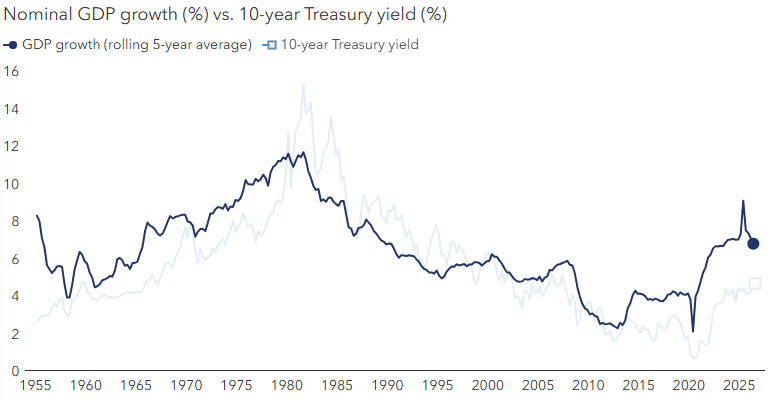
What Do Interest Rate Hikes Mean?
When the Fed raises interest rates, the good news is that banks and other financial institutions typically offer higher interest rates on deposits. Money market rates and short-term CDs generally move higher as well.
On the other hand, higher interest rates make it more expensive to borrow money. One rate hike alone is unlikely to have a significant impact, but credit card interest rates typically move higher when the Fed raises rates.
Auto loans and mortgages are affected differently because they do not closely track the federal funds rate and are longer-term in nature. Instead, they tend to follow the yield on the 10-year Treasury. With the 10-year Treasury yield above 5%, the average 30-year mortgage rate is now more than 7%.
Bond Yields in the 3% to 6% Range Are Common Over the Long Term
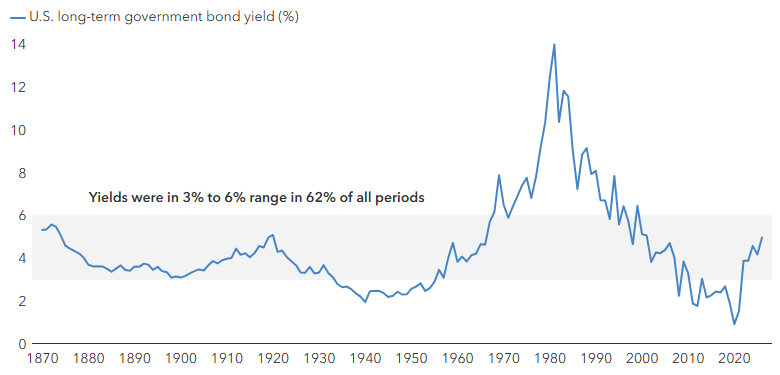
While the 10-year Treasury yield has risen above 5%, current yields remain well below the levels experienced during the inflationary decades of the 1970s and early 1980s.
Prior to the recent move, the last time the 10-year Treasury yield exceeded 5% was October 2023, and before that, July 2007. As shown in the chart above, most of this century has been characterized by lower bond yields.
For stock and bond investors, higher yields can lead to increased market volatility. Higher rates can pressure stock valuations because borrowing costs rise, which can weigh on company profits. In addition, higher yields may attract some investment dollars away from riskier assets such as stocks. So far, however, higher yields have not been enough to derail the broader equity market, which continues to be supported by strong earnings growth and ongoing economic expansion.
For bond investors, higher yields mean higher income potential. However, there is an inverse relationship between bond yields and bond prices. As yields rise, prices fall. Bonds currently held by bond funds may experience price declines, but fund managers are able to reinvest in higher-yielding bonds, helping to lock in higher income levels for longer periods.
Higher yields set a higher bar for stocks. Even so, the outlook remains favorable despite tariffs, inflation, and geopolitical tensions. It is important to remember that the federal funds rate and the 10-year Treasury yield do not always move together, and stocks can continue to advance even when yields rise.
Resilient consumer spending, strong business investment, and rising corporate earnings continue to support equities. Over time, stock prices tend to follow earnings, and corporate earnings growth remains a key driver of long-term market performance.
Higher yields may create periods of market volatility, but they do not change the fundamental drivers of long-term investment returns. Strong corporate earnings, continued business investment, resilient consumers, and ongoing technological innovation remain supportive of economic growth. While interest rates will continue to influence markets, we believe that staying disciplined and focused on long-term objectives remains the best path forward.

The CD Wealth Formula
We help our clients reach and maintain financial stability by following a specific plan, catered to each client.
Our focus remains on long-term investing with a strategic allocation while maintaining a tactical approach. Our decisions to make changes are calculated and well thought out, looking at where we see the economy heading. We are anticipating and moving to those areas of strength in the economy and in the stock market.
We will continue to focus on the fact that what really matters right now is time in the market, not out of the market. That means staying the course and continuing to invest, even when the markets dip, to take advantage of potential market upturns. We continue to adhere to the proven disciplines of diversification, periodic rebalancing, and forward-looking strategies, while avoiding reliance on stale retrospective data.
It is important to focus on the long-term goal, not on one specific data point or indicator. Long-term fundamentals are what matter. In markets and moments like these, it is essential to stick to the financial plan. Investing is about following a disciplined process over time.
Sources: Capital Group, AARP, Fidelity


