

Stocks continue to move higher, even amid war in the Middle East, higher inflation, and 30-year Treasury yields at their highest levels since the Great Financial Crisis. The S&P 500 reached another all-time high last week — its 25th this year — as the current bull market approaches its fourth anniversary in October.
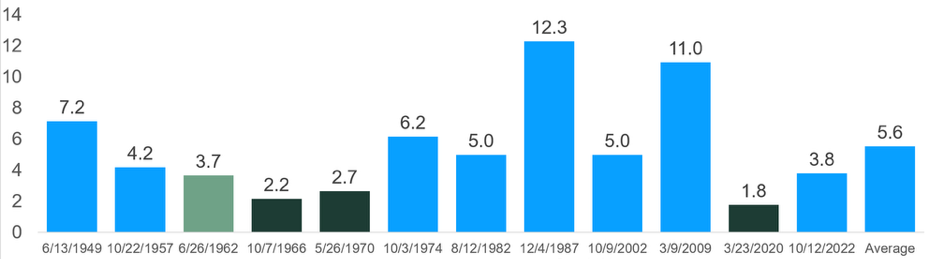
Bull markets have historically lasted longer than many investors realize. As the chart below illustrates, there can be many more years of gains after bull markets make it past three years. Since 1949, only three bull markets have lasted less than three years, and only two that surpassed the three-year mark failed to continue beyond five years.
Bulls That Get to 3 Usually Last Many More Years
Length of bull markets in years
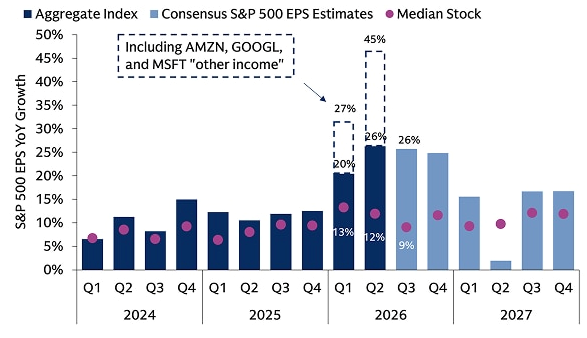
Obviously, there are no guarantees that the current bull market will reach the five-year mark. But if you look at S&P 500 earnings, it is difficult to see a bear market on the horizon. Companies in the index are on track to achieve their seventh consecutive quarter of double-digit year-over-year earnings growth.
S&P 500 earnings per share (EPS) growth is tracking 45% year over year for the second quarter. For the median company, EPS growth is tracking 12%, well ahead of the 9% estimate at the start of the quarter. This reflects broad-based earnings strength across the index, not just among technology companies.
Exceptional Earnings
SpaceX remains one of the most talked-about and frequently asked-about stocks in the current market. SpaceX went public June 12 in one of the highest-profile IPOs of all time. The company raised more than $85 billion, making it the largest IPO in history.
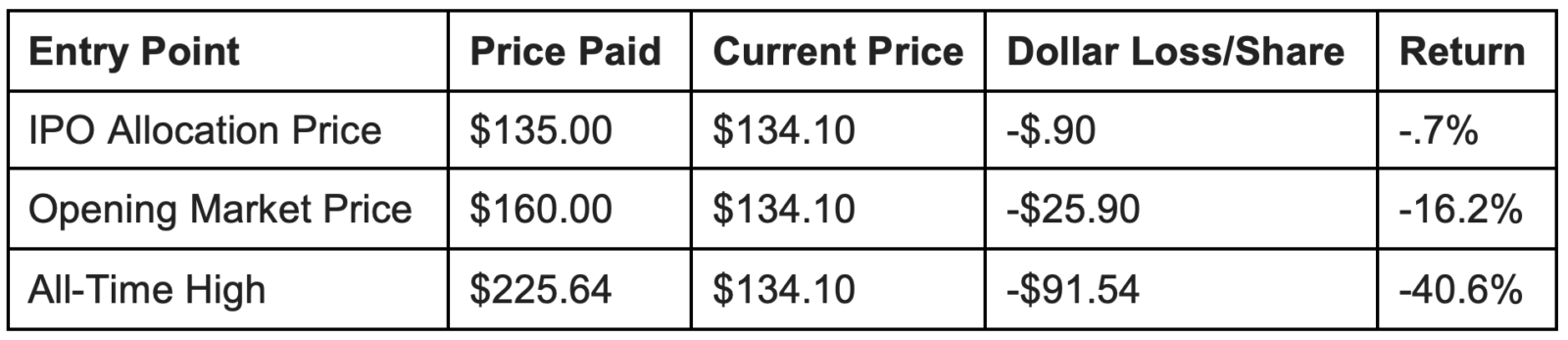
Shares soared following the IPO, climbing from the $135 offering price to more than $220 before eventually coming back down to earth. The stock hit a low of $104.83 in early August, a decline of more than 50% from its all-time high, before climbing back above its $135 offering price this week.
As we wrote prior to the SpaceX IPO, major technology companies have often experienced significant drawdowns in the months following their public debuts. According to data compiled by a University of Florida professor, nearly half of all large IPOs between 1975 and 2021 were still trading below their offering price on their third anniversary.
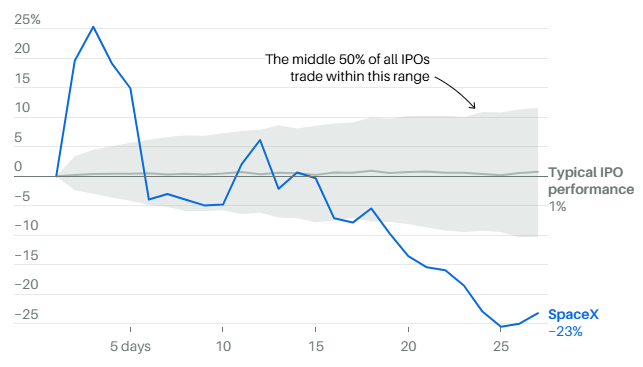
According to Barron’s, SpaceX has performed worse than 90% of U.S. IPOs with a market capitalization greater than $1 billion since July 2009. During its first 27 trading days, SpaceX declined 23% from its day-one closing price, compared with an average gain of 0.8% for other IPOs over the same period.
Return Since IPO, Indexed to First Close
Being down from its IPO price does not mean a stock will never recover or go on to become a great performer. For example, META (Facebook) declined more than 54% from its offering price and has gone on to average approximately 23% annual returns since 2012. The turnaround was far from immediate, however. It took more than a year for the stock to climb above its first-day closing price, in part because of the flood of newly unlocked shares entering the market as lockup periods expired.
History suggests that patience can be rewarded. As investors, we are often better served by giving the public markets time to assess a company’s earnings power, competitive advantages, and long-term prospects.
SpaceX is an extraordinary company, but our investment decisions are driven by a disciplined process — not excitement surrounding a particular name.
We must also determine whether its valuation, risk profile, growth expectations, and overall opportunity set offer an attractive risk-adjusted return for our clients. At this stage, we believe it is still too early to justify an investment. While we recognize the company’s leadership in space exploration and satellite communications, we believe its current valuation reflects very optimistic expectations and leaves limited margin for error.
History has shown that many highly anticipated IPOs and newly public companies experience significant declines as investors reassess growth expectations and valuations after the initial enthusiasm fades. Our process considers valuation, risk, competitive positioning, growth prospects, and portfolio fit, and at this time, SpaceX does not meet our investment criteria.
We continue to monitor the company closely and would be willing to invest if the risk-reward profile becomes more attractive in the future.
A great company does not always make a great investment at today’s price.

The CD Wealth Formula
We help our clients reach and maintain financial stability by following a specific plan, catered to each client.
Our focus remains on long-term investing with a strategic allocation while maintaining a tactical approach. Our decisions to make changes are calculated and well thought out, looking at where we see the economy heading. We are anticipating and moving to those areas of strength in the economy and in the stock market.
We will continue to focus on the fact that what really matters right now is time in the market, not out of the market. That means staying the course and continuing to invest, even when the markets dip, to take advantage of potential market upturns. We continue to adhere to the proven disciplines of diversification, periodic rebalancing, and forward-looking strategies, while avoiding reliance on stale retrospective data.
It is important to focus on the long-term goal, not on one specific data point or indicator. Long-term fundamentals are what matter. In markets and moments like these, it is essential to stick to the financial plan. Investing is about following a disciplined process over time.
Sources: Barrons, FactSet, Goldman Sachs, Schwab


