

It’s been just a few weeks since the S&P 500 reached new all-time highs, and as of today, it remains less than 2% below that level. For many investors, highs like these feel like a warning sign that a correction is due. If you listen to the average investor, however, you might think stocks were nowhere near record levels.
Retail investors have been heading for the exits, selling at the end of July at one of the fastest rates we have seen all year. That kind of selling can be difficult in the moment, but it also tends to shake out weaker investors, making it easier for stocks to continue moving higher.
The big story is that the 30-year Treasury reached levels not seen since 2007, causing markets to worry that higher yields could eventually weigh on the bull market. It is not surprising that long-term yields are higher, as we remain in an inflationary growth environment.
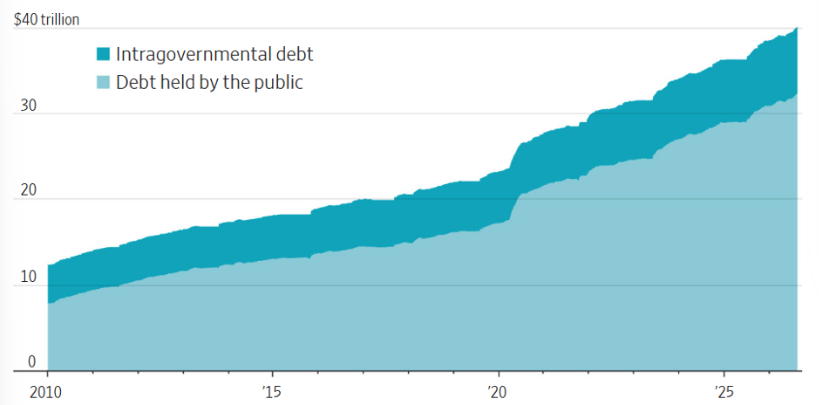
At the same time, U.S. government debt crossed the $40 trillion mark, doubling in just nine years. We now pay an annualized $1.1 trillion in interest on our debt, which exceeds the Defense Department’s entire current budget. For years, we have heard calls that higher debt would lead to a market crash, but it has not happened yet.
The balance sheets of corporate America and consumers remain healthy, and that matters greatly to both the economy and the stock market. While our national debt has doubled over the past nine years, household net worth has nearly doubled over the same period.
U.S. Public Debt Outstanding
Bull markets have typically ended with euphoria, not anxiety. To many investors, investing in stocks at record highs can be very uncomfortable; their thinking is that a high must be followed by a fall.
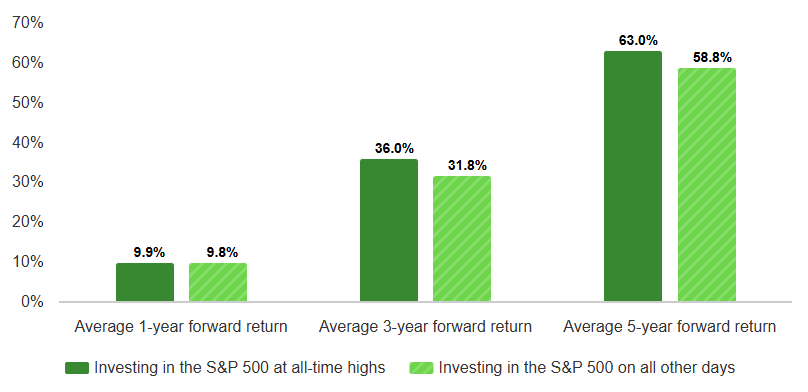
The record says otherwise, as shown in the chart below. Since 1920, investing on a day when the S&P 500 closed at an all-time high has produced average forward returns of nearly 10% over the following year, 36% over three years, and 63% over five years. These returns are better than those achieved by investing on all other days, outperforming both three- and five-year time horizons by nearly 4 percentage points.
That is a substantial difference and not just statistical noise.
All-Time Highs vs. All Other Days
Average S&P 500 returns investing in all-time highs vs. all other days since 1920
Why is this the case? Doesn’t it make sense that what goes up must come down?
Market highs are based on fundamentals, not only on momentum. You can argue that momentum takes stocks to new highs, and that may be true, but sustained market strength requires fundamental support.
1. Corporate earnings remain strong. For the second quarter, earnings were very strong, with most companies in the S&P 500 outperforming analyst estimates, and full-year profits are now expected to grow at double-digit rates in both 2026 and 2027. Stock prices follow earnings.
2. The economy continues to expand. The real economy has been more resilient than the headlines suggest. Manufacturing activity has expanded for seven consecutive months, and the ISM Manufacturing Index recently reached a four-year high.
3. The labor market is holding steady. Unemployment remains low at 4.1%. Permanent job losses have not surged. While nonfarm payroll growth has softened, the pattern in the job market appears to be a low-hire, low-fire slowdown rather than a meaningful deterioration in labor market conditions.
Strong earnings, expanding manufacturing activity, and a labor market that is holding steady are not the signs of an economy heading into a recession or a market on the verge of a large correction.
What could cause the market to falter?
The main risks to the market are monetary policy, valuations, and a potential slowing of artificial intelligence growth and spending.
The Fed is in a tough spot, having held interest rates steady for most of the year. The Federal Reserve Board is becoming more divided, with three members voting for a rate cut.
President Trump would like to see interest rates move lower. However, with inflation running well above its target rate, the Fed has reason to remain restrictive and avoid reducing interest rates, even as growth moderates. The softness in payrolls strengthens the case for lower rates, making the Fed’s job even more difficult as it balances higher inflation with softer labor market data.
Valuations are a risk because today’s higher stock prices depend in part on continued earnings growth. Should corporate earnings start to stall, investors may be less willing to pay those prices, putting more pressure on the market.
Lastly, if AI spending weakens and more evidence emerges of slower monetization, earnings expectations could be challenged. This could potentially unsettle the strong rally in AI-related stocks, which remain a significant part of the overall market. Ultimately, we believe these factors could lead to greater market turbulence but do not undermine the longer-term trend of underlying market strength.
The market fundamentals supporting current market highs are real, but so are the risks of investing. Record highs by themselves are not a good reason to sell. Our focus continues to be on managing market volatility through portfolio diversification, rather than avoiding equities simply because prices are high.

The CD Wealth Formula
We help our clients reach and maintain financial stability by following a specific plan, catered to each client.
Our focus remains on long-term investing with a strategic allocation while maintaining a tactical approach. Our decisions to make changes are calculated and well thought out, looking at where we see the economy heading. We are anticipating and moving to those areas of strength in the economy and in the stock market.
We will continue to focus on the fact that what really matters right now is time in the market, not out of the market. That means staying the course and continuing to invest, even when the markets dip, to take advantage of potential market upturns. We continue to adhere to the proven disciplines of diversification, periodic rebalancing, and forward-looking strategies, while avoiding reliance on stale retrospective data.
It is important to focus on the long-term goal, not on one specific data point or indicator. Long-term fundamentals are what matter. In markets and moments like these, it is essential to stick to the financial plan. Investing is about following a disciplined process over time.
Sources: Fidelity, U.S. Treasury


