

Over the last several years, artificial intelligence has become one of the most important themes shaping the global economy. While many investors are familiar with AI applications such as ChatGPT, Claude, and other digital assistants, the technology depends on a vast ecosystem of companies that work together behind the scenes.
Understanding that ecosystem can help explain where investment opportunities may exist.
A Closer Look at the AI Ecosystem
Data Centers:
The Factories of the Digital Economy
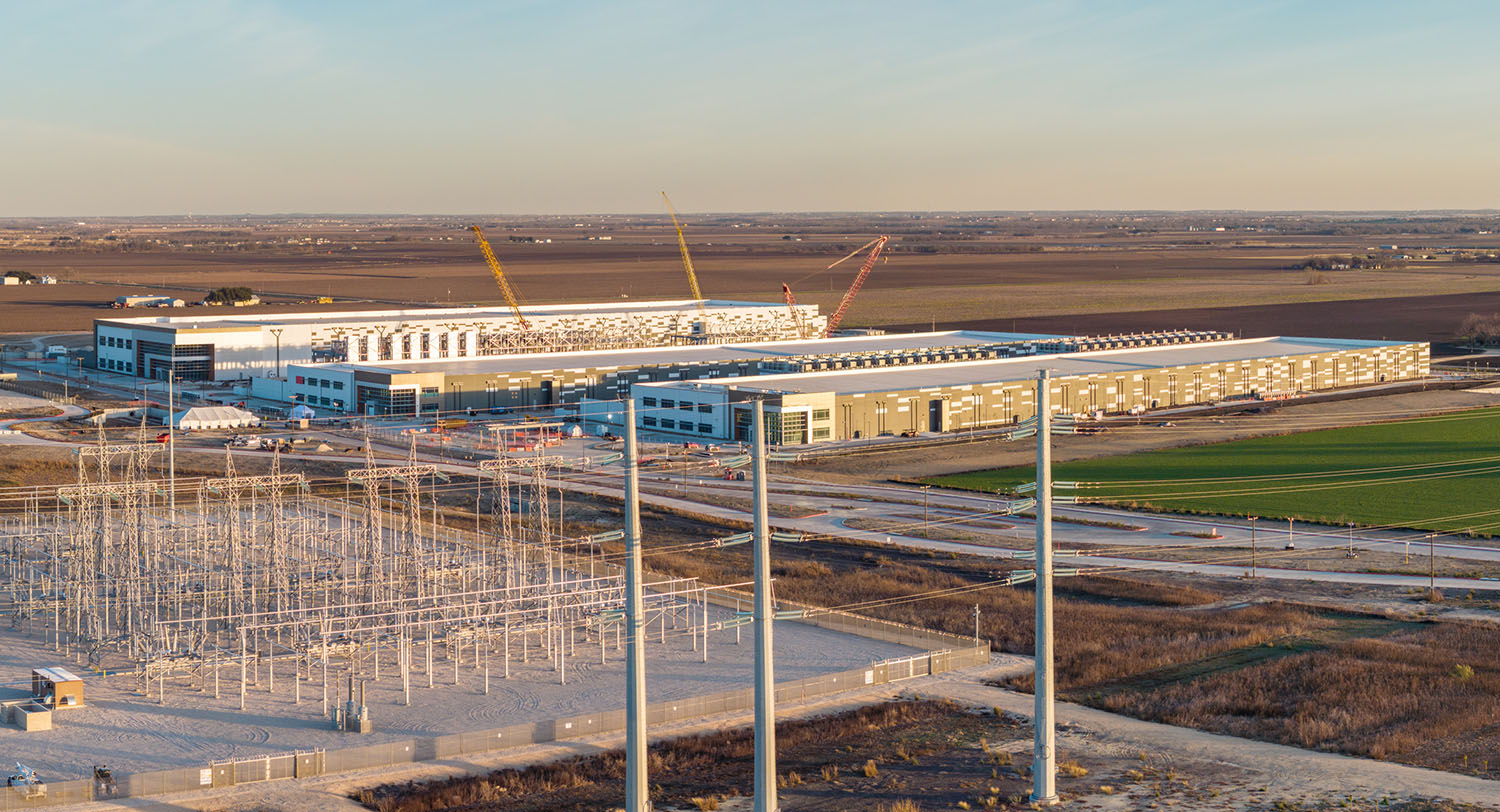
A data center is a large facility that houses thousands, and sometimes hundreds of thousands, of computers working together. Think of a data center as a modern-day digital factory.
Instead of manufacturing physical products, data centers process, store, and analyze enormous amounts of information. Large data centers can house thousands of servers and occupy tens of thousands of square feet. As AI applications become more advanced, they require significantly more computing power than traditional software.
This has led to an unprecedented wave of investment in new data centers around the world. Industry forecasts call for global data center capacity to roughly double over the second half of this decade.
Every time you stream a movie, save a file to the cloud, search the internet, or use an AI application, the work is being performed inside a data center. AI has dramatically increased the amount of computing power required because AI models must analyze vast amounts of data and perform billions of calculations.
As AI adoption grows, companies are building larger and more sophisticated data centers, creating demand for computing equipment, networking infrastructure, cooling systems, and electricity.
Hyperscalers:
The Architects and Funders
Hyperscalers are the companies that build and operate the world’s largest data center networks. A hyperscaler is a massive-scale cloud computing service provider that delivers vast computing, storage, and networking resources globally. They are the engine driving modern artificial intelligence, machine learning, and big data analytics.
The primary hyperscalers today include:
• Microsoft (Azure)
• Amazon (AWS)
• Google (Google Cloud)
• Meta
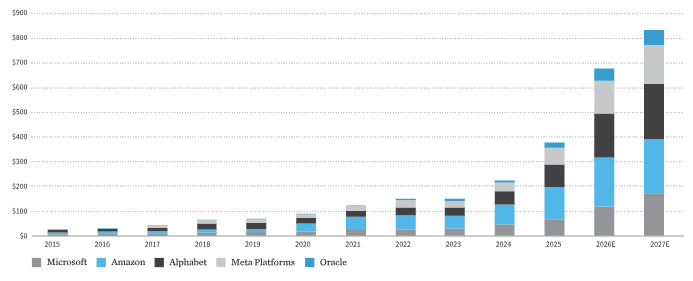
These companies spend hundreds of billions of dollars building AI infrastructure because they provide the cloud services that businesses rely on. Industry analysts estimate that the largest hyperscale technology companies may collectively spend more than $600 billion on AI and cloud infrastructure in 2026.
To help fund these investments, many have turned to the corporate debt market. For example, Amazon recently announced a bond offering of approximately $25 billion to support its infrastructure investments. Rather than purchasing their own supercomputer, companies can rent computing power from a hyperscaler.
A useful analogy is that hyperscalers are similar to utility companies for the digital economy. Just as homes receive electricity from the power grid, businesses increasingly receive computing power from hyperscalers.
Hyperscaler Capex Spend (in Billions)
Semiconductors:
The Brains of AI
Semiconductors, commonly called “chips,” perform the calculations that make AI possible. Traditional computing relied heavily on Central Processing Units (CPUs). AI, however, requires massive parallel processing, making Graphics Processing Units (GPUs) much more effective. Companies such as Nvidia, AMD, Broadcom, and Marvell provide many of the critical chips used in AI systems.
If a data center is the factory, semiconductors are the machines inside the factory doing the work. At the foundation of AI infrastructure is the semiconductor layer. The more advanced the AI model, the greater the demand for processing power.
This is why chip companies have become some of the largest beneficiaries of the AI investment cycle. Some of the largest technology companies have begun designing their own custom chips tailored to their workloads. This is creating a new source of demand that flows through a broader network of semiconductor suppliers.
Memory:
The Short-Term Recall System
Processing power alone is not enough. AI systems must rapidly access enormous amounts of information while performing calculations. AI-related memory demand is projected to increase dramatically as larger models require more data to be moved and stored. Certain categories of advanced AI memory, particularly High-Bandwidth Memory (HBM), remain supply-constrained.
A useful comparison for memory chips is the human brain: Processors are like the brain’s ability to think, and memory is like short-term recall. Without sufficient memory, even the fastest processor spends time waiting for information to arrive.
HBM is one of the fastest-growing areas, sitting close to AI processors and allowing data to move at extremely high speeds. Major memory suppliers include Micron, Samsung, and SK Hynix.
As AI models become larger and more complex, memory requirements are growing nearly as quickly as processor requirements.
Energy:
The Fuel Behind Everything
Perhaps the most underappreciated aspect of AI is electricity. AI data centers consume enormous amounts of power because thousands of processors operate simultaneously, 24 hours a day.
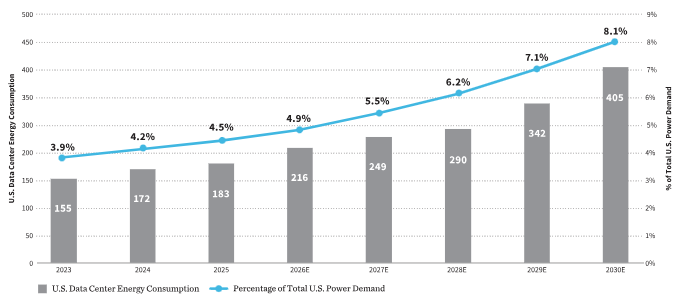
A single large AI data center may require as much electricity as a small city. Industry forecasts suggest that data center electricity demand could increase dramatically by 2030, creating significant pressure on power generation and transmission infrastructure.
This demand creates opportunities not only for technology companies but also for:
• Electric utilities
• Power producers
• Natural gas infrastructure companies
• Nuclear energy providers
• Electrical equipment manufacturers
The AI economy cannot function without reliable energy. In fact, one of the biggest constraints on future AI growth may not be the availability of chips, but the availability of power.
U.S. Data Center Energy Consumption
In terawatt-hours (TWh)
How It All Fits Together
The AI ecosystem can be thought of as a chain:
Energy → Data Centers → Servers (Processors + Memory) → Cloud Platforms → AI Applications
1. Power companies generate electricity.
2. Data centers provide the physical infrastructure.
3. Semiconductor companies supply the computational power.
4. Networking Infrastructure serves as the nervous system of AI
5. Memory companies help move and store data efficiently.
6. Hyperscalers combine these resources and deliver AI services to businesses and consumers.
Every link in the chain is essential. When investors think about AI, they often focus on the software applications people interact with. However, many of the most compelling investment opportunities may be found in the infrastructure that makes those applications possible.
In many ways, today’s AI buildout resembles the construction of the railroad system, electrical grid, or the internet itself. The applications may capture the headlines, but the underlying infrastructure is what makes the entire ecosystem work.
Risks to Monitor
While this is a very exciting time for AI and the rapid change we are seeing, we must acknowledge the risks that could cause disruptions:
• Spending – A slowdown in AI spending represents the most significant risk to the demand outlook across the board. This could be driven by macroeconomic conditions worsening, shifts in capital allocation by corporations, or a lack of monetization. In other words, what happens if companies are spending all this money with little to no return on investment — or a much smaller return on investment than expected?
• Regulatory and policy risk – Governments may impose restrictions on AI usage, power consumption, data privacy, or exports of advanced semiconductor technologies.
• Technology substitution – With the rapid pace of innovation, certain architectures may become obsolete much faster than expected, which in turn could disrupt suppliers in the semiconductor and networking layers.
• Geopolitical risks – Potential disruption in South Korea or Taiwan could affect semiconductor manufacturing, which in turn would affect the AI supply chain.
Investment Implications
While AI applications often receive the most attention, many of the investment opportunities exist throughout the broader ecosystem. The winners may include not only software companies, but also infrastructure providers, semiconductor manufacturers, memory suppliers, industrial companies, and energy producers.
As investors, we believe it is important to look beyond the headlines and understand the entire value chain. The AI revolution is not a single company story. It is an ecosystem story, with multiple participants helping build the digital infrastructure that may support economic growth for years to come. AI infrastructure buildout remains a multiyear investment cycle.

The CD Wealth Formula
We help our clients reach and maintain financial stability by following a specific plan, catered to each client.
Our focus remains on long-term investing with a strategic allocation while maintaining a tactical approach. Our decisions to make changes are calculated and well thought out, looking at where we see the economy heading. We are anticipating and moving to those areas of strength in the economy and in the stock market.
We will continue to focus on the fact that what really matters right now is time in the market, not out of the market. That means staying the course and continuing to invest, even when the markets dip, to take advantage of potential market upturns. We continue to adhere to the proven disciplines of diversification, periodic rebalancing, and forward-looking strategies, while avoiding reliance on stale retrospective data.
It is important to focus on the long-term goal, not on one specific data point or indicator. Long-term fundamentals are what matter. In markets and moments like these, it is essential to stick to the financial plan. Investing is about following a disciplined process over time.
Sources: CNBC, IBM, William Blair


