

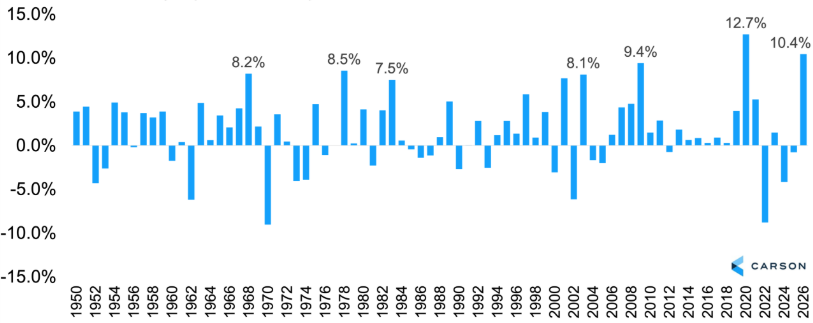
April 2026 was one for the record books. Markets pushed through considerable geopolitical turbulence to reach new highs. Even with the Strait of Hormuz still severely restricted and oil back above $100 a barrel, the S&P 500 posted its best month since November 2020 — rising 10.4% and delivering its second-best April since 1950. The NASDAQ surged more than 15%, marking its strongest month since April 2020.
The Second-Best April Ever
S&P 500 returns in April (1950-present)
Global stocks rotated back into artificial intelligence stocks. AI continues to have a major impact on the economy, and AI-related investment continues to rise. We expect the AI wave to keep supporting the stock market, even as inflation remains high.
The Federal Reserve continues to keep interest rates at current levels despite a new wave of inflationary pressures moving through the economy. Inflation accelerated in March, with CPI rising at a 3.3% annual rate — its hottest level in almost two years. The increase has been driven largely by higher energy costs tied to the war in Iran.
Food and energy prices tend to be volatile month to month, and the Fed cares more about the broader inflation trajectory. The current wave of inflation is being driven less by a hot economy and more by specific energy constraints. Raising rates will not increase the amount of oil in the global economic system.
Current parallels exist between today’s inflation resurgence and the 2021–2022 surge that saw CPI rise above 9%. The 2022 spike also occurred against the backdrop of a geopolitical conflict and higher energy prices. Supply-chain disruptions are once again playing a role, as they did then. Fiscal stimulus pressures are also coinciding with rising prices, this time flowing from the One Big Beautiful Bill tax cuts.

There are also several differences this time around. In 2022, the job market was tight, wage growth was surging, and inflationary pressures were much broader. Today, the labor market is more stable and cooler than it was four years ago. Wage growth has slowed, making it harder for companies to raise prices. The immediate impact of fiscal stimulus is also more modest than during the pandemic, with most inflationary pressures tied to energy, as mentioned earlier.
The renewed inflation pressures have not been strong enough to put rate hikes back on the table anytime soon, but they have been strong enough to delay interest rate cuts for now. The interest-rate futures market is showing no rate cuts for 2026. At the beginning of the year, markets were expecting one to two interest rate cuts in 2026. Those expectations could always shift in either direction as new data comes in and the Fed’s upcoming leadership change plays out.
April was a month that defied the headlines. Geopolitical pressures pushed oil above $100 a barrel, yet optimism around a potential resolution to the conflict, combined with a strong corporate earnings backdrop, propelled markets to new highs led by AI-related stocks.
The risks remain two-sided: A reopening of the Strait of Hormuz could see energy prices fall and rate expectations ease, while a continued blockade could dampen activity and lead to further inflationary pressures. A well-diversified portfolio across asset classes and geographies remains as important as ever.

The CD Wealth Formula
We help our clients reach and maintain financial stability by following a specific plan, catered to each client.
Our focus remains on long-term investing with a strategic allocation while maintaining a tactical approach. Our decisions to make changes are calculated and well thought out, looking at where we see the economy heading. We are anticipating and moving to those areas of strength in the economy and in the stock market.
We will continue to focus on the fact that what really matters right now is time in the market, not out of the market. That means staying the course and continuing to invest, even when the markets dip, to take advantage of potential market upturns. We continue to adhere to the proven disciplines of diversification, periodic rebalancing, and forward-looking strategies, while avoiding reliance on stale retrospective data.
It is important to focus on the long-term goal, not on one specific data point or indicator. Long-term fundamentals are what matter. In markets and moments like these, it is essential to stick to the financial plan. Investing is about following a disciplined process over time.
Sources: Carson, Fidelity, JP Morgan


