
You’ve inherited an IRA. What happens next?

Prior to December 2019, if you inherited an IRA from someone who was not your spouse, you were able to take distributions from the inherited account based on your life expectancy and not the original owner’s, a strategy commonly known as a Stretch IRA. The benefit of using a Stretch IRA was that the beneficiary could stretch the taxable distributions over their lifetime, which potentially meant a lower tax bill. The rules were the same for a Roth IRA; even though the original Roth IRA owners did not have required minimum distributions, their heirs were required to withdraw the funds according to their life expectancy.

Under current tax law, the inheritance of an IRA is tax-free, but you are still required to take distributions from the account that may be taxable. When you inherit an IRA, you are free to withdraw as much of the account as you want at any time without penalty.

Stretch IRA rules changed with the passage of the SECURE Act in December 2019, however. The SECURE Act mandates that an IRA inherited from someone who is not your spouse must be depleted by Dec. 31 after the 10th anniversary of the owner’s death. For example: If you inherit an IRA this year, you will have to distribute the balance of the account by Dec. 31, 2032.

Spousal IRA beneficiaries have different rules and more options to consider when taking their required minimum distributions. As the chart below indicates, there are exceptions to the 10-year rule, such as a surviving spouse, a disabled or chronically ill person, a minor or a person who is not more than 10 years younger than the IRA account owner. These beneficiaries are not obligated to empty the IRA within 10 years but still must take their distributions. If you fall into the eligible designated beneficiary category, the inherited IRA can be taken over the life of the beneficiary (except in the case of minors). If you are a non-eligible designated beneficiary, such as someone who inherits an IRA from a parent, the 10-year rule applies.
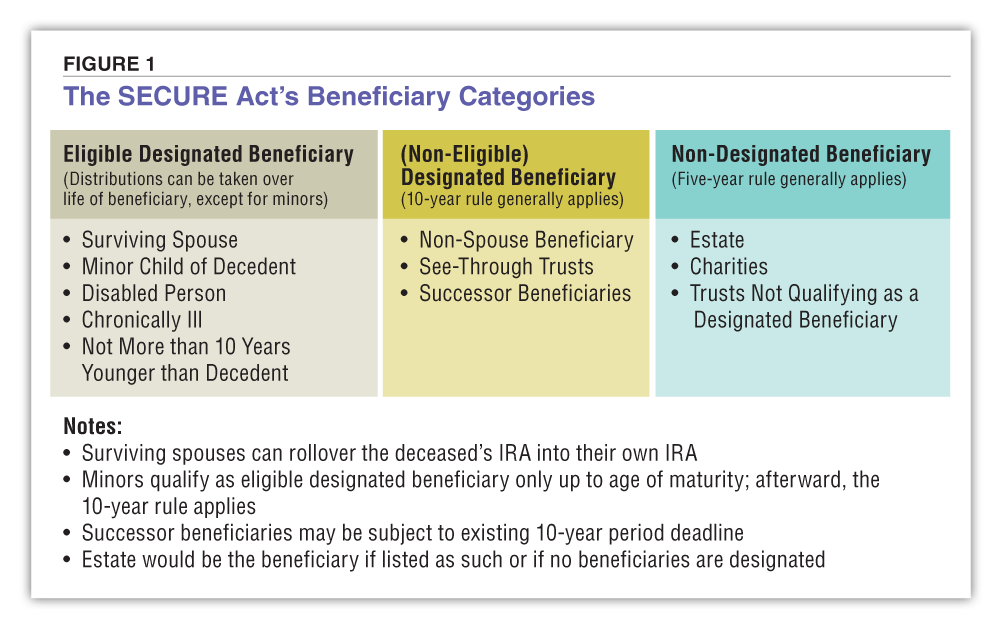
Chart explaining the beneficiary categories in the SECURE Act of 2019

What does this mean for me?

If you inherit an IRA and are a non-eligible beneficiary, planning for taxes and how you take distributions becomes more important. Under current law, you have 10 years to deplete the entire value of the IRA. However, if you wait until the 10th year to take the entire distribution and the IRA has experienced significant growth, you may be in the highest tax bracket, having to pay almost 40% in taxes for that one year. If you take distributions over the 10 years, you may incur less tax on an annual basis, and the potential growth of the IRA may be minimized as well. As we have previously written, another way to potentially reduce taxes is to transfer up to $100,000 from an IRA directly to a qualified charity if you are 70 ½ or older.

The IRS has proposed new regulations to the SECURE Act which have yet to be approved. The proposed changes state that if you inherit a traditional IRA from someone who has already passed their required beginning date and had been taking mandatory distributions, you cannot wait until the 10th year to withdraw the money. Instead, under the proposal, you would be required take annual distributions in the first nine years and the balance in the 10th. A tax liability would occur each year from the required distribution.

The SECURE Act has brought Roth conversions into the conversation for those who want to help their heirs avoid a large tax bill. Roth conversions transfer the tax liability to the older generation, because taxes are paid when the conversion is done. If the conversion is done early in retirement, when income is low, the tax bracket may be lower and thus, lower taxes would be paid on the Roth conversion. Then the money can grow tax-free inside the Roth IRA and when the owner passes away, the money can continue to grow tax-free for an additional 10 years.

Promo for an article titled Should Investors Own Bonds in Today's Market?

So, what can we learn from all this? While the SECURE Act effectively eliminated the Stretch IRA, it did not eliminate the need for proper financial planning when it comes to taking distributions from an inherited IRA. We will continue to closely watch proposed legislation about the 10-year rule for inherited IRAs and ensure that our clients take the necessary distributions, if mandated by law. In the interim, we continue to analyze your situation and help you determine what makes the most sense for taxes, investments and your overall financial plan for IRA distributions.

From a portfolio perspective, we continue to adhere to the tried-and-true disciplines of diversification, periodic rebalancing and looking forward, while not making investment decisions based on where we have been. As we say each week, it is important to stay the course and focus on the long-term goal, not on one specific data point or indicator. In markets and moments like these, it is essential to stick to the financial plan.

Remember first and foremost that panic is not an investing strategy. Neither are “get in” or “get out” — those are just gambling on moments in time. Investing is about following a disciplined process over time.

At the end of the day, investors will be well-served to remove emotion from their investment decisions and remember that over a longer time horizon, markets tend to rise. Market corrections are normal, as nothing goes up in a straight line. Making market decisions based on what might happen may be detrimental to long-term performance. The key is to stay invested and stick with the financial plan. Markets go up and down over time, and downturns present opportunities to purchase stocks at a lower value.

It all starts with a solid financial plan for the long run that understands the level of risk that is acceptable for each client. Regarding investments, we believe in diversification and having different asset classes. The best option is to stick with a broadly diversified portfolio that can help you to achieve your own specific financial goals — regardless of market volatility. Long-term fundamentals are what matter.

Sources:  Kiplinger, Investopedia, Forbes, ThinkAdvisor

Promo for article on the formula for wealth

This material contains an assessment of the market and economic environment at a specific point in time and is not intended to be a forecast of future events, or a guarantee of future results. Forward-looking statements are subject to certain risks and uncertainties. Actual results, performance, or achievements may differ materially from those expressed or implied. Information is based on data gathered from what we believe are reliable sources.

Using diversification as part of your investment strategy neither assures nor guarantees better performance and cannot protect against loss of principal due to changing market conditions.

Past performance is not a guarantee of future results.

The opinions expressed in this commentary are those of the author and may not necessarily reflect those held by Kestra Investment Services, LLC or Kestra Advisory Services, LLC. This is for general information only and is not intended to provide specific investment advice or recommendations for any individual. It is suggested that you consult your financial professional, attorney, or tax advisor with regard to your individual situation.

Securities offered through Kestra Investment Services, LLC (Kestra IS), member FINRA/SIPC. Investment Advisory Services offered through Kestra Advisory Services, LLC (Kestra AS) an affiliate of Kestra IS. CD Wealth Management and Bluespring Wealth Partners LLC* are affiliates of Kestra IS and Kestra AS.  Investor Disclosures: https://bit.ly/KF-Disclosures

*Bluespring Wealth Partners, LLC acquires and supports high quality investment adviser and wealth management companies throughout the United States.


Why Women Need Life Insurance

Who needs life insurance?

Working women

Increasingly, families depend on the income of two working parents. If you’re a working mother, your income can have a significant impact on the quality of your family’s lifestyle. Your income helps cover the cost of ordinary living expenses such as food, clothing, and utilities, and it provides savings for your children’s college education, and for your retirement. Life insurance protects your family by providing proceeds that can be used to replace your lost income if you die prematurely.

Single women

Often, women, like men, think that it’s not necessary to buy life insurance because they have no dependents. What’s often overlooked is that life insurance can provide necessary funds to pay off car loans, education loans, debts, a mortgage, taxes, and funeral expenses that might otherwise be the responsibility of family members. Also, the cash value of permanent life insurance may be used to supplement retirement income.

Single moms

Whether you’re divorced, widowed, or simply a single mom, you’re most likely primarily responsible for your child’s support. If you die prematurely, life insurance can provide ongoing income to cover child-care costs, medical expenses, debts, and future college costs.

If you die, your surviving spouse may have to pay for services such as child care, transportation for your children, and housekeeping. Proceeds from your life insurance can help your spouse pay for services that keep the household running and allow your spouse to keep working.

Stay-at-home moms

Maintaining a household is a full-time job, and you have many important roles and duties. The cost of the services performed by a stay-at-home mom could be quite significant if someone had to be hired to do them. If you die, your surviving spouse may have to pay for services such as child care, transportation for your children, and housekeeping. Taking over these added responsibilities could cause your spouse to shorten work hours, resulting in a reduction in income. Proceeds from your life insurance can help your spouse pay for services that keep the household running and allow your spouse to keep working.

Family caregiver

Many women find themselves providing care for both children and elderly family members. Caring for an aging parent or family member can include paying for the costs of adult day care, uninsured medical expenses, and extra transportation. Adding these expenses to the costs of maintaining a household, child care, and college tuition can be financially overwhelming. Unfortunately, these added financial responsibilities often continue after your death. Life insurance provides a source of funds that can be used to help pay for these expenses.

Business owner

You may be one of the increasing number of women business owners. If you die while owning your business, life insurance can be used to provide cash for company expenses such as payroll or operating costs while your estate is being settled. Also, life insurance can be a useful tool for business owners structuring buy-sell arrangements or providing benefits to key employees.

Life insurance types and options

Life insurance comes in many different sizes and shapes, and determining the policy that meets your needs may depend on a number of factors. Understanding the basic types of life insurance can help you find the policy that’s appropriate for you.


Term life insurance

Term life insurance provides a simple death benefit for a specified period of time. If you die during the coverage period, the beneficiary you name in the policy receives the death benefit. If you live past the term period, your coverage ends, and you get nothing back. The cost, or premium, for the coverage can be fixed for the duration of the policy term (usually 1 to 30 years) or it can be “annually renewable” meaning that the premium can increase each year as you get older. However, the premium for term insurance usually costs less than the premium for permanent insurance when all factors are the same, including the death benefit.

Whole life insurance

Whole life is permanent or cash value insurance that provides insurance coverage for your entire life. With most whole life policies, part of your premium is added to the cash value account, which earns interest. Some whole life policies also pay a dividend, which represents a portion of the company’s profits made during the prior year.


The cash value grows tax deferred and can either be used as collateral to borrow from the insurance company or be directly accessed through a partial or complete surrender of the policy. It is important to note, however, that a policy loan or partial surrender will reduce the policy’s death benefit, there could be income tax implications, and a complete surrender will terminate coverage altogether.


Guarantees are subject to the claims-paying ability and financial strength of the issuing insurance company.

Universal life insurance

Universal life is another type of permanent life insurance with a death benefit and a cash value account. A universal life insurance policy will generally provide very broad premium guidelines (i.e., minimum and maximum premium payments), but within these guidelines you can choose how much and when you pay premiums. You are also free to change the policy’s death benefit directly (again, within the limits set out by the policy) as your financial circumstances change. But if you want to raise the amount of coverage, you’ll need to go through the insurability process again, probably including a new medical exam, and your premiums will increase.

Variable life insurance

Variable life insurance is a type of cash value coverage that allows you to choose how your cash value account is invested. A variable life policy generally contains several investment options, or subaccounts, that are professionally managed to pursue a stated investment objective. Choices can range from a fixed interest subaccount to an international growth subaccount. Variable life insurance policies require a fixed annual premium for the life of the policy and may provide a minimum guaranteed death benefit. If the cash value exceeds a certain amount, the death benefit will increase.

Variable universal life insurance

Variable universal life combines all of the options and flexibility of universal life with the investment choices of a variable policy. You decide how often and how much your premium payments are to be, within policy guidelines. With most variable universal life policies, you can direct how your premium payments are invested among policy subaccounts. But you get no guaranteed minimum cash value or death benefit, and the investment return and principal value of the investment options will fluctuate.

Proceeds from your life insurance can help your spouse pay for services that keep the household running and allow your spouse to keep working.

Joint and survivor life insurance

You and your spouse may choose to buy a single policy of permanent insurance that covers both of your lives. With first-to-die, the death benefit is paid at the death of the spouse who dies first. With second-to-die, no death benefit is paid until both spouses are deceased. Second-to-die policies are commonly used in estate planning to pay estate taxes and other expenses due at the death of the second spouse. Other than the fact that two people are insured by one policy, the policy characteristics remain the same.

Bottom line

Life insurance protection for women is equally as important as it is for men. However, women’s life insurance coverage is often inadequate. It may be time to consult an insurance professional who can help you assess your life insurance needs, and offer information about the various types of policies available.

Main wage earner passes away, now what?

THE SITUATION

Norma’s husband passed away suddenly leaving her with bills, a mortgage, and a lack of financial education to plan for her and her children’s futures. 

THE SOLUTION

Norma was referred by a friend to Ilona Friedman and her team at CD Wealth Management. At first, Norma was shell-shocked and she found it difficult to even leave the house. Ilona met with her at Norma’s home taking time to listen to stories about her late husband and what a wonderful man and provider he was. Ilona and her team helped her get organized, going through the bills and looking through insurance policies, financial account statements, and loan documents. Because her husband had a life insurance policy, Ilona helped Norma realize that as a woman in her 50s, she would have enough to allow her to pay off debt, keep the house, provide for her children’s college education, and plan for her early retirement. 

In the wake of one of the most difficult chapters of her life, her relationship with Ilona and the CD Wealth Management team is one of the bright spots. Her meetings with Ilona have even become a family affair. Norma now brings her kids to her meetings to help them get a financial education.

Norma is a real client. Her name has been changed to protect her privacy.

Finding the way forward

THE SITUATION

Cynthia was referred by a friend to CD Wealth Management after her husband unexpectedly passed away. She was in her mid-50s, wasn’t working, and didn’t have a good understanding of her financial situation. Her husband had money in many different institutions and insurance firms.  

THE SOLUTION

Andy Dropkin of CD Wealth Management began meeting regularly with Cynthia. At first their meetings were helpful to allow Cynthia to process her grief and to help her with the immediate financial needs of her situation. Andy learned that Cynthia had been approached by several financial management companies to try to “sell” her on programs, products, and plans for her benefit and her large single stock position. Cynthia explained that she felt that Andy and the CD Wealth Management team was different because they took the time to just listen to her and make sure her needs were being met instead of jumping in right away to manage her money. 

In the months following her husband’s death, Cynthia faced an ugly legal family battle over the estate proceeds. Once again, Andy and the CD Wealth Management team worked with Cynthia and her attorney to protect her assets and help her get through the ordeal. 

In the years since working with Andy and his team, Cynthia’s portfolio has blossomed. Her large single stock position went through a merger many years later. Andy helped her set up a donor advised fund to reduce some of the tax impact from the stock merger. Now to her delight, she is able to support her church and create a scholarship at a local university for students in need. 

Cynthia used to be skittish talking about topics related to finances and skeptical of people who shared their advice on money matters. Now, thanks to Andy and his team, she relies on CD Wealth Management as a trusted advisor and family friend.

Cynthia is a real client. Her name has been changed to protect her privacy.

Qualified Opportunity Fund Investments & the Tax Breaks

Introduction

More and more people are looking to put their personal capital to work in support of society and their communities. And Congress gave them a new way to do just that when it passed the comprehensive tax reform law in late 2017. Among the many changes in the law was a section that encouraged taxpayers to invest in economically distressed communities across the United States and, in return, potentially receive very favorable capital gains tax breaks.

People at a desk discussing financial planning

In October 2018, the U.S. Department of the Treasury issued proposed regulations to clarify the tax laws surrounding Opportunity Zones and Opportunity Funds, hoping to reduce uncertainty and encourage investors to get involved. A second set of regulations proposed in April 2019 provided additional clarity, easing many of the remaining concerns and driving increased interest among investors. As a result, we are likely to see the formation of additional Opportunity Funds moving forward.

Rules Vary State-to-State

Some states have yet to bring their tax rules into conformance with the federal Opportunity Zone rules. For example, New York has done so, while California has not.

How It Works

Investors who realize a short-term or long-term capital gain from the sale of such investments as securities, collectibles, real estate or businesses can reinvest those gains in what is called a Qualified Opportunity Fund (QOF). These funds are corporations or partnerships (which may include some LLCs) that invest in businesses or assets in any of the nearly 9,000 low-income communities within the United States or its possessions certified by the U.S. Treasury as Qualified Opportunity Zones (QOZ).

Breaking Down the Benefits

Investing in a QOF may allow you to defer recognition of a capital gain on your income tax return, so long as you reinvest that gain into a QOF within 180 days of realizing it. (There are some exceptions to this deadline.) You then defer recognition of the capital gain until December 31, 2026, or until you sell or dispose of the investment, whichever comes first.

In addition to the deferral, taxpayers can reduce the taxable capital gain by 10% or 15% if they hold their QOF investment for five or seven years, respectively, and the deferral period hasn’t ended. That means to qualify for the 10% reduction, the capital gain would need to be reinvested into a QOF by December 31, 2022, and for the full 15% reduction, it would need to be reinvested by the end of 2024.

Perhaps the greatest tax benefit is reserved for taxpayers willing to make a truly long-term commitment to the investment in a QOF. Any gain realized after the investment in the fund can be considered eliminated for tax purposes if the investor holds the investment for 10 years and then sells it by 2047.

In identifying partners to manage Opportunity Zone investments, it’s important to pay close attention to past discipline in capital allocation.

Looking Out for Yourself

It should be noted that to realize the full benefits of this program, investors must commit to holding illiquid assets for at least 10 years. In addition, some QOFs (1) might hold only a single asset — or multiple assets that may not be well-diversified in terms of industry and geography:

  • Investing in a QOF
  • Capital gain on your income tax return
  • Deferral of capital gain
  • Generating a majority of gross income from your community