

Last week marked the bull market’s fourth anniversary. Since its low in October 2022, the S&P 500 has gained more than 120%, a remarkable recovery from the last bear market.
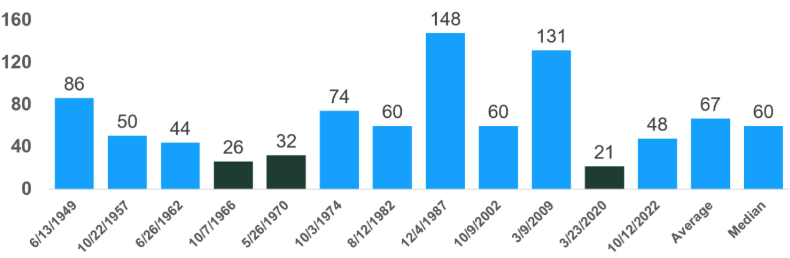
While four years may feel like a long run, history reminds us that bull markets do not expire simply because of age. Since 1949, the average bull market has lasted approximately 67 months. And since 1974, every bull market except the brief COVID cycle has lasted at least five years. Historically, fifth-year returns also have been positive on average.
Healthy corporate earnings and a resilient labor market could support further gains in 2027. Rather than focusing on how old the bull market is, however, we believe investors should pay closer attention to what is happening beneath the surface.
Bull Markets Last Longer Than You Think
Length of bull markets (in months) and when they started
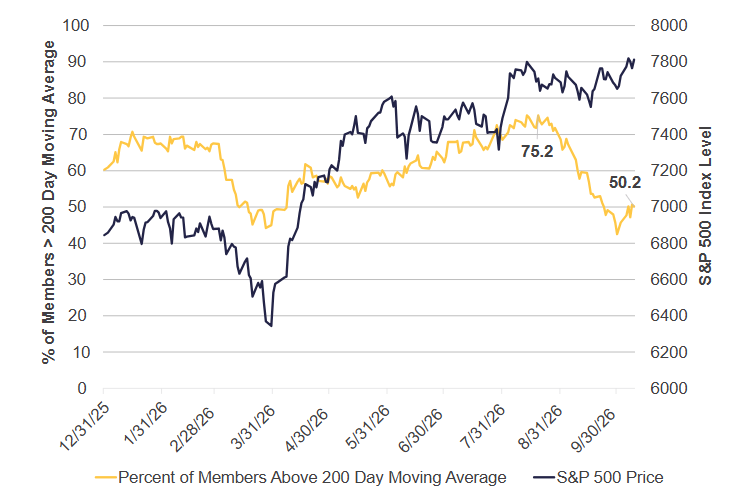
Third-quarter earnings season began last week with the major stock indexes still trading near all-time highs. Yet despite those strong headline numbers, only about half of the stocks in the S&P 500 are currently trading above their 200-day moving average, down significantly from levels seen earlier this year.
This is an example of market breadth, which measures how many stocks are participating in a market advance. If 400 of the 500 stocks in the S&P 500 are rising, market participation is broad. If only 150 stocks are rising while the overall index continues to move higher, leadership is much narrower. So how can the S&P 500 remain near record highs when participation has weakened?
Market Breadth of S&P 500 Constituents
The answer lies in how the index is constructed. The S&P 500 is weighted by market capitalization, meaning its largest companies have an outsized influence on the index. When companies such as Nvidia, Microsoft, Apple, Amazon, and Meta move higher, they can lift the overall market even when many other stocks are struggling.
That is different from what we saw earlier in 2026, when the largest technology companies were less dominant and market leadership broadened. More recently, however, enthusiasm around artificial intelligence and improving technology earnings has once again helped some of the market’s largest companies lead the major indexes higher.
Earnings growth this year has not been limited to technology. Corporate profits have remained healthy across many parts of the market, providing fundamental support for stock prices even as leadership has narrowed.
The third quarter brought a return to more concentrated market leadership, with large-cap U.S. stocks accounting for much of the market’s gains. Although higher interest rates can create a headwind for stocks, strong corporate earnings can help offset some of that pressure. Ultimately, investors purchase stocks for their share of future corporate profits, and earnings remain one of the most important long-term drivers of stock prices.
There is also an important distinction between a market driven primarily by rising valuations and one supported by rising earnings. Stock prices sometimes rise much faster than corporate profits, causing price-to-earnings multiples to expand and valuations to become increasingly stretched. When earnings grow faster than stock prices, however, valuation multiples can decline instead, even as the market moves higher.
That distinction is important. A rising market does not necessarily mean the market is becoming more expensive.
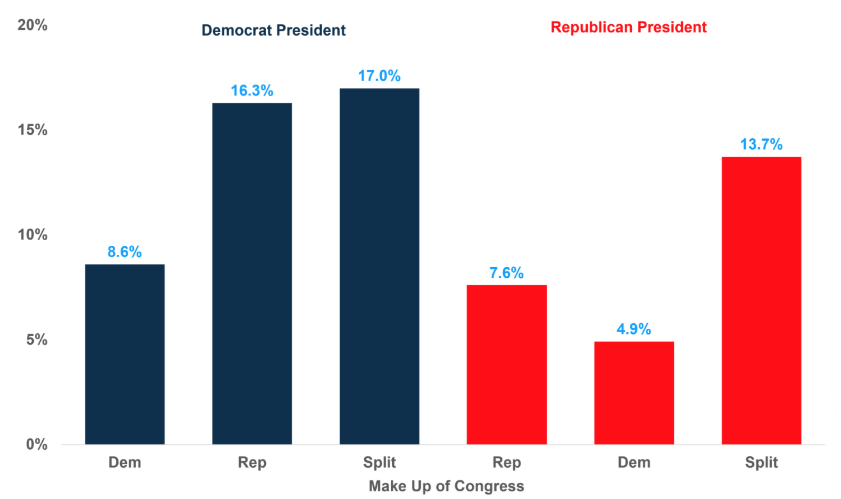
As Election Day approaches, political rhetoric will inevitably become louder. That can make investors uncomfortable and create the temptation to change portfolios based on expectations about what might happen in Washington. History offers an important lesson: Markets have performed well under Republican presidents, Democratic presidents and various combinations of congressional control.
Historically, periods of divided government also have produced strong market returns. But the more important takeaway is that election outcomes have rarely provided investors with a reliable signal for when to enter or exit the stock market.
Stock Performance Based on Congress Makeup
Average S&P 500 annual return (1951-2025)
Consider the experience of the past decade-plus. An investor who put $100,000 into the S&P 500 in 2013 and remained fully invested would have seen that investment grow substantially despite presidential elections, midterm elections, government shutdowns, geopolitical conflicts, a global pandemic, inflation, and rapidly changing interest rates. Investors who repeatedly moved to cash because of political concerns likely missed some of the market’s strongest periods.
That is because financial markets do not wait for uncertainty to disappear. In fact, stocks frequently begin moving well before the political or economic outlook feels comfortable.
There will always be reasons for investors to worry about the markets. Today we have narrow market breadth, elevated interest rates, geopolitical uncertainty and an approaching election. Six months from now, the list will probably look different. That does not mean these risks should be ignored. It means they should be considered within the context of a thoughtful, diversified investment plan rather than used as a reason to make sweeping portfolio changes.
We would caution against allowing short-term political uncertainty to drive long-term investment decisions. Instead, we believe investors are better served by remaining diversified, staying invested and keeping their focus on their long-term goals.
Politics will change. Market leadership will change. A sound investment plan should be built to withstand both.

The CD Wealth Formula
We help our clients reach and maintain financial stability by following a specific plan, catered to each client.
Our focus remains on long-term investing with a strategic allocation while maintaining a tactical approach. Our decisions to make changes are calculated and well thought out, looking at where we see the economy heading. We are anticipating and moving to those areas of strength in the economy and in the stock market.
We will continue to focus on the fact that what really matters right now is time in the market, not out of the market. That means staying the course and continuing to invest, even when the markets dip, to take advantage of potential market upturns. We continue to adhere to the proven disciplines of diversification, periodic rebalancing, and forward-looking strategies, while avoiding reliance on stale retrospective data.
It is important to focus on the long-term goal, not on one specific data point or indicator. Long-term fundamentals are what matter. In markets and moments like these, it is essential to stick to the financial plan. Investing is about following a disciplined process over time.
Sources: Carson Wealth, Horizon, Blackrock


