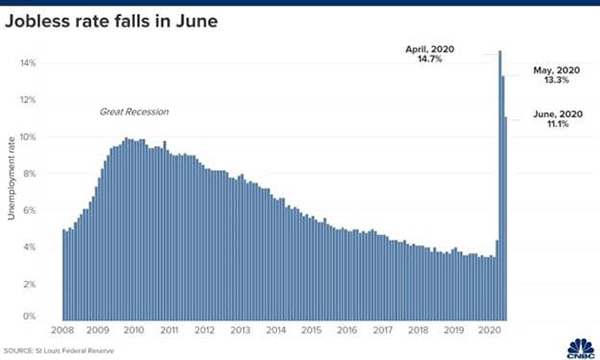
Yesterday’s unemployment numbers were significantly above expectations, and the current unemployment rate is now at 11.1%, a decrease from the previous number of 13.3%. A large contributor to the decline of the jobless rate was a plunge in those on temporary layoff as the economy continues to reopen and companies who have received PPP loans bringing back furloughed employees.
The market reacted positively to yesterday’s news with U.S. stocks trading higher, even as we continue to see rising numbers of new coronavirus cases.
WHAT’S DRIVING THE MARKETS?
The overall rebound in the stock market has been driven by the aggressive fiscal and monetary stimulus packages, progress in Coronavirus treatments and containment, as well as optimism for a quick economic recovery. The U.S. added 4.8 million jobs in June compared with expectations of 3.7 million and the unemployment rate fell for the second straight month. Stocks rallied after testimony to Congress by Federal Reserve Chairman Jerome Powell and U.S. Treasury Secretary Steve Mnuchin, who committed to anchor the U.S. economy through the public health disaster.
WHAT ARE WE LOOKING FOR?
We are looking for continued decrease in unemployment rates in addition to monitoring the second wave of COVID-19 cases. Currently, COVID-19 cases are on the rise in most states and the government is unable to restrain public behavior such as ensuring mask compliance.
We expect the road ahead will be filled with uncertainty and volatility; however, Powell’s promise this past Tuesday to continue doing whatever it takes to support the U.S. economy until it gets back to where it was before the pandemic has been a relief to investors and the U.S. markets.
Despite everything that the world is facing with the global pandemic, upcoming election in November and social protests, this quarter has started in a positive direction. The lowest number of companies on record have provided forward looking guidance for upcoming earnings. Technology and healthcare stocks have continued to provide a strong beacon of light for this market and we do not anticipate a sector rotation at this point in time.
_____
This material contains an assessment of the market and economic environment at a specific point in time and is not intended to be a forecast of future events, or a guarantee of future results. Forward-looking statements are subject to certain risks and uncertainties. Actual results, performance, or achievements may differ materially from those expressed or implied. Information is based on data gathered from what we believe are reliable sources.
The opinions expressed in this commentary are those of the author and may not necessarily reflect those held by Kestra Investment Services, LLC or Kestra Advisory Services, LLC. This is for general information only and is not intended to provide specific investment advice or recommendations for any individual. It is suggested that you consult your financial professional, attorney, or tax advisor with regard to your individual situation.
Securities offered through Kestra Investment Services, LLC (Kestra IS), member FINRA/SIPC. Investment Advisory Services offered through Kestra Advisory Services, LLC (Kestra AS) an affiliate of Kestra IS. Kestra IS and Kestra AS are not affiliated with CD Wealth Management.
Many of you ask us on a regular basis, “How can the market rebound so fast when the economy is still partially shut down and millions of Americans are unemployed?” There is a normal level of disconnect between the stock market and the economy, as the stock market is a leading indicator. The market will normally sell off before the economy turns south and will recover before the economy picks back up. This is never more clear than today.
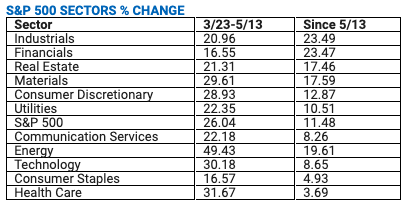
As you peel back the onion on this stock market rally, look at what is driving the market higher from the March lows. You will notice that most of the sectors in the S&P 500 are still negative year-to-date, as is the overall stock market, and those that are negative, are mainly down double digits. While it should not surprise us that most sectors are in the same camp as the market, what is surprising is which sectors are in the red and which are in the black.
It is abnormal because the sectors that usually lead the stock market out of a recession-induced downturn are not doing so now. Instead, leadership has come largely from big tech stocks and pharmaceuticals, rather than financials and cyclical sectors that closely track the ups and downs of the economy, such as industrials and consumer discretionary stocks. This time, it is very different as we have the first ever global pandemic.
In March and May, we continued to tweak our portfolios and increase our exposure to technology and health care stocks. Throughout the entire downturn, Technology and Health Care, along with Biotech stocks, are leading the way. In the last few weeks, the cyclical sectors are starting to catch up, as you can see from the table below. It is healthy for the market to have sector rotation and not just two or three sectors leading the way, while the rest of the market struggles.
Markets continue to move higher off a rotation-driven rally as investors move into those economically sensitive value stocks. At the same time, we still have a global pandemic with many businesses shutdown, employees working from home, nationwide protests and an election coming up in November.
We believe that technology and health care continue to be very strong sectors to own. We will continue to closely track the markets, the sector rotation and continue to tweak the portfolios as necessary.
Full Transparency
Our Process
Our planning process has the rigor and comprehensiveness you would expect when trusting a firm with your financial well-being.
This material contains an assessment of the market and economic environment at a specific point in time and is not intended to be a forecast of future events, or a guarantee of future results. Forward-looking statements are subject to certain risks and uncertainties. Actual results, performance, or achievements may differ materially from those expressed or implied. Information is based on data gathered from what we believe are reliable sources.
S&P 500 Index is an unmanaged group of securities considered to be representative of the stock market in general. You cannot directly invest in the index.
The opinions expressed in this commentary are those of the author and may not necessarily reflect those held by Kestra Investment Services, LLC or Kestra Advisory Services, LLC. This is for general information only and is not intended to provide specific investment advice or recommendations for any individual. It is suggested that you consult your financial professional, attorney, or tax advisor with regard to your individual situation.
Securities offered through Kestra Investment Services, LLC (Kestra IS), member FINRA/SIPC. Investment Advisory Services offered through Kestra Advisory Services, LLC (Kestra AS) an affiliate of Kestra IS. Kestra IS and Kestra AS are not affiliated with CD Wealth Management.
The last few months have definitely been challenging and interesting on many different levels from a stock market perspective. A silver lining in the recent market volatility that many people do not often take advantage of is tax-loss harvesting. What is tax-loss harvesting?
Tax-loss harvesting is where you realize losses in the portfolio with the intention of offsetting realized gains now or in the future to help reduce future tax bills. This works through selling an investment that has underperformed and is losing money and changing to another investment that becomes a tax-winner. Drawdowns in the market, as we saw in February and March, can provide a significant amount of loss that may be harvested.
Many investors wait until year end to attempt tax-loss harvesting, especially in a year like 2019, where we saw very little volatility. However, this year offers an opportunity to capture losses that we haven’t seen since 2008 and 2009.
An investment loss can be used for 2 different scenarios:
1. The losses can be used to offset investment gains either today or in the future. Short-term losses can be used to offset short-term gains, and long-term losses can be used to offset long-term gains. The least effective use of short-term losses is to apply them to long-term gains, but may still be preferable to paying long-term capital gains tax.
2. The losses can help offset $3,000 of income on a joint tax return in one year. Unused losses can be carried forward indefinitely.
When performing tax-loss harvesting, one has to be aware of the wash-sale rule. The wash-sale rule states that if you sell a security, fund or ETF at a loss and buy the same or substantially identical security within 30 days after the sale, the loss will be disallowed for tax purposes. For example, if you own IVV, iShares Core S&P 500 ETF and sell it for a loss, and then purchase SPY, SPDR S&P 500 ETF with the proceeds, the IRS will most likely deem this to be a wash sale violation and, therefore, not be able to take advantage of the realized loss.
Tax-loss harvesting and portfolio rebalancing can provide nice synergies as they play different roles in portfolio management. When we rebalance a portfolio, we are managing risk in the portfolio, by selling holdings that have outsized their target holdings and adding those gains to positions that may have losses or not grown as much. Often in rebalancing, the portfolio will experience sizable capital gains. That’s where tax-loss harvesting helps reduce the gains and bring the risk of the portfolio back to its target allocation.
We will continue to monitor the portfolios and look for opportunities to tax-loss harvest in the future, not just at year-end, but year round.
____________
This material contains an assessment of the market and economic environment at a specific point in time and is not intended to be a forecast of future events, or a guarantee of future results. Forward-looking statements are subject to certain risks and uncertainties. Actual results, performance, or achievements may differ materially from those expressed or implied. Information is based on data gathered from what we believe are reliable sources.
The opinions expressed in this commentary are those of the author and may not necessarily reflect those held by Kestra Investment Services, LLC or Kestra Advisory Services, LLC. This is for general information only and is not intended to provide specific investment advice or recommendations for any individual. It is suggested that you consult your financial professional, attorney, or tax advisor with regard to your individual situation.
Neither Kestra IS nor Kestra AS provide legal or tax advice and are not Certified Public Accounting Firms.
Securities offered through Kestra Investment Services, LLC (Kestra IS), member FINRA/SIPC. Investment Advisory Services offered through Kestra Advisory Services, LLC (Kestra AS) an affiliate of Kestra IS. Kestra IS and Kestra AS are not affiliated with CD Wealth Management.

The past 60 days have seen an unprecedented move in the
tax-free, municipal bond markets. In late March, we saw the municipal
bond market* and tax-free bonds yielding 4 to 5 times higher than a 10-year
U.S. Treasury bond. So, why the dislocation, what caused the panic and
what are we doing to take advantage of this opportunity?
Historically bonds, or fixed income, provide solid diversification from equities. As investors age, often they shift additional dollars to bonds for capital preservation as well as income. We call it “sleep at night money” in the municipal bond market. Investments, that while are not guaranteed, provide much lower risk and allow the investor peace of mind. However, the last 60 days have not quite followed this playbook.
In March, as the COVID-19 pandemic took hold on the financial markets, we saw panic set in the bond markets as well. Selling pressures from investors liquidating their bond funds and ETFs cause historic levels of redemptions. Investors were selling bonds at any cost to have cash. Unfortunately, the bond market does not work the exact same way as the stock market. There are thousands of bonds in the market, many from the same issuer, with different maturities, and some more liquid than others. When a bond investor goes to sell a bond, the price received depends on the buyer on the other side and what they are willing to pay.
If you are not paying attention and just want to sell, a bond may be priced at $95 or $100 on your statement, but you may only get 60 or 70 cents on the dollar if there is no demand to buy your bonds.
This is what we saw in March. Panic selling by bond investors and the result was poor pricing and trade execution for those sellers, resulting in rock-bottom prices to virtually anyone willing to buy. We realize that there is more headline risk right now in the bond market, as Mitch McConnell recently suggested bankruptcy was a route for financially strapped states to consider.
Fortunately, the Federal Reserve took serious action to help settle the stock and bond markets through both The Coronavirus Aid, Relief and Economic Security (CARES) Act as well as reopening the Money Market Liquidity Facility. The CARES Act authorized the U.S. Treasury to direct $150 billion to state, local, tribal and territorial governments to cover necessary expenditures incurred due to the pandemic not covered in their budgets. The legislation also provides liquidity benefits by authorizing $454 billion of direct loans and loan guarantees from the Treasury to corporations and municipalities. They are also considering direct bond purchases in the primary and secondary markets. Since these actions, we have seen the fixed income markets settle down, however, prices are still not back to pre-pandemic levels and we are now receiving questions from our clients on our thoughts on the municipal markets and the risk that exists today.
Many bonds that we purchase are tied to infrastructure, like utilities, school districts, toll roads.
We believe that while the economic shock of the coronavirus is severe, the investment grade municipal bond market still provides a safe haven to individual investors. There are a number of factors that should help municipal bonds survive this economic downturn:
1. The economy is reopening.
2. Municipal bonds tend to finance long term projects.
3. Municipalities have the ability to raise taxes as well as tap into reserves to overcome shortfalls.
4. Many bonds that we purchase are tied to infrastructure, like utilities, school districts, toll roads.
5. Municipalities have the flexibility to adjust budgets quickly through reduced costs as well as the ability to furlough employees.
6. The CARES Act provides additional resources to municipalities to purchase bonds as well as additional borrowing capabilities.
7. Future potential higher tax rates to counter influx of funding from the Federal Reserve and Government which will increase demand for municipal bonds to shelter additional income from higher taxes.
While municipal issuers will experience short term declines
in tax revenues from stay at home orders and decreased consumer demand, we
believe that the downgrade risk of bonds is significantly greater than default
risk. Historically, the default risk in municipal bonds is less than 1%
of all bonds. For perspective, the par value of the S&P Municipal
Bond Index is $2.321 trillion. The par value of bonds defaulted as of
April 2020, was $21 billion, of which $16 billion is attributed to Puerto Rico,
a default risk of less than .03%.
We continue to actively buy individual municipal bonds and employ the same strategy we have for many years.
We believe in buying investment grade individual tax-free bonds, studying the underlying credit quality, looking at the revenue source for the bonds and monitoring the credit quality.
Also, an important difference to keep in mind, is that unlike corporate bonds, where if the corporation declares bankruptcy, then all their bonds are bankrupt, this is not the case in municipal bonds. Most recently when Detroit had issues, there were water bonds issued by Detroit that had no issue. Some bonds also have insurance as another source of security. That is why we stress looking at each bond and what the funding source is to understand the underlying risks.
In summary, we continue to believe that the bond market
offers value. The headline risk will remain until the states open up and
remain open. As always, we will actively monitor the portfolios and make
changes as needed.
We appreciate your continued trust in CD Wealth Management.
*Municipal bonds are debt obligations of a state or local government entity. The funds may support general government needs or special projects. Safety is based on the viability of the issuing municipality and the community in general.
_______________
This material contains an assessment of the market and economic environment at a specific point in time and is not intended to be a forecast of future events, or a guarantee of future results. Forward-looking statements are subject to certain risks and uncertainties. Actual results, performance, or achievements may differ materially from those expressed or implied. Information is based on data gathered from what we believe are reliable sources.
The opinions expressed in this commentary are those of the author and may not necessarily reflect those held by Kestra Investment Services, LLC or Kestra Advisory Services, LLC. This is for general information only and is not intended to provide specific investment advice or recommendations for any individual. It is suggested that you consult your financial professional, attorney, or tax advisor with regard to your individual situation.
Securities offered through Kestra Investment Services, LLC (Kestra IS), member FINRA/SIPC. Investment Advisory Services offered through Kestra Advisory Services, LLC (Kestra AS) an affiliate of Kestra IS. Kestra IS and Kestra AS are not affiliated with CD Wealth Management.

As states have moved to ease the lockdowns which have cost tens of millions of jobs, a safe return to normal life without a vaccine has taken time.
In South Korea and Germany, countries that were among the most effective at controlling initial outbreaks of Covid-19, have been hindered by new flare-ups. While the virus is still present, America is continuing to reopen the economy.
If and when vaccines start to work, the next crucial step will be distributing them widely enough to rein in the Coronavirus so that social and economic life can continue down a positive path to a new normal.
VACCINE
Progress and setbacks in the vaccine race will continue to have positive and negative effects on stock market prices each day and week. We continue to increase our exposure to the healthcare sector to help take advantage of positive movements as Covid-19 plays itself out.
Investing into individual stocks in the biotech industry has substantial risks as those stocks could experience steep declines if their attempt at developing a Covid-19 vaccination falls short.
The FDA has the ability to issue emergency-use authorizations during public health crises to allow the use of unapproved medical products which could potentially be an unapproved vaccine.
If a vaccine comes to a fruition, whichever company that would bring a vaccine to the market first, will most likely will not be the last. The first vaccine might not be the best, and many scientists involved in the race for a vaccine say that making enough of a vaccine to inoculate the world is beyond the capability of even the largest drug maker.
MARKET OUTLOOK
The economies around the world are just beginning to emerge from the Covid-19 crisis. The pandemic is probably far from over, and the last 10 weeks have shown the importance of staying the course with a financial plan and diversified investment portfolio.
The markets have been vulnerable to pullbacks after the main benchmarks managed to retrace much of the losses suffered in March. More aggressive Fed interventions may keep the stock market bottoms higher, and low interest rates and more innovation can boost the tops.
Timing the markets historically has proven to be dangerous; however, time in the market has historically proven a successful course of action. We will most likely continue to see different levels of volatility during Covid-19, and it has never been more important to focus on the long-term of your financial plan which is coordinated with your short-term needs and objectives.
We will continue staying the course of your financial plan and being proactive to make specific strategic moves in the portfolios that have proven necessary during these times. 2020 has been an abnormal year, and we have made more updates to our portfolios in the first 5 ½ months of the year than we have done in the previous 24 months. Our reduction in the exposure of the energy sector earlier this year, the reduction in the allocation of small and mid-cap companies and real estate, along with the moves to additional exposure to large and technology companies have been additive to the portfolio. These were all lateral moves in which we did not time the market, as these were moves made within the market.
Regarding the fixed income portion of our portfolios, we continue to stay the course with a combination of investment grade corporate bonds and a total return fund that has the flexibility to invest in different segments of the bond market. In March, we removed our exposure to emerging market debt and added those monies back into U.S. corporate bonds. While we believe that short-term interest rates will be held close to zero for years to come, there are still opportunities in the bond market that provide return, diversification from equities and add value to the portfolios.
We want you to continue to consider the following:
1.Revisit Your Investment & Financial Planning Objectives: For nearly all investors, longer-term objectives are made possible when taking an appropriate level of risk.
2. Continue to Maintain a Longer-Term Mindset: Avoid letting recent market volatility convince you to abandon your prudently designed, long-term investment plan. Short-term reactive decisions could significantly impair portfolio returns.
3.Excess Cash Reserves: Continue to contribute according to your periodic investment plans as investing a portion of your excess cash reserves while markets are trading at more favorable levels.
We continue to be all-hands on deck and focused on making sure we are doing our job as your wealth management, financial advisory, and financial planning team.
Barron’s, Josh Nathan-Kazis, May 17, 2020
MarketWatch, May 19, 2020
MarketWatch, May 20, 2020
________________________
This material contains an assessment of the market and economic environment at a specific point in time and is not intended to be a forecast of future events, or a guarantee of future results. Forward-looking statements are subject to certain risks and uncertainties. Actual results, performance, or achievements may differ materially from those expressed or implied. Information is based on data gathered from what we believe are reliable sources.
The opinions expressed in this commentary are those of the author and may not necessarily reflect those held by Kestra Investment Services, LLC or Kestra Advisory Services, LLC. This is for general information only and is not intended to provide specific investment advice or recommendations for any individual. It is suggested that you consult your financial professional, attorney, or tax advisor with regard to your individual situation.
Securities offered through Kestra Investment Services, LLC (Kestra IS), member FINRA/SIPC. Investment Advisory Services offered through Kestra Advisory Services, LLC (Kestra AS) an affiliate of Kestra IS. Kestra IS and Kestra AS are not affiliated with CD Wealth Management.
The U.S. economy is experiencing suspended progress as shelter-in-place orders have powered down a large fraction of economic activity.
Below are three possible scenarios and their respective implications for the economy and markets. Early economic data for March shows a devastating dislocation in employment and a plunge in consumer confidence. As we have seen, the shelter-at-home orders across the U.S. in response to the COVID-19 pandemic have caused large portions of the economy to close.
2020 may well become known as the Great Reboot. Many aspects of this pandemic are being labeled unprecedented.
A looming challenge, that is new to our country, is how to safely and effectively reboot our economy after hitting “the pause button.” It is critical to note that the predominant variable among these three hypothetical scenarios is how the pandemic will evolve in 2020.
The economy partially re-opened this past Friday, and we are looking forward to seeing the results of how it progresses. For the purposes of this market insight, we are limiting the hypothetical reboot scenarios to 3; however, there are many other routes this economy can take, majority of which stems from how quickly the economy re-stimulates.
May reboot
This is a possible best-case scenario, which assumes that beginning in May, we can reopen the economy. This potential scenario implies the COVID-19 pandemic essentially caused a 6-week-long health crisis that largely resolves. While the -16.5% decline in Q2 would be the worst on record, it would leave 2020 GDP down -1.6%, which is more typical of a normal recession.
Summertime V-shape
This potential scenario assumes that cases peak at a higher level and peak later into the second quarter. This could mean a potential delayed reopening until June or even July. This longer broad-based lockdown could cause Q2 GDP to potentially decline -35.6%, almost twice as much as the first scenario. It could also mean a possible sharper rebound, but it leaves 2020 with a hypothetical contraction of -5.6%.
Fall recovery
This potential scenario reflects a more protracted arc to the pandemic. The possible decline in Q2 is significant here, at -29.9%. In this scenario, as the economy tries to restart mid-Q2, there are possible setbacks related to a resurgence of COVID-19 cases that causes the shelter-at-home orders to recur. This keeps growth in Q3 weak and, with a third consecutive quarter of contraction, delivers a -6.0% contraction in growth.
These hypothetical scenarios all include a decline in Q2, followed by some form of record quarterly gain, causing many to assign a V-shape to the economy. A shallower downturn is better, as is a faster recovery. In the past, in a typical recession, it can take more than a year after the recession ends for the economy to recapture the same pre-downturn level of output. As the country begins to re-open, many areas are still closed and limited. The remaining social-distancing requirements continue to impact particular sectors (concerts, sporting events, international travel and tourist attractions) of the economy.
3 reboot scenarios compared
The focus on the Great Reboot is sparking hope that our economy, once free of shelter-at-home orders, will nimbly and rapidly rebound. Much of this depends on how the pandemic evolves. Once businesses are allowed to reopen and consumers can shop more freely, a significant amount of activity could return. Many economists expect the economy to reboot in stages, sometimes successfully and sometimes with setbacks. The labor market could determine how much traction spending will get as the economy starts back up.
Nobody knows how long this virus will last, but it is universally agreed upon that it will not last forever. Over the last six weeks we have seen the Federal Reserve and the Treasury Department and our government’s willingness to put fiscal stimulus into the economy. It is not often that there is a 96-0 vote in the Senate as we saw on March 25, 2020. It appears that our government is going to continue to support stimulus to help combat this pandemic-led recession. Contrary to what the media portrays at times, there is a level of unity amongst our leaders.
We continue to pay close attention as this pandemic plays itself out. We will make tweaks to your portfolio if necessary and when needed. We want to remind you that our strategy is for you to stay the course as you have a solid financial plan behind your investments.
PLEASE NOTE:Our office continues to remain open during this time. Although some of us are working remotely, there will always be someone in our office to assist you. If there is something you need to drop off, or something you need for us to mail to you, please let us know! We understand these are extraordinary times, and we are here to continue to help you and your family!
_____________________
This material contains an assessment of the market and economic environment at a specific point in time and is not intended to be a forecast of future events, or a guarantee of future results. Forward-looking statements are subject to certain risks and uncertainties. Actual results, performance, or achievements may differ materially from those expressed or implied. Information is based on data gathered from what we believe are reliable sources.
The opinions expressed in this commentary are those of the author and may not necessarily reflect those held by Kestra Investment Services, LLC or Kestra Advisory Services, LLC. This is for general information only and is not intended to provide specific investment advice or recommendations for any individual. It is suggested that you consult your financial professional, attorney, or tax advisor with regard to your individual situation.
Securities offered through Kestra Investment Services, LLC (Kestra IS), member FINRA/SIPC. Investment Advisory Services offered through Kestra Advisory Services, LLC (Kestra AS) an affiliate of Kestra IS. Kestra IS and Kestra AS are not affiliated with CD Wealth Management.

Last week was a historic week for the oil markets, as for the first time ever, futures contracts for West Texas Intermediate Crude traded negative to start the week. Oil investors and traders were rushing to sell the May futures contracts as no one wanted to take delivery of oil, as there is nowhere to store it.
What does that mean for you as an investor?
We have seen global oil demand drop by 25 million barrels a day as the majority of the world economy has shut down to battle the COVID-19 pandemic. Going back to Economics 101, we are dealing with basic supply and demand issues for the price of oil.
As of today, there is a tremendous excess supply of oil. With global demand down 25% and oil storage capacity almost completely full, we have no place to store additional barrels of oil. Therefore, prices have to come down to combat excess supply. How do oil prices eventually go back up?
* Upstream companies begin cutting back on capital spending and reducing production – i.e. active rig counts have fallen over 40% this month.
* OPEC must cut oil production.
* Most importantly, when the global economy reopens, demand for oil will increase, thus causing prices in the future to increase.
A question that we receive often is, “How do I invest in oil in this very volatile time? The future price of oil has to go up, right?”
For retail investors, unfortunately, there is no easy way to invest in the current price of a barrel of oil (often referred to as spot price). Unlike gold, you cannot take possession of a barrel of oil, store it in your garage, and then sell it in the future when the price of oil has gone back up. There are several ETF’s (exchange-traded funds) that use futures-based pricing. These ETFs do not have good tracking records to accurately track the current price of oil. For example, USO, the most heavily traded ETF, saw massive inflows last week as retail investors try to “buy the dip” in oil prices. However, each month this ETF and others like it, have to continually roll into the next month future contract and end up paying more for the price of oil than in the current spot market. This “contango” occurs as the price of a futures contract on oil is higher than the current price. Consequently, we could actually see oil prices rise and the owners of the Exchange Traded Funds lose money.
In summary, while we all hope that the future price of oil will rise, there are no guarantees. We can expect the price of oil to continue this volatile trend as the world navigates the unprecedented global pandemic.
__________________
This material contains an assessment of the market and economic environment at a specific point in time and is not intended to be a forecast of future events, or a guarantee of future results. Forward-looking statements are subject to certain risks and uncertainties. Actual results, performance, or achievements may differ materially from those expressed or implied. Information is based on data gathered from what we believe are reliable sources.
The opinions expressed in this commentary are those of the author and may not necessarily reflect those held by Kestra Investment Services, LLC or Kestra Advisory Services, LLC. This is for general information only and is not intended to provide specific investment advice or recommendations for any individual. It is suggested that you consult your financial professional, attorney, or tax advisor with regard to your individual situation.
Securities offered through Kestra Investment Services, LLC (Kestra IS), member FINRA/SIPC. Investment Advisory Services offered through Kestra Advisory Services, LLC (Kestra AS) an affiliate of Kestra IS. Kestra IS and Kestra AS are not affiliated with CD Wealth Management.
As we are in this for the long haul, we know there will be peaks and valleys, and our plan is to continue to stay the course. From a portfolio perspective, we continue to actively monitor your portfolio. In late March, we made the following adjustments:
1. Increased large cap exposure, through additional exposure to technology and healthcare.
2. We funded the increase in large cap stocks by selling out of small and mid-cap stocks as well as real estate.
3. For fixed income, we sold emerging market debt and added to our U.S. bond portfolio through additional exposure to high quality corporate bonds.
From a planning perspective, we remain focused on tax loss harvesting, postponing Required Minimum Distributions for those clients who do not need the income from their IRAs, and repositioning the portfolio when appropriate.
Over the weekend, the Wall Street Journal relayed that markets are reacting not just to where the economy is, but also to the range of outcomes for where it could be going. Many factors are driving this recession with two prominent themes being the lockdowns and social distancing, which is in turn driven by the pandemic. The best minds in our country are working around the clock to help us get past this pandemic. The continued fiscal and monetary policy stimulus of epic proportions have pumped trillions of dollars into our economy. Medical experts continue to collaborate to provide a cure.
As of April 16th, the curve has flattened as the U.S. had fewer new reported cases than it did 12 days prior.
The continued movement in the markets, paired with all the economic headlines you see daily, can leave you searching for facts to try and make sense out of all the information we see and hear. It has been roughly 2 months since the S&P 500 hit an all-time high, and about one month since it hit a low we have not seen since 2017. This made March the most volatile month in U.S. history and the S&P 500’s 34% drop between February 19 and March 23 the fastest decline from a record bull market to a bear market. Thanks to a massive government stimuli package, combined with discussions of upcoming plans to ease some restrictions due to COVID-19, the markets have rallied the last few weeks. The S&P 500 is now just 15% below its pre-pandemic high and the Nasdaq 100 is positive (1.1%), as of Friday, April 17.
Furthermore, earnings season kicked off last week giving a glimpse into how the pandemic affected the financials of key corporations during the first quarter, with many companies even stating their expectations for the remainder of 2020. The markets showed optimism last week for two potential reasons:
1. Talk of steps to begin to reopen the economy.
2. Flattening of the curve of new COVID-19 cases (see above graph).
Volatility has continued this week, with the markets coming down Monday and Tuesday and then rallying back on Wednesday. This shows that uncertainty continues to drive this market. While our views are to stay the course, we will continue to monitor and make necessary updates to your portfolio.
The source for any S&P 500 Index (Daily) Data, will be Yahoo Finance (^GSPC). It will be shown assuming historical dividends are reinvested and in U.S. Dollar terms.
____________________________
This material contains an assessment of the market and economic environment at a specific point in time and is not intended to be a forecast of future events, or a guarantee of future results. Forward-looking statements are subject to certain risks and uncertainties. Actual results, performance, or achievements may differ materially from those expressed or implied. Information is based on data gathered from what we believe are reliable sources.
The opinions expressed in this commentary are those of the author and may not necessarily reflect those held by Kestra Investment Services, LLC or Kestra Advisory Services, LLC. This is for general information only and is not intended to provide specific investment advice or recommendations for any individual. It is suggested that you consult your financial professional, attorney, or tax advisor with regard to your individual situation.
Securities offered through Kestra Investment Services, LLC (Kestra IS), member FINRA/SIPC. Investment Advisory Services offered through Kestra Advisory Services, LLC (Kestra AS) an affiliate of Kestra IS. Kestra IS and Kestra AS are not affiliated with CD Wealth Management.

The Coronavirus Aid, Relief, and Economic Security Act (“CARES Act”) was signed into law by President Trump on Friday, March 27, 2020. Phase Three of the stimulus is estimated at more than $2.2 Trillion. Given the speed with which the U.S. economy is slowing down, the government is acting quickly to limit the economic damage wrought by the coronavirus and is indicating further actions may be needed.
Fiscal and monetary responses have been unprecedented. The Fed, for the first time, is buying corporate bonds. Other central banks have moved into buying equities. While the odds are stacked against the Federal Reserve stretching from corporate debt from buying stocks, the historical response has been to say, “never say never”. We expect as the news regarding jobless claims increases, monetary policy should respond accordingly.
Employers and workers will be adjusting to a new normal once this health crisis has passed. There has often been concern regarding how the internet would handle increased traffic all at once and how it would react to those changes. The good news is that US networks are handling internet traffic spikes without any major hiccups thus far while many people are having to work from home. Video streaming is up 38% and video chat has been up 212%1.
Putting current market volatility into historical perspective will help you stay the course during turbulent times. While the market continues to be volatile, sticking to your investment strategy may be a challenge, but remains extremely important. Market cycles offer both obstacles and opportunities.
Remember, markets go up and down. Since the turn of the millennium, the market’s negative response to health crises has been relatively short-lived.
As this table shows, approximately six months after early reports of a major outbreak, the S&P 500 bounced back by an average of 10.47%. After 12 months, it rebounded by an average of 17.17%. Although there are no guarantees the current situation will follow a similar pattern, it may be reassuring to know that over even longer periods of time, stocks typically regain their upward trajectory, helping long-term investors who hold steady to recoup their temporary losses, catch their breath, and go on to pursue their goals.
HISTORICAL RESPONSE TO HEALTH CRISES
(6 AND 12 MONTHS POST MAJOR OUTBREAK)
Source: Dow Jones Market Data, as cited on foxbusiness.com, January 27, 2020. *End of month during which early incidents of outbreak were reported. **H1N1 occurred during the financial crisis, when, as during other periods, many different factors influenced stock market performance.
The volatility in the market is largely driven by ever-increasing fears about the potential effects of the coronavirus (COVID-19) and its ultimate impact on the global economy. The unpredictability, strength, and suddenness of the historic tumble was and has been unsettling for all of us.
What should you do?
First, keep in mind that market downturns sometimes offer the chance to pick up potentially solid stocks at value prices, which could position a portfolio well for future growth. Again, there are no guarantees that stocks will perform to anyone’s expectations, and decisions could result in losses including a possible loss in principal, but it may be helpful to remember that some investors use downturns as opportunities to buy stocks that were previously overvalued relative to their perceived earnings potential.
Moreover, if you typically invest set amounts into your portfolio at regular intervals, a strategy known as dollar-cost averaging (DCA), which is commonly used in workplace retirement plans and college investment plans — take heart knowing you are utilizing a method of investing that helps you behave like the value investors noted above. Through DCA, your investment dollars purchase fewer shares when prices are high, and more shares when prices drop. Essentially, in a down market, you automatically “buy low”, one of the most fundamental investment tenets. Over extended periods of volatility, DCA can result in a lower average cost for your holdings than the investment’s average price over the same time period.
We are closely monitoring the still-unfolding situation. We do not currently find compelling reasons that would justify overriding our asset allocation methodology despite the current elevated uncertainty from the Coronavirus. CD Wealth Management continues to believe that our clients should remain patient and adhere to their well-constructed, diversified investment portfolio anchored to their long-term goals and time horizon.
1 Barrons.com, April 5, 2020
____________________________________
This material contains an assessment of the market and economic environment at a specific point in time and is not intended to be a forecast of future events, or a guarantee of future results. Forward-looking statements are subject to certain risks and uncertainties. Actual results, performance, or achievements may differ materially from those expressed or implied. Information is based on data gathered from what we believe are reliable sources.
The opinions expressed in this commentary are those of the author and may not necessarily reflect those held by Kestra Investment Services, LLC or Kestra Advisory Services, LLC. This is for general information only and is not intended to provide specific investment advice or recommendations for any individual. It is suggested that you consult your financial professional, attorney, or tax advisor with regard to your individual situation.
Securities offered through Kestra Investment Services, LLC (Kestra IS), member FINRA/SIPC. Investment Advisory Services offered through Kestra Advisory Services, LLC (Kestra AS) an affiliate of Kestra IS. Kestra IS and Kestra AS are not affiliated with CD Wealth Management.

The first step is to determine your financial needs for each goal. Answering the following questions can help you get started:
For retirement:
How many years until you retire?
Does your company offer an employer-sponsored retirement plan or a pension plan? Do you participate? If so, what’s your balance? Can you estimate what your balance will be when you retire?
How much do you expect to receive in Social Security benefits? (One way to get an estimate of your future Social Security benefits is to use the benefit calculators available on the Social Security Administration’s website, www.ssa.gov. You can also sign up for a my Social Security account so that you can view your online Social Security Statement. Your statement contains a detailed record of your earnings, as well as estimates of retirement, survivor’s, and disability benefits.)
What standard of living do you hope to have in retirement? For example, do you want to travel extensively, or will you be happy to stay in one place and live more simply?
Do you or your spouse expect to work part-time in retirement?
For college:
How many years until your child starts college?
Will your child attend a public or private college? What’s the expected cost?
Do you have more than one child whom you’ll be saving for?
Does your child have any special academic, athletic, or artistic skills that could lead to a scholarship?
Do you expect your child to qualify for financial aid?
Many on-line calculators are available to help you predict your retirement income needs and your child’s college funding needs.
Though college is certainly an important goal, you should probably focus on your retirement if you have limited funds. With generous corporate pensions mostly a thing of the past, the burden is primarily on you to fund your retirement. But if you wait until your child is in college to start saving, you’ll miss out on years of potential tax-deferred growth and compounding of your money. Remember, your child can always attend college by taking out loans (or maybe even with scholarships), but there’s no such thing as a retirement loan!
Figure out what you can afford to put aside each month
After you know what your financial needs are, the next step is to determine what you can afford to put aside each month. To do so, you’ll need to prepare a detailed family budget that lists all of your income and expenses. Keep in mind, though, that the amount you can afford may change from time to time as your circumstances change. Once you’ve come up with a dollar amount, you’ll need to decide how to divvy up your funds.
If possible, save for your retirement and your child’s college at the same time
Ideally, you’ll want to try to pursue both goals at the same time. The more money you can squirrel away for college bills now, the less money you or your child will need to borrow later. Even if you can allocate only a small amount to your child’s college fund, say $50 or $100 a month, you might be surprised at how much you can accumulate over many years. For example, if you saved $100 every month and earned 8% annually, you’d have $18,415 in your child’s college fund after 10 years. (This example is for illustrative purposes only and does not represent a specific investment. Investment returns will fluctuate and cannot be guaranteed.)
If you’re unsure about how to allocate your funds between retirement and college, a professional financial planner may be able to help. This person can also help you select appropriate investments for each goal. Remember, just because you’re pursuing both goals at the same time doesn’t necessarily mean that the same investments will be suitable. It may be appropriate to treat each goal independently.
Help! I can’t meet both goals
If the numbers say that you can’t afford to educate your child or retire with the lifestyle you expected, you’ll probably have to make some sacrifices. Here are some suggestions:
Defer retirement: The longer you work, the more money you’ll earn and the later you’ll need to dip into your retirement savings.
Work part-time during retirement.
Reduce your standard of living now or in retirement: You might be able to adjust your spending habits now in order to have money later. Or, you may want to consider cutting back in retirement.
Increase your earnings now: You might consider increasing your hours at your current job, finding another job with better pay, taking a second job, or having a previously stay-at-home spouse return to the workforce.
Invest more aggressively: If you have several years until retirement or college, you might be able to earn more money by investing more aggressively (but remember that aggressive investments mean a greater risk of loss). Note that no investment strategy can guarantee success.
Expect your child to contribute more money to college: Despite your best efforts, your child may need to take out student loans or work part-time to earn money for college.
Send your child to a less expensive school: You may have dreamed your child would follow in your footsteps and attend an Ivy League school. However, unless your child is awarded a scholarship, you may need to lower your expectations. Don’t feel guilty — a lesser-known liberal arts college or a state university may provide your child with a similar quality education at a far lower cost.
Think of other creative ways to reduce education costs: Your child could attend a local college and live at home to save on room and board, enroll in an accelerated program to graduate in three years instead for four, take advantage of a cooperative education where paid internships alternate with course work, or defer college for a year or two and work to earn money for college.
If you have several years until retirement or college, you might be able to earn more money by investing more aggressively.
Can retirement accounts be used to save for college?
Yes. Should they be? That depends on your family’s circumstances. Most financial planners discourage paying for college with funds from a retirement account; they also discourage using retirement funds for a child’s college education if doing so will leave you with no funds in your retirement years. However, you can certainly tap your retirement accounts to help pay the college bills if you need to. With IRAs, you can withdraw money penalty free for college expenses, even if you’re under age 59½ (though there may be income tax consequences for the money you withdraw). But with an employer-sponsored retirement plan like a 401(k) or 403(b), you’ll generally pay a 10% penalty on any withdrawals made before you reach age 59½ (age 55 or 50 in some cases), even if the money is used for college expenses. There may be income tax consequences, as well. (Check with your plan administrator to see what withdrawal options are available to you in your employer-sponsored retirement plan.)