Are tech stocks in a bubble?

The ongoing strength in large cap technology stocks has many investors wondering if there is another bubble in the making. The Nasdaq 100, as measured by the ETF, QQQ, is up 27.85 percent year to date, while the S&P 500 is up 4.75 percent for the year. 

The top 10 holdings of QQQ, which comprise almost 60 percent of the index, are all part of the so-called FAANG (Facebook, Amazon, Apple, Netflix and Google) stocks. At the same time, the top five holdings of the S&P 500, Apple, Microsoft, Amazon, Facebook and Google, make up more than 22 percent of the current index, and a big reason that the stock market returns are now positive year to date.

Investors have been willing to pay an increasingly higher price for these FAANG stocks as they continue to show massive innovation, whether through 5G, the ever-growing cloud business, or taking advantage of the stay-at-home economy caused by the pandemic.

These stocks have provided shelter from lockdown-sensitive stocks like restaurants, hotels and airlines. Cloud spending and internet streaming are proving to be mostly recession-resistant, and the at-home environment has accelerated these growth trends.

Analysts valuate these companies by looking at a myriad of financial ratios: P/E (price-to-earnings), P/B (price-to-book), P/S (Price to Sales) and PEG (price/earnings to growth), to name a few. Back in the late 1990s and early 2000s, many of the newly public growth technology companies were unprofitable and had zero revenues and earnings. These companies were far from becoming innovators and game-changers.

As seen in the chart below, at the peak of the dot-com bubble, the top 50 companies in the S&P 500 produced a P/E ratio of 40.2x, while the bottom 450 stocks had a P/E ratio of 19x. Today, the top 50 companies are trading at a P/E of 25.7x, while the bottom 450 are trading at a multiple of 20.8x. 
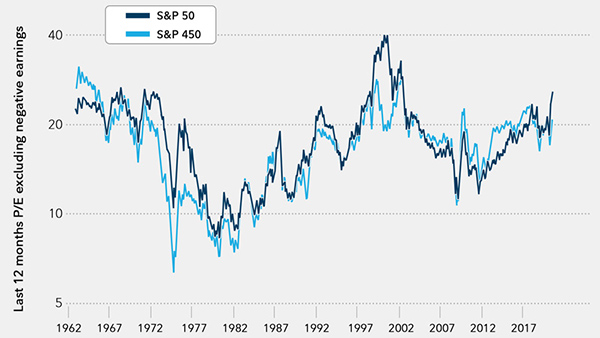
Fast-forward to today, the leading companies in the Nasdaq 100 are large revenue and profit generators, with a few exceptions. The price gains we have seen over the last six months in the stock market have been justified by solid earnings growth, and as a result, we have seen valuation spreads widen between these technology companies and the rest of the market. 

It is important to keep in mind that stocks trade based on future earnings and are forward-looking in nature. The earnings expectations for the top large cap companies are high, and we should expect these companies to face volatility in the near future with growing regulatory pressure, ad-spending boycotts, the upcoming election and potential corporate tax changes.

So, what can we learn from all this? The best option is to stick with a broadly diversified portfolio that can help you to achieve your own specific financial goals and not place all your eggs in one sector basket.

_____

This material contains an assessment of the market and economic environment at a specific point in time and is not intended to be a forecast of future events, or a guarantee of future results.  Forward-looking statements are subject to certain risks and uncertainties.  Actual results, performance, or achievements may differ materially from those expressed or implied.  Information is based on data gathered from what we believe are reliable sources.

The opinions expressed in this commentary are those of the author and may not necessarily reflect those held by Kestra Investment Services, LLC or Kestra Advisory Services, LLC.  This is for general information only and is not intended to provide specific investment advice or recommendations for any individual.  It is suggested that you consult your financial professional, attorney, or tax advisor with regard to your individual situation. 

Investing involves risk, including the possible loss of principal.  Past performance does not guarantee future results.  Asset allocation alone cannot eliminate the risk of fluctuating prices and uncertain returns.  There is no guarantee that a diversified portfolio will outperform a non-diversified portfolio in any given market environment.  No investment strategy, such as asset allocation, can guarantee a profit or protect against a loss.  Actual client results will vary based on investment selection, timing, and market conditions.  It is not possibly to invest directly in an index.

Securities offered through Kestra Investment Services, LLC (Kestra IS), member FINRA/SIPC. Investment Advisory Services offered through Kestra Advisory Services, LLC (Kestra AS) an affiliate of Kestra IS. Kestra IS and Kestra AS are not affiliated with CD Wealth Management.


The Headlines You Should Read This Week

With so many factors causing markets to move, we’re always on the lookout for the biggest stories, the ones that will affect our economic outlook. This week’s headlines cover Big Tech, the race to a COVID vaccine and even the return of disinfectant wipes.

+++

From Forbes: With fewer than 100 days left until the election, some investors are worried about the economic pros and cons of either candidate, but at least one expert believes Wall Street’s fixation on politics is misplaced.

TL;DR: There may be a relationship between the actions of a president and the performance of the market, but in general, the economy may have more to do with business cycles than the occupant of the White House. No matter who’s in office, investors can take comfort that in the long run, “buy and hold” worked best.

+++

From The New York Times (subscription required): Congressional hearings for the heads of Amazon, Apple, Facebook and Google promise to be a spectacle. Whether it’s more theater than substance, some say the hearings show momentum toward regulations.

TL;DR: “The C.E.O.s don’t want to be testifying. Even having this collective hearing creates a sense of quasi-guilt just because of who else has gotten called in like this — Big Pharma, Big Tobacco, Big Banks,” said Paul Gallant, a tech policy analyst at the investment firm Cowen. “That’s not a crowd they want to be associated with.”

+++

From The Wall Street Journal (subscription required): Two of the most advanced experimental coronavirus vaccines entered the pivotal phase of their studies this week, with the first subjects receiving doses of vaccines developed by Moderna and Pfizer.

TL;DR: Researchers plan to enroll 30,000 people in separate last-stage — or phase 3 — trials, the results of which will determine whether the vaccines protect against symptomatic COVID-19 and whether they should be cleared for widespread use.

Related: Think twice before speculating on a COVID-19 cure (CD Wealth Management)

+++

From CNBC: While toilet paper has mostly returned to the shelves since the panic buying of the early pandemic days in March, disinfectant wipes are still in short supply, thanks to supply chain disruptions due to competition with PPE manufacturers for the same raw materials.

TL;DR: The return of disinfectant wipes and cleaning supplies may lag behind demand well into 2021, even with companies ramping up production efforts. Manufacturers predict demand will last even beyond introduction of a COVID vaccine because of long-term shifts in consumer behavior.

+++

From NPR: It should come as no surprise that gold prices started going up as coronavirus started to spread; in uncertain times, investors tend to put their money in gold because it’s considered a “safe haven” for investors worried over instable financial markets.

TL;DR: Even though high gold prices traditionally indicate uncertainty, financial markets have generally been performing well, thanks to aggressive steps taken by the Fed. But many experts caution that market instability could be likely to continue until there is a COVID-19 vaccine, and there also are market experts who suggest that gold prices could continue to climb in the meantime.

______

This material contains an assessment of the market and economic environment at a specific point in time and is not intended to be a forecast of future events, or a guarantee of future results.  Forward-looking statements are subject to certain risks and uncertainties.  Actual results, performance, or achievements may differ materially from those expressed or implied.  Information is based on data gathered from what we believe are reliable sources.

The opinions expressed in this commentary are those of the author and may not necessarily reflect those held by Kestra Investment Services, LLC or Kestra Advisory Services, LLC.  This is for general information only and is not intended to provide specific investment advice or recommendations for any individual.  It is suggested that you consult your financial professional, attorney, or tax advisor with regard to your individual situation. 

Securities offered through Kestra Investment Services, LLC (Kestra IS), member FINRA/SIPC. Investment Advisory Services offered through Kestra Advisory Services, LLC (Kestra AS) an affiliate of Kestra IS. Kestra IS and Kestra AS are not affiliated with CD Wealth Management.

The upcoming election: It always comes back to fundamentals

We are now less than 100 days from the upcoming presidential election, and many investors are thinking about the pros and cons of which president may win the White House.  You may feel strongly about one party or the other when it comes to your politics, but when it comes to your portfolio, it doesn’t matter which party wins the White House according to historical returns. 

Fundamentals like corporate earnings, interest rates and economic growth are the main concerns for the stock market.  Jeremy Siegel, author of the book Stocks for the Long Run, says that Wall Street’s obsession with politics is mostly misplaced: 

“Bull markets and bear markets come and go, and it’s more to do with business cycles than presidents.”

Stock returns are influenced by multiple factors including business cycles, corporate profits, globalization and unpredictable events, like 9/11 or COVID-19.

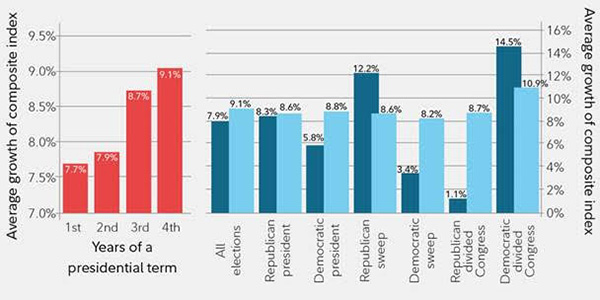
The chart below is a breakdown of the “Presidential Cycle” during the first two years of a presidency compared to the end of the four-year term.  The “Presidential Cycle” shows a consistent pattern in which the first two years of a presidential term have tended to produce below-average returns while the last two years have been above average. 

The reason for this, more than likely, is that during the first two years, the president’s new agenda takes time to work its way through the economy while the last two years, the party in power is focused more on getting re-elected and see increase fiscal and monetary stimulus.  What’s interesting to note in the chart below is that whatever differences there are in the outcomes over the first two years all but disappear by the time the four-year cycle takes place. 

As shown by the light blue bars below, over four years there is little difference in stock market return between Republican and Democratic presidents.

SOURCE: Fidelity – Presidential Elections & Stock Returns

If we look at numbers alone, the short answer is that Democratic presidents have had better returns since 1929 than their Republican counterparts.  More reliable is the market’s influence on election outcomes.  When the S&P 500 has risen the 3 months before an election, the incumbent party generally has gone on to win the White House; when it has fallen, the incumbent has generally lost.

What can we learn from all this?  The best option is to stick with a broadly diversified portfolio that can help you to achieve your own specific financial goals – regardless of who prevails in November.  The economy, and therefore the market, is bigger than the direction the political winds are blowing.  Ultimately, it’s the long term fundamentals that matter.

Now more than ever, it is important to maintain an investment strategy based on your own goals, time horizon and risk tolerance.  All investing involves risk and there are no guarantees that any investment strategy, especially which biotech or pharmaceutical stock wins the COVID-19 vaccine race, will be successful.

_____

This material contains an assessment of the market and economic environment at a specific point in time and is not intended to be a forecast of future events, or a guarantee of future results.  Forward-looking statements are subject to certain risks and uncertainties.  Actual results, performance, or achievements may differ materially from those expressed or implied.  Information is based on data gathered from what we believe are reliable sources.

The opinions expressed in this commentary are those of the author and may not necessarily reflect those held by Kestra Investment Services, LLC or Kestra Advisory Services, LLC.  This is for general information only and is not intended to provide specific investment advice or recommendations for any individual.  It is suggested that you consult your financial professional, attorney, or tax advisor with regard to your individual situation.

Securities offered through Kestra Investment Services, LLC (Kestra IS), member FINRA/SIPC. Investment Advisory Services offered through Kestra Advisory Services, LLC (Kestra AS) an affiliate of Kestra IS. Kestra IS and Kestra AS are not affiliated with CD Wealth Management.

Think twice before speculating on a COVID-19 cure

As hundreds of companies around the world race to develop vaccines and drug therapies that could help end the COVID-19 pandemic, reports of successful or failed trials wildly affect individual stock prices and can trigger swings in the overall market. These stories have a knack for stirring up investors’ emotions as we all hope to move past this pandemic and return to a new “normal.”

A vaccine prepares the body’s immune system to be able to resist a specific disease and prevent it from causing sickness and spreading to others. At this point in time, there are more than 125 experimental candidates globally in the clinical evaluation stage, and another 115 candidates are in the pre-clinical stage. Clinical studies are conducted in three phases:

Phase I: A small study of healthy people tests the safety and immune response of the vaccine at different doses.

Phase II: A random, double-blind controlled study of hundreds of people further assesses safety, efficacy and optimal dosing.

Phase III: If all goes well, then thousands of people are tested in Phase III.  These larger studies are challenging as they test how well the vaccine works in an environment where the virus is spreading.

In developing a vaccine, not one of these crucial steps can be skipped, and typically a vaccine takes up to 12 to 18 months before becoming available. In this case, the government is accelerating the timeline to speed up the phases, and massive public investment has allowed drug makers to get a head start on manufacturing doses while waiting for human trials to conclude. 

Is hope on the horizon?

Needless to say, a COVID-19 vaccine is not imminent, but unprecedented levels of dollars are being spent in an effort to develop successful treatments and therapies to help COVID-19 patients. New biotechnologies, financial support and cooperation between governments and industry leaders could shave several years off typical developmental timelines.

It is rarely easy to predict which new products will perform well enough in multiple rounds of studies to earn regulatory approval. Headline-induced price swings suggest that investors are making decisions driven by hopes and fears, and possibly based on limited information, instead of a realistic assessment of long-term earnings potential. 

Investors need to be wary of banking on a particular company to emerge as the winner in the COVID-19 race just because they are the apparent leader right now. It’s impossible to know which, if any, of the experimental vaccines will be successful. Also, it’s possible that there are multiple drug makers that win regulatory approval for the vaccine.

Now more than ever, it is important to maintain an investment strategy based on your own goals, time horizon and risk tolerance.  All investing involves risk and there are no guarantees that any investment strategy, especially which biotech or pharmaceutical stock wins the COVID-19 vaccine race, will be successful.

__________

This material contains an assessment of the market and economic environment at a specific point in time and is not intended to be a forecast of future events, or a guarantee of future results.  Forward-looking statements are subject to certain risks and uncertainties.  Actual results, performance, or achievements may differ materially from those expressed or implied.  Information is based on data gathered from what we believe are reliable sources.

The opinions expressed in this commentary are those of the author and may not necessarily reflect those held by Kestra Investment Services, LLC or Kestra Advisory Services, LLC.  This is for general information only and is not intended to provide specific investment advice or recommendations for any individual.  It is suggested that you consult your financial professional, attorney, or tax advisor with regard to your individual situation. 

Securities offered through Kestra Investment Services, LLC (Kestra IS), member FINRA/SIPC. Investment Advisory Services offered through Kestra Advisory Services, LLC (Kestra AS) an affiliate of Kestra IS. Kestra IS and Kestra AS are not affiliated with CD Wealth Management.

Q3 outlook: Jobs on the rise, but so are coronavirus cases

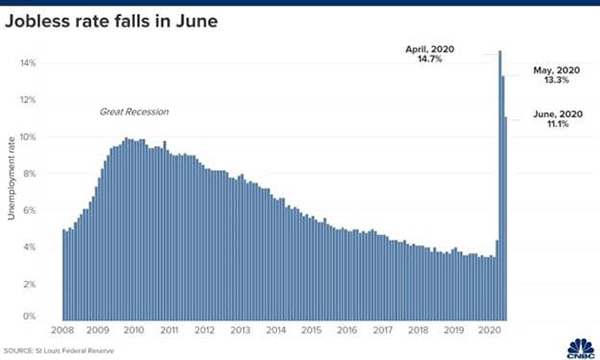
Yesterday’s unemployment numbers were significantly above expectations, and the current unemployment rate is now at 11.1%, a decrease from the previous number of 13.3%.  A large contributor to the decline of the jobless rate was a plunge in those on temporary layoff as the economy continues to reopen and companies who have received PPP loans bringing back furloughed employees.

The market reacted positively to yesterday’s news with U.S. stocks trading higher, even as we continue to see rising numbers of new coronavirus cases. 

WHAT’S DRIVING THE MARKETS?

The overall rebound in the stock market has been driven by the aggressive fiscal and monetary stimulus packages, progress in Coronavirus treatments and containment, as well as optimism for a quick economic recovery.  The U.S. added 4.8 million jobs in June compared with expectations of 3.7 million and the unemployment rate fell for the second straight month.  Stocks rallied after testimony to Congress by Federal Reserve Chairman Jerome Powell and U.S. Treasury Secretary Steve Mnuchin, who committed to anchor the U.S. economy through the public health disaster.

WHAT ARE WE LOOKING FOR?

We are looking for continued decrease in unemployment rates in addition to monitoring the second wave of COVID-19 cases.  Currently, COVID-19 cases are on the rise in most states and the government is unable to restrain public behavior such as ensuring mask compliance. 

We expect the road ahead will be filled with uncertainty and volatility; however, Powell’s promise this past Tuesday to continue doing whatever it takes to support the U.S. economy until it gets back to where it was before the pandemic has been a relief to investors and the U.S. markets.

Despite everything that the world is facing with the global pandemic, upcoming election in November and social protests, this quarter has started in a positive direction.  The lowest number of companies on record have provided forward looking guidance for upcoming earnings.  Technology and healthcare stocks have continued to provide a strong beacon of light for this market and we do not anticipate a sector rotation at this point in time.

_____

This material contains an assessment of the market and economic environment at a specific point in time and is not intended to be a forecast of future events, or a guarantee of future results.  Forward-looking statements are subject to certain risks and uncertainties.  Actual results, performance, or achievements may differ materially from those expressed or implied.  Information is based on data gathered from what we believe are reliable sources.

The opinions expressed in this commentary are those of the author and may not necessarily reflect those held by Kestra Investment Services, LLC or Kestra Advisory Services, LLC.  This is for general information only and is not intended to provide specific investment advice or recommendations for any individual.  It is suggested that you consult your financial professional, attorney, or tax advisor with regard to your individual situation. 

Securities offered through Kestra Investment Services, LLC (Kestra IS), member FINRA/SIPC. Investment Advisory Services offered through Kestra Advisory Services, LLC (Kestra AS) an affiliate of Kestra IS. Kestra IS and Kestra AS are not affiliated with CD Wealth Management.

How can the market rebound when the economy still hasn’t?

Many of you ask us on a regular basis, “How can the market rebound so fast when the economy is still partially shut down and millions of Americans are unemployed?” There is a normal level of disconnect between the stock market and the economy, as the stock market is a leading indicator. The market will normally sell off before the economy turns south and will recover before the economy picks back up. This is never more clear than today.

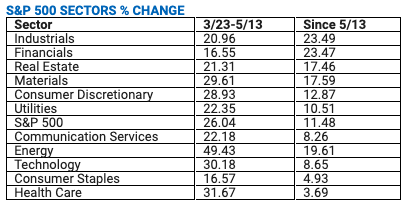
As you peel back the onion on this stock market rally, look at what is driving the market higher from the March lows. You will notice that most of the sectors in the S&P 500 are still negative year-to-date, as is the overall stock market, and those that are negative, are mainly down double digits. While it should not surprise us that most sectors are in the same camp as the market, what is surprising is which sectors are in the red and which are in the black. 

It is abnormal because the sectors that usually lead the stock market out of a recession-induced downturn are not doing so now. Instead, leadership has come largely from big tech stocks and pharmaceuticals, rather than financials and cyclical sectors that closely track the ups and downs of the economy, such as industrials and consumer discretionary stocks. This time, it is very different as we have the first ever global pandemic. 

In March and May, we continued to tweak our portfolios and increase our exposure to technology and health care stocks. Throughout the entire downturn, Technology and Health Care, along with Biotech stocks, are leading the way. In the last few weeks, the cyclical sectors are starting to catch up, as you can see from the table below. It is healthy for the market to have sector rotation and not just two or three sectors leading the way, while the rest of the market struggles.

Markets continue to move higher off a rotation-driven rally as investors move into those economically sensitive value stocks. At the same time, we still have a global pandemic with many businesses shutdown, employees working from home, nationwide protests and an election coming up in November. 

We believe that technology and health care continue to be very strong sectors to own. We will continue to closely track the markets, the sector rotation and continue to tweak the portfolios as necessary.

Full Transparency

a business executive smiling and shaking hands with a room full of co-workers

Our Process

Our planning process has the rigor and comprehensiveness you would expect when trusting a firm with your financial well-being.

Learn More

two people shaking hands

Our Fees

Full transparency regarding the costs tailored to your salary, gender, and lifespan (aka your real life). We’ve got your back!

Learn More

This material contains an assessment of the market and economic environment at a specific point in time and is not intended to be a forecast of future events, or a guarantee of future results.  Forward-looking statements are subject to certain risks and uncertainties.  Actual results, performance, or achievements may differ materially from those expressed or implied.  Information is based on data gathered from what we believe are reliable sources.

S&P 500 Index is an unmanaged group of securities considered to be representative of the stock market in general. You cannot directly invest in the index.

The opinions expressed in this commentary are those of the author and may not necessarily reflect those held by Kestra Investment Services, LLC or Kestra Advisory Services, LLC.  This is for general information only and is not intended to provide specific investment advice or recommendations for any individual.  It is suggested that you consult your financial professional, attorney, or tax advisor with regard to your individual situation. 

Securities offered through Kestra Investment Services, LLC (Kestra IS), member FINRA/SIPC. Investment Advisory Services offered through Kestra Advisory Services, LLC (Kestra AS) an affiliate of Kestra IS. Kestra IS and Kestra AS are not affiliated with CD Wealth Management.

How Can Tax-Loss Harvesting Help Your Portfolio?

The last few months have definitely been challenging and interesting on many different levels from a stock market perspective.  A silver lining in the recent market volatility that many people do not often take advantage of is tax-loss harvesting.  What is tax-loss harvesting?
 
Tax-loss harvesting is where you realize losses in the portfolio with the intention of offsetting realized gains now or in the future to help reduce future tax bills.  This works through selling an investment that has underperformed and is losing money and changing to another investment that becomes a tax-winner.  Drawdowns in the market, as we saw in February and March, can provide a significant amount of loss that may be harvested. 

Many investors wait until year end to attempt tax-loss harvesting, especially in a year like 2019, where we saw very little volatility. However, this year offers an opportunity to capture losses that we haven’t seen since 2008 and 2009.

An investment loss can be used for 2 different scenarios:

1. The losses can be used to offset investment gains either today or in the future.  Short-term losses can be used to offset short-term gains, and long-term losses can be used to offset long-term gains.  The least effective use of short-term losses is to apply them to long-term gains, but may still be preferable to paying long-term capital gains tax.

2. The losses can help offset $3,000 of income on a joint tax return in one year.  Unused losses can be carried forward indefinitely.

When performing tax-loss harvesting, one has to be aware of the wash-sale rule.  The wash-sale rule states that if you sell a security, fund or ETF at a loss and buy the same or substantially identical security within 30 days after the sale, the loss will be disallowed for tax purposes.  For example, if you own IVV, iShares Core S&P 500 ETF and sell it for a loss, and then purchase SPY, SPDR S&P 500 ETF with the proceeds, the IRS will most likely deem this to be a wash sale violation and, therefore, not be able to take advantage of the realized loss. 

Tax-loss harvesting and portfolio rebalancing can provide nice synergies as they play different roles in portfolio management.  When we rebalance a portfolio, we are managing risk in the portfolio, by selling holdings that have outsized their target holdings and adding those gains to positions that may have losses or not grown as much.   Often in rebalancing, the portfolio will experience sizable capital gains.  That’s where tax-loss harvesting helps reduce the gains and bring the risk of the portfolio back to its target allocation.

We will continue to monitor the portfolios and look for opportunities to tax-loss harvest in the future, not just at year-end, but year round. 

____________

This material contains an assessment of the market and economic environment at a specific point in time and is not intended to be a forecast of future events, or a guarantee of future results.  Forward-looking statements are subject to certain risks and uncertainties.  Actual results, performance, or achievements may differ materially from those expressed or implied.  Information is based on data gathered from what we believe are reliable sources.

The opinions expressed in this commentary are those of the author and may not necessarily reflect those held by Kestra Investment Services, LLC or Kestra Advisory Services, LLC.  This is for general information only and is not intended to provide specific investment advice or recommendations for any individual.  It is suggested that you consult your financial professional, attorney, or tax advisor with regard to your individual situation. 

Neither Kestra IS nor Kestra AS provide legal or tax advice and are not Certified Public Accounting Firms.

Securities offered through Kestra Investment Services, LLC (Kestra IS), member FINRA/SIPC. Investment Advisory Services offered through Kestra Advisory Services, LLC (Kestra AS) an affiliate of Kestra IS. Kestra IS and Kestra AS are not affiliated with CD Wealth Management.


 

4 Reasons to Introduce Your Children to Your Financial Planner

It’s safe to say that anyone who spends a lifetime building wealth wants to ensure that it’s managed well for generations to come, to have a plan in place not only for the next generation, but for the ones that follow as well.

For families with adult children – especially those who are transitioning into a new life phase, such as graduating, beginning careers or even starting families of their own – it’s important to plant the seeds of financial planning early.

“We have clients we’ve worked with since the mid-1990s, when the kids were tweens,” said Scott Cohen, CD Wealth Management’s principal, founder and CEO. “As the kids became adults, the parents brought them in and passed on a gift to work with our firm. These former kids now work independently with us and with their own nuclear families.

“It’s really special because now the third generation is growing up, and they know who we are, too.”

If you’re contemplating the best way to help a young adult in your family get started on financial planning, consider these arguments for doing so:

1. Starting early gives you an advantage: The earlier you start planning, Cohen says, the higher the likelihood of success.

“Take two 22-year-olds – one who maxes out his 401(k) for 40 years and one who waits,” he said. “The one who waits never catches up. Getting an early start gives you an advantage no matter what kinds of recessions come and go.”

2. Sharing a plan makes transitions easier: When an entire family uses the same financial planner, it’s easier to move through the seasons of life together.

“As the older generation starts to age, you want an easier transition where everyone knows what the plan is for all of the assets,” Cohen said. “Kids have to grow up fast sometimes, and picking up the pieces without knowing what to do ahead of time is not a pretty picture.”

3. It’s good to have everything in one place: Think of your financial planner as a hub for all records, account access and measurements against goals – and during times of transition, there will be less upheaval.

“When we work with multiple generations of a family, we manage the transparency so people know what they need to know when it’s appropriate,” Cohen said. “There is usually no need for the youngest generation to have the whole picture, for example, until they’re more mature.

“The key is to have a plan, and it’s our job to carry that plan out.”

4. You will need a neutral party to help you: The best financial planners are experts at dealing with human emptions and the psychology of money, and their focus is on making the right choices from an objective point of view.

“We didn’t earn your money, so we don’t feel the same way you do about it,” Cohen said. “We can act in a way that is not clouded by emotion. Sometimes, people have a hard time making investment decisions on their own.

“We always tailor our approach to each person with logic, objectivity and reason.”

_________

This material contains an assessment of the market and economic environment at a specific point in time and is not intended to be a forecast of future events, or a guarantee of future results.  Forward-looking statements are subject to certain risks and uncertainties.  Actual results, performance, or achievements may differ materially from those expressed or implied.  Information is based on data gathered from what we believe are reliable sources.

The opinions expressed in this commentary are those of the author and may not necessarily reflect those held by Kestra Investment Services, LLC or Kestra Advisory Services, LLC.  This is for general information only and is not intended to provide specific investment advice or recommendations for any individual.  It is suggested that you consult your financial professional, attorney, or tax advisor with regard to your individual situation. 

Securities offered through Kestra Investment Services, LLC (Kestra IS), member FINRA/SIPC. Investment Advisory Services offered through Kestra Advisory Services, LLC (Kestra AS) an affiliate of Kestra IS. Kestra IS and Kestra AS are not affiliated with CD Wealth Management.

Municipal bonds are moving; here’s what you should know

The past 60 days have seen an unprecedented move in the tax-free, municipal bond markets.  In late March, we saw the municipal bond market* and tax-free bonds yielding 4 to 5 times higher than a 10-year U.S. Treasury bond.  So, why the dislocation, what caused the panic and what are we doing to take advantage of this opportunity?

Historically bonds, or fixed income, provide solid diversification from equities.  As investors age, often they shift additional dollars to bonds for capital preservation as well as income.  We call it “sleep at night money” in the municipal bond market. Investments, that while are not guaranteed, provide much lower risk and allow the investor peace of mind.  However, the last 60 days have not quite followed this playbook.

In March, as the COVID-19 pandemic took hold on the financial markets, we saw panic set in the bond markets as well.  Selling pressures from investors liquidating their bond funds and ETFs cause historic levels of redemptions.  Investors were selling bonds at any cost to have cash.  Unfortunately, the bond market does not work the exact same way as the stock market.  There are thousands of bonds in the market, many from the same issuer, with different maturities, and some more liquid than others.  When a bond investor goes to sell a bond, the price received depends on the buyer on the other side and what they are willing to pay. 

If you are not paying attention and just want to sell, a bond may be priced at $95 or $100 on your statement, but you may only get 60 or 70 cents on the dollar if there is no demand to buy your bonds.

This is what we saw in March.  Panic selling by bond investors and the result was poor pricing and trade execution for those sellers, resulting in rock-bottom prices to virtually anyone willing to buy.  We realize that there is more headline risk right now in the bond market, as Mitch McConnell recently suggested bankruptcy was a route for financially strapped states to consider.  

Fortunately, the Federal Reserve took serious action to help settle the stock and bond markets through both The Coronavirus Aid, Relief and Economic Security (CARES) Act as well as reopening the Money Market Liquidity Facility.  The CARES Act authorized the U.S. Treasury to direct $150 billion to state, local, tribal and territorial governments to cover necessary expenditures incurred due to the pandemic not covered in their budgets.  The legislation also provides liquidity benefits by authorizing $454 billion of direct loans and loan guarantees from the Treasury to corporations and municipalities.  They are also considering direct bond purchases in the primary and secondary markets.  Since these actions, we have seen the fixed income markets settle down, however, prices are still not back to pre-pandemic levels and we are now receiving questions from our clients on our thoughts on the municipal markets and the risk that exists today.

Many bonds that we purchase are tied to infrastructure, like utilities, school districts, toll roads.

We believe that while the economic shock of the coronavirus is severe, the investment grade municipal bond market still provides a safe haven to individual investors.  There are a number of factors that should help municipal bonds survive this economic downturn:

1. The economy is reopening.

2. Municipal bonds tend to finance long term projects.

3. Municipalities have the ability to raise taxes as well as tap into reserves to overcome shortfalls.

4. Many bonds that we purchase are tied to infrastructure, like utilities, school districts, toll roads.

5. Municipalities have the flexibility to adjust budgets quickly through reduced costs as well as the ability to furlough employees.

6. The CARES Act provides additional resources to municipalities to purchase bonds as well as additional borrowing capabilities.

7. Future potential higher tax rates to counter influx of funding from the Federal Reserve and Government which will increase demand for municipal bonds to shelter additional income from higher taxes.

While municipal issuers will experience short term declines in tax revenues from stay at home orders and decreased consumer demand, we believe that the downgrade risk of bonds is significantly greater than default risk.  Historically, the default risk in municipal bonds is less than 1% of all bonds.  For perspective, the par value of the S&P Municipal Bond Index is $2.321 trillion.  The par value of bonds defaulted as of April 2020, was $21 billion, of which $16 billion is attributed to Puerto Rico, a default risk of less than .03%. 

We continue to actively buy individual municipal bonds and employ the same strategy we have for many years. 

We believe in buying investment grade individual tax-free bonds, studying the underlying credit quality, looking at the revenue source for the bonds and monitoring the credit quality.

Also, an important difference to keep in mind, is that unlike corporate bonds, where if the corporation declares bankruptcy, then all their bonds are bankrupt, this is not the case in municipal bonds.  Most recently when Detroit had issues, there were water bonds issued by Detroit that had no issue.  Some bonds also have insurance as another source of security.  That is why we stress looking at each bond and what the funding source is to understand the underlying risks.

In summary, we continue to believe that the bond market offers value.  The headline risk will remain until the states open up and remain open.  As always, we will actively monitor the portfolios and make changes as needed.

We appreciate your continued trust in CD Wealth Management.

*Municipal bonds are debt obligations of a state or local government entity. The funds may support general government needs or special projects. Safety is based on the viability of the issuing municipality and the community in general.

_______________

This material contains an assessment of the market and economic environment at a specific point in time and is not intended to be a forecast of future events, or a guarantee of future results.  Forward-looking statements are subject to certain risks and uncertainties.  Actual results, performance, or achievements may differ materially from those expressed or implied.  Information is based on data gathered from what we believe are reliable sources.

The opinions expressed in this commentary are those of the author and may not necessarily reflect those held by Kestra Investment Services, LLC or Kestra Advisory Services, LLC.  This is for general information only and is not intended to provide specific investment advice or recommendations for any individual.  It is suggested that you consult your financial professional, attorney, or tax advisor with regard to your individual situation. 

Securities offered through Kestra Investment Services, LLC (Kestra IS), member FINRA/SIPC. Investment Advisory Services offered through Kestra Advisory Services, LLC (Kestra AS) an affiliate of Kestra IS. Kestra IS and Kestra AS are not affiliated with CD Wealth Management.

How will the race for a vaccine affect the markets?

As states have moved to ease the lockdowns which have cost tens of millions of jobs, a safe return to normal life without a vaccine has taken time.

In South Korea and Germany, countries that were among the most effective at controlling initial outbreaks of Covid-19, have been hindered by new flare-ups.  While the virus is still present, America is continuing to reopen the economy.

If and when vaccines start to work, the next crucial step will be distributing them widely enough to rein in the Coronavirus so that social and economic life can continue down a positive path to a new normal.

VACCINE

Progress and setbacks in the vaccine race will continue to have positive and negative effects on stock market prices each day and week.  We continue to increase our exposure to the healthcare sector to help take advantage of positive movements as Covid-19 plays itself out.

Investing into individual stocks in the biotech industry has substantial risks as those stocks could experience steep declines if their attempt at developing a Covid-19 vaccination falls short.

The FDA has the ability to issue emergency-use authorizations during public health crises to allow the use of unapproved medical products which could potentially be an unapproved vaccine.

If a vaccine comes to a fruition, whichever company that would bring a vaccine to the market first, will most likely will not be the last.  The first vaccine might not be the best, and many scientists involved in the race for a vaccine say that making enough of a vaccine to inoculate the world is beyond the capability of even the largest drug maker.

MARKET OUTLOOK

The economies around the world are just beginning to emerge from the Covid-19 crisis.  The pandemic is probably far from over, and the last 10 weeks have shown the importance of staying the course with a financial plan and diversified investment portfolio. 

The markets have been vulnerable to pullbacks after the main benchmarks managed to retrace much of the losses suffered in March.  More aggressive Fed interventions may keep the stock market bottoms higher, and low interest rates and more innovation can boost the tops.

Timing the markets historically has proven to be dangerous; however, time in the market has historically proven a successful course of action.   We will most likely continue to see different levels of volatility during Covid-19, and it has never been more important to focus on the long-term of your financial plan which is coordinated with your short-term needs and objectives. 

We will continue staying the course of your financial plan and being proactive to make specific strategic moves in the portfolios that have proven necessary during these times.  2020 has been an abnormal year, and we have made more updates to our portfolios in the first 5 ½ months of the year than we have done in the previous 24 months.  Our reduction in the exposure of the energy sector earlier this year, the reduction in the allocation of small and mid-cap companies and real estate, along with the moves to additional exposure to large and technology companies have been additive to the portfolio.  These were all lateral moves in which we did not time the market, as these were moves made within the market. 

Regarding the fixed income portion of our portfolios, we continue to stay the course with a combination of investment grade corporate bonds and a total return fund that has the flexibility to invest in different segments of the bond market.  In March, we removed our exposure to emerging market debt and added those monies back into U.S. corporate bonds.  While we believe that short-term interest rates will be held close to zero for years to come, there are still opportunities in the bond market that provide return, diversification from equities and add value to the portfolios.

We want you to continue to consider the following:

1. Revisit Your Investment & Financial Planning Objectives: For nearly all investors, longer-term objectives are made possible when taking an appropriate level of risk.

2. Continue to Maintain a Longer-Term Mindset: Avoid letting recent market volatility convince you to abandon your prudently designed, long-term investment plan.  Short-term reactive decisions could significantly impair portfolio returns.

3. Excess Cash Reserves: Continue to contribute according to your periodic investment plans as investing a portion of your excess cash reserves while markets are trading at more favorable levels. 

We continue to be all-hands on deck and focused on making sure we are doing our job as your wealth management, financial advisory, and financial planning team.

Barron’s, Josh Nathan-Kazis, May 17, 2020

MarketWatch, May 19, 2020

MarketWatch, May 20, 2020

________________________

This material contains an assessment of the market and economic environment at a specific point in time and is not intended to be a forecast of future events, or a guarantee of future results.  Forward-looking statements are subject to certain risks and uncertainties.  Actual results, performance, or achievements may differ materially from those expressed or implied.  Information is based on data gathered from what we believe are reliable sources.

The opinions expressed in this commentary are those of the author and may not necessarily reflect those held by Kestra Investment Services, LLC or Kestra Advisory Services, LLC.  This is for general information only and is not intended to provide specific investment advice or recommendations for any individual.  It is suggested that you consult your financial professional, attorney, or tax advisor with regard to your individual situation. 

Securities offered through Kestra Investment Services, LLC (Kestra IS), member FINRA/SIPC. Investment Advisory Services offered through Kestra Advisory Services, LLC (Kestra AS) an affiliate of Kestra IS. Kestra IS and Kestra AS are not affiliated with CD Wealth Management.