The Rule Change That Could Affect Your 401K Contributions This Year

Earlier this month, markets reached another milestone as the Dow closed above 50,000 for the first time. Congratulations to those who stuck with the investment plan through thick and thin. Volatility sometimes brings challenges for investors, but with the knowledge that stocks tend to rise over the long run, buying when times are scary is a great way to build wealth. 

Since 2020 alone, we have seen a global pandemic, a 25% market decline in 2022, and another 20% drop last year with Liberation Day and the Trump tariffs. There have always been reasons to wait and not invest, but history shows that investors who look beyond short-term uncertainty typically are rewarded.

How the Market Has Climbed Past Crises
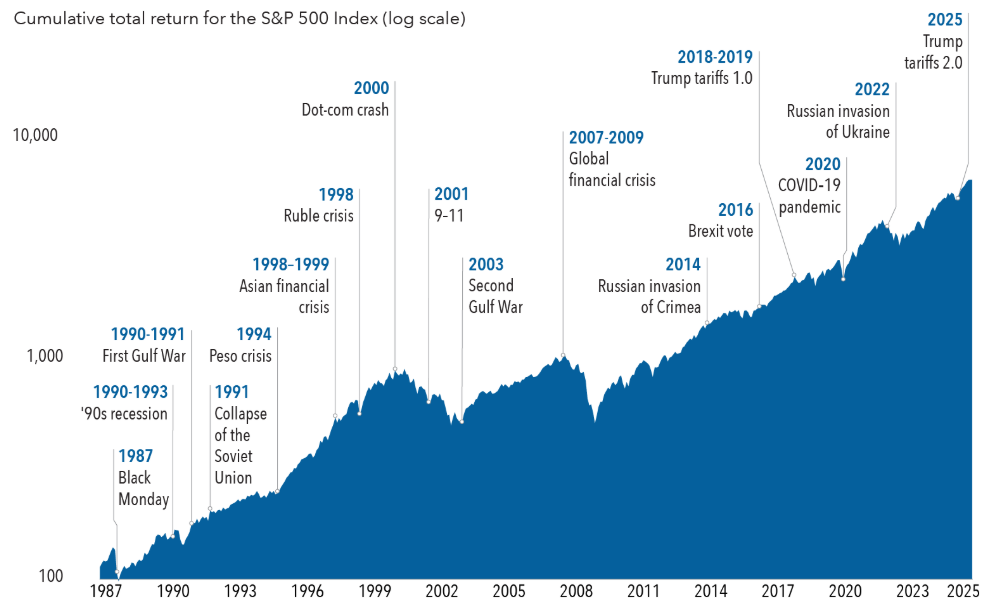
Chart showing the S&P 500 index return rising since 1987 despite geopolitical turmoil.
Sources: Capital Group, Standard & Poor’s. As of Dec. 31, 2025. Data is indexed to 100 as of Jan. 1, 1987, based on cumulative total returns for the S&P 500 Index.

Key Retirement Rule Changes in 2026

There are some important changes this year for those who make catch-up contributions to their retirement plans. A provision of the Secure 2.0 Act emphasizes contributions to Roth accounts that can have a meaningful impact on retirement planning.

If you are 50 or older and have taxable earnings over $150,000 for the prior year (i.e., 2025 for 2026 contributions), any catch-up contribution to your 401K, 403b and 457b plans will have to be made to a Roth 401K with after-tax dollars. If you make less than $150,000, you will not be affected by the rule change; you can continue making catch-up contributions to your traditional 401K or Roth 401K.


Roth Refresher

Roth contributions are made with after-tax dollars.

How do Roth contributions impact your taxes and paycheck?
• You don’t get a tax deduction up front, which may result in a higher income tax bill.
• Qualified withdrawals in retirement will be tax-free.
• Your net paycheck is reduced because your payroll deduction is taken after income taxes are withheld.

Roth contributions can potentially be beneficial for investors who:
• Haven’t been able to make Roth IRA contributions because of income limitations.
• Want to minimize taxable income during retirement years.
• Seek more tax-free withdrawals in retirement with no required minimum distributions.
• Want to have more estate-planning options in the future to transfer money to heirs without tax obligations.


For 2026, the standard catch-up limit is $8,000, though individuals aged 60-63 may be eligible for a “super catch-up” of $11,250. That means you lose out on the upfront tax deduction, but you can potentially benefit from the Roth tax advantages, including tax-free earnings and withdrawals if you meet the five-year aging rule for the plan.

If your plan does not offer a Roth 401K option, you won’t be able to make catch-up contributions, though other options may be available, such as contributing your catch-up amount to a Roth IRA if you are under the income limit or making a Roth conversion.


401K Contribution and Catch-Up Amounts
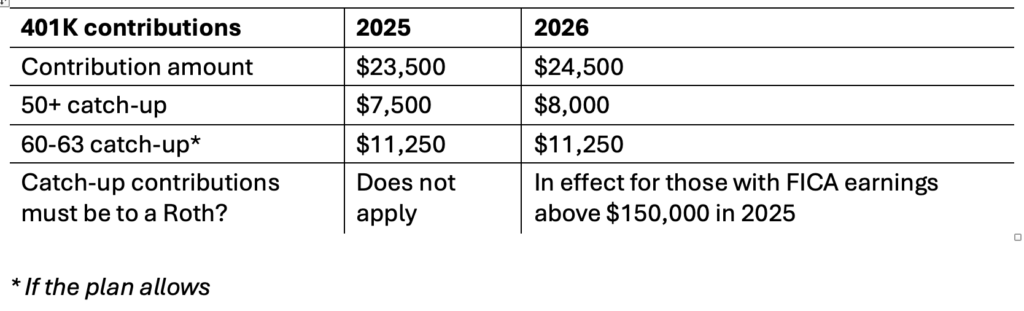
Chart showing how 401k contributions limits changed in 2026.


5 Strategies to Consider

1. Max out your regular contributions. Regardless of age, the maximum contribution for this year is $24,500, which is a $1,000 increase over 2025. Contributions are separate from the matching funds. This year’s aggregate employee and employer contribution limit is $72,000.

2. Consider making partial contributions to a Roth IRA. If you are looking for Roth options, you may be able to contribute to a Roth IRA, depending on income levels. Contributions for prior tax years can be made up until the April 15 deadline of the current tax year. Both you and your spouse can make independent contributions. Roth IRA and Roth 401K contributions must each meet the separate five-year aging rule to avoid taxes and penalties.

3. Think about contributing to a traditional IRA. Whether or not you are covered by a workplace 401K, you can still make non-deductible contributions to a traditional IRA up to the annual limit of $7,500 for 2026. Individuals who are 50 and older can make catch-up contributions of $1,100 for 2026. This won’t lower your tax bill, but the funds can grow tax-deferred until you withdraw them in retirement. You also can convert them later into a Roth IRA using a backdoor conversion.

4. Convert your traditional IRA to a Roth IRA. In a backdoor Roth IRA conversion, you make non-deductible contributions first to a traditional IRA and then convert those funds into a Roth IRA. This is different from standard Roth conversion, which transfers tax-deductible contributions in a traditional IRA to a Roth IRA. A backdoor Roth conversion has more complex tax considerations, especially if the IRA has some tax-deferred funds. Converted balances to a Roth must also meet the separate five-year aging rule to avoid penalties on withdrawals. It is crucial to consult with your tax professional to understand the tax implications in advance.

5. Consider a health savings account (HSA). You may be able to contribute to an HSA account if you are enrolled in an eligible health savings plan. This can help you pay for qualified medical expense with pretax income while also allowing you to invest the money to help support retirement if you don’t need the funds now. The money you contribute to an HSA account isn’t subject to federal income taxes. Earnings accumulate tax-free, and withdrawals are not subject to federal taxes if used for qualified medical expenses. If you are eligible to contribute, the limits are $4,400 for an individual and $8,750 for family coverage.


Key Takeaways

• Starting in 2026, high earners making catch-up contributions to a 401K will have to make these contributions to a Roth 401K.
• Consider fully funding your 401K to take advantage of the employer match (if available).
• In addition to your 401K, you may be able to contribute to other tax-advantaged accounts, such as HSAs.
• Nondeductible contributions to an IRA and backdoor Roth IRA conversions may also be good considerations.


The CD Wealth Formula

We help our clients reach and maintain financial stability by following a specific plan, catered to each client. 

Our focus remains on long-term investing with a strategic allocation while maintaining a tactical approach. Our decisions to make changes are calculated and well thought out, looking at where we see the economy heading. We are anticipating and moving to those areas of strength in the economy and in the stock market. 

We will continue to focus on the fact that what really matters right now is time in the market, not out of the market. That means staying the course and continuing to invest, even when the markets dip, to take advantage of potential market upturns. We continue to adhere to the proven disciplines of diversification, periodic rebalancing, and forward-looking strategies, while avoiding reliance on stale retrospective data.

It is important to focus on the long-term goal, not on one specific data point or indicator. Long-term fundamentals are what matter. In markets and moments like these, it is essential to stick to the financial plan. Investing is about following a disciplined process over time. 

Sources: Capital Group, Fidelity, Carson Wealth     

Trump Accounts Are Coming This Year; Here’s What You Should Know

Starting this year, families will have a new way to save for their children’s financial futures: the 530A account, more commonly referred to as a Trump account. This tax‑advantaged IRA is designed specifically for children; each account is owned by a child and administered by an adult until the child turns 18.

Trump accounts become available July 5.

Initially, the Treasury Department will establish and administer each account. After that, families will have the option to roll the account over to another financial institution. The government will make a one‑time $1,000 contribution for American children born between Jan. 1, 2025, and Dec. 31, 2028. Additional contributions may be made by individuals, employers, and charities. Investments are limited to low‑cost index funds.

While some details about Trump accounts are still forthcoming, we’ve addressed some of the key questions below.

What are Trump accounts?

A Trump account is a tax-advantaged account with IRA-like rules, established for a child under age 18. The child is both the beneficiary and the legal owner of the account, while an adult (typically a parent or guardian) acts on the child’s behalf until age 18. These accounts are intended to help families begin saving and investing early. The Treasury Department will create and administer the initial accounts.

Who is eligible?

Children under the age of 18 with a Social Security number are eligible; only one account per child is allowed. The government will seed each account with a one-time $1,000 contribution for U.S. citizens born between Jan. 1, 2025, and Dec. 31, 2028, when a tax election is filed on the child’s behalf. Children who aren’t eligible for the $1,000 contribution can still have an account.

Who can contribute and how much?

The new account is designed to be flexible for families. Contributions can come from parents or other individuals, employers, and even charitable organizations. Each source can be treated differently for tax purposes.

The amount that can be contributed is capped at $5,000 per year; this will be indexed for inflation after 2027. The initial $1,000 seed contribution from the government does not count towards this annual limit.

There is no earned-income requirement for the child. Contributions made on an after-tax basis are not taxed again when withdrawn. In some cases, employers may offer a pre-tax payroll deduction, but availability will vary by employer and plan.

Employer-funded contributions: An employer may choose to contribute up to $2,500 per employee per year. If an employee has multiple children, the employer may split the contribution among children.

Employer salary reduction: Employees can elect to direct part of their pay, on a pre-tax basis, into a Trump account. Combined employer and employee contributions cannot exceed $5,000 per child, per year.

Taxes on withdrawals depend on the source of the contribution, making accurate recordkeeping important. In general, all investment earnings are taxable when withdrawn, while the tax treatment of the principal depends on whether contributions were made before or after taxes.

Promo for an article titled How Do Successful Investors Respond to Market Volatility?

When can you withdraw funds?

Withdrawals are generally not permitted before age 18, except for rollovers. On Jan. 1 of the year the child turns 18, the account may be transitioned into a traditional IRA, though this is not required.

Early withdrawals are typically taxable and may be subject to a 10% penalty unless used for qualifying expenses, such as education, a first-time home purchase, birth or adoption, or eligible medical expenses.

Once the beneficiary turns 18, there are several options:

1. Keep the account as a Trump account under IRA rules. Trump accounts are not grouped with IRAs when determining how much of a withdrawal is taxable.

2. Roll over the balance into a traditional IRA or another eligible retirement account. A Trump account will not automatically become a traditional IRA; you may need to take action for that to happen.

3. Convert the account to a Roth IRA if it’s appropriate for the child.

How do you open a Trump account?

Opening a Trump account starts with an election process through the IRS, either by filing Form 4547 or using this online tool. Elections are scheduled for mid-2026, with accounts becoming available July 5. Once the election is complete, the Treasury will provide instructions on how to activate the account.

How can the money be invested?

Investment options are straightforward:

• Mutual funds or exchange-traded funds (ETFs): Investments must be in funds that track the S&P 500 or another equity index, with at least 90% invested in U.S. companies.
• No leverage: Borrowed money cannot be used to buy investments inside the account.
• Expense ratio: Eligible funds must have an expense ratio of .10% or less.

Promo for an article called The Formula for Wealth Is Simple, and It's Non-Negotiable.

The bottom line

Trump accounts offer a simple, low‑cost way to invest for a child’s long‑term future. If you have a newborn or plan to grow your family in the next three years, coordinating this new account with your overall education and retirement strategy may help maximize its impact.

The CD Wealth Formula

We help our clients reach and maintain financial stability by following a specific plan, catered to each client.

Our focus remains on long-term investing with a strategic allocation while maintaining a tactical approach. Our decisions to make changes are calculated and well thought out, looking at where we see the economy heading. We are anticipating and moving to those areas of strength in the economy and in the stock market. 

We will continue to focus on the fact that what really matters right now is time in the market, not out of the market. That means staying the course and continuing to invest, even when the markets dip, to take advantage of potential market upturns. We continue to adhere to the proven disciplines of diversification, periodic rebalancing, and forward-looking strategies, while avoiding reliance on stale retrospective data.

It is important to focus on the long-term goal, not on one specific data point or indicator. Long-term fundamentals are what matter. In markets and moments like these, it is essential to stick to the financial plan. Investing is about following a disciplined process over time.

Sources: Fidelity, Vanguard, Trumpaccounts.gov

The Financial Questions That Mattered Most To Our Clients in 2025

At CD Wealth Management, we view education as a fundamental part of our client relationships. Transparency matters to us; helping you understand the why behind our strategies is as important as the strategies themselves. Through our newsletters and articles, we share insights that provide clarity and context so you can feel informed, confident, and engaged in the planning process.

The following pieces resonated with our clients the most this year. If you found them insightful, please share them with family members or friends who might benefit from them as well.

+++

1. What to Expect Now That the ‘Big Beautiful Bill’ Has Become Law

Closeup of the documents of the One Big Beautiful Bill Act (OBBBA), a budget reconciliation bill in the 119th United States Congress.

July 10, 2025
Trump’s tax law locks in lower rates and higher exemptions for high earners and estates — and adds new savings incentives.

+++

2. Understanding the 10-Year Treasury and Its Impact on Your Investments

United States Treasury Department Building in Washington, DC.

June 27, 2025 
It influences all borrowing costs, from interest rates on bonds to mortgage rates and student loans.

+++

3. Here’s What History Tells Us About the Impact of the Government Shutdown

National Capitol building with US flag in Washington DC, USA.

Oct. 2, 2025
Government shutdowns are typically more of a political standoff than an economic crisis.

+++

4. Your Guide to Paying for College: Save More, Stress Less

portrait of happy female university graduate and parents at ceremony.

June 12, 2025
A savings strategy that includes a tax-advantaged 529 plan can help you prepare for the challenge of paying for college.

+++

5. What Caused Mid-May’s Market Selloff — and What Happens Next?

Close-up of a trading screen showing multiple red "SELL" alerts, indicating a stock market drop or panic selling event. Photograph of computer screen.

May 22, 2025
The sudden decline was driven largely by the bond market, not by any shift in the economy or corporate fundamentals.

+++

The CD Wealth Formula

We help our clients reach and maintain financial stability by following a specific plan, catered to each client.

Our focus remains on long-term investing with a strategic allocation while maintaining a tactical approach. Our decisions to make changes are calculated and well thought out, looking at where we see the economy heading. We are anticipating and moving to those areas of strength in the economy and in the stock market. 

We will continue to focus on the fact that what really matters right now is time in the market, not out of the market. That means staying the course and continuing to invest, even when the markets dip, to take advantage of potential market upturns. We continue to adhere to the proven disciplines of diversification, periodic rebalancing, and forward-looking strategies, while avoiding reliance on stale retrospective data.

It is important to focus on the long-term goal, not on one specific data point or indicator. Long-term fundamentals are what matter. In markets and moments like these, it is essential to stick to the financial plan. Investing is about following a disciplined process over time.

Year-End Review: How the New Tax Law Could Impact Your Taxes

Earlier this year, President Trump signed the “One Big Beautiful Bill” into law, reinforcing many provisions from the 2017 Tax Cuts and Jobs Act, along with other significant tax changes. As we approach the end of the year, here’s a summary of the law’s permanent and temporary changes — and what they mean for you.

Permanent Changes

The following provisions will become a permanent part of the tax code:

• Seven tax brackets remain, with a top rate of 37% and a bottom rate of 10%.
• The mortgage interest deduction remains at its current limit of $750,000 for joint filers ($375,000 for single filers).
• The State and Local Tax (SALT) deduction will increase to $40,000 and then revert to $10,000 in 2030. The higher SALT cap will phase out for incomes over $500,000.
• The standard deduction increases to $15,750 for single filers and $31,500 for joint filers, indexed for inflation after 2025.
• Lifetime gift and estate tax exclusions increase to $15 million for single filers and $30 million for filers who are married and filing jointly, indexed for inflation going forward.
• Child Tax Credit will increase to $2,200 per child starting in 2025.
• Non-itemizers can claim a deduction for charitable contributions of up to $1,000 ($2,000 for couples) starting in 2026.

Promo for an article titled Your Year-End Financial Checklisty: Moves to Make Before 2025 Ends.

Temporary Provisions (4 Years)

The legislation includes some temporary deductions and credits that are valid for the 2025-2028 tax years only.

• Tip and overtime deductions: Workers can deduct up to $25,000 in qualifying tip income and $12,500 in overtime pay ($25,000 for joint filers). These deductions phase out with income over $150,000 ($300,000 for joint filers).
• Additional deduction for seniors:Those over the age of 65 will get an additional $6,000 deduction that begins to phase out at an income of $75,000 for single filers and $150,000 for joint filers. This is in addition to the $2,000 deduction for single filers and $3,200 for joint filers.
Vehicle loan interest deduction: Auto buyers can deduct up to $10,000 of loan interest for purchased vehicles whose final assembly took place in the U.S. The deduction would apply for single taxpayers with adjusted gross income of $100,000 or less ($200,000 for people filing jointly).

Promo for an article titled Before You Sell for a Loss, Make Sure You Know the Wash-Sale Rule.

Additional Provisions

New savings account: Parents and relatives can now contribute up to $5,000 a year to a new savings account for minor beneficiaries, called Trump accounts. Initially acting like a non-deductible IRA, contributions can be made until the beneficiary reaches the age of 18. Then, the account would effectively convert to a traditional IRA. Additionally, parents of children born between Jan. 1, 2025, and Dec. 31, 2028, would qualify for $1,000 in federal money to start the account.
Expanded 529 plan uses: Acceptable uses include miscellaneous expenses such as testing fees, tutoring outside the home, and educational therapies, as well as tax-free withdrawals for recognized postsecondary credential programs.
Broader HSA eligibility: More health plan types and participant categories are included.

Social Security taxes: The legislation did not eliminate taxes on Social Security benefits, which remain taxable up to 85% for individuals with income greater than $34,000, or $44,000 for a couple. However, the $6,000 deduction for those 65 and older may help offset taxes on Social Security benefits for some over the next four years.

Key Individual Tax Changes

As you review the new tax legislation, it may be the perfect time to review your financial planning needs as well. This includes revisiting your investment portfolio, assessing tax planning opportunities, reevaluating retirement goals, and managing your wealth transfer and legacy plans.

As we learn more about the Trump Savings accounts and other aspects of the bill, we will continue to communicate and educate.

This summary of the new legislation contains merely a portion of the items that may apply to your family. We are always happy to meet and discuss any of the above to ensure that you remain on track with your financial profile and your goals.

Promo for an article titled Here's Why the Stock Market is the Best Place to Build Wealth.

The CD Wealth Formula

We help our clients reach and maintain financial stability by following a specific plan, catered to each client.

Our focus remains on long-term investing with a strategic allocation while maintaining a tactical approach. Our decisions to make changes are calculated and well thought out, looking at where we see the economy heading. We are anticipating and moving to those areas of strength in the economy and in the stock market. 

We will continue to focus on the fact that what really matters right now is time in the market, not out of the market. That means staying the course and continuing to invest, even when the markets dip, to take advantage of potential market upturns. We continue to adhere to the proven disciplines of diversification, periodic rebalancing, and forward-looking strategies, while avoiding reliance on stale retrospective data.

It is important to focus on the long-term goal, not on one specific data point or indicator. Long-term fundamentals are what matter. In markets and moments like these, it is essential to stick to the financial plan. Investing is about following a disciplined process over time.

Source: Kestra Investment Management

Your Year-End Financial Checklist: Moves To Make Before 2025 Ends

As we prepare to wrap up another year, it is the perfect time to review year-end planning strategies to ensure your wealth plan reflects changes in your circumstances or goals, the current tax environment, and the economic landscape.

The end of the year is an important time for making financial decisions that can have an impact in the year ahead — and for years to come. We recommend that you review the planning strategies below to consider and discuss.

Income Tax Strategies

Traditional year-end planning focuses on deferring income into a future year and accelerating deductions into the current year.

— If you anticipate being in a lower tax bracket next year:

• Defer income if possible so you can postpone paying the tax and have that income at a lower bracket.
• If you itemize on your tax return, bunch your medical expenses in the current year to meet the percentage of your adjusted gross income to claim those deductions.
• Make your January mortgage payment in December so you can deduct the interest on this year’s return.

Promo for an article titled Turning Investment Losses into Gains: The Art of Tax-Loss Harvesting.

Tax-Related Investment Strategies

— Tax-loss harvesting is the strategy of selling securities at a loss to offset a capital gain liability, either for today or in the future. Securities must be sold by Dec. 31, the last trading day of 2025, to realize a capital gain or loss.

• Harvest losses by selling taxable investments. To avoid the IRS wash-sale rule, you must wait at least 31 days before buying back a holding that’s sold for a loss.
• Harvest gains by selling taxable investments if you have a tax loss carryforward.

— Make sure that you have satisfied your required minimum distributions (RMD).

• If you fail to take your RMD, this may result in a 25% penalty. (This is down from 50%.)
• If you own an inherited IRA, RMD may be required separately for that account as well. If you inherited an IRA after 2019, it must be depleted by the end of the 10th year. If the original owner of the IRA was already taking RMDs at the time of death, you must take an annual distribution in years 1-9, in addition to making sure the IRA is fully depleted in year 10.
• Beneficiaries of a Roth IRA do not have to take RMDs. However, the 10-year rule still applies, and the entire account must be fully distributed by the end of the 10th year.

Promo for an article titled Before You Sell for a Loss, Make Sure You Know the Wash-Sale Rule.

Retirement Planning Strategies

— Maximize your IRA contributions. You may be able to deduct annual contributions of up to $7,000 to your traditional IRA and $7,000 to your spouse’s IRA ($8,000 if over the age of 50).

— Make a Roth IRA contribution if you qualify under the applicable income limits.

— Consider increasing or maximizing your 401(k) contribution; the maximum for 2025 is $23,500 for those under age 50 and $31,000 for those 50 and older. Contributing more to your 401(k) can reduce your adjusted gross income while boosting your long-term retirement savings.

— New in 2025: If you are between 60 and 63, you can contribute an additional amount to your employer-sponsored retirement plan.

— Consider making contributions to a Roth 401(k) if your plan allows.

— Consider setting up a Roth IRA for each of your children who have earned income during the year.

Gifting Strategies

— Consider making gifts up to $19,000 per person, as allowed under the federal annual gift tax exclusion. You can give up to $19,000 this year to as many people as you want without triggering gift taxes. Note: Payments made directly to educational and/or medical institutions on behalf of your intended beneficiary do not count towards your annual exclusion amount — or against your lifetime estate tax exclusion.

— Create a donor advised fund for an immediate income tax deduction and provide immediate and future benefits to charity over time.

— If you already have a donor advised fund or want to donate to a charity, consider gifting appreciated assets that have been held longer than one year to get the fair market value income tax deduction while avoiding income tax on the appreciation.

— If over the age of 70½, consider making a direct transfer from an IRA to a public charity. The distribution is excluded from gross income, and you can give up to $108,000 as a tax-free gift from your IRA, which may fully satisfy RMD requirements.

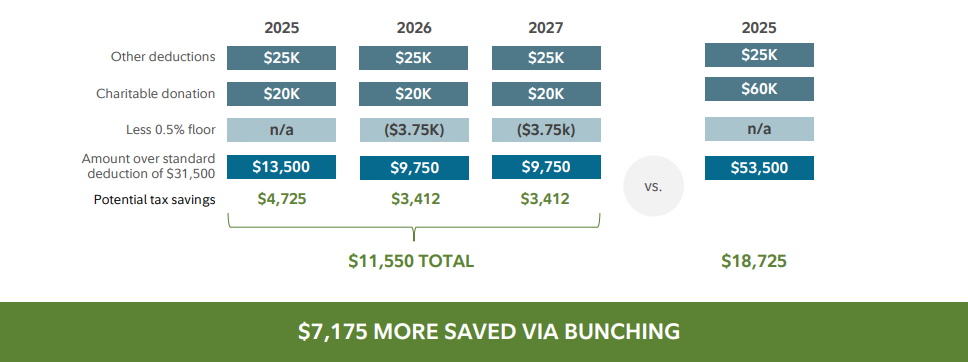
— Consider combining multiple years of charitable giving into a single year to exceed the standard deduction threshold. This is called “bunching.” The chart below illustrates how bunching can reduce taxes if executed properly.

Bunching in 2025

Scenario: Donor has income of $750K, is in the 35% income federal tax bracket, files jointly as a married couple, and itemizes deductions.

Source: Fidelity Charitable. This is a hypothetical example for illustrative purposes only. This example does not take into account other deductions. Information herein is not legal or tax advice. As with any tax-planning strategy, there may be additional considerations that pertain to your personal situation. Other strategies may provide more flexibility and similar savings. Please consult your tax advisor.

Wrapping up 2025, Planning for 2026

— Discuss major life events with CD Wealth to confirm you have clarity in your current situation.

— Communicate with your CPA to provide capital gains and investment income information for a more accurate year-end projection.

— Check your Health Savings Account (HSA) contributions for 2025. If you qualify, you can contribute up to $4,300 (individual) or $8,850 (family) — and an additional $1,000 catch-up if over the age of 55.

— Double-check your beneficiary designations for retirement plans, IRAs, Roth IRAs, annuities, and life insurance policies.

— If you do not already have identity theft protection, consider purchasing a service to help protect you and your family.

The end of the year is a perfect time to review your financial planning needs. This includes reviewing the investment portfolio, assessing year-end tax planning opportunities, reviewing retirement goals, and managing your legacy plans. The list above includes some of the items that may apply to you and your family. 

We are happy to meet to discuss any of the above to ensure you remain on track with your financial goals.

Promo for an article titled Here's Why the Stock Market Remains the Best Place to Build Wealth.

The CD Wealth Formula

We help our clients reach and maintain financial stability by following a specific plan, catered to each client. 

Our focus remains on long-term investing with a strategic allocation while maintaining a tactical approach. Our decisions to make changes are calculated and well thought out, looking at where we see the economy is heading. We are not guessing or market timing. We are anticipating and moving to those areas of strength in the economy — and in the stock market. 

We will continue to focus on the fact that what really matters right now is time in the market, not out of the market. That means staying the course and continuing to invest, even when the markets dip, to take advantage of potential market upturns. We continue to adhere to the tried-and-true disciplines of diversification, periodic rebalancing and looking forward, while not making investment decisions based on where we have been.

It is important to focus on the long-term goal, not on one specific data point or indicator. Long-term fundamentals are what matter. In markets and moments like these, it is essential to stick to the financial plan. Investing is about following a disciplined process over time.

Sources: Fidelity

Here’s What History Tells Us About the Impact of the Government Shutdown

Government shutdowns are typically more of a political standoff than an economic crisis. As lawmakers approach the Sept. 30 fiscal year deadline, negotiations often devolve into a blame game and a test of endurance. With no stopgap measure in place this year, a shutdown began Oct. 1, forcing federal agencies to halt operations and leaving both parties pointing fingers. It’s worth noting that shutdowns have occurred under both Republican and Democratic leadership.

The immediate concern is that the monthly jobs report and inflation readings could be delayed, complicating the Federal Reserve’s outlook on interest rates. Beyond that, a shutdown affects “nonessential” government functions, leading to furloughed workers and paused services, which may cause short-term economic ripples.

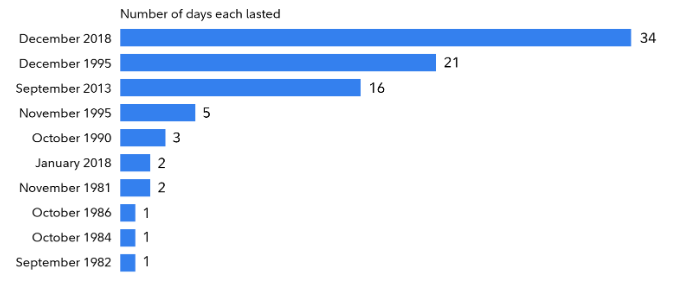
Since the first shutdown in 1981, the government has closed 10 times, most recently in 2018. In recent years, Congress has often relied on last-minute, short-term measures to keep the government open, usually with little lasting impact on markets or the broader economy.

Government Shutdowns

There have been 10 government shutdowns since 1980. Other funding gaps have occurred, but the gaps were either too short or occurred over a weekend, so affected agencies did not begin to shut down before Congress restored funding.

Bar chart showing the length of previous government shutdowns in days.
Source: U.S. House of Representatives

How could a shutdown affect bonds and credit rating?

A shutdown does not affect the government’s ability to pay its debt to bondholders, nor does it have an impact on its borrowing costs or creditworthiness. Treasury interest payments and Social Security would continue to be paid, and the Treasury would conduct its regularly scheduled bond auctions.

A prolonged shutdown could potentially affect prices of some bonds issued by corporations that rely on contracts with the government for a significant portion of their revenue, but that would be temporary. 

Rating agencies such as Moody’s already downgraded the debt earlier this year, and while further downgrades are possible, they are not likely. If it does happen, a downgrade could raise borrowing costs for the government in the future and push up interest rates.

How could a shutdown affect stocks?

Over the last 45 years, the government shutdowns we’ve seen have had little impact on investors, consumers or financial markets. History shows us that the market understands that while these short-lived political dramas make headlines, they don’t have a meaningful impact on corporate earnings. And earnings are the primary driver of stock prices.

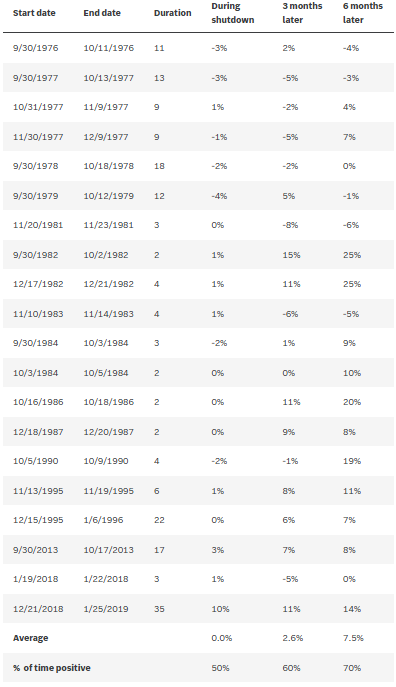
That is not to say we couldn’t see an uptick in volatility, especially after a period of strong returns since mid-April. During previous government closures, stocks have been positive half the time, and six months later, they have been higher 70 percent of the time.

S&P 500 Returns Around Government Shutdowns

Chart showing the S&P 500 effect of shutdowns during, three months later and six months later.
Sources: Congressional Research Service, Morningstar, Edward Jones. Past performance does not guarantee future results.

How could a shutdown affect the economy?

Furloughed workers are guaranteed to receive back pay once funding resumes. President Trump’s threat to fire federal workers complicates matters, but many view it as a strategic pressure tactic aimed at pushing Democrats to advance the stopgap bill already passed by the House.

From an economic perspective, we expect a short-term slowdown in growth but a quick recovery once operations resume. Government spending doesn’t disappear; it’s simply delayed or displaced. Because the federal government plays a significant role in purchasing goods, providing services and driving economic activity, a prolonged shutdown could dampen overall output. Still, while the impact grows with the length of the disruption, the broader economic damage will probably be minimal.

The bottom line: Stay the course.

Concerns about a shutdown may trigger some market volatility. History has shown that the impact is short-lived, and we do not expect a shutdown to alter the outlook for the economy or federal markets. 

Rather than worry about the impact of a shutdown, investors should focus on avoiding the temptation to overreact or make decisions based on fear and uncertainty. As always, the key is to stick with the plan that is already in place and not make changes in response to headlines.

Promo for an article titled The Most-Searched Questions That Lead Investors to Our Articles.

The CD Wealth Formula

We help our clients reach and maintain financial stability by following a specific plan, catered to each client. 

Our focus remains on long-term investing with a strategic allocation while maintaining a tactical approach. Our decisions to make changes are calculated and well thought out, looking at where we see the economy is heading. We are not guessing or market timing. We are anticipating and moving to those areas of strength in the economy — and in the stock market. 

We will continue to focus on the fact that what really matters right now is time in the market, not out of the market. That means staying the course and continuing to invest, even when the markets dip, to take advantage of potential market upturns. We continue to adhere to the tried-and-true disciplines of diversification, periodic rebalancing and looking forward, while not making investment decisions based on where we have been.

It is important to focus on the long-term goal, not on one specific data point or indicator. Long-term fundamentals are what matter. In markets and moments like these, it is essential to stick to the financial plan. Investing is about following a disciplined process over time.

Sources: Capital Group, Fidelity, Edward Jones, U.S. House of Representatives

The Most-Searched Questions That Lead Investors to Our Articles

Here are the most frequently searched questions that have led readers to our Insights page so far this year — and the answers they found. If you find our articles helpful, please feel free to share them with your family and friends!

1. Are we in a bull market?

(Also searched often: When will the bull market end?)

Yes, we are still in a bull market. The current rally began in October 2022.

You can’t pinpoint the exact end of a bull market, but there are common signals that investors and analysts watch for. A bull market often ends when economic conditions shift: slowing growth, rising unemployment or tighter monetary policy from the Federal Reserve. Market indicators like falling corporate earnings, an inverted yield curve or a broad decline across major stock indexes can also suggest the rally is losing steam.

The end of a bull market is usually only clear in hindsight, but watching economic fundamentals and earnings trends can provide early warning signs.

2. Why is the 10-year Treasury important?

The 10-year U.S. Treasury yield is a critical economic indicator because it influences borrowing costs, reflects investor sentiment and serves as a benchmark for various interest rates. As the yield on the 10-year Treasury rises, so do mortgage rates and other borrowing rates, affecting consumer spending and business investments.

When the yield declines, borrowing becomes cheaper, potentially stimulating economic activity. A rising yield might prompt the Fed to raise short-term rates, while a falling yield could lead to lower rates to support economic growth. Monitoring the 10-year Treasury yield provides valuable insights into economic expectations and can guide investment and policy decisions.

3. Is compound interest taxed?

Compound interest itself isn’t directly taxed, but the earnings it generates — such as interest or dividends — are typically taxable in the year they’re received, even if you reinvest them, reducing the effective return in taxable accounts.

4. How often do stock market corrections happen?

Since World War II, there have been 48 market corrections, but only 12 of those escalated into full-fledged bear markets. While a correction (typically defined as a 10%+ drop) is fairly common, most don’t become much more serious. Since 1980, the S&P 500 has fallen 5% or more in nearly every year (93% of the time) and dropped 10% or more in almost half of the years (47% of the time), showing that double-digit pullbacks happen more than half the time and aren’t unusual.

Promo for an article titled Transparency over Illusion — the case for liquid investments.

5. How can I avoid a wash sale?

You need to wait at least 30 days before or after selling an investment at a loss before buying it back (or buying anything too similar) so that the IRS doesn’t disallow your tax deduction. A good way to stay safe is to use the money to buy something different, like another stock or a different type of fund, instead of the same or nearly identical investment. Be careful if you trade in retirement accounts or across different accounts you own, because those count too. If you’re unsure what “too similar” means, it’s best to ask a tax professional.

6. How can I talk to my aging parents about their future?

Start any conversation with your aging parents in a calm and non-judgmental way and remember it doesn’t all have to happen at once. Gently focus on their hopes and needs, such as their health, housing, long-term care, legal documents and estate plans. Holidays or relaxed family times are great opportunities to begin; break the discussion into smaller chats over several days rather than doing it all at once.

Ask practical questions, like where they keep important records, whether they’ve updated wills, powers of attorney, healthcare directives, or long-term care plans — and make sure you know their doctors. Ask about their insurance policies and see if they will share access to any safety deposit boxes. Also, help shield them from financial scams by staying connected, teaching them about digital red flags and encouraging judgment-free communication so they feel supported and in control, not rushed or defensive.

7. What does a strong dollar mean?

A stronger U.S. dollar often is the result of higher interest rates that attract global investment into U.S. bonds or perceptions of the U.S. as a safer financial haven. It means more purchasing power abroad, letting Americans pay less when traveling or buying imports. However, it can hurt U.S. companies with large international operations by shrinking the value of overseas earnings when converted back to dollars and making their goods more expensive to foreign buyers.

8. What investments are liquid?

Liquid investments are those you can quickly buy or sell — like stocks, bonds, ETFs, mutual funds, money market funds and short-term instruments such as Treasury bills or CDs — without significantly affecting their price, making them great for accessing cash when needed. These assets benefit from regulatory oversight, transparent pricing and real-time valuations, which help reduce uncertainty and ensure accountability.

By contrast, illiquid investments like private deals or partnerships may promise higher returns but often come with long lock-up periods, less transparency and potential conflicts of interest. Keeping your portfolio in liquid markets helps preserve flexibility, clarity and control — even if those investments may not be as flashy as alternatives.

Promo for an article called The Formula for Wealth Is Simple, and It's Non-Negotiable.

The CD Wealth Formula

We help our clients reach and maintain financial stability by following a specific plan, catered to each client. 

Our focus remains on long-term investing with a strategic allocation while maintaining a tactical approach. Our decisions to make changes are calculated and well thought out, looking at where we see the economy is heading. We are not guessing or market timing. We are anticipating and moving to those areas of strength in the economy — and in the stock market. 

We will continue to focus on the fact that what really matters right now is time in the market, not out of the market. That means staying the course and continuing to invest, even when the markets dip, to take advantage of potential market upturns. We continue to adhere to the tried-and-true disciplines of diversification, periodic rebalancing and looking forward, while not making investment decisions based on where we have been.

It is important to focus on the long-term goal, not on one specific data point or indicator. Long-term fundamentals are what matter. In markets and moments like these, it is essential to stick to the financial plan. Investing is about following a disciplined process over time.

What to Expect Now That the ‘Big Beautiful Bill’ Has Become Law

On July 4, President Trump signed the “One Big Beautiful Bill” into law, which cements most of the tax cuts embedded in the 2017 Tax Cuts and Jobs Act (TCJA), along with some significant additional tax changes.

However, the primary question remains: What will be the long-term impact of this bill on the deficit? Let’s uncover what is inside this new tax law.

Permanent Changes

The following provisions will become a permanent part of the tax code, initially introduced in the original Tax Cuts and Job Act.

• The seven tax brackets with a top rate of 37% and a bottom rate of 10% will remain the same.
• The mortgage interest deduction will remain at its current limit of $750,000 in mortgage debt for joint filers ($375,000 for single filers).
• The State and Local Tax (SALT) deduction had been capped at $10,000. This will increase to $40,000 and then revert to $10,000 in 2030. The higher SALT cap will phase out for incomes over $500,000.
• The standard deduction will be made permanent and increase to $15,750 for single filers and $31,500 for joint filers. These amounts will be indexed for inflation after 2025.
• The lifetime gift and estate tax exclusions will increase to $15 million for single filers and $30 million for those who are married and filing jointly. The exclusions will be indexed for inflation going forward.
• The Child Tax Credit will be permanent and will increase to $2,200 per child starting in 2025.
• Those who do not itemize deductions can claim a deduction for charitable contributions of up to $1,000 ($2,000 for couples) starting in 2026.

Temporary Provisions (4 Years)

The legislation includes numerous temporary deductions and credits that are valid for tax years 2025 to 2028 only.

• Workers can deduct up to $25,000 in qualifying tip income and $12,500 in overtime pay ($25,000 for joint filers). These deductions phase out with income over $150,000 ($300,000 for joint filers).
• People who are 65 or older will get an additional $6,000 deduction that begins to phase out at an income of $75,000 for single filers and $150,000 for joint filers. This is in addition to the $2,000 deduction for single filers and $3,200 for joint filers.
• The new law allows for a deduction of up to $10,000 of loan interest for purchased vehicles whose final assembly took place in the U.S. The deduction would apply for single taxpayers with adjusted gross income of $100,000 or less ($200,000 for people filing jointly).

What Else Is New?

Other additions include a savings account for children and expanded usage for health savings accounts and 529 plans.

• Parents and relatives can now contribute up to $5,000 a year to a new savings account, called Trump accounts. Initially acting like a non-deductible IRA, contributions can be made until the beneficiary reaches the age of 18. Then, the account would effectively convert to a traditional IRA. Additionally, parents of newborns born between Jan. 1, 2025, and Dec. 31, 2028, would qualify for $1,000 in federal money to start the account.
• The legislation expands the use of 529 funds to include miscellaneous expenses such as testing fees, tutoring outside the home, and educational therapies, as well as tax-free withdrawals for recognized postsecondary credential programs.
• The legislation also broadens HSA eligibility by including more health plan types and participant categories.

The legislation does not eliminate taxes on Social Security benefits, which remain taxable up to 85% for individuals with income greater than $34,000, or $44,000 for a couple. However, the $6,000 deduction for those 65 and older may help offset taxes on Social Security benefits for some over the next four years.

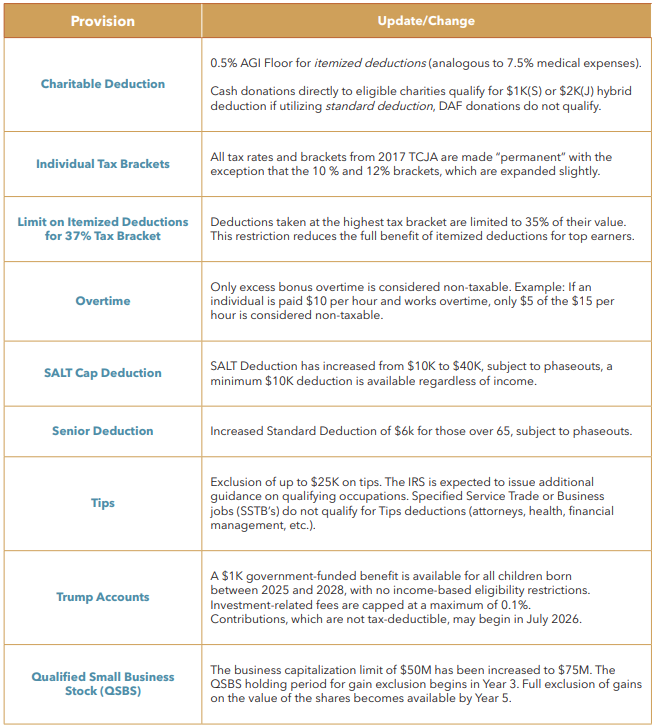
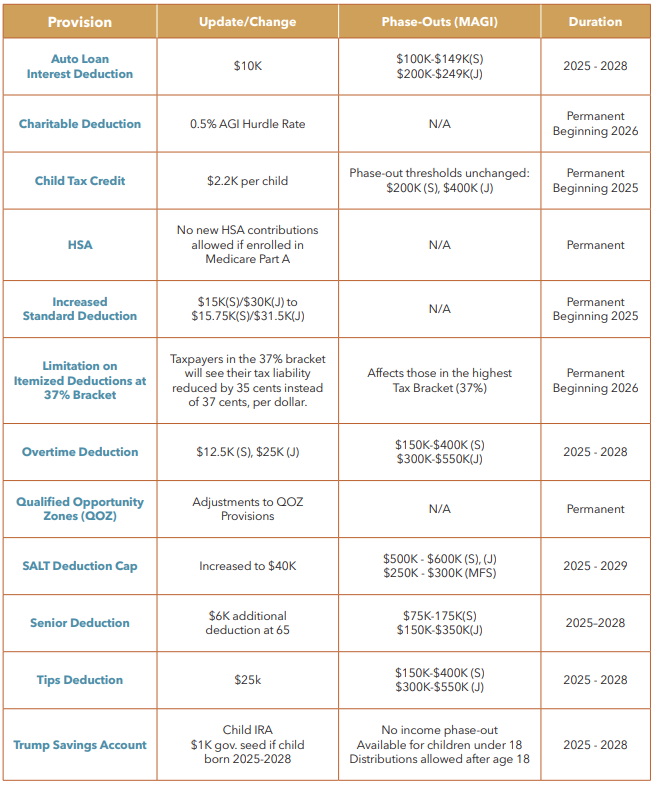
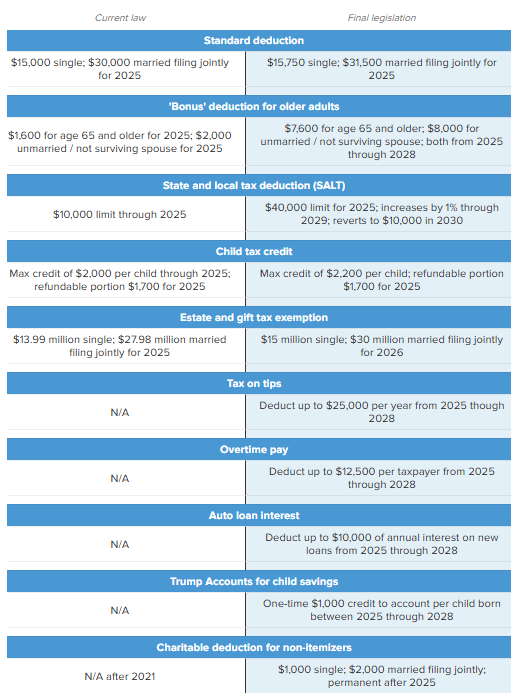
Key Individual Tax Changes

Chart outlining the changes to tax law from the Big Beautiful Bill.
Source: CNBC

As you review the new tax legislation, it may be the perfect time to review your financial planning needs as well. This includes revisiting your investment portfolio, assessing tax planning opportunities, reevaluating retirement goals and managing your wealth transfer and legacy plans.

This summary of the new legislation contains merely a portion of the items that may apply to your family. We are always happy to meet and discuss any of the above to ensure that you remain on track with your financial profile and your goals.

Promo for an article titled Transparency over Illusion — the case for liquid investments.

The CD Wealth Formula

We help our clients reach and maintain financial stability by following a specific plan, catered to each client. 

Our focus remains on long-term investing with a strategic allocation while maintaining a tactical approach. Our decisions to make changes are calculated and well thought out, looking at where we see the economy is heading. We are not guessing or market timing. We are anticipating and moving to those areas of strength in the economy — and in the stock market. 

We will continue to focus on the fact that what really matters right now is time in the market, not out of the market. That means staying the course and continuing to invest, even when the markets dip, to take advantage of potential market upturns. We continue to adhere to the tried-and-true disciplines of diversification, periodic rebalancing and looking forward, while not making investment decisions based on where we have been.

It is important to focus on the long-term goal, not on one specific data point or indicator. Long-term fundamentals are what matter. In markets and moments like these, it is essential to stick to the financial plan. Investing is about following a disciplined process over time.

Sources: CNBC, Fidelity, Schwab

What We’re Watching: The Market Rebounds and the Tax Deadline Looms

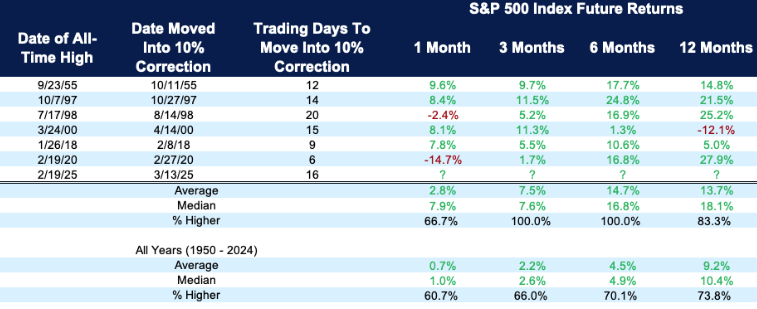
The S&P 500 finished in the positive last week for the first time in more than a month. It wasn’t that long ago that the S&P was down more than 10% on the year and stocks were in correction mode. It took only 16 days for stocks to fall more than 10%, and since that time, stocks have rebounded just as quickly.

Fast bouncebacks are common after fast corrections. As the chart shows, the market has been positive three, six and 12 months after other fast drawdowns in stocks, with an average return of more than 13%. This doesn’t mean that our recent volatility is done or that we won’t revisit the March lows — but it does reiterate our constant drumbeat to ignore the noise and not to time the market because historically, the market has always rebounded.

One of the Fastest Corrections Ever; Now What?

S&P 500 returns after quickest moves into a correction (from all-time high to 10% off peak)

Graphic showing S&P 500 returns after quickest moves into a correction (from all-time high to 10% off peak).
Sources: Carson Investment Research, FactSet 3/16/24 (1950-current)

The April 15 tax deadline is approaching fast. Staying informed about policy changes and regularly assessing your financial situation can help you build strategies that align with your goals.

To help you with tax preparation — whether you are doing it yourself or having a CPA help you — here’s a list of the most common documents you will need to gather:

W-2s: If you work for an employer, you will receive this form, which shows how much you earned and how much was deducted for taxes and other withholdings.

1099-NEC (MISC): If you are a contract employee, you can expect to receive this form.

1099-INT and 1099-DIV: If you earned interest from savings or investments, you may receive this form. The 1099-DIV reports dividends and distributions from investments.

Consolidated 1099: This brokerage tax form will show income from dividends, both qualified and non-qualified, as well as any capital gains and losses that occurred during the year.

1099-R: If you take a distribution from your retirement account, you will receive this form, which shows the amount of distribution and the amount of taxes withheld.

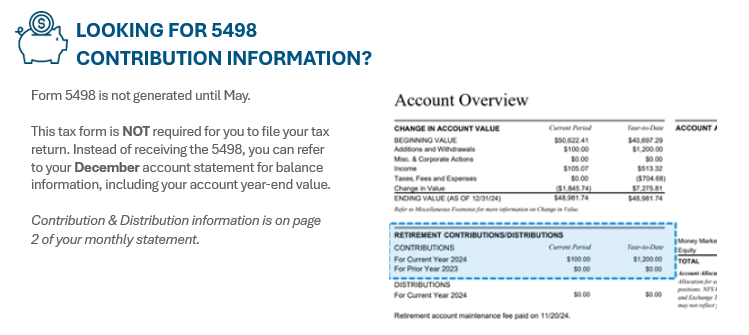
Form 5498: This form reports your total annual contributions to an IRA account and identifies the type of retirement account you have. Here is some new information about this form for 2024 tax reporting:
— In an effort to be more environmentally conscious and efficient, NFS is sending the Form 5498 tax document only if you’ve made contributions, completed rollovers, reached age 72, or have certain types of investments within your brokerage IRA.
— From now on, the Form 5498 will also be generated in May. This document is not technically needed for filing and provides a clean summary of your IRA activity, which can be useful for future planning or if you ever need to verify past transactions.
— In lieu of this form, you will still need to know how to obtain your contribution and distribution information for your taxes.

Graphic with key information points about Form 5498.

1098: Those who own a home and pay mortgage interest will receive this form from their lender. It shows the amount of deductible interest a homeowner paid.

1098-T: If you have a dependent in college, you will receive this form that reports how much qualified tuition and expense was paid during the year.

K-1s: If you have any limited partner investments, you will receive this form, which shows each partner’s share of the earnings, losses, deductions and credits.

No one wants to pay more than taxes than they must. The tax code has been simplified over the years, yet it remains incredibly complex.

The number of tax brackets has been reduced significantly, and knowing what marginal tax bracket you are in is very important. If you know your estimated tax rate, that may help determine the most tax-efficient investments.

For example, if you are in a high tax bracket, owning municipal bonds may make sense to reduce your taxable income. If you are in a low tax bracket, you may be able to take advantage of lower capital gains rates and pay less on investments sold for a gain. As always, we recommend speaking with your CPA/Accountant to review.

By first understanding the tax bracket, we can plan better tax strategies for you and your family.

If you’re in a higher tax bracket, the following strategies may make sense:

• If you’re older than 70, consider reducing taxable income by using IRA monies to make charitable distributions.
• Consider delaying taking Social Security income until you turn 70.
• Take advantage of itemizing by lumping charitable contributions together in one year.

If you’re in a lower tax bracket, the following strategies may make sense:

• Consider increasing withdrawals from IRAs up to the level of the current tax bracket.
• You may wish to convert an IRA to a Roth IRA in a year of lower income taxes.
• If possible, defer income and sale of capital gain property to postpone taxable income.
• If you’re itemizing on your tax return, bunch your medical expenses in the current year to meet the percentage of your adjusted gross income to claim those deductions.

Tax planning is not just a once-a-year event. The chart below is a good reminder that as part of the financial planning process, we are constantly evaluating current circumstances to guide our clients with potential tax saving strategies.

Along with your CPA, we want to ensure we are evaluating the current landscape for tax changes and strategies that may help save future dollars and keep money in your pocket.

Here are some steps to consider before the end of the year:

Graphic showing 6 questions to ask when planning next year's taxes.

So, what can we learn from all this? As you prepare to file your taxes before April 15, it is a perfect time to review your financial planning needs. This includes reviewing the investment portfolio, assessing ongoing tax planning opportunities, reviewing retirement goals, and managing your wealth transfer and legacy plans.

The checklist above contains just some of the items that may apply to your family. We are happy to meet to discuss any of the above to make sure you remain on track with your financial profile.

The CD Wealth Formula

We help our clients reach and maintain financial stability by following a specific plan, catered to each client. 

Our focus remains on long-term investing with a strategic allocation while maintaining a tactical approach. Our decisions to make changes are calculated and well thought out, looking at where we see the economy is heading. We are not guessing or market timing. We are anticipating and moving to those areas of strength in the economy — and in the stock market. 

Promo for an article titled A Closer Look at Tariffs, Market Volatility and Recession Fears.

We will continue to focus on the fact that what really matters right now is time in the market, not out of the market. That means staying the course and continuing to invest, even when the markets dip, to take advantage of potential market upturns. We continue to adhere to the tried-and-true disciplines of diversification, periodic rebalancing and looking forward, while not making investment decisions based on where we have been.

It is important to focus on the long-term goal, not on one specific data point or indicator. Long-term fundamentals are what matter. In markets and moments like these, it is essential to stick to the financial plan. Investing is about following a disciplined process over time.

Sources: Bloomberg, Carson, CNBC, Fidelity

Revisiting the Year’s Most Valuable Insights for Our Clients

As 2024 draws to a close, we wanted to take this occasion to look back at the articles we’ve produced for our clients so far this year and share the 10 most popular pieces, in case you missed any of them — or if you want to revisit and share them with friends and family.

Every two weeks, we thoughtfully craft these pieces with our clients in mind, broaching subjects we think are relevant and interesting. This is not syndicated content. We want you to find value in these letters — especially in times like these.

1. Understanding How a Living Trust Can Help Your Estate Planning

Senior couple, documents and sign contract for life insurance or home mortgage. Discussion, signature and retired elderly man and woman signing legal paperwork for will or loan application together.

June 20: A living trust is a flexible, popular tool that allows the estate to avoid probate and lets you control asset distribution after your death. Read more

2. Another Milestone for the Dow: What Could Happen Next?

Stock market data with uptrend vector. 3d render.

May 23: The Dow’s rise to 40,000 is a reminder that when it comes to investing, patience is the key. Read more

3. Here’s Why Investors Shouldn’t Panic Over the Market’s New Year’s Hangover

Index on a screen.

Jan. 12: We talk regularly about not timing the market, and we don’t see these circumstances any differently. Read more

4. Election Advice for Investors: Ignore the Noise, Focus on the Big Picture

American Social Unrest.

Oct. 31: Presidential elections historically have had very little impact on the stock market. Read more

5. What Investors Should Know About This Week’s Market Pullback

financial stock market graph chart of stock market investment trading screen.

Aug. 8: Remember that volatility is normal and that the market does not go up in a straight line. Read more

6. The Market’s Recovery Puts August Pullback in the Rearview Mirror

Businesswoman in suit drawing stock analytics interface on virtual screen. Business and financial success concept.

Aug. 22: More often than any other month, August is when we tend to see out-of-the-blue volatility in the stock market. Read more

7. Here’s How We’re Rebalancing the Portfolio as We Enter the Second Quarter

Smiling mature couple meeting with bank manager for investment. Beautiful mid adult woman with husband listening to businessman during meeting in conference room in modern office. Happy middle aged couple meeting loan advisor to buy a new home.

March 15: We think much of the pain from rising interest rates is behind us — and the key to navigating volatility remains being in a diversified portfolio. Read more

8. Investor Outlook: A Strong May, the First 100 Trading Days and 4 Scams to Watch

Male manager businessmen are looking at the tablet screen with the company's financial information and he is tense about the performance.

June 6: S&P 500 companies are enjoying their best earnings season in almost two years. Read more

9. The Fed’s Next Move: What Could Rate Cuts Mean for Investors?

Federal Reserve Chairman Jerome Powell speaking on stage.

Sept. 5: Investors who stay only in short-term investments may risk an opportunity to lock in higher yields. Read more

10. How To Make the Biggest Impact With Your Charitable Donation

Green donate button on the keyboard close-up. blurred in motion background.

Sept. 19: Giving can offer a financial benefit for you and your family — as well as the intangible rewards that come with helping others. Read more

The CD Wealth Formula

We help our clients reach and maintain financial stability by following a specific plan, catered to each client. 

Our focus remains on long-term investing with a strategic allocation while maintaining a tactical approach. Our decisions to make changes are calculated and well thought out, looking at where we see the economy is heading. We are not guessing or market timing. We are anticipating and moving to those areas of strength in the economy — and in the stock market. 

We will continue to focus on the fact that what really matters right now is time in the market, not out of the market. That means staying the course and continuing to invest, even when the markets dip, to take advantage of potential market upturns. We continue to adhere to the tried-and-true disciplines of diversification, periodic rebalancing and looking forward, while not making investment decisions based on where we have been.

It is important to focus on the long-term goal, not on one specific data point or indicator. Long-term fundamentals are what matter. In markets and moments like these, it is essential to stick to the financial plan. Investing is about following a disciplined process over time.