Your Year-End Financial Checklist: Moves to Make Before 2025 Ends

As we prepare to wrap up another year, it is the perfect time to review year-end planning strategies to ensure your wealth plan reflects changes in your circumstances or goals, the current tax environment, and the economic landscape.

The end of the year is an important time for making financial decisions that can have an impact in the year ahead — and for years to come. We recommend that you review the planning strategies below to consider and discuss.

Income Tax Strategies

Traditional year-end planning focuses on deferring income into a future year and accelerating deductions into the current year.

— If you anticipate being in a lower tax bracket next year:

• Defer income if possible so you can postpone paying the tax and have that income at a lower bracket.
• If you itemize on your tax return, bunch your medical expenses in the current year to meet the percentage of your adjusted gross income to claim those deductions.
• Make your January mortgage payment in December so you can deduct the interest on this year’s return.

Promo for an article titled Turning Investment Losses into Gains: The Art of Tax-Loss Harvesting.

Tax-Related Investment Strategies

— Tax-loss harvesting is the strategy of selling securities at a loss to offset a capital gain liability, either for today or in the future. Securities must be sold by Dec. 31, the last trading day of 2025, to realize a capital gain or loss.

• Harvest losses by selling taxable investments. To avoid the IRS wash-sale rule, you must wait at least 31 days before buying back a holding that’s sold for a loss.
• Harvest gains by selling taxable investments if you have a tax loss carryforward.

— Make sure that you have satisfied your required minimum distributions (RMD).

• If you fail to take your RMD, this may result in a 25% penalty. (This is down from 50%.)
• If you own an inherited IRA, RMD may be required separately for that account as well. If you inherited an IRA after 2019, it must be depleted by the end of the 10th year. If the original owner of the IRA was already taking RMDs at the time of death, you must take an annual distribution in years 1-9, in addition to making sure the IRA is fully depleted in year 10.
• Beneficiaries of a Roth IRA do not have to take RMDs. However, the 10-year rule still applies, and the entire account must be fully distributed by the end of the 10th year.

Promo for an article titled Before You Sell for a Loss, Make Sure You Know the Wash-Sale Rule.

Retirement Planning Strategies

— Maximize your IRA contributions. You may be able to deduct annual contributions of up to $7,000 to your traditional IRA and $7,000 to your spouse’s IRA ($8,000 if over the age of 50).

— Make a Roth IRA contribution if you qualify under the applicable income limits.

— Consider increasing or maximizing your 401(k) contribution; the maximum for 2025 is $23,500 for those under age 50 and $31,000 for those 50 and older. Contributing more to your 401(k) can reduce your adjusted gross income while boosting your long-term retirement savings.

— New in 2025: If you are between 60 and 63, you can contribute an additional amount to your employer-sponsored retirement plan.

— Consider making contributions to a Roth 401(k) if your plan allows.

— Consider setting up a Roth IRA for each of your children who have earned income during the year.

Gifting Strategies

— Consider making gifts up to $19,000 per person, as allowed under the federal annual gift tax exclusion. You can give up to $19,000 this year to as many people as you want without triggering gift taxes. Note: Payments made directly to educational and/or medical institutions on behalf of your intended beneficiary do not count towards your annual exclusion amount — or against your lifetime estate tax exclusion.

— Create a donor advised fund for an immediate income tax deduction and provide immediate and future benefits to charity over time.

— If you already have a donor advised fund or want to donate to a charity, consider gifting appreciated assets that have been held longer than one year to get the fair market value income tax deduction while avoiding income tax on the appreciation.

— If over the age of 70½, consider making a direct transfer from an IRA to a public charity. The distribution is excluded from gross income, and you can give up to $108,000 as a tax-free gift from your IRA, which may fully satisfy RMD requirements.

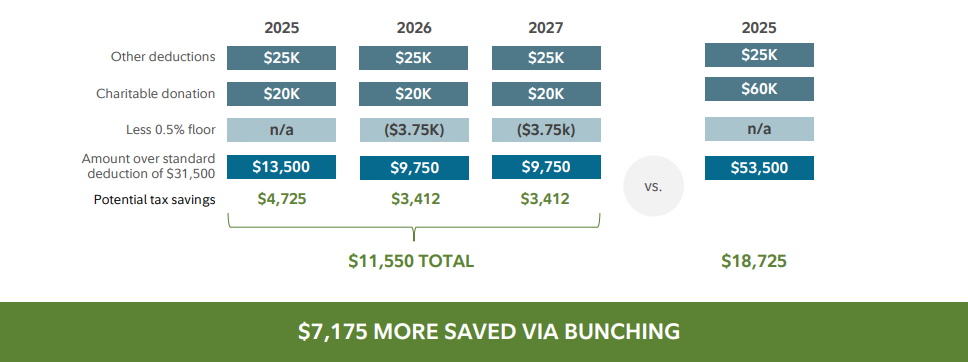
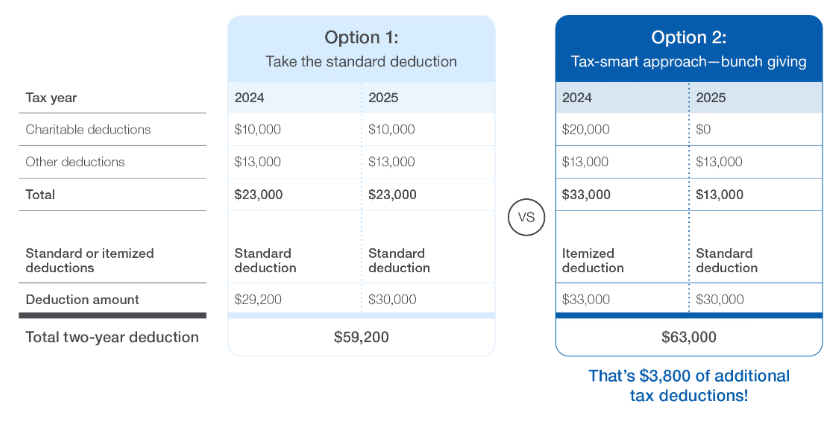
— Consider combining multiple years of charitable giving into a single year to exceed the standard deduction threshold. This is called “bunching.” The chart below illustrates how bunching can reduce taxes if executed properly.

Bunching in 2025

Scenario: Donor has income of $750K, is in the 35% income federal tax bracket, files jointly as a married couple, and itemizes deductions.

Source: Fidelity Charitable. This is a hypothetical example for illustrative purposes only. This example does not take into account other deductions. Information herein is not legal or tax advice. As with any tax-planning strategy, there may be additional considerations that pertain to your personal situation. Other strategies may provide more flexibility and similar savings. Please consult your tax advisor.

Wrapping up 2025, Planning for 2026

— Discuss major life events with CD Wealth to confirm you have clarity in your current situation.

— Communicate with your CPA to provide capital gains and investment income information for a more accurate year-end projection.

— Check your Health Savings Account (HSA) contributions for 2025. If you qualify, you can contribute up to $4,300 (individual) or $8,850 (family) — and an additional $1,000 catch-up if over the age of 55.

— Double-check your beneficiary designations for retirement plans, IRAs, Roth IRAs, annuities, and life insurance policies.

— If you do not already have identity theft protection, consider purchasing a service to help protect you and your family.

The end of the year is a perfect time to review your financial planning needs. This includes reviewing the investment portfolio, assessing year-end tax planning opportunities, reviewing retirement goals, and managing your legacy plans. The list above includes some of the items that may apply to you and your family. 

We are happy to meet to discuss any of the above to ensure you remain on track with your financial goals.

Promo for an article titled Here's Why the Stock Market Remains the Best Place to Build Wealth.

The CD Wealth Formula

We help our clients reach and maintain financial stability by following a specific plan, catered to each client. 

Our focus remains on long-term investing with a strategic allocation while maintaining a tactical approach. Our decisions to make changes are calculated and well thought out, looking at where we see the economy is heading. We are not guessing or market timing. We are anticipating and moving to those areas of strength in the economy — and in the stock market. 

We will continue to focus on the fact that what really matters right now is time in the market, not out of the market. That means staying the course and continuing to invest, even when the markets dip, to take advantage of potential market upturns. We continue to adhere to the tried-and-true disciplines of diversification, periodic rebalancing and looking forward, while not making investment decisions based on where we have been.

It is important to focus on the long-term goal, not on one specific data point or indicator. Long-term fundamentals are what matter. In markets and moments like these, it is essential to stick to the financial plan. Investing is about following a disciplined process over time.

Sources: Fidelity

Here’s Why the Stock Market Remains the Best Place to Build Wealth

At CD Wealth Management, we believe the stock market remains the best place to invest money, both today and for the long term. Stocks represent ownership in the most innovative, productive and forward-looking companies across every industry and region — and the market is the world’s greatest engine for growth and wealth creation.

As the global economy expands and technology connects more people, investing is no longer just for the wealthy. As the Internet has opened access to information and fostered transparency, markets have become more democratic and resilient. With billions now taking part and a steady flow of capital, innovation, efficiency and long-term growth can thrive.

We believe that trend will only deepen over the next several decades. Innovation compounds — it doesn’t go backwards. We will not return to a world without smartphones or instant access to information. Advances in artificial intelligence, biotechnology, clean energy and global connectivity will continue to reshape how we live, how businesses grow and how people invest.

The stock market captures that progress in one place. It reflects human ingenuity, enterprise and adaptability, the very forces that have driven wealth creation for more than a century.

Yes, the market moves up and down in the short term — and it can be volatile, as we have seen repeatedly, especially in the last five years. But over time, it has rewarded investors who stay disciplined and participate in the growth of the global economy. The market remains liquid, transparent, and resilient.

We are never going to claim to know what will happen tomorrow. What we do know, however, is that history has consistently rewarded patience, discipline and time in the market. Our process is built on those principles, not on predictions.

That is why we remain committed to staying invested through every cycle, whether we are at an all-time high or a major low.

+++

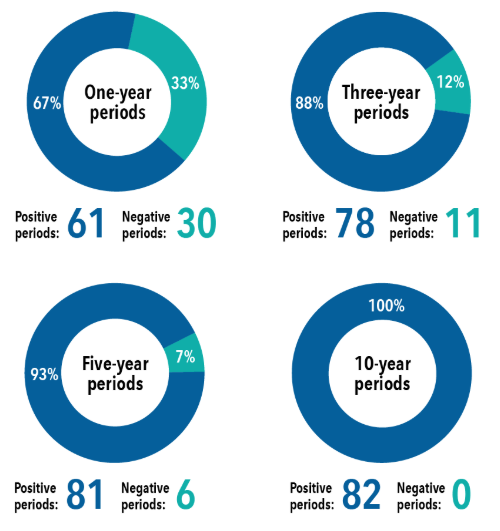
History has shown the longer the period, the greater the chance of a positive outcome.

Graphs showing the performance of investments over different time periods.
Source: S&P 500 Index. S&P 500 Index is a market capitalization-weighted index based on the results of approximately 500 widely held common stocks. The index is unmanaged and, therefore, has no expenses. Investors cannot invest directly in an index.

+++

After such a strong run in the markets, it’s natural for investors to wonder: What matters most right now?

It is easy to feel confident when markets are rising, but confidence can fade quickly when volatility returns. Even if markets were to drop 30% next week, however, we would maintain the same steady long-term view that the stock market is the best place to generate wealth and value.

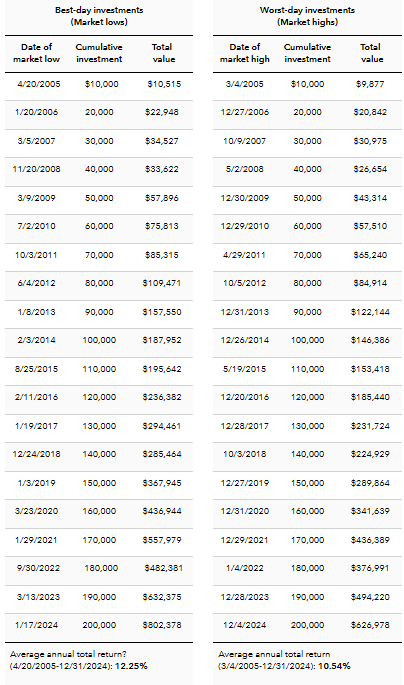
The market goes up and down, but over time it has always rewarded those who stay invested. The chart below shows two hypothetical investments in the S&P 500 over a 20-year period. Each investor contributed $10,000 per year, but one investor picked the best day to invest each year, and the other investor picked the worst day each year. Even with the worst market timing each year, the average annual return would have been 10.54%, compared to the best return of 12.25%.

The takeaway: Even selecting the worst day to invest, if you continue investing, you would have come out ahead.

Timing Isn’t Critical to Long-Term Success

Table showing the value of investments on different trading days.
Source: S&P 500 Index

This is why we believe the stock market is the place to be. We are not basing this opinion on speculation, but rather we are participating in the ongoing story of growth, innovation and progress.

We are not trying to outguess the market. We are following evidence that shows that long-term investors who stay the course come out ahead. Our strength is in discipline and consistency, not in forecasting. That is why we keep investing, why we add during periods of opportunity, and why we trust the strategy that has worked over decades, not days.

We are not here to shy away from where we are in the market at any given moment. We are here to follow our process, remain long-term focused and trust the history that has rewarded investors for generations.

Promo for an article titled The Case for Staying Invested: The Market High Is Not a Warning Sign.

The CD Wealth Formula

We help our clients reach and maintain financial stability by following a specific plan, catered to each client. 

Our focus remains on long-term investing with a strategic allocation while maintaining a tactical approach. Our decisions to make changes are calculated and well thought out, looking at where we see the economy is heading. We are not guessing or market timing. We are anticipating and moving to those areas of strength in the economy — and in the stock market. 

We will continue to focus on the fact that what really matters right now is time in the market, not out of the market. That means staying the course and continuing to invest, even when the markets dip, to take advantage of potential market upturns. We continue to adhere to the tried-and-true disciplines of diversification, periodic rebalancing and looking forward, while not making investment decisions based on where we have been.

It is important to focus on the long-term goal, not on one specific data point or indicator. Long-term fundamentals are what matter. In markets and moments like these, it is essential to stick to the financial plan. Investing is about following a disciplined process over time.

Sources: Capital Group, S&P 500

The Most-Searched Questions That Lead Investors to Our Articles

Here are the most frequently searched questions that have led readers to our Insights page so far this year — and the answers they found. If you find our articles helpful, please feel free to share them with your family and friends!

1. Are we in a bull market?

(Also searched often: When will the bull market end?)

Yes, we are still in a bull market. The current rally began in October 2022.

You can’t pinpoint the exact end of a bull market, but there are common signals that investors and analysts watch for. A bull market often ends when economic conditions shift: slowing growth, rising unemployment or tighter monetary policy from the Federal Reserve. Market indicators like falling corporate earnings, an inverted yield curve or a broad decline across major stock indexes can also suggest the rally is losing steam.

The end of a bull market is usually only clear in hindsight, but watching economic fundamentals and earnings trends can provide early warning signs.

2. Why is the 10-year Treasury important?

The 10-year U.S. Treasury yield is a critical economic indicator because it influences borrowing costs, reflects investor sentiment and serves as a benchmark for various interest rates. As the yield on the 10-year Treasury rises, so do mortgage rates and other borrowing rates, affecting consumer spending and business investments.

When the yield declines, borrowing becomes cheaper, potentially stimulating economic activity. A rising yield might prompt the Fed to raise short-term rates, while a falling yield could lead to lower rates to support economic growth. Monitoring the 10-year Treasury yield provides valuable insights into economic expectations and can guide investment and policy decisions.

3. Is compound interest taxed?

Compound interest itself isn’t directly taxed, but the earnings it generates — such as interest or dividends — are typically taxable in the year they’re received, even if you reinvest them, reducing the effective return in taxable accounts.

4. How often do stock market corrections happen?

Since World War II, there have been 48 market corrections, but only 12 of those escalated into full-fledged bear markets. While a correction (typically defined as a 10%+ drop) is fairly common, most don’t become much more serious. Since 1980, the S&P 500 has fallen 5% or more in nearly every year (93% of the time) and dropped 10% or more in almost half of the years (47% of the time), showing that double-digit pullbacks happen more than half the time and aren’t unusual.

Promo for an article titled Transparency over Illusion — the case for liquid investments.

5. How can I avoid a wash sale?

You need to wait at least 30 days before or after selling an investment at a loss before buying it back (or buying anything too similar) so that the IRS doesn’t disallow your tax deduction. A good way to stay safe is to use the money to buy something different, like another stock or a different type of fund, instead of the same or nearly identical investment. Be careful if you trade in retirement accounts or across different accounts you own, because those count too. If you’re unsure what “too similar” means, it’s best to ask a tax professional.

6. How can I talk to my aging parents about their future?

Start any conversation with your aging parents in a calm and non-judgmental way and remember it doesn’t all have to happen at once. Gently focus on their hopes and needs, such as their health, housing, long-term care, legal documents and estate plans. Holidays or relaxed family times are great opportunities to begin; break the discussion into smaller chats over several days rather than doing it all at once.

Ask practical questions, like where they keep important records, whether they’ve updated wills, powers of attorney, healthcare directives, or long-term care plans — and make sure you know their doctors. Ask about their insurance policies and see if they will share access to any safety deposit boxes. Also, help shield them from financial scams by staying connected, teaching them about digital red flags and encouraging judgment-free communication so they feel supported and in control, not rushed or defensive.

7. What does a strong dollar mean?

A stronger U.S. dollar often is the result of higher interest rates that attract global investment into U.S. bonds or perceptions of the U.S. as a safer financial haven. It means more purchasing power abroad, letting Americans pay less when traveling or buying imports. However, it can hurt U.S. companies with large international operations by shrinking the value of overseas earnings when converted back to dollars and making their goods more expensive to foreign buyers.

8. What investments are liquid?

Liquid investments are those you can quickly buy or sell — like stocks, bonds, ETFs, mutual funds, money market funds and short-term instruments such as Treasury bills or CDs — without significantly affecting their price, making them great for accessing cash when needed. These assets benefit from regulatory oversight, transparent pricing and real-time valuations, which help reduce uncertainty and ensure accountability.

By contrast, illiquid investments like private deals or partnerships may promise higher returns but often come with long lock-up periods, less transparency and potential conflicts of interest. Keeping your portfolio in liquid markets helps preserve flexibility, clarity and control — even if those investments may not be as flashy as alternatives.

Promo for an article called The Formula for Wealth Is Simple, and It's Non-Negotiable.

The CD Wealth Formula

We help our clients reach and maintain financial stability by following a specific plan, catered to each client. 

Our focus remains on long-term investing with a strategic allocation while maintaining a tactical approach. Our decisions to make changes are calculated and well thought out, looking at where we see the economy is heading. We are not guessing or market timing. We are anticipating and moving to those areas of strength in the economy — and in the stock market. 

We will continue to focus on the fact that what really matters right now is time in the market, not out of the market. That means staying the course and continuing to invest, even when the markets dip, to take advantage of potential market upturns. We continue to adhere to the tried-and-true disciplines of diversification, periodic rebalancing and looking forward, while not making investment decisions based on where we have been.

It is important to focus on the long-term goal, not on one specific data point or indicator. Long-term fundamentals are what matter. In markets and moments like these, it is essential to stick to the financial plan. Investing is about following a disciplined process over time.

Transparency Over Illusion: The Case for Liquid Investments

Note: A PDF version of this article is available here.


At CD Wealth Management, our philosophy with investing is to focus on the liquid markets — Stocks (Individual Equities), Fixed Income (municipal bonds, corporate bonds, Treasuries, CDs), Index Funds (ETFs), Mutual Funds, and money markets. We are not investing our clients’ monies in alternative investments — either liquid alternatives or illiquid alternatives.

To use a golf analogy, we play in the fairway. We want to ensure that if a client needs their money, whatever holdings are in the portfolio could be sold that day. It is paramount that clients have access to their monies when needed.  

The Case for Liquid Investments

The financial world offers no shortage of investment opportunities. Over the years, a trend has emerged that has become popular to discuss at cocktail parties or on the golf course: illiquid partnerships and private deals, framed as exclusive opportunities and high-return potential. While they may appear enticing, these arrangements frequently prioritize the interests of general partners over investors. 

These private deals and investments do not carry the same level of regulatory oversight, transparency, and accountability. 

By contrast, liquid investments operate under strict oversight by regulators such as the Securities and Exchange Commission (SEC) and the Financial Industry Regulatory Authority (FINRA). These regulatory bodies ensure transparency and protect investors. Failure to comply with the regulatory agencies may lead to serious consequences, including fines and/or imprisonment. 

Liquid investments may not carry the same flashiness as private deals, but they are tried, tested, and proven.  

What Are Liquid Investments? 

Liquid investments are financial assets that can be bought or sold quickly and easily without significantly affecting their price. These assets are traded on public exchanges, offering real-time valuations and high levels of transparency. Examples include:

Stocks: Stocks represent ownership in publicly traded companies. Stocks allow investors to participate in the growth and profitability of businesses. They are traded throughout the day on exchanges like the NYSE or NASDAQ and are valued daily.

Bonds: Fixed-income securities are issued by governments, municipalities, or corporations. Bonds provide a stream of income through interest payments and are considered a much lower risk than stocks.

Marketable Securities: Mutual funds and exchange-traded funds (ETFs) are liquid investments designed to diversify portfolios while maintaining daily liquidity. ETFs can be sold throughout the day, like stocks, while mutual funds have daily liquidity at the end of the trading day.

Cash Equivalents: Assets like Treasury bills, money market funds or short-term certificates of deposit (CDs) are as good as cash. These provide immediate access to funds with minimal risk.  

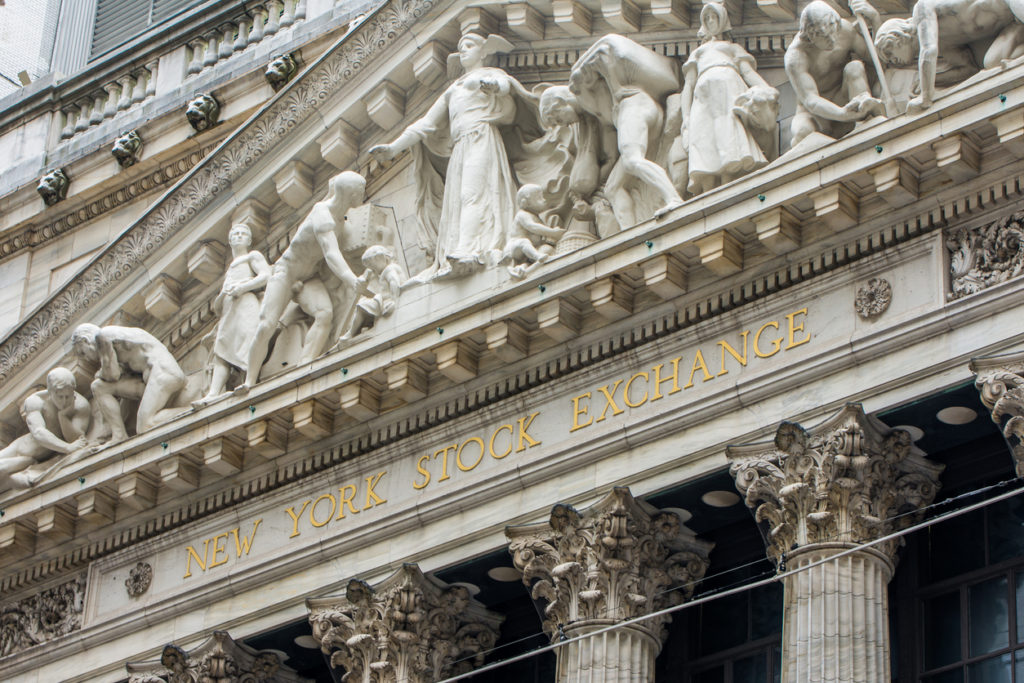
The front facade and sign of the New York Stock Exchange at wall street.
Stocks are traded throughout the day on exchanges like the NYSE or NASDAQ and are valued daily, so investors can see the exact value of their holdings at any time.

How Liquid Investments Work: The Value of Transparency and Management

Liquid investments operate with transparency:

Daily Valuation: Investors can see the exact value of their holdings at any time. This removes ambiguity and allows for informed decision-making.

Professional Asset Management: Investors pay a transparent management fee to professionals who manage their investments. Management fees for liquid investments are disclosed upfront and published online, providing complete transparency about costs. Unlike illiquid investments, managers of liquid assets do not take a share of the profits.

Accountability: Regulatory oversight by the SEC and FINRA ensures that managers act in the best interest of their clients. This eliminates conflicts of interest and ensures ethical behavior.

Accessibility: Investors can buy or sell these assets quickly and with minimal impact on their value, making them ideal for individuals who may need access to cash in emergencies or for other financial goals.

What Are Illiquid Investments?

Illiquid investments are financial assets that cannot be easily or quickly converted into cash. These investments often come with long lock-up periods, a lack of transparency, and high levels of uncertainty regarding their valuation. Investors in illiquid investments typically face challenges when they want to sell or redeem their investments, as there is no open market to provide daily liquidity. 

Types of Illiquid Investments

Private Real Estate Deals: Investors pool money to purchase or develop properties, often in the form of limited partnerships. Returns are tied to property appreciation or rental income but often require years before seeing liquidity.

Oil and Gas Ventures: Investments in exploration, drilling, and extraction projects typically are structured as partnerships. They are highly speculative and dependent on volatile commodity markets. Organizers may offer tax advantages as incentives to invest in the project.

Private Equity Funds: A fund invests in privately held companies or leveraged buyouts of public companies. The fund typically invests in private companies with a predetermined investment strategy. The types of private equity strategies are venture capital or buyout funds. Illiquid by nature, these funds typically lock up money for seven to 10 years or more.

Venture Capital: These are early-stage investments in startups or small businesses, typically with a minority investment in the company. Returns are speculative and contingent on the company’s success.

Hedge Funds: Hedge funds are actively managed funds that use complex strategies to generate returns and protect against market losses. They often have lock-up periods and redemption restrictions, making them illiquid. They also charge higher fees and have fewer regulations.

Collectibles and Art: With investments in rare items like artwork, antiques, or wine collections, illiquidity arises from the difficulty in finding buyers and determining fair market value.

Real Assets: Tangible assets like timberland, farmland, or infrastructure investments typically require long-term commitments with limited liquidity.

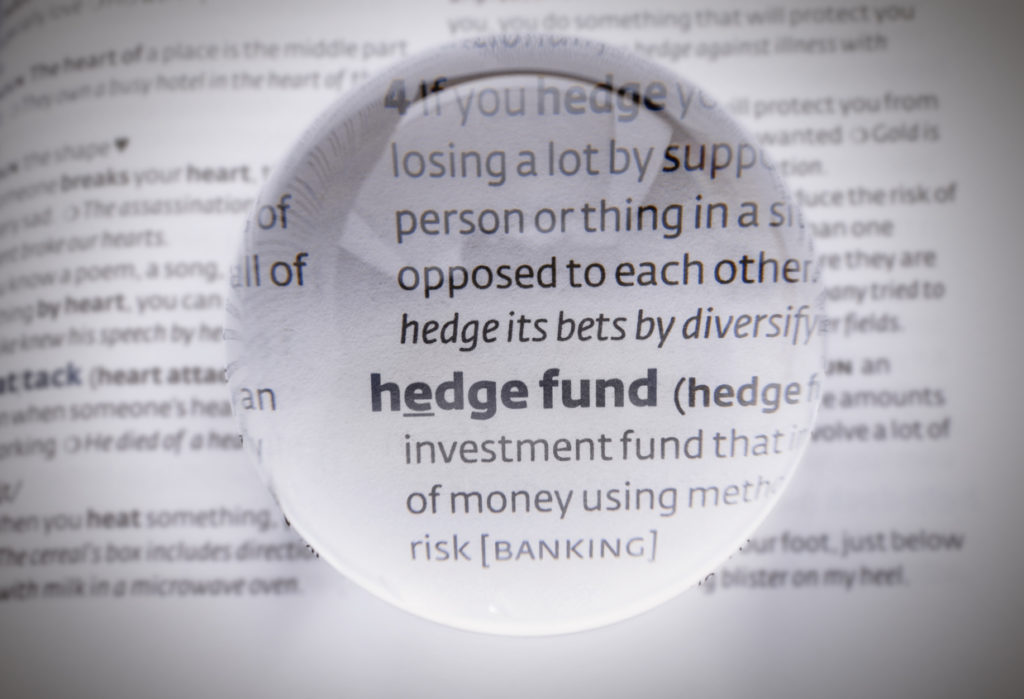
Dictionary definition of hedge fund.
Hedge funds use complex strategies to generate returns and often have lock-up periods and redemption restrictions, making them illiquid.

How Illiquid Investments Work

General Partners with No Real Stake: In many private real estate deals, the general partner does not put their own money into the project. Instead, they use investor capital and bank loans, bearing little to no financial risk themselves. The general partner often takes a management fee and a significant share of the profits (sometimes 50% or more). This profit-sharing occurs even though the limited partners bear all the financial risk.

Leveraging Investor Capital: General partners use investor funds to secure loans, further leveraging the investment. If the project fails, investors lose their capital while the general partner remains protected.

Opaque Reporting: Illiquid investments often rely on unaudited reports produced by the general partner. These reports highlight irrelevant successes or inflated valuations while obscuring the true financial picture.

Lack of Oversight: Without SEC or FINRA oversight, investors have no external authority ensuring fair play or ethical behavior.

Why We Stay Away from Illiquid Investments

Lack of Transparency: Illiquid investments, such as private real estate deals, venture capital, and oil and gas partnerships, often lack daily pricing and rely on unaudited, self-reported valuations from general partners. This may leave investors in the dark about the true value of their investments and limits their ability to make informed decisions. Without regulatory oversight, there is no guarantee that reports are accurate or unbiased, creating a significant risk for investors.

Imbalanced Risk and Reward: In many illiquid investments, general partners contribute little to no capital but reap substantial rewards, including management fees and up to 50% of the profits. Meanwhile, limited partners bear all the financial risk. This misalignment of incentives can lead to decisions that prioritize the general partner’s interests over the investors’ interests, potentially resulting in losses or suboptimal outcomes for the limited partners.

Restricted Access and Estate Planning Challenges: Illiquid investments often come with long lock-up periods, tying up investor funds for years or even decades. This lack of accessibility can be problematic for those who need liquidity for personal reasons or to settle estates after death. Executors and heirs face delays, subjective valuations, and legal hurdles when trying to access or liquidate illiquid assets, adding unnecessary complexity and financial stress.

Promo for an article called The Formula for Wealth Is Simple, and It's Non-Negotiable.

A Stronger Conclusion: Transparency Over Illusion

Investing should never feel like guessing. Illiquid investments thrive on a lack of transparency, emotional manipulation, and the allure of exclusivity.  Having a mix of liquid assets can help you achieve your financial goals while also providing a safety net in times of uncertainty when money may be needed most. 

Understanding the pros and cons of each type of asset — liquid or illiquid — is critical in making informed decisions as to what is right for each person and family based on their financial needs. 

In contrast, liquid investments offer:

 •       Transparency
 •       Accessibility
 •       Accountability
 •       Ownership of Profits
 •       Estate Planning Simplicity

When it comes to your financial future, the choice is clear: Choose transparency, accountability, and liquidity. Your wealth deserves nothing less.

The CD Wealth Formula

We help our clients reach and maintain financial stability by following a specific plan, catered to each client. 

Our focus remains on long-term investing with a strategic allocation while maintaining a tactical approach. Our decisions to make changes are calculated and well thought out, looking at where we see the economy is heading. We are not guessing or market timing. We are anticipating and moving to those areas of strength in the economy — and in the stock market. 

We will continue to focus on the fact that what really matters right now is time in the market, not out of the market. That means staying the course and continuing to invest, even when the markets dip, to take advantage of potential market upturns. We continue to adhere to the tried-and-true disciplines of diversification, periodic rebalancing and looking forward, while not making investment decisions based on where we have been.

It is important to focus on the long-term goal, not on one specific data point or indicator. Long-term fundamentals are what matter. In markets and moments like these, it is essential to stick to the financial plan. Investing is about following a disciplined process over time.

Sources: Blackstone, Fidelity, Investopedia, Schwab

Stocks Surged Again in 2024 — Will the Bull Market Continue?

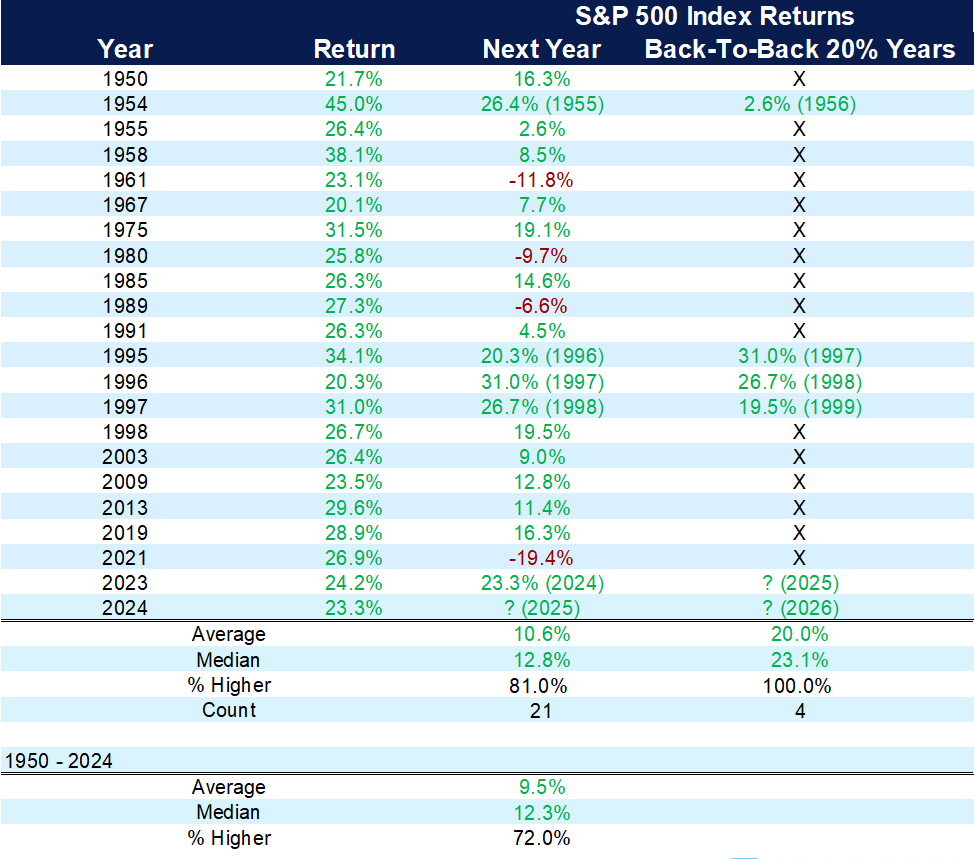
For the second year in a row, the S&P 500 gained more than 20% in 2024, marking the first time that’s occurred since the late 1990s. In each of the last four times there have been back-to-back gains of over 20% since 1950, the market has been higher — potentially a good sign for the year ahead.

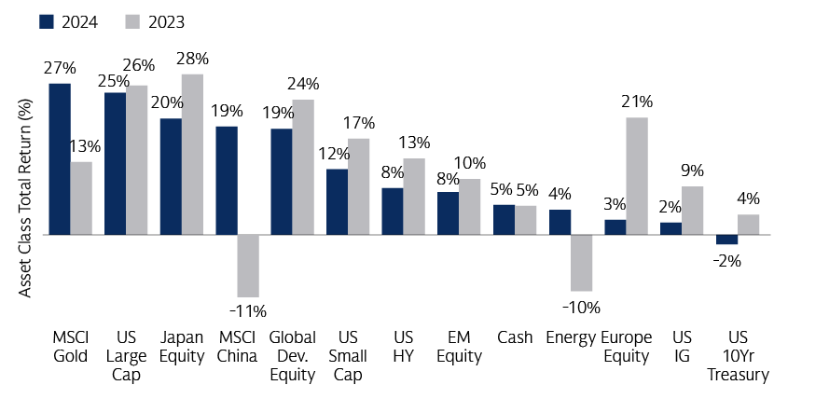
Large-growth stocks continued to lead last year, while small-cap stocks and large-value stocks lagged, gaining less than half of large-cap stocks. The Material sector in the S&P 500 was the only sector to finish negative for the year.

Returns After 20% Gains

Chart showing returns after back-to-back years with gains over 20%.
Sources: Carson Investment Research, FactSet 1/5/2025 (1950-Current)

The Magnificent Seven stocks — Apple, Amazon, Google, Meta, Microsoft, Nvidia and Tesla — returned more than 66% in 2024, boosting gains in the S&P 500 again. Magnificent Seven stocks saw a wider dispersion of returns compared to 2023. Nvidia led the way, up over 170%, and Microsoft brought up the rear, returning only 12% while being the only member to underperform the S&P 500.

The 10 largest stocks in the S&P 500 increased their weight to nearly 40% of the index. Only 19% of the stocks within the S&P 500 outperformed the index itself. The S&P 500 had a maximum drawdown during the year of 8% from its 2024 high, falling short of a 10% correction in 2024. However, both the NASDAQ and Russell 2000 fell more than 10% during the year.

2024 In Review

Chart showing stock performances by segment in 2024 and 2023.
Sources: Bloomberg, Goldman Sachs Asset Management. As of Dec. 31, 2024.

Given the narratives surrounding the election and the upcoming change in administration, the post-election aggressive market gains receded sharply to end the year. The S&P stumbled into the end of the year, with the last all-time close for the year occurring on Dec. 6.

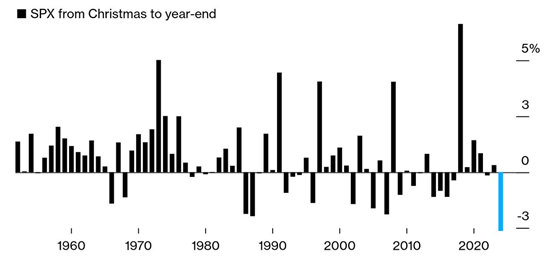
Investors were hoping for a Santa Claus Rally; since 1950, the S&P 500 has averaged a 1.3% gain during the last five trading days of the year and the first two of the new year. Unfortunately, Santa Claus did not come for the market this year; the S&P ended 2024 on a five-day losing streak, down 1.5%. Despite those results, the market had another great year!

The S&P 500’s Worst Year-End Fall Since 1952

Chart showing year-end market showings since 1952.
Source: Bespoke Investment Group

Each year, there are defining themes that dominate the markets. In 2020 it was the global pandemic, which caused the supply chain issues of 2021. In 2022, it was all about inflation. Artificial intelligence and the Magnificent Seven led the way the last two years.

Some of these themes can be positive, while others are negative. One thing that is consistent is that one theme always gives way to another — a good reminder to not chase the annual theme and stick with the investment plan. We cannot predict what theme will dominate the markets in 2025.

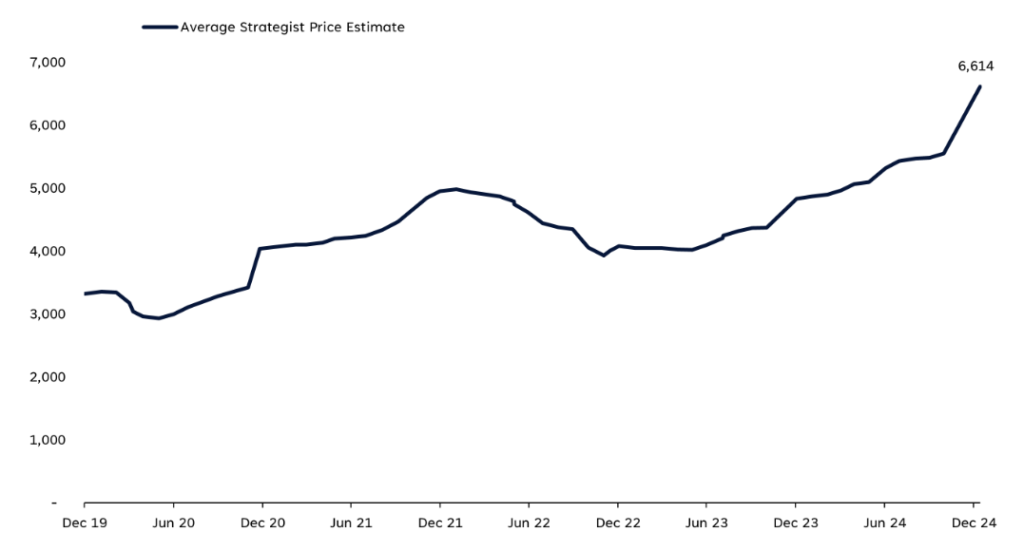
A survey of 15 Wall Street firms arrived at a predicted median S&P 500 value of 6,600 by the end of 2025, a gain of roughly 9% from recent levels. Estimates range from 6,000 to 7,100 on the S&P. Analysts have underestimated the index each year since 2019, with 2022 being the exception when the market fell more than 18%.

The 2025 aggregate forecast is the most bullish forecast since 2022, as the broad consensus is another positive year for stocks, with the bull market reaching its third anniversary during 2025. At the end of the day, though, these are predictions, and no one knows for sure how this year will play out. What we know is that over time, markets tend to rise — and staying invested is the best strategy.

Average Strategist Price Estimate

Chart showing analysts' predictions for market performance.
Sources: LPL Research, Bloomberg 12/30/24. All indexes are unmanaged and cannot be invested in directly. Past performance is no guarantee of future results. Estimates may not materialize as predicted and are subject to change.

We do see many reasons to be bullish in 2025:

1. The economic foundation remains in good shape headed into the new year.

2. Continued advancement in artificial intelligence leads to innovation among all sectors and industries. Companies continue to spend billions of dollars on infrastructure and AI buildout for the future.

3. Earnings for companies in the S&P 500 are expected to grow by double digits again for 2025, following very strong earnings growth in 2024.

4. Don’t mix politics with investing. Markets have gone up over time, no matter who has been in the White House.

5. Trump 2.0 is expected to reduce regulation and cut taxes. Markets are expecting deregulation that in turn will help foster more merger and acquisition activity.

6. Congress is expected to tackle major tax legislation and extend the Tax Cuts and Job Act that was initially passed in 2017.

7. The Fed is expected to cut rates twice in 2025 due to higher growth of the economy and is expected to keep the bull market intact headed into its third year.

8. The bull market has advanced more than 67% in the two-plus years since it started in October 2022. History suggests that the bull market has a good chance of celebrating its third anniversary.

9. We expect more balanced growth across the U.S. economy, and we expect the U.S. economy’s continued leadership. Earnings and valuations together suggest the strong potential for a continued broadening of the market.

Promo for an article titled The Formula for Wealth is Simple, and It's Non-Negotiable.

We expect market volatility to be higher in 2025, as there are more unknowns heading into the year, as well as markets that are more fully valued. Higher volatility may cause some worry. Every year there are scary headlines; ignore them.

Market pullbacks are normal, and while markets have gone up over time, they do not climb in a straight line. Since 1980, the S&P 500’s average peak-to-trough correction per year is 14.2%. In 2024, the S&P 500 did not have a correction as an index but came within 1.5% of entering correction mode.

Even strong years have market pullbacks. It is very rare that the market doesn’t have at least a 5% pullback at some point. When the inevitable pullback and correction do occur, we will continue to stay the course and be here as your guide throughout the year.

The CD Wealth Formula

We help our clients reach and maintain financial stability by following a specific plan, catered to each client. 

Our focus remains on long-term investing with a strategic allocation while maintaining a tactical approach. Our decisions to make changes are calculated and well thought out, looking at where we see the economy is heading. We are not guessing or market timing. We are anticipating and moving to those areas of strength in the economy — and in the stock market. 

We will continue to focus on the fact that what really matters right now is time in the market, not out of the market. That means staying the course and continuing to invest, even when the markets dip, to take advantage of potential market upturns. We continue to adhere to the tried-and-true disciplines of diversification, periodic rebalancing and looking forward, while not making investment decisions based on where we have been.

It is important to focus on the long-term goal, not on one specific data point or indicator. Long-term fundamentals are what matter. In markets and moments like these, it is essential to stick to the financial plan. Investing is about following a disciplined process over time.

Sources: Schwab, LPL, Bloomberg, Carson, JP Morgan, Capital Group

Revisiting the Year’s Most Valuable Insights for Our Clients

As 2024 draws to a close, we wanted to take this occasion to look back at the articles we’ve produced for our clients so far this year and share the 10 most popular pieces, in case you missed any of them — or if you want to revisit and share them with friends and family.

Every two weeks, we thoughtfully craft these pieces with our clients in mind, broaching subjects we think are relevant and interesting. This is not syndicated content. We want you to find value in these letters — especially in times like these.

1. Understanding How a Living Trust Can Help Your Estate Planning

Senior couple, documents and sign contract for life insurance or home mortgage. Discussion, signature and retired elderly man and woman signing legal paperwork for will or loan application together.

June 20: A living trust is a flexible, popular tool that allows the estate to avoid probate and lets you control asset distribution after your death. Read more

2. Another Milestone for the Dow: What Could Happen Next?

Stock market data with uptrend vector. 3d render.

May 23: The Dow’s rise to 40,000 is a reminder that when it comes to investing, patience is the key. Read more

3. Here’s Why Investors Shouldn’t Panic Over the Market’s New Year’s Hangover

Index on a screen.

Jan. 12: We talk regularly about not timing the market, and we don’t see these circumstances any differently. Read more

4. Election Advice for Investors: Ignore the Noise, Focus on the Big Picture

American Social Unrest.

Oct. 31: Presidential elections historically have had very little impact on the stock market. Read more

5. What Investors Should Know About This Week’s Market Pullback

financial stock market graph chart of stock market investment trading screen.

Aug. 8: Remember that volatility is normal and that the market does not go up in a straight line. Read more

6. The Market’s Recovery Puts August Pullback in the Rearview Mirror

Businesswoman in suit drawing stock analytics interface on virtual screen. Business and financial success concept.

Aug. 22: More often than any other month, August is when we tend to see out-of-the-blue volatility in the stock market. Read more

7. Here’s How We’re Rebalancing the Portfolio as We Enter the Second Quarter

Smiling mature couple meeting with bank manager for investment. Beautiful mid adult woman with husband listening to businessman during meeting in conference room in modern office. Happy middle aged couple meeting loan advisor to buy a new home.

March 15: We think much of the pain from rising interest rates is behind us — and the key to navigating volatility remains being in a diversified portfolio. Read more

8. Investor Outlook: A Strong May, the First 100 Trading Days and 4 Scams to Watch

Male manager businessmen are looking at the tablet screen with the company's financial information and he is tense about the performance.

June 6: S&P 500 companies are enjoying their best earnings season in almost two years. Read more

9. The Fed’s Next Move: What Could Rate Cuts Mean for Investors?

Federal Reserve Chairman Jerome Powell speaking on stage.

Sept. 5: Investors who stay only in short-term investments may risk an opportunity to lock in higher yields. Read more

10. How To Make the Biggest Impact With Your Charitable Donation

Green donate button on the keyboard close-up. blurred in motion background.

Sept. 19: Giving can offer a financial benefit for you and your family — as well as the intangible rewards that come with helping others. Read more

The CD Wealth Formula

We help our clients reach and maintain financial stability by following a specific plan, catered to each client. 

Our focus remains on long-term investing with a strategic allocation while maintaining a tactical approach. Our decisions to make changes are calculated and well thought out, looking at where we see the economy is heading. We are not guessing or market timing. We are anticipating and moving to those areas of strength in the economy — and in the stock market. 

We will continue to focus on the fact that what really matters right now is time in the market, not out of the market. That means staying the course and continuing to invest, even when the markets dip, to take advantage of potential market upturns. We continue to adhere to the tried-and-true disciplines of diversification, periodic rebalancing and looking forward, while not making investment decisions based on where we have been.

It is important to focus on the long-term goal, not on one specific data point or indicator. Long-term fundamentals are what matter. In markets and moments like these, it is essential to stick to the financial plan. Investing is about following a disciplined process over time.

Year-End Suggestions to Help You Save More and Reduce Your Taxes

With the election in the rearview mirror, we are entering the home stretch for 2024. The end of the year is an important time for making financial decisions that can have an impact not only in the new year ahead, but for years to come.

As 2025 approaches, now is the perfect time to review planning strategies to ensure that your wealth plan reflects any changes in your circumstances or goals, the current tax environment and the economic landscape.

We recommend that you review the checklist below for ideas to consider and discuss.

Income Tax Strategies

1. If you anticipate your marginal income tax bracket to increase next year, you may consider accelerating income into 2024 and deferring deductions to 2025.

2. If you anticipate being in a lower tax bracket next year:

• Defer income (if possible) to postpone paying the tax and to have that income at a lower bracket.
• If you itemize on your tax return, bunch your medical expenses in the current year to meet the percentage of your adjusted gross income to claim those deductions.
• Make your January mortgage payment in December so you can deduct the interest on this year’s return.

Tax-related Investment Strategies

1. Tax-loss harvesting is the strategy of selling securities at a loss to offset a capital gain liability, either for today or in the future. Securities must be sold by Dec. 31, the last trading day of 2024, to realize a capital gain or loss.

• Harvest losses by selling taxable investments. Note: You must wait at least 31 days before buying back a holding that is sold for a loss to avoid the IRS wash-sale rule.
• Harvest gains by selling taxable investments if you have a tax loss carryforward.

2. Ensure that you have satisfied your required minimum distributions (RMD).

• If you fail to take your RMD, this may result in a 25% penalty (down from 50%). 
• If you own an inherited IRA, an RMD may be required separately for that account as well. If you inherited an IRA after 2019, the inherited IRA must be depleted by the end of the 10th year. Beginning next year, certain beneficiaries must take an annual distribution over the 10-year period following inheritance, instead of waiting to distribute the entire amount until the 10th year.

Retirement Planning Strategies

1. Maximize your IRA contributions. You may be able to deduct annual contributions of up to $7,000 to your traditional IRA and $7,000 to your spouse’s IRA ($8,000 if over the age of 50).

2. Consider increasing or maximizing your 401(k) contribution. The maximum contribution in 2024 for those under 50 is $23,000, and for those over 50, the maximum contribution is $30,500. Boosting contributions to your 401(k) can lower your adjusted gross income while increasing your retirement savings.

3. Consider making contributions to a Roth 401(k) if your plan allows.

4. Consider setting up a Roth IRA for each of your children who have earned income during the year.

Gifting Strategies

1. Consider making gifts of up to $18,000 per person as allowed under the federal annual gift tax exclusion. You can give up to $18,000 this year to as many people as you want without triggering gift taxes. Payments made directly to educational and/or medical institutions on behalf of your intended beneficiary do not count towards your annual exclusion amount — or against your lifetime estate tax exclusion.

2. Create a donor advised fund for an immediate income tax deduction and provide immediate and future benefits to charity over time.

3. If you already have a donor advised fund or want to donate to a charity, consider gifting appreciated assets that have been held longer than one year to get the fair market value income tax deduction while avoiding income tax on the appreciation.

4. If you are over the age of 70½, consider making a direct transfer from an IRA to a public charity. The distribution is excluded from gross income, and you can give up to $105,000 as a tax-free gift from your IRA that may fully satisfy RMD requirements.

5. Consider combining multiple years of charitable giving into a single year to exceed the standard deduction threshold. This is called “bunching.” The chart below illustrates how it can reduce taxes if executed properly.

Wrapping Up 2024, Planning for 2025

1. Discuss major life events with your team at CD Wealth to confirm you have clarity in your current situation.

2. Communicate with your CPA to provide capital gains and investment income information for a more accurate year-end projection.

3. Check your Health Savings Account (HSA) contributions for 2025. If you qualify, you can contribute up to $4,300 (individual) or $8,550 (family), plus an additional $1,000 catch-up if you are over 55.

4. Double-check your beneficiary designations for retirement plans, IRAs, Roth IRAs, annuities and life insurance policies.

5. If you do not already have identity theft protection, consider purchasing a service to help protect you and your family. 

The end of the year is the perfect time to review your financial planning needs.

This includes reviewing the investment portfolio, assessing year-end tax planning opportunities, reviewing retirement goals, and managing your legacy plans.

The checklist above includes just some of the items that may apply to you and your family. We are happy to meet with you to discuss any of the above and to ensure that you stay on track with your financial goals.

Promo for an article titled How to Make the Biggest Impact with your charitable donation.

The CD Wealth Formula

We help our clients reach and maintain financial stability by following a specific plan, catered to each client. 

Our focus remains on long-term investing with a strategic allocation while maintaining a tactical approach. Our decisions to make changes are calculated and well thought out, looking at where we see the economy is heading. We are not guessing or market timing. We are anticipating and moving to those areas of strength in the economy — and in the stock market. 

We will continue to focus on the fact that what really matters right now is time in the market, not out of the market. That means staying the course and continuing to invest, even when the markets dip, to take advantage of potential market upturns. We continue to adhere to the tried-and-true disciplines of diversification, periodic rebalancing and looking forward, while not making investment decisions based on where we have been.

It is important to focus on the long-term goal, not on one specific data point or indicator. Long-term fundamentals are what matter. In markets and moments like these, it is essential to stick to the financial plan. Investing is about following a disciplined process over time.

Sources: Capital Group, Fidelity, Schwab

Our Top Articles of 2024 So Far: Did You Miss Any?

Now that we’re past the halfway point of 2024, we wanted to take this occasion to look back at the articles we’ve produced for our clients so far this year and share the five most popular pieces, in case you missed any of them — or if you want to revisit and share them with friends and family.

Twice a month, we thoughtfully craft these pieces with our clients in mind, broaching subjects we think are relevant and interesting. This is not syndicated content. We want you to find value in these letters — especially in times like these.

+++

Senior couple, documents and sign contract for life insurance or home mortgage. Discussion, signature and retired elderly man and woman signing legal paperwork for will or loan application together.

1. Understanding How a Living Trust Can Help Your Estate Planning

June 20 | A living trust is a flexible, popular tool that allows the estate to avoid probate and lets you control asset distribution after your death. Read more

+++

Stock market data with uptrend vector. 3d render.

2. Another Milestone for the Dow: What Could Happen Next?

May 23 | The Dow’s rise to 40,000 is a reminder that when it comes to investing, patience is the key. Read more

+++

Index on a screen.

3. Here’s Why Investors Shouldn’t Panic Over the Market’s New Year’s Hangover

Jan. 12 | We talk regularly about not timing the market, and we don’t see these circumstances any differently. Read more

+++

Smiling mature couple meeting with bank manager for investment. Beautiful mid adult woman with husband listening to businessman during meeting in conference room in modern office. Happy middle aged couple meeting loan advisor to buy a new home.

4. Here’s How We’re Rebalancing the Portfolio as We Enter the Second Quarter

March 15 | We think much of the pain from rising interest rates is behind us — and the key to navigating volatility remains being in a diversified portfolio. Read more

+++

Male manager businessmen are looking at the tablet screen with the company's financial information and he is tense about the performance.

5. Investor Outlook: A Strong May, the First 100 Trading Days and 4 Scams to Watch

June 6  |  S&P 500 companies are enjoying their best earnings season in almost two years. Read more

+++

P.S. Looking for more? Here are the five articles that are most popular this year on our website (no matter when they were published).

1. The Importance of Compound Interest and Tax Planning on Your Portfolio (Sept. 8, 2022)
2. You’ve inherited an IRA. What happens next? (April 14, 2022)
3. Understanding the 10-Year Treasury and Why It Matters to Investors (Nov. 2, 2023)
4. Understanding How a Living Trust Can Help Your Estate Planning (June 20, 2024)
5. Before you sell for a loss, make sure you know the wash-sale rule (May 5, 2022)

+++

The CD Wealth Formula

We help our clients reach and maintain financial stability by following a specific plan, catered to each client. 

Our focus remains on long-term investing with a strategic allocation while maintaining a tactical approach. Our decisions to make changes are calculated and well thought out, looking at where we see the economy is heading. We are not guessing or market timing. We are anticipating and moving to those areas of strength in the economy — and in the stock market. 

We will continue to focus on the fact that what really matters right now is time in the market, not out of the market. That means staying the course and continuing to invest, even when the markets dip, to take advantage of potential market upturns. We continue to adhere to the tried-and-true disciplines of diversification, periodic rebalancing and looking forward, while not making investment decisions based on where we have been.

It is important to focus on the long-term goal, not on one specific data point or indicator. Long-term fundamentals are what matter. In markets and moments like these, it is essential to stick to the financial plan. Investing is about following a disciplined process over time.

Promo for an article titled Here's Why Patience May Be an Investor's Greatest Asset.

This material contains an assessment of the market and economic environment at a specific point in time and is not intended to be a forecast of future events, or a guarantee of future results. Forward-looking statements are subject to certain risks and uncertainties. Actual results, performance, or achievements may differ materially from those expressed or implied. Information is based on data gathered from what we believe are reliable sources.

Using diversification as part of your investment strategy neither assures nor guarantees better performance and cannot protect against loss of principal due to changing market conditions.

Past performance is not a guarantee of future results.

The opinions expressed in this commentary are those of the author and may not necessarily reflect those held by Kestra Investment Services, LLC or Kestra Advisory Services, LLC. This is for general information only and is not intended to provide specific investment advice or recommendations for any individual. It is suggested that you consult your financial professional, attorney, or tax advisor with regard to your individual situation.

Securities offered through Kestra Investment Services, LLC (Kestra IS), member FINRA/SIPC. Investment Advisory Services offered through Kestra Advisory Services, LLC (Kestra AS) an affiliate of Kestra IS. CD Wealth Management and Bluespring Wealth Partners LLC* are affiliates of Kestra IS and Kestra AS.  Investor Disclosures: https://bit.ly/KF-Disclosures

*Bluespring Wealth Partners, LLC acquires and supports high quality investment adviser and wealth management companies throughout the United States.

Fidelity Investments and Fidelity Institutional® (together “Fidelity”) is an independent company, unaffiliated with Kestra Financial or CD Wealth Management. Fidelity is a service provider to both. There is no form of legal partnership, agency affiliation, or similar relationship between your financial advisor and Fidelity, nor is such a relationship created or implied by the information herein. Fidelity has not been involved with the preparation of the content supplied by CD Wealth Management and does not guarantee, or assume any responsibility for, its content. Fidelity Investments is a registered service mark of FMR LLC. Fidelity Institutional provides clearing, custody, or other brokerage services through National Financial Services LLC or Fidelity Brokerage Services LLC, Members NYSE, SIPC.

Debunking the Myth of Market Timing During an All-Time High

Stocks have had an impressive rally to start the year. The S&P 500 finished the first quarter with a five-month winning streak — shrugging off higher interest rates, hotter than expected inflation data and a reduction in the number of potential rate cuts from the Federal Reserve.

Large-cap stocks, especially those related to artificial intelligence, continue to lead the way, but this year’s rally has been much broader than what we saw in 2023. Apple and Tesla, two of the Magnificent Seven stocks, have had very weak starts to the year.

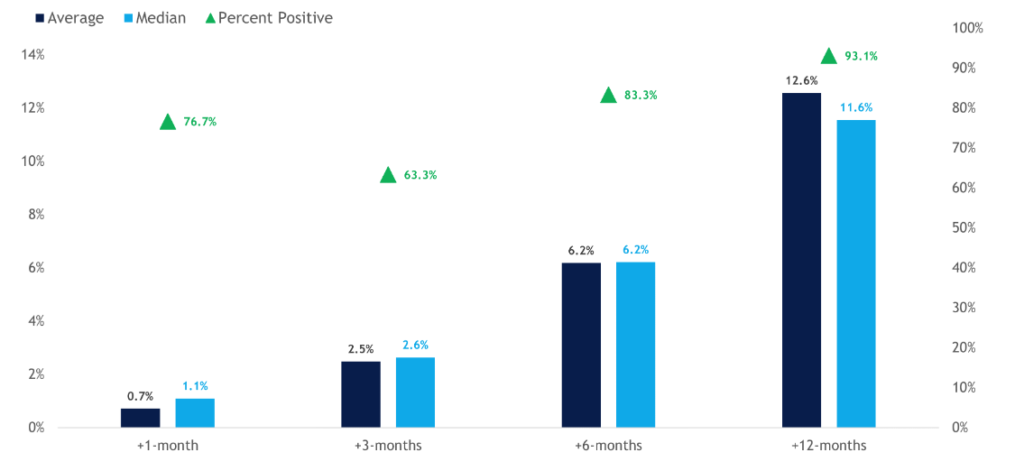
Since 1950, there have been only 30 occurrences in which the market rose for at least five consecutive months. In those occasions, the average return has been 12.6% in the following 12 months, and it has been positive 93.1% of the time.

S&P 500 Peformance Following a Five-Month Win Streak (1950-YTD)

Chart showing S&P 500 results after a five-month win streak.
Source: LPL Research, Bloomberg 3/27/24. Disclosures: Past performance is no guarantee of future results. All indexes are unmanaged and can’t be invested in directly. The modern design of the S&P 500 stock index was first launched in 1957. Performance back to 1950 incorporates the performance of the predecessor index, the S&P 90.

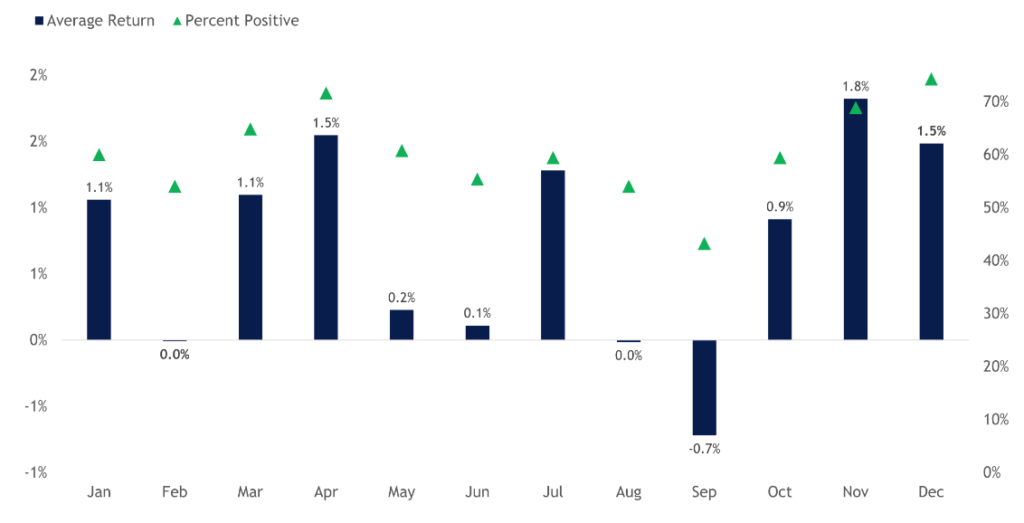
For stocks, April has historically been a good month for growth. Going back to 1950, the S&P 500 has averaged 1.5% in April and finished higher 72% of the time. During an election year, the index has posted an average return of 1.3% in April.

This April, the market started on a choppy note — which is not surprising, considering the start to the year and the Fed’s mixed messages on interest rates. A few weeks ago, Fed Chairman Jerome Powell said three rate cuts were still on the table for 2024, but over the last week, policymakers have indicated that there may be only one rate cut this year. The market is trying to digest what that may mean for stocks and, more importantly, for company valuations.

S&P 500 Monthly Seasonality (1950-YTD)

Chart showing the average return by month of the S&P 500.
Source: LPL Research, Bloomberg 3/27/24. Disclosures: Past performance is no guarantee of future results. All indexes are unmanaged and can’t be invested in directly. The modern design of the S&P 500 stock index was first launched in 1957. Performance back to 1950 incorporates the performance of the predecessor index, the S&P 90. Gains in April are typically front-end loaded. Most of the 1.5% average monthly gain is generated during the first 12 trading days, with price progression tapering off into month-end.

If you are invested, it’s great that stocks are hitting new all-time highs. But if you are looking to put cash to work or considering adding to the portfolio, what does it mean? It’s kind of like climbing a mountain: If you reach the top, isn’t down the only other option?

This kind of thinking is often short-sighted. Not investing — or worse, pulling money out of the market after stocks reach new highs — is calling a market top. Timing the market, which is the strategy of buying in when the market is at the lowest and selling at its peak, requires near-perfect insight to succeed.

Since 2020, the S&P 500 has experienced more than 120 all-time highs. Each of those moments was a market top. Selling on any of those days would have prevented you from participating in the next all-time high.

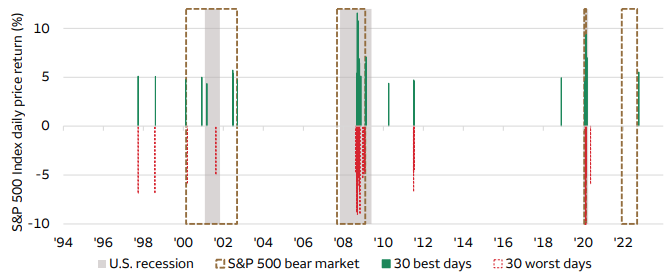
For market timing to work, you must be right twice: once on the way out and then again when to get back in. Investing in the S&P 500 at all-time highs has been a good strategy over the last several decades. As the chart below shows, the 30 best days (as well as the 30 worst days) tend to be clustered together. They also tend to occur during bear markets, when volatility is high.

The Market’s Best and Worst Days Have Often Been Close Together

Chart showing that the market's best and worst days have often been close together.
Sources: Bloomberg and Wells Fargo Investment Institute. Daily data: Feb. 1, 1994, through Jan. 31, 2024, for the S&P 500 Index. Best and worst days are calculated using daily returns. For illustrative purposes only. A price index is not a total return index and does not include the reinvestment of dividends. There are difficulties assessing index performance during certain correction periods, in part, because index results do not represent actual trading and cannot completely account for the impact financial risk has on actual trading. An index is unmanaged and not available for direct investment. Past performance is no guarantee of future results.

There’s an old saying that bull markets don’t die of old age. Staying invested, maintaining a diversified portfolio and rebalancing the portfolio periodically can mitigate the risks that come with trying to time the market.

Momentum begets momentum. Rather than thinking of an all-time high as the top of the mountain, think of it as another step in establishing a new baseline to climb even higher over the long run.

The CD Wealth Formula

We help our clients reach and maintain financial stability by following a specific plan, catered to each client. 

Our focus remains on long-term investing with a strategic allocation while maintaining a tactical approach. Our decisions to make changes are calculated and well thought out, looking at where we see the economy is heading. We are not guessing or market timing. We are anticipating and moving to those areas of strength in the economy — and in the stock market. 

We will continue to focus on the fact that what really matters right now is time in the market, not out of the market. That means staying the course and continuing to invest, even when the markets dip, to take advantage of potential market upturns. We continue to adhere to the tried-and-true disciplines of diversification, periodic rebalancing and looking forward, while not making investment decisions based on where we have been.

It is important to focus on the long-term goal, not on one specific data point or indicator. Long-term fundamentals are what matter. In markets and moments like these, it is essential to stick to the financial plan. Investing is about following a disciplined process over time.

Sources: Baird, LPL Financial, Schwab, Wells Fargo

Promo for an article titled As the Market Soars, Now’s the Time to Review Your Estate Plan.

This material contains an assessment of the market and economic environment at a specific point in time and is not intended to be a forecast of future events, or a guarantee of future results. Forward-looking statements are subject to certain risks and uncertainties. Actual results, performance, or achievements may differ materially from those expressed or implied. Information is based on data gathered from what we believe are reliable sources.

Using diversification as part of your investment strategy neither assures nor guarantees better performance and cannot protect against loss of principal due to changing market conditions.

Past performance is not a guarantee of future results.

The opinions expressed in this commentary are those of the author and may not necessarily reflect those held by Kestra Investment Services, LLC or Kestra Advisory Services, LLC. This is for general information only and is not intended to provide specific investment advice or recommendations for any individual. It is suggested that you consult your financial professional, attorney, or tax advisor with regard to your individual situation.

Securities offered through Kestra Investment Services, LLC (Kestra IS), member FINRA/SIPC. Investment Advisory Services offered through Kestra Advisory Services, LLC (Kestra AS) an affiliate of Kestra IS. CD Wealth Management and Bluespring Wealth Partners LLC* are affiliates of Kestra IS and Kestra AS.  Investor Disclosures: https://bit.ly/KF-Disclosures

*Bluespring Wealth Partners, LLC acquires and supports high quality investment adviser and wealth management companies throughout the United States.

Fidelity Investments and Fidelity Institutional® (together “Fidelity”) is an independent company, unaffiliated with Kestra Financial or CD Wealth Management. Fidelity is a service provider to both. There is no form of legal partnership, agency affiliation, or similar relationship between your financial advisor and Fidelity, nor is such a relationship created or implied by the information herein. Fidelity has not been involved with the preparation of the content supplied by CD Wealth Management and does not guarantee, or assume any responsibility for, its content. Fidelity Investments is a registered service mark of FMR LLC. Fidelity Institutional provides clearing, custody, or other brokerage services through National Financial Services LLC or Fidelity Brokerage Services LLC, Members NYSE, SIPC.

Here’s How We’re Rebalancing the Portfolio as We Enter the Second Quarter

Fifteen years ago this week, the stock market bottomed after the vicious bear market crash from the global financial crisis. The S&P 500 fell almost 57% before hitting its low point on March 9, 2009. Like all bad markets have in the past, this one came to an end. The decade of the 2000s went down as one of the worst decades for stock investors.

We have experienced incredible gains since then. The S&P 500 is up more than 900% on a total basis return over the past 15 years. Don’t assume that this climb was in a straight line, either. Over the last 15 years, we’ve had two bear market close calls (2011 and 2018), a global pandemic bear market in 2020 and another bear market in 2022.

The key lesson to remember is that long-term investors were rewarded for remaining invested!

This year, the S&P 500 was positive in the first two months for the first time since 2019. Historically, gains during the first two months of the year have suggested above-average returns for the rest of the year. Going back to 1950, the following months have been higher 27 out of 28 times, with an average return of 14.8%. The S&P 500 was up 19.9% in years when both January and February were higher.

A Positive January and February Is a Good Thing for 2024

S&P 500 performance for the year, based on if January and February are higher

Source: Carson Investment Research, FactSet 2/26/24 (1950-present)

We are starting to see more breadth in this market compared to last year. The Magnificent Seven has not been nearly as magnificent as last year. Nvidia and Meta have started the year very strong, but the remaining five stocks have seen mixed results. As of this week, all 11 sectors of the S&P 500 are positive year-to-date. This is a sign of a much broader rally in the stock market, compared to last year being so heavily dominated by technology stocks.

Magnificent Seven Performance, 2023 vs. 2024

From a portfolio management perspective, we continue to look ahead. The markets are forward-looking, often telling us what may happen ahead of time. The market seems to have put recession talk in the rearview mirror and has moved on to Fed watch: When will the Fed begin cutting interest rates in 2024? Earlier in the year, the market was pricing in as many as six cuts of 25 basis points. That number now is down to three. 

Inflation continues to show signs of weakening but remains persistently, stubbornly above the targeted 2% level. With an eye on the future, we are making the following portfolio changes as we end the first quarter:

1. We are beginning to see the broadening of the market away from the Magnificent Seven stocks. Technology stocks continue to be the leading sector in the S&P 500, led by the continued advancement of artificial intelligence. The key for investors is to distinguish between what is hype and what is real from an investment standpoint.

Artificial intelligence is no longer just a buzzword. Companies across all sectors are beginning to harness its potential to automate complex tasks, streamline workflow and accelerate technological advancements. This is not like the GameStop trade during the pandemic. From an equity perspective, we are maintaining our allocation to large-cap stocks as well as technology stocks.

Internationally, we added a position to maintain the overall overseas allocation but switched to a manager that allows for additional flexibility investing not only in developed markets but also in emerging markets. Rebalancing is important to capture some of the winnings and redistribute throughout the rest of the portfolio.

2. We continue to increase the duration of the fixed-income portfolio as we near the peak of interest rates. The longer-dated maturities at the end of the yield curve are more volatile than the short-end of the yield curve. Like with our equity allocation, it is important to rebalance our fixed-income allocations.

We like our fixed-income positions, but from time to time, they need to be shifted to the right size in the right position for where we see the markets heading. We believe that when rates fall, we will be able to capture nice income, along with capital appreciation from rising bond prices.

We continue to maneuver the portfolio in response to where we think the puck is moving.

The world in which interest rates stay higher for longer is not one we have been accustomed to for the last 15 years. Financial markets, both stocks and bonds, may be more volatile in response, and we have seen glimpses of this in the first quarter.

With higher yields for longer, investors are being compensated in cash through money markets and CDs. However, as soon as the Fed lowers the fed funds rate, we will see those yields fall rapidly. We think that much of the pain from rising interest rates is behind us and the key to navigating volatility remains being in a diversified portfolio. We will continue to monitor the portfolio and make changes to go to the puck, not wait for the puck to come to us.

The CD Wealth Formula

We help our clients reach and maintain financial stability by following a specific plan, catered to each client. 

Our focus remains on long-term investing with a strategic allocation while maintaining a tactical approach. Our decisions to make changes are calculated and well thought out, looking at where we see the economy is heading. We are not guessing or market timing. We are anticipating and moving to those areas of strength in the economy — and in the stock market. 

We will continue to focus on the fact that what really matters right now is time in the market, not out of the market. That means staying the course and continuing to invest, even when the markets dip, to take advantage of potential market upturns. We continue to adhere to the tried-and-true disciplines of diversification, periodic rebalancing and looking forward, while not making investment decisions based on where we have been.

It is important to focus on the long-term goal, not on one specific data point or indicator. Long-term fundamentals are what matter. In markets and moments like these, it is essential to stick to the financial plan. Investing is about following a disciplined process over time.

Sources: Capital Group, Carson, FS Investments, Schwab

Promo for an article titled Here's Why We Focus on Investing in Liquid Markets.

This material contains an assessment of the market and economic environment at a specific point in time and is not intended to be a forecast of future events, or a guarantee of future results. Forward-looking statements are subject to certain risks and uncertainties. Actual results, performance, or achievements may differ materially from those expressed or implied. Information is based on data gathered from what we believe are reliable sources.

Using diversification as part of your investment strategy neither assures nor guarantees better performance and cannot protect against loss of principal due to changing market conditions.

Past performance is not a guarantee of future results.

The opinions expressed in this commentary are those of the author and may not necessarily reflect those held by Kestra Investment Services, LLC or Kestra Advisory Services, LLC. This is for general information only and is not intended to provide specific investment advice or recommendations for any individual. It is suggested that you consult your financial professional, attorney, or tax advisor with regard to your individual situation.

Securities offered through Kestra Investment Services, LLC (Kestra IS), member FINRA/SIPC. Investment Advisory Services offered through Kestra Advisory Services, LLC (Kestra AS) an affiliate of Kestra IS. CD Wealth Management and Bluespring Wealth Partners LLC* are affiliates of Kestra IS and Kestra AS.  Investor Disclosures: https://bit.ly/KF-Disclosures

*Bluespring Wealth Partners, LLC acquires and supports high quality investment adviser and wealth management companies throughout the United States.

Fidelity Investments and Fidelity Institutional® (together “Fidelity”) is an independent company, unaffiliated with Kestra Financial or CD Wealth Management. Fidelity is a service provider to both. There is no form of legal partnership, agency affiliation, or similar relationship between your financial advisor and Fidelity, nor is such a relationship created or implied by the information herein. Fidelity has not been involved with the preparation of the content supplied by CD Wealth Management and does not guarantee, or assume any responsibility for, its content. Fidelity Investments is a registered service mark of FMR LLC. Fidelity Institutional provides clearing, custody, or other brokerage services through National Financial Services LLC or Fidelity Brokerage Services LLC, Members NYSE, SIPC.