Originally published Sept. 19, 2024; updated in September 2026 to reflect current tax rules.
Next Thursday, Sept. 17, is North Texas Giving Day, an important occasion in our community and an annual reminder to consider charitable giving for both philanthropic and tax planning purposes. Regardless of your interests or passions, supporting causes that are meaningful to you can be one of the most rewarding uses of your wealth.
Ultimately, what matters most is helping organizations that align with your values and make a difference in the areas you care about most. While the tax benefits of charitable giving should not be the primary motivation, they can be a valuable added benefit.
Most charitable donations are made by check or credit card. However, there may be more efficient ways to give that can maximize the impact of your contribution while also providing greater tax benefits. Understanding the advantages of different gifting methods is an important part of making informed philanthropic decisions.
With the stock market gains over the last several years, donating appreciated assets such as stock can have meaningful tax advantages. Donors can deduct gifts of stocks that have been held more than a year (long enough to qualify as long-term capital gains) at the fair market value, rather than at the purchase price (cost basis), while avoiding capital gains tax on the appreciation.
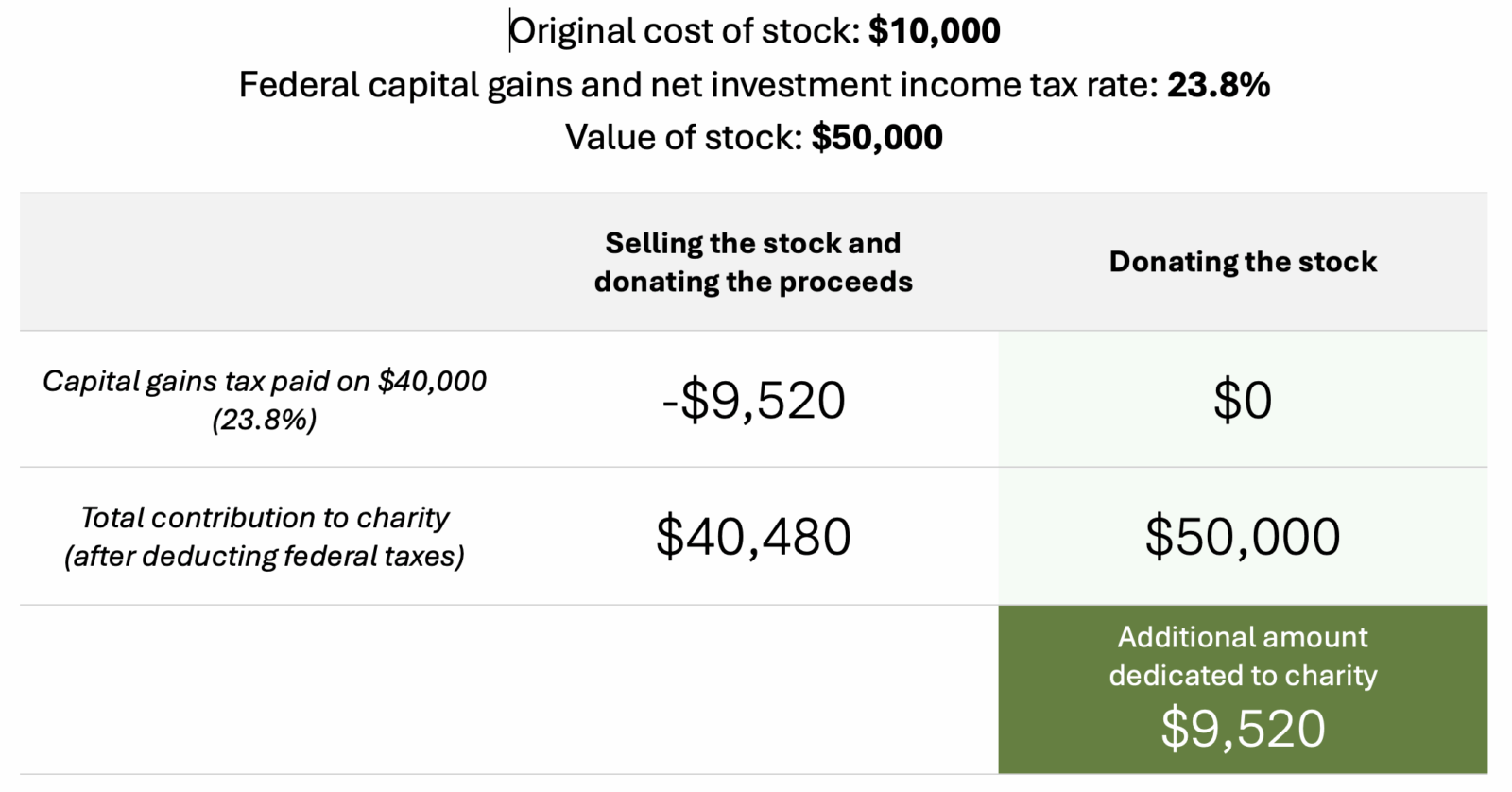
For example, if you purchased stock for $10,000 that is now worth $50,000, you may donate it directly to a qualified charity and calculate your deduction using its full $50,000 value while avoiding the capital gains tax on the $40,000 gain.
The downside is that your deduction can offset only up to 30% of your adjusted gross income (AGI), with excess amounts carried forward for up to five years. If you donate stocks you have held for less than one year, you will receive a deduction for their cost basis, rather than fair market value. However, the deduction can offset up to 50% of AGI. The new AGI floor of 0.5% on charitable deductions also applies to stock donations.
Often, donors may gift the stock with the biggest winnings, which maximizes savings on capital gains, and then buy back the same stock with cash — which in turn raises the cost basis. If you happen to own a stock or mutual fund for more than one year and do not have the cost basis, this holding can be ideal for donation to charity.
The chart below shows the difference between selling appreciated stock and then donating cash to charity, compared to gifting appreciated stock. Not only would the individual save on taxes, as the capital gains tax is not incurred on the donated stock, but the charity would also receive additional monies!
Cash, Check or Credit Card
Cash gifts, whether made by check, credit card, electronic transfer, or cash, remain the simplest and most straightforward way to support charitable organizations. To substantiate charitable contributions, it is important to maintain appropriate documentation, such as a receipt from the charity or a bank or credit card record. For gifts of $250 or more, additional written acknowledgment requirements apply.
Beginning in 2026, taxpayers who do not itemize deductions may claim a federal charitable deduction of up to $1,000 ($2,000 for married couples filing jointly) for qualifying cash contributions while still taking the standard deduction. This provision allows more taxpayers to receive a tax benefit for charitable giving, even if they do not itemize.
For contributions made in 2026, cash gifts to public charities remain deductible up to 60% of AGI. Contributions exceeding this limit may generally be carried forward for up to five years until fully utilized. Beginning in 2026, taxpayers who itemize deductions are also subject to a new 0.5% AGI floor on charitable contributions. In other words, only charitable gifts that exceed 0.5% of AGI are deductible. For example, if your AGI is $100,000, only charitable contributions above $500 would qualify for a deduction.
In addition, taxpayers in the highest income tax bracket, with taxable income exceeding $640,600 ($768,700 for married couples filing jointly), are subject to a new limitation that caps the value of itemized deductions, including charitable contributions, at 35%. As a result, the tax benefit received is calculated using the 35% rate rather than the taxpayer’s marginal income tax rate.
For example, if your AGI is $700,000 and you make $50,000 of charitable contributions, the 0.5% AGI floor would first apply. Because 0.5% of $700,000 is $3,500, only $46,500 of the contribution would be deductible. Applying the 35% limitation results in federal tax savings of approximately $16,275.
If you do not have appreciated assets available for gifting, or simply prefer to give cash, it is important to consider how charitable contributions fit into your overall tax picture.
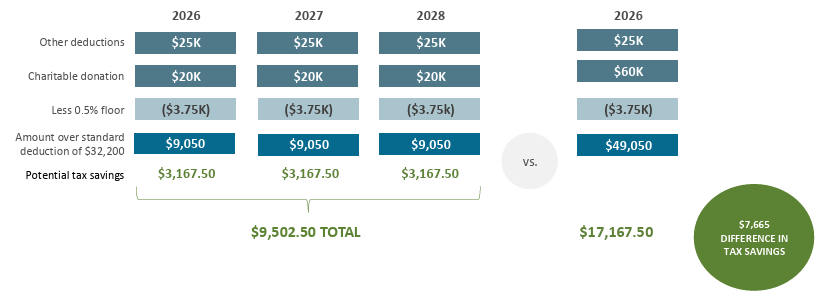
With the increased standard deduction of $16,100 for single filers and $32,200 for married couples filing jointly, many taxpayers may find that their itemized deductions do not exceed the standard deduction. In these situations, a “bunching” strategy may be worth considering.
By combining several years’ worth of planned charitable gifts into a single tax year, you may be able to exceed the standard deduction threshold, maximize itemized deductions in that year, and potentially increase the overall tax benefit of your charitable giving.
This approach can be especially effective for individuals and families who have consistent charitable intentions but want to make their giving as tax-efficient as possible.
Bunching in 2026
Scenario: Donor has income of $750K, is in the 35% income federal tax bracket, files jointly as a married couple, and itemizes deductions.
IRA Qualified Charitable Distributions (QCD)
Qualified Charitable Distributions (QCDs) are available to IRA owners who are age 70½ or older and can be one of the most tax-efficient ways to support charitable organizations. In 2026, individuals may donate up to $111,000 annually directly from an IRA to qualified charities. Donor Advised Funds are not eligible recipients of QCDs; the distribution must be made directly to a qualified charitable organization.
A QCD can be especially valuable because the distribution is excluded from taxable income rather than generating a charitable deduction. As a result, a QCD may help lower AGI, which can potentially reduce Medicare premium surcharges and the taxation of Social Security benefits. In addition, QCDs count toward satisfying annual required minimum distributions (RMDs).
Beginning in 2026, donors may also make a one-time QCD of up to $55,000 to fund certain charitable vehicles, including a charitable remainder trust or charitable gift annuity, providing additional planning opportunities for philanthropically minded families.
Donor Advised Fund (DAF)
A Donor Advised Fund (DAF) can be thought of as a family foundation without much of the administrative complexity and expense. A DAF is a charitable account established at a public charity or community foundation that allows donors to make charitable contributions, receive an immediate tax deduction, and recommend grants to charities over time.
The donor retains advisory privileges regarding when grants are made, which charities receive funding, and the amount distributed from the account. Because the charitable deduction is generally received when the DAF is funded, donors can separate the timing of their tax deduction from the timing of their charitable distributions.
Unlike private foundations, DAFs are not currently subject to an annual distribution requirement, which may allow assets to remain invested and potentially grow tax-free, increasing the amount available for future charitable giving. Donor Advised Funds can also be designated as beneficiaries of IRA assets, creating additional estate and charitable planning opportunities.

A Commitment to Giving Back
At CD Wealth Management, charitable giving is an important part of our culture and our values. We believe in giving back to the communities we serve, not only through financial support but also through volunteering our time and expertise. We proudly support a variety of organizations throughout the Dallas-Fort Worth Metroplex and encourage our team members to become actively involved in causes that are meaningful to them.
Before making a significant charitable gift, we encourage you to reach out to our team. We can help evaluate whether gifting cash, appreciated securities, utilizing a DAF, or making a QCD may be the most effective strategy based on your personal, financial, and philanthropic objectives.
As North Texas Giving Day approaches, we encourage you to visit the North Texas Giving Day website and explore the organizations making a difference in our community. If there is a cause that is meaningful to you, thoughtful planning can help maximize both the impact of your gift and the potential benefits to your overall financial plan.
Please note that not all charitable organizations or giving platforms can accept every type of donation discussed above. We recommend confirming available funding options with the charitable organization before initiating a gift.
The CD Wealth Formula
We help our clients reach and maintain financial stability by following a specific plan, catered to each client.
Our focus remains on long-term investing with a strategic allocation while maintaining a tactical approach. Our decisions to make changes are calculated and well thought out, looking at where we see the economy heading. We are anticipating and moving to those areas of strength in the economy and in the stock market.
We will continue to focus on the fact that what really matters right now is time in the market, not out of the market. That means staying the course and continuing to invest, even when the markets dip, to take advantage of potential market upturns. We continue to adhere to the proven disciplines of diversification, periodic rebalancing, and forward-looking strategies, while avoiding reliance on stale retrospective data.
It is important to focus on the long-term goal, not on one specific data point or indicator. Long-term fundamentals are what matter. In markets and moments like these, it is essential to stick to the financial plan. Investing is about following a disciplined process over time.
Sources: Fidelity, IRS