How Will the Economy Fare in the Second Half of 2022?

The U.S. economy and the stock market struggled mightily in the first half of 2022, and the S&P 500 had its worst start in 52 years. Inflation levels not seen since the 1980s — combined with aggressive monetary policy by the Federal Reserve, the effects of the Russia/Ukraine war and continued COVID lockdowns in China — sent the S&P 500 into a bear market. While the S&P 500 officially crossed into a bear market in mid-June, many of the underlying stock holdings had been in a bear market for a while, which is similar with the Russell 2000 and the NASDAQ as well.

The market attempted several rallies during the first half of the year, but aggressive Fed policy and the removal of liquidity from the stock market kept pressure on stocks. As a result of the pandemic, the Federal Reserve and Congress added trillions of dollars to the economy in the last few years. The Fed began aggressive interest rate hikes and stopped bond purchases to remove excess liquidity from the economy and slow down inflation. Fears of a recession have intensified, and more companies are lowering earnings guidance for the second half of the year.

The bond market also had a difficult six months. Inflation spiked higher than anticipated, and rates rose more rapidly than the market expected. Bonds were down almost 10% for the first half of the year. As the economy continues to show signs of slowing down, with a potential recession on the horizon, the 10-year Treasury yield has decreased to under 3%. The bond market is showing signs that the Federal Reserve may have to slow down the rate of increase and potentially even reduce interest rates in 2023.

We do not know when the bear market will come to an end, but we do know that it will come to an end.

As we recently wrote, the average bear market since 1929 has lasted 9½ months. Going back to World War II, the average bear market has lasted 12 months, and it has taken 21 months on average to break even after a bear market. The chart below shows the peaks and troughs of every bear market since WWII. On average, it has taken much longer to reach 20% losses than it takes to reach a bottom. Seven out of the last 12 bear markets have bottomed in 46 days or less, once the 20% barrier was breached. 
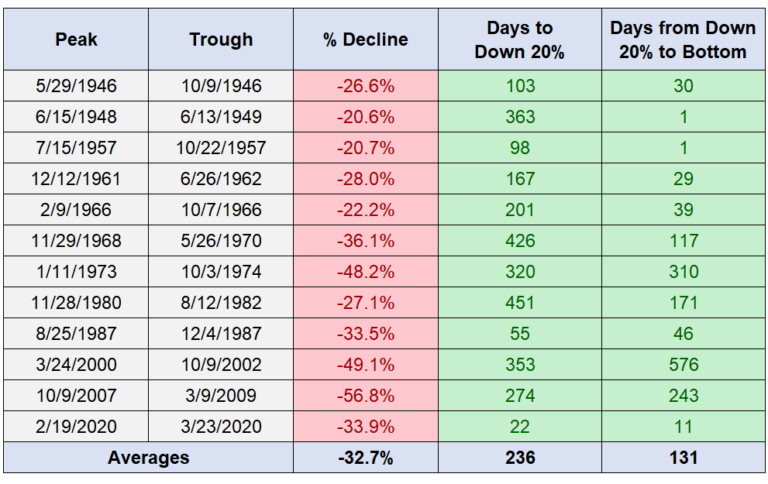
Chart showing peaks and troughs of previews bear markets
Source: Ben Carlson, A Wealth of Common Sense.

The chart below shows how the S&P 500 bounced back after first-half falls of 15% or more. The sample size is small, however, with only five instances going back to 1932. The S&P 500 did rise in each of these instances, with an average return of 23.66% and a median rise of 15.25%.

S&P 500 second-half performance after a first-half fall of 15% or more
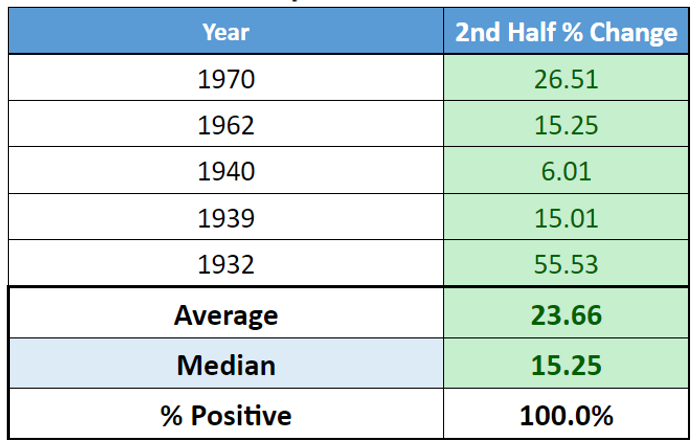
Chart showing S&P 500 second-half performance after 15% fall in the first half
Source: Dow Jones Market Data, MarketWatch. 

Looking at the Dow Jones Index provides a larger sample size. The Dow Jones has had 15 instances of first-half declines of greater than 10%. The Dow was down almost 15% for the first half of the year, its largest decline since 2008. More than two-thirds of the time, the Dow rallied in the second half of the year for an average return of 4.45% and a median return of almost 7%.

DJIA second-half performance after 10% fall in first half 
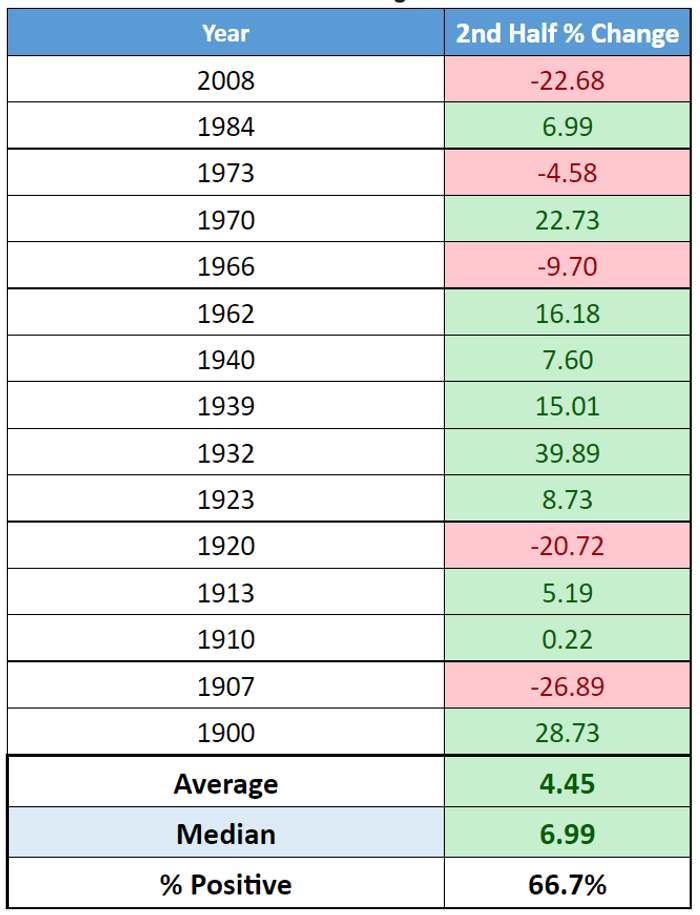
Chart showing Dow Jones second-half performance after 10% fall in the first half
Source: Dow Jones Market Data, MarketWatch.

Please remember that past results do not guarantee future returns. Time will tell how the market responds to the current bear market. The charts above provide some great context for staying invested and hope that positive market returns may be around the corner.

So, what can we learn from all this? For the second half of 2022, we anticipate volatility to remain in both the equity and fixed-income markets. Our plan is to remain invested, take advantage of the markets being down by tax loss harvesting, and as always, to make the necessary tweaks to the portfolio as the economy continues to change. It appears more evident that the U.S. is headed towards a recession. GDP is likely to show two straight quarters of negative growth, a traditional sign that the economy is in a recession. Remember, though, that the stock market is a leading indicator and is already projecting that the economy is softening. Once the economy is in an official recession, the market is forward-looking and heading towards a recovery. 

We will continue to focus on the fact that what really matters right now is time in the market, not out of the market. That means staying the course and continuing to invest, even when the markets dip, to take advantage of potential market upturns. We continue to adhere to the tried-and-true disciplines of diversification, periodic rebalancing and looking forward, while not making investment decisions based on where we have been. It is important to focus on the long-term goal, not on one specific data point or indicator. 

In markets and moments like these, it is essential to stick to the financial plan. Investing is about following a disciplined process over time.

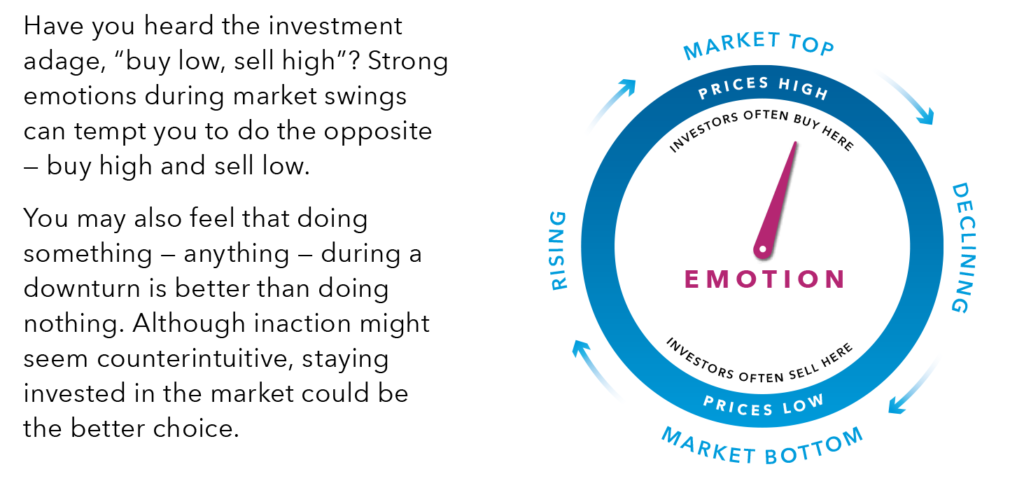
At the end of the day, investors will be well-served to remove emotion from their investment decisions and remember that over time, markets tend to rise. During volatile markets, it is important to remember that the fear of losing money is stronger than the joy of making money. Investor emotions can have a big impact on retirement outcomes. Market corrections and bear markets are normal; nothing goes up in a straight line. Making market decisions based on what might happen may be detrimental to long-term performance. The key is to stay invested and stick with the financial plan. Markets go up and down over time, and downturns present opportunities to purchase stocks at a lower value.

It all starts with a solid financial plan for the long run that understands the level of risk that is acceptable for each client. Regarding investments, we believe in diversification and having different asset classes that allow you to stay invested. The best option is to stick with a broadly diversified portfolio that can help you to achieve your own specific financial goals — regardless of market volatility. Long-term fundamentals are what matter.

Sources: Ben Carlson, Dow Jones Data, Schwab

Promo for article titled Here's Why Today's Housing Market is Different From 2008

This material contains an assessment of the market and economic environment at a specific point in time and is not intended to be a forecast of future events, or a guarantee of future results. Forward-looking statements are subject to certain risks and uncertainties. Actual results, performance, or achievements may differ materially from those expressed or implied. Information is based on data gathered from what we believe are reliable sources.

Using diversification as part of your investment strategy neither assures nor guarantees better performance and cannot protect against loss of principal due to changing market conditions.

Past performance is not a guarantee of future results.

The opinions expressed in this commentary are those of the author and may not necessarily reflect those held by Kestra Investment Services, LLC or Kestra Advisory Services, LLC. This is for general information only and is not intended to provide specific investment advice or recommendations for any individual. It is suggested that you consult your financial professional, attorney, or tax advisor with regard to your individual situation.

Securities offered through Kestra Investment Services, LLC (Kestra IS), member FINRA/SIPC. Investment Advisory Services offered through Kestra Advisory Services, LLC (Kestra AS) an affiliate of Kestra IS. CD Wealth Management and Bluespring Wealth Partners LLC* are affiliates of Kestra IS and Kestra AS.  Investor Disclosures: https://bit.ly/KF-Disclosures

*Bluespring Wealth Partners, LLC acquires and supports high quality investment adviser and wealth management companies throughout the United States.
What Should Investors Consider in a Bear Market?

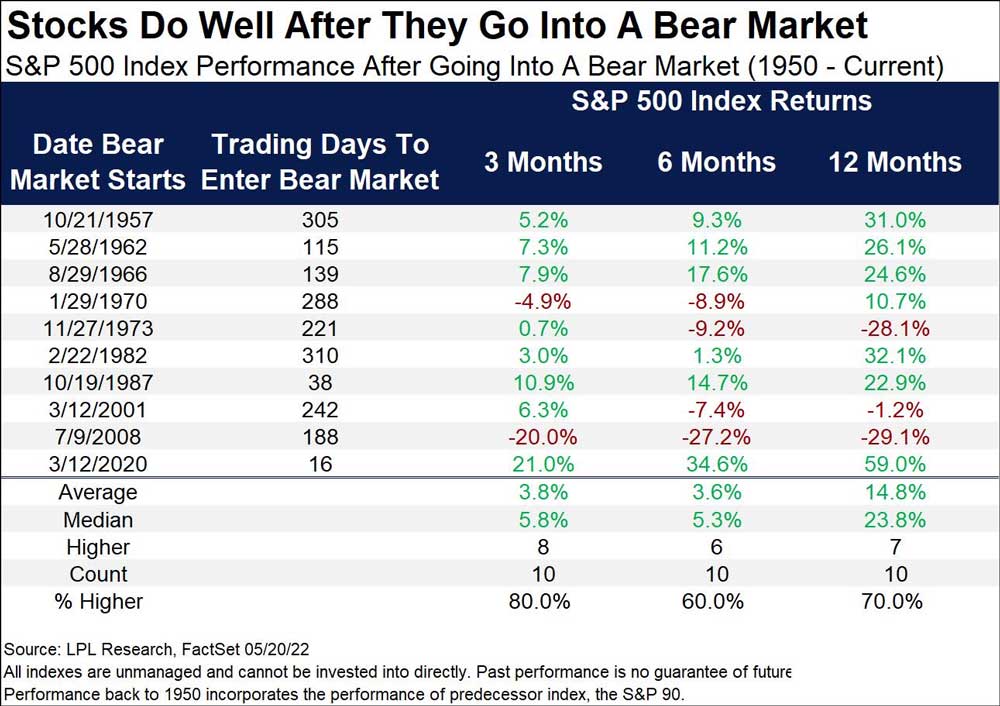
Markets are good at reminding investors that stock prices don’t always go up. U.S. stocks continued their sharp drop on Monday after Friday’s inflation report, which showed that consumer prices rose at their fastest pace in 41 years. Although economists were already seeing signs of peak inflation with home, used car and lumber prices decreasing, the war in Ukraine’s effect on oil and gas prices led to a much stronger increase in the month-over-month consumer price index (CPI). As the markets braced for the Federal Reserve’s announcement on interest rate hikes, stocks in the S&P 500 again entered bear market territory, closing more than 20% below their all-time highs (which were set earlier this year). As we’ve written recently, bear markets, last an average of 15 months, while the average bull market lasts about six years. The chart below is a great reminder that on average, stocks have performed well three, six and 12 months after falling into a bear market.

Down markets provide investors with opportunities that may help with returns, reduce risk and provide tax advantages over time. What should you consider in a down market like the one we have today?

First, and foremost, do not panic

Panic is not an investing strategy. Selling and going into cash when the market is down can do irreparable harm to your long-term financial outlook. There is a reason you have a financial plan, and now more than ever is the time to stick with it.

Rebalancing portfolios

Investment portfolio construction, when done properly, is made up of various securities and asset classes that each perform differently. You may have often heard the term “asset allocation,” which references how a portfolio is constructed of stocks, bonds, cash, etc. Within each of these categories, there are different investment exposures. For stocks, the exposures might be small-cap, mid-cap, large-cap and international, while bond exposure may have investment-grade bonds, high-yield bonds, floating-rate bonds, treasuries, etc. By combining each of the different asset classes together, the overall risk of the portfolio may be reduced.

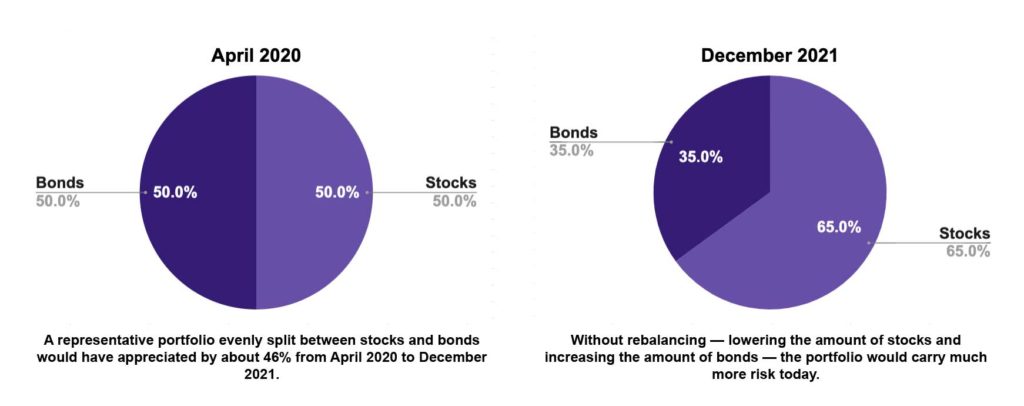
Over time, the portfolio may need to be rebalanced. Think of it like taking your car in for a tune-up after hitting a big pothole or speed bump. After large market moves, either up or down, a portfolio may benefit from tweaks or adjustments. The graph below displays how a portfolio needs a tune-up. Following the pandemic, a portfolio that had a 50-50 stock/bond allocation has grown to 65% stocks and 35% bonds a year and a half later, due to the run up in the market. Rebalancing helps investors ensure that they’re taking an acceptable level of portfolio risk and adhering to their set financial plan. It also helps with the adage of “buy low and sell high.”

Without Rebalancing, Large Market Moves Can Add Risk to a Portfolio

Tax-Loss Harvesting

When markets are rising and stocks or funds are sold for a profit, taxable gains occur. While taxable gains are not necessarily fun, they are a necessary part of investing. Selling holdings when the values are down may generate losses, which can be used to offset capital gains and potentially lower your future tax bill. Investment losses may also be used to reduce taxes on ordinary income. For further details, please see our past client letter on tax-loss harvesting.

Dollar-Cost Averaging*

Who doesn’t like shopping when their favorite items are 20% off or even more? With Monday’s losses, the S&P 500 is down nearly 22% from its high in January. The NASDAQ and Russell 2000 are down almost 30% from their recent highs. Investing in stocks when prices are down can be a powerful way to generate wealth over time. We recognize that it may be hard to invest more cash into the market when it is falling, but that is where dollar-cost averaging comes into play. For those in a 401K plan, this is exactly what you are doing – every two weeks you are investing money into the portfolio, whether the market is up or down.

There are very few free lunches in the investment world. As the saying goes, if it is too good to be true, then more than likely it is. However, asset allocation, diversification and periodic rebalancing are as close as it gets to a free lunch for investors. We are fully aware that down markets can be painful. At the same time, they can create opportunities for those who have excess cash. The chart below is a great reminder that historically, bull markets last much longer than bear markets, and the total return of a bull market far outweighs the negative return during a bear market.

Source: Charles Schwab

So, what can we learn from all this? Sticking with the financial plan during times like these can be a real challenge – but that is why you have the plan. If we use our heads and don’t act on emotion, we can expect a more successful investing future — and maybe even get a free lunch along the way, thanks to rebalancing, tax-loss harvesting and dollar-cost averaging.

During these challenging times, it is important to keep the following in mind: 

• Ignore the noise and sensationalist headlines.
• Remember that selling into a panic is not an investment strategy.
• Market declines are a part of economic cycles.
• Don’t try to time the market. Instead invest regularly, even when the market is falling.

It is likely that this recent market drop may be a mere blip in the long-term investment plan. We do not try to time the market. What really matters is time in the market, not out of the market. That means staying the course and continuing to invest, even when the markets dip to take advantage of potential market upturns. We continue to adhere to the tried-and-true disciplines of diversification, periodic rebalancing and looking forward, while not making investment decisions based on where we have been. It is important to focus on the long-term goal, not on one specific data point or indicator. In markets and moments like these, it is essential to stick to the financial plan. Investing is about following a disciplined process over time.

Sticking with the financial plan during times like these can be a real challenge – but that is why you have the plan.

At the end of the day, investors will be well-served to remove emotion from their investment decisions and remember that over time, markets tend to rise. During volatile markets, it is it is important to remember that the fear of losing money is stronger than the joy of making money. Investor emotions can have a big impact on retirement outcomes. Market corrections are normal; nothing goes up in a straight line. Making market decisions based on what might happen may be detrimental to long-term performance. The key is to stay invested and stick with the financial plan. Markets go up and down over time, and downturns present opportunities to purchase stocks at a lower value.

It all starts with a solid financial plan for the long run that understands the level of risk that is acceptable for each client. Regarding investments, we believe in diversification and having different asset classes that allow you to stay invested. The best option is to stick with a broadly diversified portfolio that can help you to achieve your own specific financial goals — regardless of market volatility. Long-term fundamentals are what matter.

Sources: Kestra Investment Management, LPL, Schwab

*Dollar cost averaging does not assure a profit and does not protect against a loss in declining markets.  This strategy involves continuous investing; you should consider your financial ability to continue purchases no matter how prices fluctuate.

This material contains an assessment of the market and economic environment at a specific point in time and is not intended to be a forecast of future events, or a guarantee of future results. Forward-looking statements are subject to certain risks and uncertainties. Actual results, performance, or achievements may differ materially from those expressed or implied. Information is based on data gathered from what we believe are reliable sources.

Using diversification as part of your investment strategy neither assures nor guarantees better performance and cannot protect against loss of principal due to changing market conditions.

Past performance is not a guarantee of future results.

The opinions expressed in this commentary are those of the author and may not necessarily reflect those held by Kestra Investment Services, LLC or Kestra Advisory Services, LLC. This is for general information only and is not intended to provide specific investment advice or recommendations for any individual. It is suggested that you consult your financial professional, attorney, or tax advisor with regard to your individual situation.

Securities offered through Kestra Investment Services, LLC (Kestra IS), member FINRA/SIPC. Investment Advisory Services offered through Kestra Advisory Services, LLC (Kestra AS) an affiliate of Kestra IS. CD Wealth Management and Bluespring Wealth Partners LLC* are affiliates of Kestra IS and Kestra AS. Investor Disclosures: https://bit.ly/KF-Disclosures

*Bluespring Wealth Partners, LLC acquires and supports high quality investment adviser and wealth management companies throughout the United States.
4 strategies to help investors worry less about the markets

Rising recession fears pushed U.S. stocks briefly into bear market territory last week, with the S&P 500’s decline from its all-time high reaching 20%. There is no official bear market designation on Wall Street, though some may count Friday’s intraday lows as confirmation of one. The Dow Jones is mired in an eight-week losing streak, the longest since 1923. Meanwhile, the S&P 500 has been down seven straight weeks, the worst run since 2001.

We recognize that these times may make investors uncomfortable. Jack Bogle, the founder of Vanguard, famously said, “Stay the course, don’t let these changes in the market, even the big ones [like the financial crisis] … change your mind — and never, never, never be in or out of the market. Always be in at a certain level.” When the market was experiencing wild fluctuations in 2016, the great Warren Buffet told investors, “Don’t watch the market closely. Try not to worry too much about it.”

Here are four ways to stay on track toward achieving your goals while avoiding the common pitfalls investors experience during turbulent times:

Remember that this, too, shall pass. 

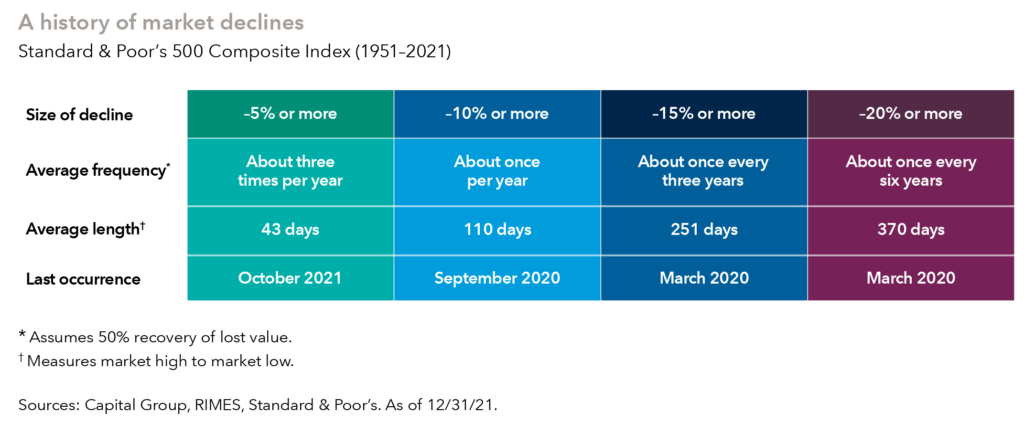
Declines have been common occurrences and, on average, have not lasted a long time. Investors who realize that declines are inevitable and temporary have avoided the imprudent behavior of selling out of the market during down times. The market has always recovered from declines (although past results don’t guarantee future results). The chart below puts into context the frequency and duration of previous declines.

Chart showing a history of market declines in the S&P 500 from 1951 to 2021

Keep your focus on the future. 

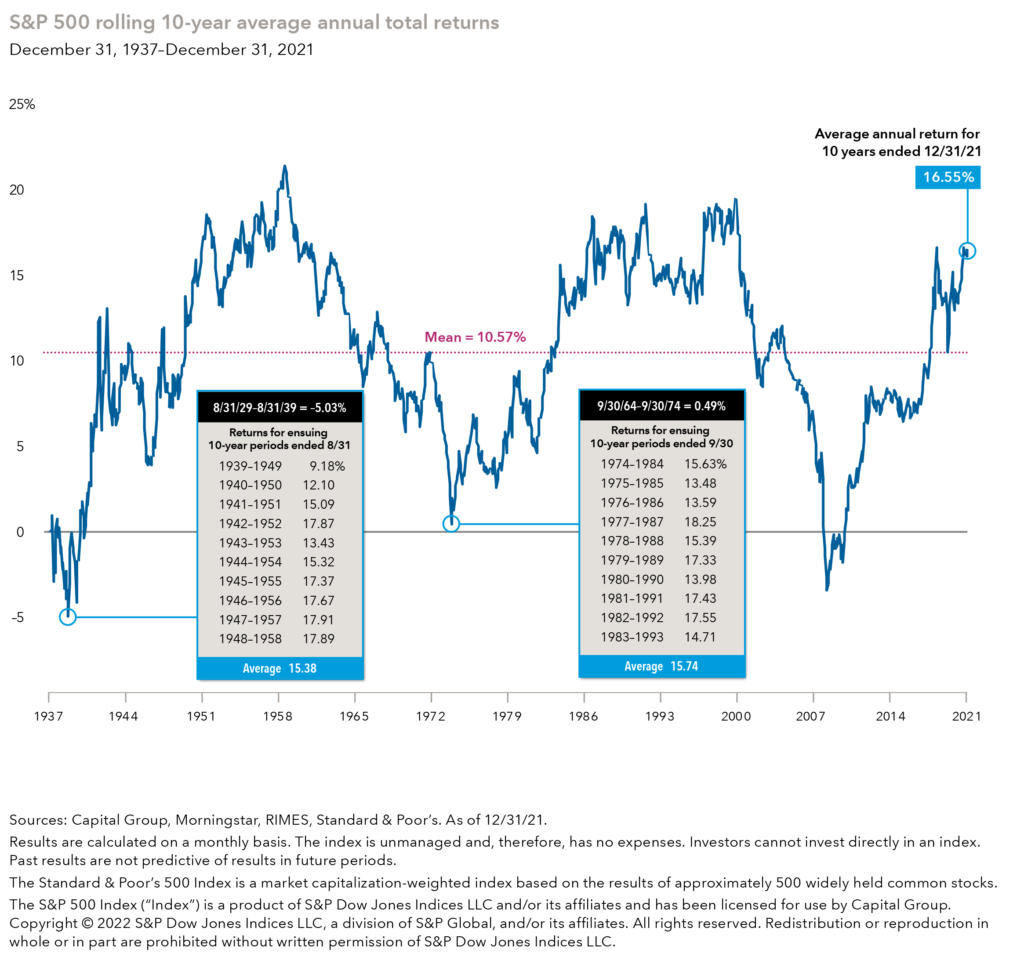
It is important to maintain proper perspective; don’t place too much emphasis on recent events or disregard long-term realities. Long-term investors have been rewarded: The chart below shows that going back to 1937, the 10-year average return of the S&P 500 is 10.57%. That doesn’t mean that there haven’t been periods of time with below-average returns, but staying invested through those times has paid off for the long-term investor.

Chart showing the S&P 500 rolling 10-year average annual total returns

Don’t try to time the market.

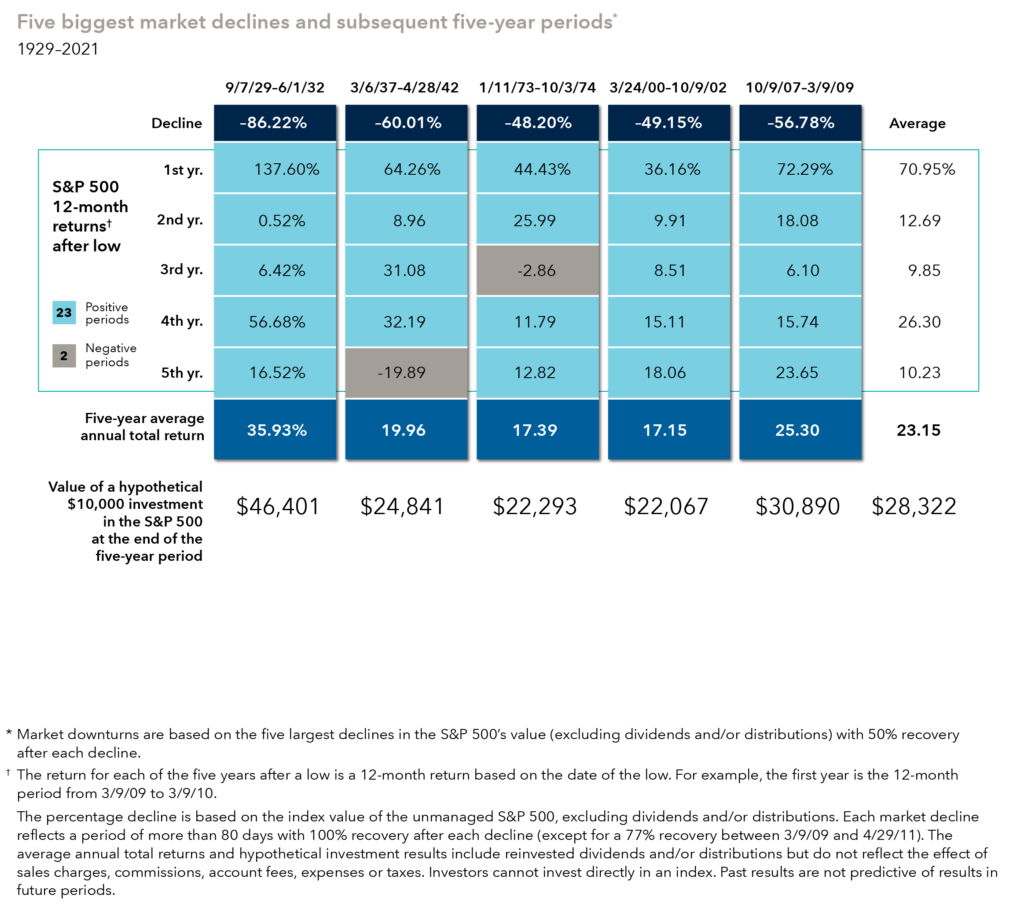
If you sell now and hope to get back into the market if it goes down further, you could miss out on gains when stocks recover. As we have written before, the pain humans feel from losses is greater than the joy they feel from an equal gain. Every S&P 500 downturn of 15% or more has been followed by a recovery. As shown on the chart below, the average return following the five biggest market declines since 1929 has been 70.95%. Over the longer term, the average value of an investment more than doubled over the five years after each market low.

Chart showing the five biggest market declines and subsequent five-year periods from 1929 to 2021

Don’t let emotions cloud your judgment.

As we often say, avoid the noise. Look past the headlines and stay focused on the longer-term goals. Don’t look at the market — or your account value — every day. During volatile times, look at the portfolio less often, knowing we are watching your portfolios very closely and continuing to make tweaks along the way. Investors tend to make poor decisions when they let their emotions take over.

Image of the emotional cycle during market volatility

So, what can we learn from all this? It is always difficult to see the value of your investments fall. During these challenging times, it is important to keep the following in mind:

• Ignore the noise of the sensational headlines.
• Selling into a panic is not an investment strategy.
• Market declines are a part of economic cycles.
• Don’t try to time the market, and do invest regularly, even when the market is falling.

It is likely that the current market drop may be a mere blip in the long-term investment plan. We are not going to try to time the market; what really matters is time in the market, not out of the market. That means staying the course and continuing to invest, even when the markets dip, to take advantage of potential market upturns.

We continue to adhere to the tried-and-true disciplines of diversification, periodic rebalancing and looking forward, while not making investment decisions based on where we have been. It is important to focus on the long-term goal, not on one specific data point or indicator. In markets and moments like these, it is essential to stick to the financial plan. Investing is about following a disciplined process over time.

At the end of the day, investors will be well-served to remove emotion from their investment decisions, and remember that over a longer time horizon, markets tend to rise. Understanding that people fear losing money more than they enjoy making money is important during volatile markets. Investor emotions can have a big impact on retirement outcomes. 

Market corrections are normal, as nothing goes up in a straight line. Making market decisions based on what might happen may be detrimental to long-term performance. The key is to stay invested and stick with the financial plan. Markets go up and down over time, and downturns present opportunities to purchase stocks at a lower value.

It all starts with a solid financial plan for the long run that understands the level of risk that is acceptable for each client. Regarding investments, we believe in diversification and having different asset classes that allow you to stay invested. The best option is to stick with a broadly diversified portfolio that can help you to achieve your own specific financial goals — regardless of market volatility. Long-term fundamentals are what matter.

Source: American Funds, CNBC

Promo for an article titled Frequently Asked Questions as the Market Correction Continues

This material contains an assessment of the market and economic environment at a specific point in time and is not intended to be a forecast of future events, or a guarantee of future results. Forward-looking statements are subject to certain risks and uncertainties. Actual results, performance, or achievements may differ materially from those expressed or implied. Information is based on data gathered from what we believe are reliable sources.

Using diversification as part of your investment strategy neither assures nor guarantees better performance and cannot protect against loss of principal due to changing market conditions.

Past performance is not a guarantee of future results.

The opinions expressed in this commentary are those of the author and may not necessarily reflect those held by Kestra Investment Services, LLC or Kestra Advisory Services, LLC. This is for general information only and is not intended to provide specific investment advice or recommendations for any individual. It is suggested that you consult your financial professional, attorney, or tax advisor with regard to your individual situation.

Securities offered through Kestra Investment Services, LLC (Kestra IS), member FINRA/SIPC. Investment Advisory Services offered through Kestra Advisory Services, LLC (Kestra AS) an affiliate of Kestra IS. CD Wealth Management and Bluespring Wealth Partners LLC* are affiliates of Kestra IS and Kestra AS.  Investor Disclosures: https://bit.ly/KF-Disclosures

*Bluespring Wealth Partners, LLC acquires and supports high quality investment adviser and wealth management companies throughout the United States.

FAQs as the market correction continues

The overall market sentiment feels very negative as the market has declined five consecutive weeks and began this week in similar fashion. Consumer confidence, a leading economic indicator, is negative. Market volatility remains elevated, as the VIX index closed at 35, more than double the historical value. Inflation is on everyone’s mind these days, especially at the grocery store or the gas pump. 

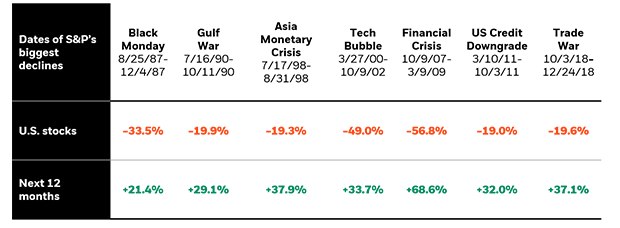
All market corrections feel similar: The sky is falling — how will the market ever come back or turn around? While we recognize that these times are painful from a portfolio perspective, we also realize that market corrections are healthy for the long-term performance of the market. It is important to remember that stock market downturns often are followed by a period of positive market performance. Since 1987, every major decline in U.S. equities has reversed itself between 21% and 68% within the following year, as seen in the chart below. And those who dollar-cost average in their portfolios — whether in taxable or tax-deferred accounts — have the potential to take advantage of the market recoveries by adding more monies into the portfolio.

Chart showing the S&P's biggest declines and the next 12 months' returns
Source: Morningstar as of 2/28/20. Returns are principal only, not including dividends. U.S. stocks represented by the S&P 500. Past performance does not guarantee or indicate future results.

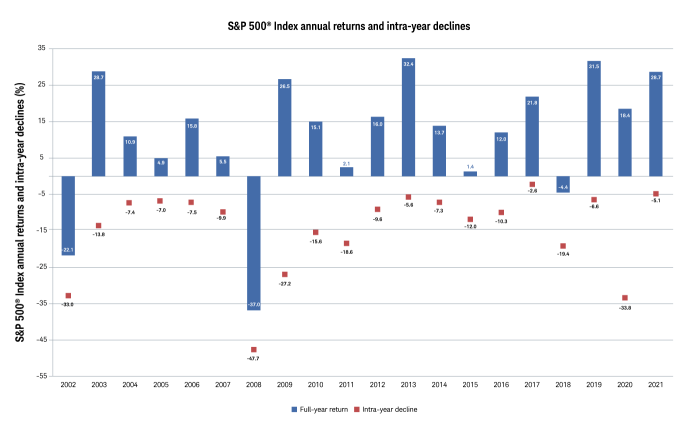
Here’s another way of looking at the volatile nature of markets and corrections: The chart below shows intra-year declines over the 20-year period from 2002 to 2021, which includes the pandemic. A decline of at least 10% occurred in 10 out of 20 years (50% of the time), with an average pullback of 15%.* Despite these pullbacks, stocks rose in most years, with positive returns in all but three years and an average gain of 7%.

Chart showing the S&P 500 Index annual returns and intra-year declines over the last 20 years

We want to share with you a few frequently asked questions that we are receiving during the market sell-off in hopes that they answer questions you may have:

I’m hearing a lot about I-bonds. What are they — and should we invest in them?

Series I Savings Bonds are a type of U.S. savings bond designed to protect the value of cash from inflation. Interest rates on I bonds are adjusted regularly to keep pace with inflation. Investors can purchase up to $10,000 of I bonds annually per person through the government’s Treasury Direct website. I bonds earn interest monthly, though you don’t get access to interest until you cash out the bond. You must own the bond for at least five years to receive all the interest that is due. You cannot sell the I bond before holding for one year. If you sell after one year and before the five-year holding requirement, you forfeit three months of interest that has been earned. These bonds have an actual maturity of 30 years. Keep in mind that these bonds cannot be purchased through our office and can only be purchased online through the Treasury Direct website.

Are there any changes to the portfolio that we need to make, and should we continue to purchase bonds?

As we communicate each week, we are constantly analyzing the market, the economy and the portfolios. To use the old hockey adage, we are skating to where the puck is going, not where it is. We are not going to make changes to the portfolio to time the market, but rather we are being strategic and thoughtful. We understand that market volatility is unsettling, but historically, this is not unusual.  The portfolios are diversified and invested per each client’s risk tolerance. 

We tweaked the fixed-income portion of the portfolio late last year to shorten the maturity and duration of the bonds. Bonds have had their worst start to the year in history, but we do not believe that it is in our clients’ best interest to abandon fixed income and move to cash or to increase risk tolerance and move to equities. While both stocks and bonds are down to start the year as inflation peaks and the Fed slows down interest rate hikes, we believe bonds will provide the necessary diversification and income to help the portfolio during market volatility. 

Bonds can be used for three primary purposes: income, capital preservation and equity diversification. As is the case with equities, being diversified within fixed income may help reduce portfolio risk. As always, we will communicate any portfolio changes as they occur.

Where does the market go from here?

Four main factors continue to be at play with this market: inflation, the war in the Ukraine, China and its continued lockdowns, and the Federal Reserve. Last week, the Fed raised rates by 50 basis points. Chairman Powell commented that the Fed is “strongly committed to restoring price stability” and that a 75-basis point hike is “not something the committee is actively considering.” Stocks are likely to remain volatile as the Fed pushes interest rates higher. 

The possibility of a recession later this year or next year remains in play, but strong earnings growth and record low unemployment are not recessionary indications. Remember that the stock market is a leading economic indicator, and often, the market sells off before the recession or the economic bottom of the cycle. By the time the economy feels worse, the stock market is already starting to recover. We do not know when the market will hit bottom, but we remain strong believers in the long-term fundamentals of the market.

Promo for article titled Before You Sell for a Loss, Make Sure You Know the Wash-Sale Rule

So, what can we learn from all this?  Selling into a panic is not an investment strategy. Understanding that people fear losing money more than they enjoy making money is important during volatile markets. Investor emotions can have a big impact on retirement outcomes.

It is likely that this recent market drop may be a mere blip in the long-term investment plan. We are not going to try to time the market; what really matters is time in the market, not out of the market. That means staying the course and continuing to invest — even when the markets dip — to take advantage of potential market upturns.  

We continue to adhere to the tried-and-true disciplines of diversification, periodic rebalancing and looking forward, while not making investment decisions based on where we have been. It is important to focus on the long-term goal, not on one specific data point or indicator. In markets and moments like these, it is essential to stick to the financial plan. Investing is about following a disciplined process over time.

At the end of the day, investors will be well-served to remove emotion from their investment decisions and remember that over a longer time horizon, markets tend to rise. Market corrections are normal, as nothing goes up in a straight line. Making market decisions based on what might happen may be detrimental to long-term performance. The key is to stay invested and stick with the financial plan. Markets go up and down over time, and downturns present opportunities to purchase stocks at a lower value.

It all starts with a solid financial plan for the long run that understands the level of risk that is acceptable for each client. Regarding investments, we believe in diversification and having different asset classes that allow you to stay invested. The best option is to stick with a broadly diversified portfolio that can help you to achieve your own specific financial goals — regardless of market volatility. Long-term fundamentals are what matter.

Sources: Blackrock, Forbes, Schwab
*As of Tuesday, May 10, the S&P 500 is down more than 15% year-to-date

Promo for article on the formula for wealth

This material contains an assessment of the market and economic environment at a specific point in time and is not intended to be a forecast of future events, or a guarantee of future results. Forward-looking statements are subject to certain risks and uncertainties. Actual results, performance, or achievements may differ materially from those expressed or implied. Information is based on data gathered from what we believe are reliable sources.

Using diversification as part of your investment strategy neither assures nor guarantees better performance and cannot protect against loss of principal due to changing market conditions.

Past performance is not a guarantee of future results.

The opinions expressed in this commentary are those of the author and may not necessarily reflect those held by Kestra Investment Services, LLC or Kestra Advisory Services, LLC. This is for general information only and is not intended to provide specific investment advice or recommendations for any individual. It is suggested that you consult your financial professional, attorney, or tax advisor with regard to your individual situation.

Securities offered through Kestra Investment Services, LLC (Kestra IS), member FINRA/SIPC. Investment Advisory Services offered through Kestra Advisory Services, LLC (Kestra AS) an affiliate of Kestra IS. CD Wealth Management and Bluespring Wealth Partners LLC* are affiliates of Kestra IS and Kestra AS.  Investor Disclosures: https://bit.ly/KF-Disclosures

*Bluespring Wealth Partners, LLC acquires and supports high quality investment adviser and wealth management companies throughout the United States.

Before you sell for a loss, make sure you know the wash-sale rule

Over the last three years, the stock market has provided some valuable investment gains. So far in 2022, the market has given back some of those gains — and as a result, we have an opportunity to capture some investment losses. One of the nice aspects of the tax code is that if an investment is trading at a loss, you can sell the holding and reduce your taxable income. 

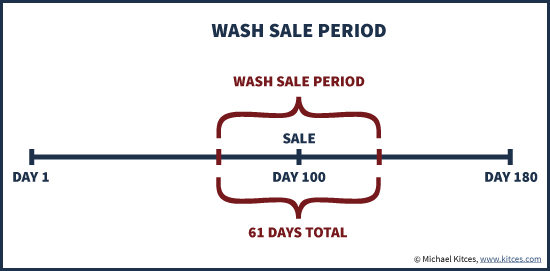
We recognize that an investor may have seller’s remorse in a down market, but capturing losses to offset current income taxes or future gains is a prudent portfolio management strategy. It is important to note that when you sell a holding for a loss, you do not want to replace that holding with a “substantially identical” investment either 30 days before or 30 days after the sale date, within the timeframe pictured below. Doing so would be a violation of the wash-sale rule.

Graphic explaining the 61-day period set up by the wash-sale rule


What is the wash-sale rule?

When you sell an investment that has a loss in a taxable account, you may be eligible for a tax benefit. The wash-sale rule prevents investors from selling at a loss, then buying back the “substantially identical” investment within a 61-day window and being able to claim the tax benefit. This rule applies to stocks, bonds, mutual funds, exchange traded funds (ETFs) and options. 

The wash-sale rule states that the tax loss will be disallowed if you buy the same security or “substantially identical” security within 30 days before or after the date you sold the investment for a loss. This includes selling a holding for a loss in a taxable account and then buying it back in a tax-advantaged account. 

How can you avoid the wash-sale rule?

ETFs or mutual funds can be helpful in avoiding the wash-sale rule, especially if you are selling an individual stock for a loss. Swapping one ETF for another — or one mutual fund for another — can be tricky because of the “substantially identical” security rule. There are no clear guidelines on what constitutes a “substantially identical” security. If you sell one individual stock and then purchase another security, avoiding the wash-sale rule is much more straightforward. The IRS determines if your transactions violate the rule. If that does happen, you may end up paying more taxes than you anticipated.

You can avoid the wash-sale rule typically in the following ways:
   • Avoid buying the same or similar investment 30 days before and after the sale.
   • Invest in a materially different investment than the one you sold.
   • Have a long-term investment plan during market downturns to help you make the best investing decisions, and don’t sell into a panic and then repurchase.

Remember, you cannot sell an investment for a loss in one account and buy it back in another account, such as in an IRA or spouse’s account. This would disallow the loss to be used since the accounts are under the same ownership. As always, we recommend that you consult with a CPA if you have questions.

What is the penalty?

If the IRS determines that you have violated the wash-sale rule, you cannot use the loss on the sale to offset gains or reduce taxable income. The loss is then added to the cost basis of the new investment. The holding period is added to the holding period of the new investment. There may be a long-term benefit to the higher cost basis to reduce future taxes, and the holding period may help you qualify for long-term capital gains tax rather than short-term capital gains tax. In the short run, however, you are not able to use the loss that you were hoping to have when the investment was sold. 

Promo for article on the formula for wealth

So, what can we learn from all this? While no one wants to see their portfolio value decrease, rebalancing the portfolio (as we did recently) may create some tax losses that can be used to help offset future gains or current income. Tax loss harvesting is an important investment principle and one that we have written about in detail. When one sells a holding for a loss in a taxable account, a “substantially identical” holding cannot be purchased 30 days before or after the sale to avoid the wash-sale rule. It is important to consult your CPA with any questions on the wash-sale rule.

Market volatility can be unsettling, but for long-term investors, it is not unusual. It is likely that the recent market drop could be a mere blip in the long-term investment plan. We are not going to try to time the market; what really matters is time in the market, not out of the market. That means staying the course and continuing to invest, even when the markets dip. 

We continue to adhere to the tried-and-true disciplines of diversification, periodic rebalancing and looking forward, while not making investment decisions based on where we have been. It is important to focus on the long-term goal, not on one specific data point or indicator. In markets and moments like these, it is essential to stick to the financial plan. Remember, first and foremost, that panic is not an investing strategy. Neither are “get in” or “get out” — those are just gambling on moments in time. Investing is about following a disciplined process over time.

At the end of the day, investors will be well-served to remove emotion from their investment decisions and remember that over longer time horizons, markets tend to rise. Market corrections are normal, as almost nothing goes up in a straight line. Making market decisions based on what might happen may be detrimental to long-term performance. The key is to stay invested and stick with the financial plan. Markets go up and down over time, and downturns present opportunities to purchase stocks at a lower value.

It all starts with a solid financial plan for the long run that understands the level of risk that is acceptable for each client. Regarding investments, we believe in diversification and having different asset classes that allow you to stay invested. The best option is to stick with a broadly diversified portfolio that can help you to achieve your own specific financial goals — regardless of market volatility. Long-term fundamentals are what matter.

Sources: Fidelity, Forbes, Kitces

Promo for article titled Today's Market Volatility is Unsettling but not Unusual

This material contains an assessment of the market and economic environment at a specific point in time and is not intended to be a forecast of future events, or a guarantee of future results. Forward-looking statements are subject to certain risks and uncertainties. Actual results, performance, or achievements may differ materially from those expressed or implied. Information is based on data gathered from what we believe are reliable sources.

Using diversification as part of your investment strategy neither assures nor guarantees better performance and cannot protect against loss of principal due to changing market conditions.

Past performance is not a guarantee of future results.

The opinions expressed in this commentary are those of the author and may not necessarily reflect those held by Kestra Investment Services, LLC or Kestra Advisory Services, LLC. This is for general information only and is not intended to provide specific investment advice or recommendations for any individual. It is suggested that you consult your financial professional, attorney, or tax advisor with regard to your individual situation.

Securities offered through Kestra Investment Services, LLC (Kestra IS), member FINRA/SIPC. Investment Advisory Services offered through Kestra Advisory Services, LLC (Kestra AS) an affiliate of Kestra IS. CD Wealth Management and Bluespring Wealth Partners LLC* are affiliates of Kestra IS and Kestra AS.  Investor Disclosures: https://bit.ly/KF-Disclosures

*Bluespring Wealth Partners, LLC acquires and supports high quality investment adviser and wealth management companies throughout the United States.
Today’s market volatility is unsettling — but not unusual

U.S. stocks fell hard on Friday, extending a run of three consecutive down weeks in the market. The selling continued to begin the week as investors reacted to disappointing earnings results from Netflix and other companies, the Federal Reserve’s increasingly aggressive talk about interest rate increases, the war in Ukraine and further lockdowns in China. With its drop on Friday, the S&P 500 is down more than 10% on the year and back in correction mode. Market volatility, as measured by the VIX index, has increased as the Fed’s plans to tackle inflation have evolved. We are likely to see continued spikes in the VIX index, given the uncertainty in the current economic environment.

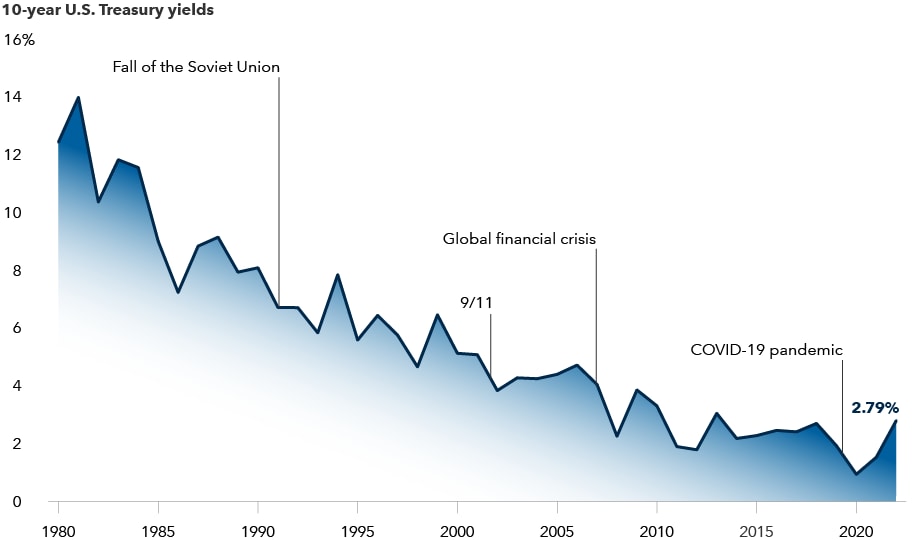
Last week, Fed Chairman Jerome Powell suggested that the central bank may be envisioning a quicker series of interest rate hikes than previously expected. Markets are bracing for a half-point increase in May, with more tightening ahead. The chart below provides a historical perspective of 10-year Treasury yields since 1980; we are a long way from the interest rates many remember from the early ’80s. David Hoag, the portfolio manager of Bond Fund of America said this week, “Central banks will do what they need to do to get inflation under control, but I don’t think that they will be able to go too far before the real economy starts hurting.” What he is implying is that the Fed is not likely to raise the federal funds target rate anywhere near the long-term historical average of 5% (today, we are in a range between .25% and .50%).

Free fall: Interest rates have plummeted in the era of easy money

Chart showing 10-year U.S. Treasury yields from 1980 to today
Sources:  Federal Reserve, Refinitiv Datastream. As of 4/11/22

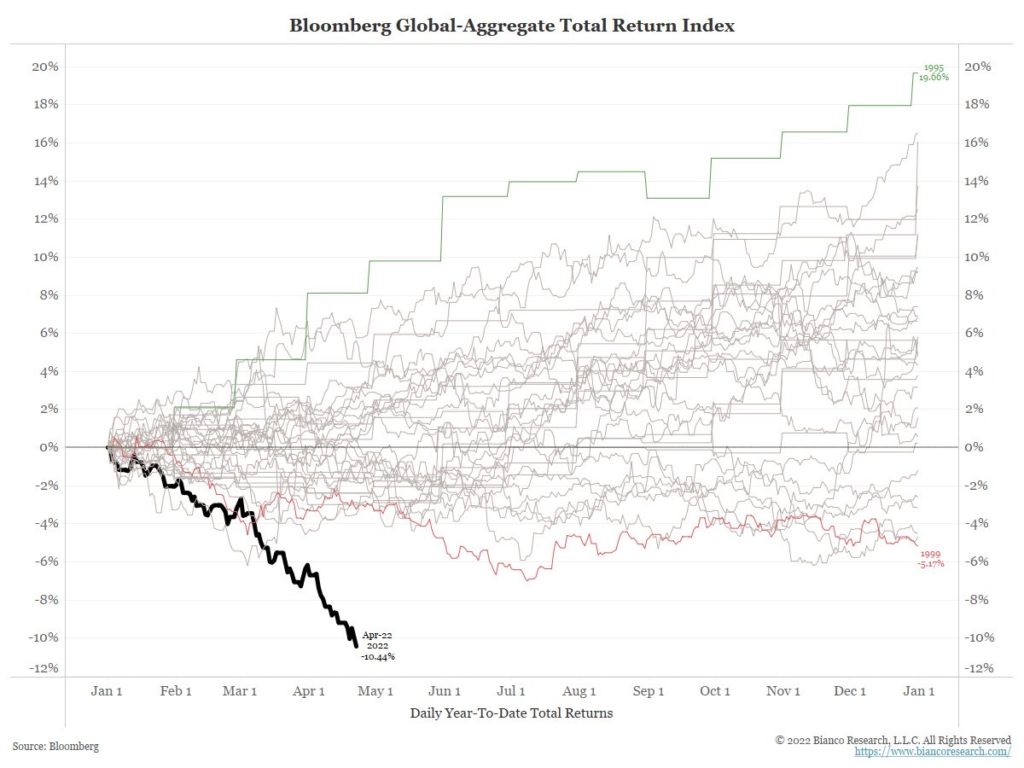
Central Banks around the world are likely to join the U.S. Federal Reserve Bank in trying to get inflation under control. The strong global economy, war in Ukraine and supply chain disruptions continue to put upward pressure on prices. Most investors follow the stock market more than the bond market. As we recently wrote, the bond market has had a rough start to the year. The chart below shows that the bond aggregate index is down more than 10% through Friday. Rate-hike expectations have pushed bond yields higher, with 2-year Treasury yields up almost 2% on the year and 10-year Treasury yields up by almost 1.5%. We believe the bond market is pricing in most of the expected tightening. The good news: Higher yields create potential opportunities for fixed-income investors, who can earn better yields and returns than we have seen in the last three years.

Chart showing the Bloomberg Global-Aggregate Total Return Index

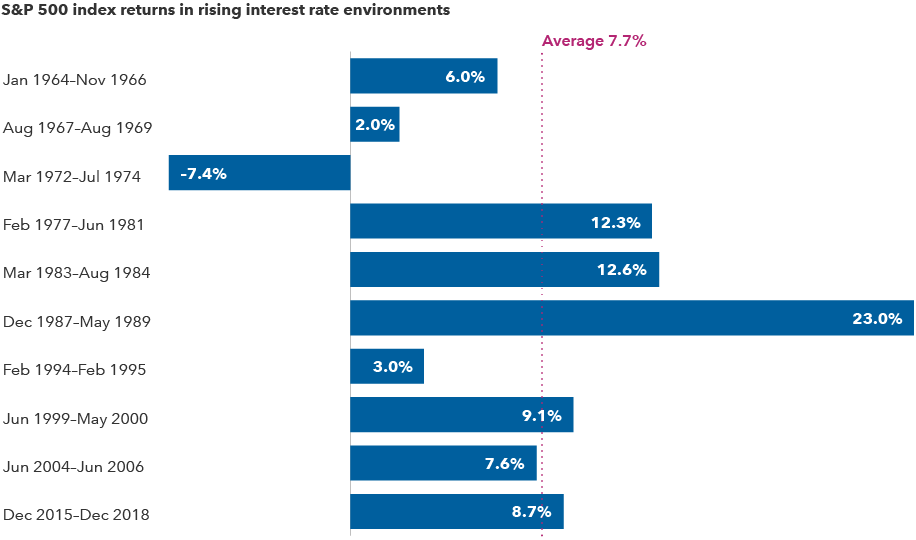
Over long periods of time, markets have tended to adjust to rising rates. During the last 10 periods of rising interest rates, the S&P 500 has posted an average return of 7.7%. Bonds have also held up well during the same time, with an average return of 3.9% during seven rate-hiking cycles dating back to 1983. Of course, the usual caveat remains: Past results are not predictive of future returns, as each market cycle is different.

Sources:  Capital Group, Refinitv Datastream, Standard & Poor’s, U.S. Federal Reserve
S&P 500 returns represent annualized total returns

Despite the uncertainties, plenty of reasons for optimism remain, and these are several to watch:

• NATO is unified against Russia, and the Macron victory in France is a big statement for unification.
• Russia is bogging down in Ukraine and struggling to win the war.
• Individual tax revenues are up by almost 35% this year compared to 2021. 
• The deficit appears to be shrinking at a fast pace and could end the year at $1 trillion, compared to $2.77 trillion in 2021.
• The Supply Management Purchasing Managers Index, a reliable predictor of growth across the economy, has retreated from its post-COVID peak but remains at levels that signal growth ahead.
• The labor market remains tight and is beginning to draw older Americans who quit or retired during the pandemic back into the workforce.
• Profit margins for S&P 500 companies stood at record levels at the end of 2021.

So, what can we learn from all this? Market volatility can be unsettling, but for long-term investors, it is not unusual. The recent market drop is likely to be a mere blip in the long-term investment plan. We are not going to try to time the market; what really matters is time in the market, not out of the market. That means it is important to stay the course and continue to invest, even when the markets dip. We continue to adhere to the tried-and-true disciplines of diversification, periodic rebalancing and looking forward, while not making investment decisions based on where we have been.

It is important to focus on the long-term goal, not on one specific data point or indicator. In markets and moments like these, it is essential to stick to the financial plan. Remember first and foremost that panic is not an investing strategy. Neither are “get in” or “get out” — those are just gambling on moments in time. Investing is about following a disciplined process over time.

At the end of the day, investors will be well-served to remove emotion from their investment decisions and remember that over a longer time horizons, markets tend to rise. Market corrections are normal, as nothing goes up in a straight line. Making market decisions based on what might happen may be detrimental to long-term performance. The key is to stay invested and stick with the financial plan. Markets go up and down over time, and downturns present opportunities to purchase stocks at a lower value.

It all starts with a solid financial plan for the long run that understands the level of risk that is acceptable for each client. Regarding investments, we believe in diversification and in having different asset classes that allow you to stay invested. The best option is to stick with a broadly diversified portfolio that can help you to achieve your own specific financial goals — regardless of market volatility. Long-term fundamentals are what matter.

Sources:  Bloomberg, Capital Group, Schwab

Promo for article on the formula for wealth

This material contains an assessment of the market and economic environment at a specific point in time and is not intended to be a forecast of future events, or a guarantee of future results. Forward-looking statements are subject to certain risks and uncertainties. Actual results, performance, or achievements may differ materially from those expressed or implied. Information is based on data gathered from what we believe are reliable sources.

Using diversification as part of your investment strategy neither assures nor guarantees better performance and cannot protect against loss of principal due to changing market conditions.

Past performance is not a guarantee of future results.

The opinions expressed in this commentary are those of the author and may not necessarily reflect those held by Kestra Investment Services, LLC or Kestra Advisory Services, LLC. This is for general information only and is not intended to provide specific investment advice or recommendations for any individual. It is suggested that you consult your financial professional, attorney, or tax advisor with regard to your individual situation.

Securities offered through Kestra Investment Services, LLC (Kestra IS), member FINRA/SIPC. Investment Advisory Services offered through Kestra Advisory Services, LLC (Kestra AS) an affiliate of Kestra IS. CD Wealth Management and Bluespring Wealth Partners LLC* are affiliates of Kestra IS and Kestra AS.  Investor Disclosures: https://bit.ly/KF-Disclosures

*Bluespring Wealth Partners, LLC acquires and supports high quality investment adviser and wealth management companies throughout the United States.
What portfolio changes are we making to start the second quarter?

As we enter the second quarter of 2022, we want to pause and look back at the difficult start to the year. The “Santa Claus rally” at the end of 2021 seems like a long time ago. Stock prices began to sink right from the first trading day of the year, and the S&P 500 recorded its worst January since 2009. At the low point of the first quarter, the S&P 500 index closed almost 14% below its all-time high. The NASDAQ was down more than 20% during the first quarter, an official bear market. Looking below the surface, the average stock in the S&P 500, NASDAQ and Russell 2000 is down significantly more than the overall index.

Chart showing major indexes and drawdowns

At the same time, the bond market in the first quarter saw U.S. Treasury indexes decline more than 10%, and the Bloomberg US Aggregate Index fell almost 6%. Volatility in the bond market portfolio’s so-called risk-free assets came amid worsening inflation, central bank tightening and the impact of the war in Europe.

We are in the process of reallocating and rebalancing our client portfolios to account for the current economic cycle, as more and more leading economic indicators are pointing toward a recession overseas and possibly in the U.S. in the next six to 24 months.

We are making the following changes: 

1. In 2020, we increased the technology position in the portfolio to take advantage of the boom brought about by the global pandemic. In 2021, we took some profits in tech stocks and slightly reduced the exposure to a market weight level. From a long-term perspective, we continue to believe strongly in technology stocks. As we move from mid cycle to late cycle, we want to continue to trim technology stocks to slightly underweight and add back mid-cap stocks for additional diversification, both in market capitalization and also across economic sectors.

2. While international equities remain less expensive than their U.S. counterparts, the war in Europe and the pandemic’s continuing effects in China continue to weigh heavier on international stocks. We are reducing our international exposure slightly and in turn increasing our allocation to higher-dividend-yielding companies that have a broad exposure to the overall economy in sectors like energy, financials and industrials. At the same time, we are reducing exposure to small-cap stocks. Smaller stocks tend to benefit coming out of a recession rather than heading into a slowdown.

3. From a fixed-income perspective, we reduced our duration of the portfolio in December as we anticipated higher interest rates in 2022. At the same time, we increased our exposure to strategic fixed income to provide for additional income in bonds. We are not making any additional changes to fixed income now, as we believe a lot of the selling in fixed income that occurred in the first quarter is pricing in a worst-case scenario for bonds. 

Our focus remains on long-term investing with a strategic allocation while maintaining a tactical approach. Our decisions to make changes are calculated and well thought-out, looking at where we see the economy is heading. We are not guessing or market timing; we are anticipating and shifting to areas of strength in the economy and the stock market. We strategically have new cash on the sidelines, and we buy in for clients on down days or dips in the market, as one does with a 401(k).  We continually speak with our clients about staying the course and not listening to the noise.

In the short term, the outlook for the global economy continues to deteriorate, and sentiment remains negative. Many economists feel that the Federal Reserve is behind the curve in regard to raising rates to stem the inflation tide while working on soft landing the economy to avoid a recession. 

Promo for article titled You've Inherited an IRA. What Happens Next?

So, what can we learn from all this? Remember, a recession is a regular finale to a business cycle. Every expansion ultimately ends in a recession. We never encourage clients to time large-scale portfolio adjustments with recessions.

From a portfolio perspective, we continue to adhere to the tried-and-true disciplines of diversification, periodic rebalancing and looking forward, while not making investment decisions based on where we have been. As we say each week, it is important to stay the course and focus on the long-term goal, not on one specific data point or indicator. In markets and moments like these, it is essential to stick to the financial plan. Remember, first and foremost, that panic is not an investing strategy. Neither are “get in” or “get out” — those are just gambling on moments in time. Investing is about following a disciplined process over time.

At the end of the day, investors will be well-served to remove emotion from their investment decisions, and remember that over a longer time horizons, markets tend to rise. Market corrections are normal, as nothing goes up in a straight line. Making market decisions based on what might happen may be detrimental to long-term performance. The key is to stay invested and stick with the financial plan. Markets go up and down over time, and downturns present opportunities to purchase stocks at a lower value.

It all starts with a solid financial plan for the long run that understands the level of risk that is acceptable for each client. Regarding investments, we believe in diversification and having different asset classes that allow you to stay invested. The best option is to stick with a broadly diversified portfolio that can help you to achieve your own specific financial goals — regardless of market volatility. Long-term fundamentals are what matter.

Sources: Schwab, Bloomberg

Promo for article on the formula for wealth

This material contains an assessment of the market and economic environment at a specific point in time and is not intended to be a forecast of future events, or a guarantee of future results. Forward-looking statements are subject to certain risks and uncertainties. Actual results, performance, or achievements may differ materially from those expressed or implied. Information is based on data gathered from what we believe are reliable sources.

Using diversification as part of your investment strategy neither assures nor guarantees better performance and cannot protect against loss of principal due to changing market conditions.

Past performance is not a guarantee of future results.

The opinions expressed in this commentary are those of the author and may not necessarily reflect those held by Kestra Investment Services, LLC or Kestra Advisory Services, LLC. This is for general information only and is not intended to provide specific investment advice or recommendations for any individual. It is suggested that you consult your financial professional, attorney, or tax advisor with regard to your individual situation.

Securities offered through Kestra Investment Services, LLC (Kestra IS), member FINRA/SIPC. Investment Advisory Services offered through Kestra Advisory Services, LLC (Kestra AS) an affiliate of Kestra IS. CD Wealth Management and Bluespring Wealth Partners LLC* are affiliates of Kestra IS and Kestra AS.  Investor Disclosures: https://bit.ly/KF-Disclosures

*Bluespring Wealth Partners, LLC acquires and supports high quality investment adviser and wealth management companies throughout the United States.
You’ve inherited an IRA. What happens next?

Prior to December 2019, if you inherited an IRA from someone who was not your spouse, you were able to take distributions from the inherited account based on your life expectancy and not the original owner’s, a strategy commonly known as a Stretch IRA. The benefit of using a Stretch IRA was that the beneficiary could stretch the taxable distributions over their lifetime, which potentially meant a lower tax bill. The rules were the same for a Roth IRA; even though the original Roth IRA owners did not have required minimum distributions, their heirs were required to withdraw the funds according to their life expectancy.

Under current tax law, the inheritance of an IRA is tax-free, but you are still required to take distributions from the account that may be taxable. When you inherit an IRA, you are free to withdraw as much of the account as you want at any time without penalty.

Stretch IRA rules changed with the passage of the SECURE Act in December 2019, however. The SECURE Act mandates that an IRA inherited from someone who is not your spouse must be depleted by Dec. 31 after the 10th anniversary of the owner’s death. For example: If you inherit an IRA this year, you will have to distribute the balance of the account by Dec. 31, 2032.

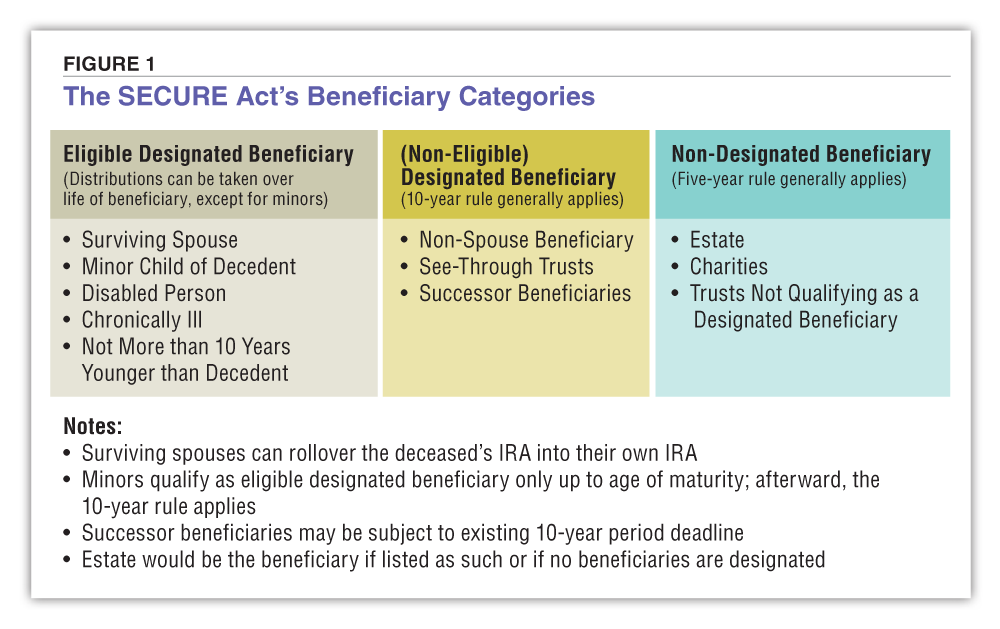
Spousal IRA beneficiaries have different rules and more options to consider when taking their required minimum distributions. As the chart below indicates, there are exceptions to the 10-year rule, such as a surviving spouse, a disabled or chronically ill person, a minor or a person who is not more than 10 years younger than the IRA account owner. These beneficiaries are not obligated to empty the IRA within 10 years but still must take their distributions. If you fall into the eligible designated beneficiary category, the inherited IRA can be taken over the life of the beneficiary (except in the case of minors). If you are a non-eligible designated beneficiary, such as someone who inherits an IRA from a parent, the 10-year rule applies.

Chart explaining the beneficiary categories in the SECURE Act of 2019

What does this mean for me?

If you inherit an IRA and are a non-eligible beneficiary, planning for taxes and how you take distributions becomes more important. Under current law, you have 10 years to deplete the entire value of the IRA. However, if you wait until the 10th year to take the entire distribution and the IRA has experienced significant growth, you may be in the highest tax bracket, having to pay almost 40% in taxes for that one year. If you take distributions over the 10 years, you may incur less tax on an annual basis, and the potential growth of the IRA may be minimized as well. As we have previously written, another way to potentially reduce taxes is to transfer up to $100,000 from an IRA directly to a qualified charity if you are 70 ½ or older.

The IRS has proposed new regulations to the SECURE Act which have yet to be approved. The proposed changes state that if you inherit a traditional IRA from someone who has already passed their required beginning date and had been taking mandatory distributions, you cannot wait until the 10th year to withdraw the money. Instead, under the proposal, you would be required take annual distributions in the first nine years and the balance in the 10th. A tax liability would occur each year from the required distribution.

The SECURE Act has brought Roth conversions into the conversation for those who want to help their heirs avoid a large tax bill. Roth conversions transfer the tax liability to the older generation, because taxes are paid when the conversion is done. If the conversion is done early in retirement, when income is low, the tax bracket may be lower and thus, lower taxes would be paid on the Roth conversion. Then the money can grow tax-free inside the Roth IRA and when the owner passes away, the money can continue to grow tax-free for an additional 10 years.

Promo for an article titled Should Investors Own Bonds in Today's Market?

So, what can we learn from all this? While the SECURE Act effectively eliminated the Stretch IRA, it did not eliminate the need for proper financial planning when it comes to taking distributions from an inherited IRA. We will continue to closely watch proposed legislation about the 10-year rule for inherited IRAs and ensure that our clients take the necessary distributions, if mandated by law. In the interim, we continue to analyze your situation and help you determine what makes the most sense for taxes, investments and your overall financial plan for IRA distributions.

From a portfolio perspective, we continue to adhere to the tried-and-true disciplines of diversification, periodic rebalancing and looking forward, while not making investment decisions based on where we have been. As we say each week, it is important to stay the course and focus on the long-term goal, not on one specific data point or indicator. In markets and moments like these, it is essential to stick to the financial plan.

Remember first and foremost that panic is not an investing strategy. Neither are “get in” or “get out” — those are just gambling on moments in time. Investing is about following a disciplined process over time.

At the end of the day, investors will be well-served to remove emotion from their investment decisions and remember that over a longer time horizon, markets tend to rise. Market corrections are normal, as nothing goes up in a straight line. Making market decisions based on what might happen may be detrimental to long-term performance. The key is to stay invested and stick with the financial plan. Markets go up and down over time, and downturns present opportunities to purchase stocks at a lower value.

It all starts with a solid financial plan for the long run that understands the level of risk that is acceptable for each client. Regarding investments, we believe in diversification and having different asset classes. The best option is to stick with a broadly diversified portfolio that can help you to achieve your own specific financial goals — regardless of market volatility. Long-term fundamentals are what matter.

Sources:  Kiplinger, Investopedia, Forbes, ThinkAdvisor

Promo for article on the formula for wealth

This material contains an assessment of the market and economic environment at a specific point in time and is not intended to be a forecast of future events, or a guarantee of future results. Forward-looking statements are subject to certain risks and uncertainties. Actual results, performance, or achievements may differ materially from those expressed or implied. Information is based on data gathered from what we believe are reliable sources.

Using diversification as part of your investment strategy neither assures nor guarantees better performance and cannot protect against loss of principal due to changing market conditions.

Past performance is not a guarantee of future results.

The opinions expressed in this commentary are those of the author and may not necessarily reflect those held by Kestra Investment Services, LLC or Kestra Advisory Services, LLC. This is for general information only and is not intended to provide specific investment advice or recommendations for any individual. It is suggested that you consult your financial professional, attorney, or tax advisor with regard to your individual situation.

Securities offered through Kestra Investment Services, LLC (Kestra IS), member FINRA/SIPC. Investment Advisory Services offered through Kestra Advisory Services, LLC (Kestra AS) an affiliate of Kestra IS. CD Wealth Management and Bluespring Wealth Partners LLC* are affiliates of Kestra IS and Kestra AS.  Investor Disclosures: https://bit.ly/KF-Disclosures

*Bluespring Wealth Partners, LLC acquires and supports high quality investment adviser and wealth management companies throughout the United States.
Should investors own bonds in today’s market?

The bond market has been anything but sleepy to start the year. With inflation at its hottest level since the early 1980s and the Federal Reserve raising rates, the U.S. Treasury index had its worst start ever to the year. Historically, bonds provide diversification from equities during volatile markets. However, during the first quarter of 2022, bonds declined in tandem with stocks and have not provided the portfolio with the cushion that investors expect.

With more rate hikes coming this year, investors may be tempted to avoid bonds altogether. Historical returns suggest that even with the current headwinds of inflation and rising rates, bonds can still provide positive returns in an environment of rising interest rates.

What has caused bond prices to decrease?

Bond prices have an inverse relationship with interest rates. When interest rates rise, bond prices fall — and vice versa. For example: If interest rates are 0% and someone offers you a bond that has a 5% coupon, you would have to pay a premium to get the 5% income. However, if interest rates were to rise to 2% and that same person offered you the same bond, you would have to pay a smaller premium, because the price of the bond falls as the interest rate rises.

The Russia-Ukraine war has led to higher energy prices and higher commodity prices for wheat and corn. These increases put additional pressure on the Federal Reserve Bank to stabilize inflation and economic growth. As a result, selling in the bond market is taking place as the market anticipates the Fed raising rates an additional six times this year.

Amid such headwinds, why own bonds?

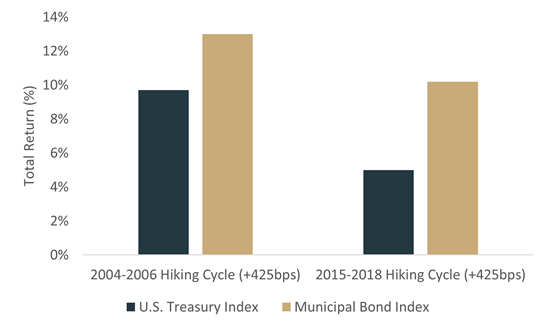
Bonds have historically provided an important buffer for portfolios during stock market downturns and corrections. In February and March of 2020, the S&P 500 index fell by almost 33% in a short period of time. As stocks fell, the Bloomberg U.S. Aggregate Bond Index rose, finishing 2020 up more than 7%. Bonds also have provided positive returns even as rates were being raised. During two of the most recent hiking cycles, both U.S. Treasuries and municipal bonds saw strong gains on a total return basis, as seen in the chart below.

How Bonds Have Performed When the Fed Was Raising Rates

Chart showing how bonds have performed when the Fed raised interest rates
Past performance is no guarantee of future results. Indexes are unmanaged and not subject to fees. It is not possible to invest directly in an index. U.S. Treasury Index, U.S. Municipal Bond Index. Source: Bloomberg

The longer the maturity of the bond or bond fund, the more sensitive the bonds are to interest rate changes. Diversification across maturities, sectors and credit risk can help mitigate portfolio risk during this more than volatile time in the bond market. For those who own individual bonds, rising rates present opportunities to purchase newer bonds as the current bonds are either called or redeemed. New bonds bring higher levels of interest income and potentially greater returns. In other words, rising rates may create some short-term pain but ultimately translate into longer-term gains.

So, what can we learn from all this? While every rising rate cycle may be different, fixed income has had positive returns most of the time during years of rising rates. Last week, we saw the yield curve invert for the first time since 2019. Remember, a recession is not a foregone conclusion. Even if a recession occurs in the next six months to two years, the stock market and bond market may continue to experience positive returns.

From a portfolio perspective, we continue to adhere to the tried-and-true disciplines of diversification, periodic rebalancing and looking forward, while not making investment decisions based on where we have been. As we say each week, it is important to stay the course and focus on the long-term goal, not on one specific data point or indicator. In markets and moments like these, it is essential to stick to the financial plan. Remember, first and foremost, that panic is not an investing strategy. Neither are “get in” or “get out” — those are just gambling on moments in time. Investing is about following a disciplined process over time.

At the end of the day, investors will be well-served to remove emotion from their investment decisions and remember that over a longer time horizon, markets tend to rise. Market corrections are normal, as nothing goes up in a straight line. Making market decisions based on what might happen may be detrimental to long-term performance. The key is to stay invested and stick with the financial plan. Markets go up and down over time, and downturns present opportunities to purchase stocks at a lower value.

It all starts with a solid financial plan for the long run that understands the level of risk that is acceptable for each client. Regarding investments, we believe in diversification and having different asset classes that allow you to stay invested. The best option is to stick with a broadly diversified portfolio that can help you to achieve your own specific financial goals — regardless of market volatility. Long-term fundamentals are what matter.

Sources: Kestra Financial, Bloomberg

Promo for an article titled What You Should Know About the Bond Market's Recession Signal

This material contains an assessment of the market and economic environment at a specific point in time and is not intended to be a forecast of future events, or a guarantee of future results. Forward-looking statements are subject to certain risks and uncertainties. Actual results, performance, or achievements may differ materially from those expressed or implied. Information is based on data gathered from what we believe are reliable sources.

Using diversification as part of your investment strategy neither assures nor guarantees better performance and cannot protect against loss of principal due to changing market conditions.

Past performance is not a guarantee of future results.

The opinions expressed in this commentary are those of the author and may not necessarily reflect those held by Kestra Investment Services, LLC or Kestra Advisory Services, LLC. This is for general information only and is not intended to provide specific investment advice or recommendations for any individual. It is suggested that you consult your financial professional, attorney, or tax advisor with regard to your individual situation.

Securities offered through Kestra Investment Services, LLC (Kestra IS), member FINRA/SIPC. Investment Advisory Services offered through Kestra Advisory Services, LLC (Kestra AS) an affiliate of Kestra IS. CD Wealth Management and Bluespring Wealth Partners LLC* are affiliates of Kestra IS and Kestra AS.  Investor Disclosures: https://bit.ly/KF-Disclosures

*Bluespring Wealth Partners, LLC acquires and supports high quality investment adviser and wealth management companies throughout the United States.

What you should know about the bond market’s recession signal

Bonds are selling off around the world, and the Global Bond Aggregate index is down more than 10% since its peak in January, its worst drawdown on record. The bond market is flashing a warning sign that has correctly predicted almost every recession over the past 60 years: an inversion of the U.S. Treasury yield curve. 

The existence of an inverted yield curve is a signal that investors are more nervous about the immediate future than the longer-term outlook. An inversion if the yield curve has preceded every recession since 1955, but in and of itself, the inversion does not guarantee a recession will occur.

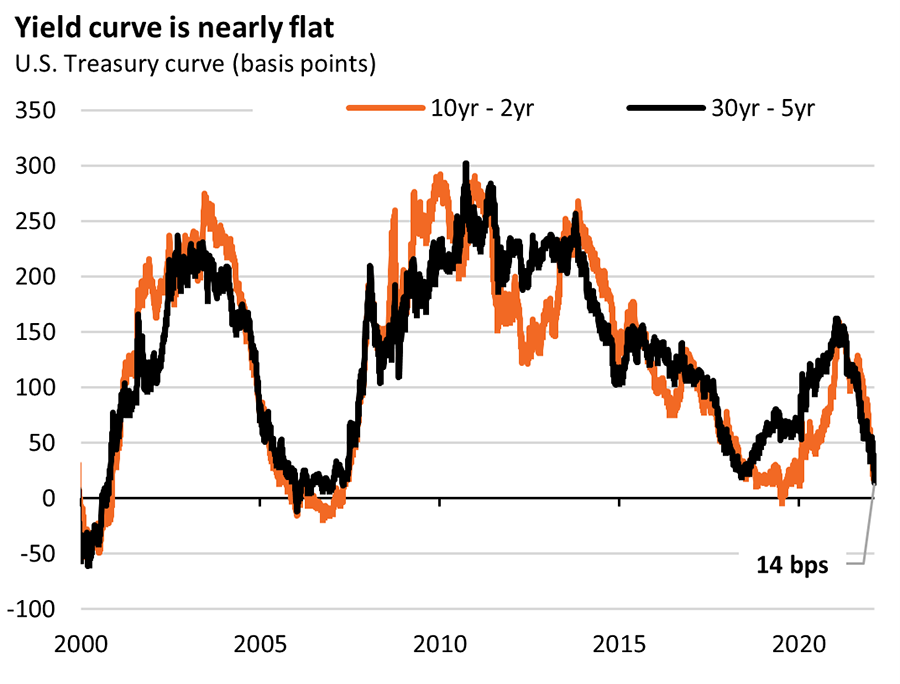
The most closely watched part of the curve is the 2-year Treasury compared to the 10-year Treasury. On Tuesday, the 2- and 10-year yield curve inverted for the first time since 2019 after starting the year at a spread of 79 basis points between the two. The 5-year Treasury bond and the 30-year Treasury bond inverted on Monday for the first time since 2006.

Chart showing U.S. Treasury yield curves since 2000
Source: Bloomberg Finance, L.P. S&P as of 12 pm on March 25, 2022

What is the yield curve?

A yield curve is a line that plots interest rates (yields) of bonds with equal credit quality but different maturity dates. There are three main shapes of a yield curve: normal (upward sloping), inverted (downward sloping) and flat. A normal yield curve, or upward sloping, is indicative of economic expansion, while an inverted yield curve points to an economic recession. 
With a normal yield curve, longer-maturity bonds have a higher yield compared to shorter-term bonds. For example, in a normal yield curve, a 2-year bond could yield 1%, a 5-year bond could yield 2% and a 10-year bond could yield 2.5%. The farther out one goes on the curve, the higher the yield. Conversely, an inverted yield curve slopes down, meaning that short-term interest rates are higher than longer-term interest rates. When the return of a 10-year bond is lower than that of a 2-year bond, for example, signs point to investors carrying a pessimistic outlook and a reluctance to commit money to longer-term maturities. 

Why does an inversion in the yield curve matter?

The yield curve is one of a handful of leading economic indicators that are considered reliable gauges of turning points in business cycles. Yield curve inversions are often viewed as a cause of a recession, but really, they are symptomatic of the conditions that lead to an economic recession.

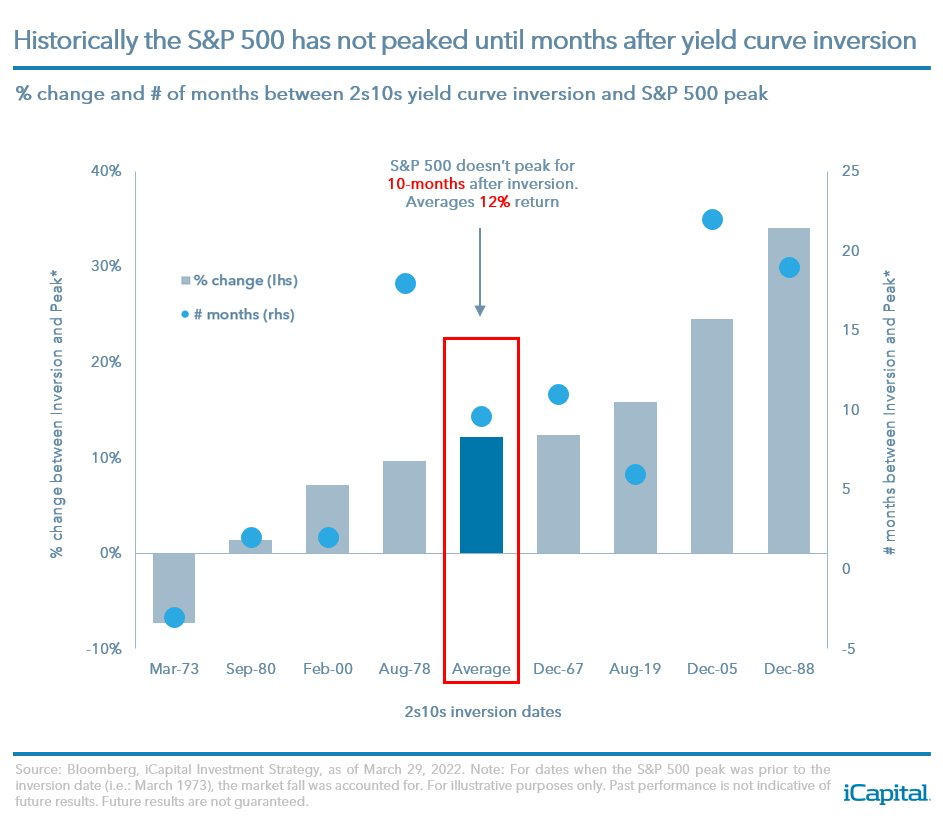
An inversion in the yield curve generally indicates a recession is coming, most often within six months to two years. It does not mean that stocks are about to sell off; historically, the stock market has not peaked until months after the inversion, as seen in the chart below.

Chart showing how the S&P 500 has performed against yield curve inversions

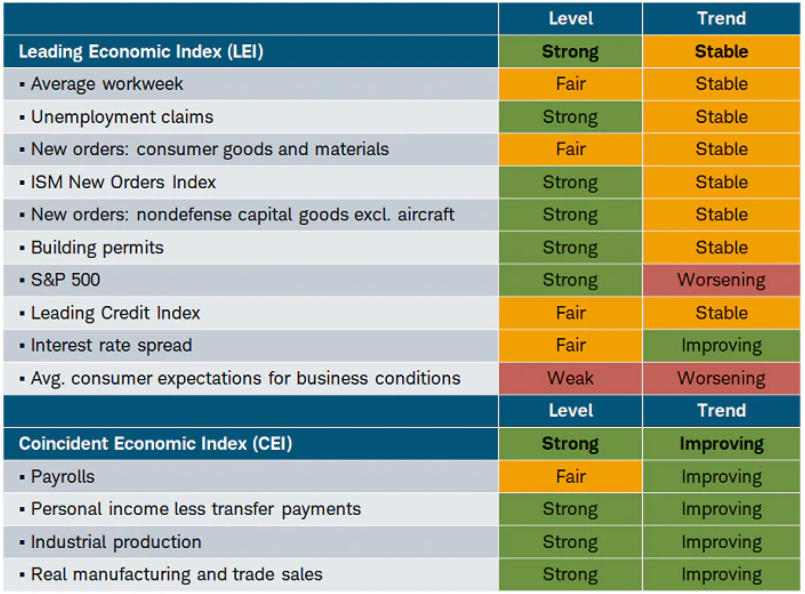
The National Bureau of Economic Research (NBER) defines a recession as “a significant decline in economic activity that is spread across the economy and that lasts more than a few months.” The chart below lists the components of Leading Economic Index as well as Coincident Economic Index (CEI). NBER primarily monitors the CEI for recession indicators, but these provide a retroactive assessment and don’t tell us much about where we are headed. The unemployment rate is another lagging indicator; unemployment rates always have been near historic lows heading into recessions. 

The chart also looks at the current level of 10 different leading economic indicators as well as the trends for each indicator. Consumer confidence has been waning as inflation runs high and the war in Ukraine continues into its second month. The S&P 500 trend is moving towards stabilization after the recent March lows, and the other leading economic indicators remain stable for now.

Chart showing economic indicators according to Leading Economic Index (LEI) and Coincident Economic Index (CEI)
Source:  Charles Schwab, Bloomberg, The Conference Board, as of 3/18/2022

As the Fed continues to raise rates and investors anticipate tighter financial conditions, we will continue to watch the yield curve and other recessionary signals to determine how they may impact the stock market and your portfolios. While the Fed has finally announced it will raise rates to combat inflation, rates remain low by historical standards. The key message from the Fed is that it is focused on fighting inflation and is prepared to hike short-term interest rates steadily while reducing the balance sheet to attain its goals.  

So, what can we learn from all this? This week, we saw the yield curve invert for the first time since 2019, but remember: A recession is not a foregone conclusion. Every recession has been preceded by a yield-curve inversion, but not every inversion of the yield curve has led to a recession. Furthermore, even if a recession occurs in the next six months to two years, the stock market may continue to experience positive returns.

From a portfolio perspective, we continue to adhere to the tried-and-true disciplines of diversification, periodic rebalancing and looking forward, while not making investment decisions based on where we have been. As we say each week, it is important to stay the course and focus on the long-term goal, not on one specific data point or indicator. In markets and moments like these, it is essential to stick to the financial plan. Panic is not an investing strategy. Neither are “get in” or “get out” — those are just gambling on moments in time. Investing is about following a disciplined process over time.

At the end of the day, investors will be well-served to remove emotion from their investment decisions; over a longer time horizon, markets tend to rise. Market corrections are normal, as nothing goes up in a straight line. Making market decisions based on what might happen may be detrimental to long-term performance. The key is to stay invested and stick with the financial plan. Markets go up and down over time, and downturns present opportunities to purchase stocks at a lower value.

It all starts with a solid financial plan for the long run that understands the level of risk that is acceptable for each client. Regarding investments, we believe in diversification and having different asset classes that allow you to stay invested. The best option is to stick with a broadly diversified portfolio that can help you to achieve your own specific financial goals — regardless of market volatility. Long-term fundamentals are what matter.

Sources: CNBC, CNN, Schwab, Investopedia, iCapital

Promo for article titled The Fed Is Raising Interest Rates. What Happens Next?

This material contains an assessment of the market and economic environment at a specific point in time and is not intended to be a forecast of future events, or a guarantee of future results. Forward-looking statements are subject to certain risks and uncertainties. Actual results, performance, or achievements may differ materially from those expressed or implied. Information is based on data gathered from what we believe are reliable sources.

Using diversification as part of your investment strategy neither assures nor guarantees better performance and cannot protect against loss of principal due to changing market conditions.

Past performance is not a guarantee of future results.

The opinions expressed in this commentary are those of the author and may not necessarily reflect those held by Kestra Investment Services, LLC or Kestra Advisory Services, LLC. This is for general information only and is not intended to provide specific investment advice or recommendations for any individual. It is suggested that you consult your financial professional, attorney, or tax advisor with regard to your individual situation.

Securities offered through Kestra Investment Services, LLC (Kestra IS), member FINRA/SIPC. Investment Advisory Services offered through Kestra Advisory Services, LLC (Kestra AS) an affiliate of Kestra IS. CD Wealth Management and Bluespring Wealth Partners LLC* are affiliates of Kestra IS and Kestra AS.  Investor Disclosures: https://bit.ly/KF-Disclosures

*Bluespring Wealth Partners, LLC acquires and supports high quality investment adviser and wealth management companies throughout the United States.