Tips for Planning Charitable Donations, on North Texas Giving Day and Beyond

Today is NTX Giving Day in North Texas. It’s an annual tradition through which the Communities Foundation of Texas connects donors with charities in need and fulfills its mission to put giving to work throughout our local communities.

What a great time to think about making charitable donations for both philanthropic and tax purposes! No matter your interests, making gifts to causes you care about can be one of the most meaningful uses of your money. In the end, what really matters is helping an organization that matters to you. The tax benefits from a donation are just icing on the cake.

Along with the intangible rewards that come from helping others, charitable giving may offer a financial benefit for you and your family.

Most donations to charitable organizations come in the form of checks and credit card payments. However, there may be more efficient ways to donate, which in turn help both the charity as well as your pocketbook. Understanding the benefits for different type of donations is important. Here are some options to consider:

• Cash, check or credit card: This is the most simple and straightforward way of donating to charity. It is important to keep a bank record or a receipt from the charity to substantiate a cash gift. Annual income tax deduction limits for gifts to public charities are 30% of adjusted gross income (AGI) for contributions of non-cash assets, if held for more than one year, and 60% of AGI for contributions of cash. If contributions are made in excess of those limits, the excess may be carried over for up to five years. If you do not have appreciated assets to give or want to give cash, it may be beneficial to combine or “bunch” two years’ worth of charitable contributions into one year so you can take advantage of itemizing deductions.  

• Appreciated stock: If you donate stock that you have held for at least 12 months, you can deduct the full value of the investment without having to pay capital gains on the appreciation. The current fair market value of the stock is deducted from your taxable income. Often, clients may donate the stock with the biggest winnings, which maximizes savings on capital gains, and then buy back the same stock with cash, which in turn, raises the cost basis. As the chart below shows, if you were to sell appreciated stock and then donate cash to charity (compared to gifting appreciated stock), not only would you save on taxes (the charity does not pay capital gains tax), but the charity would also receive additional monies!  
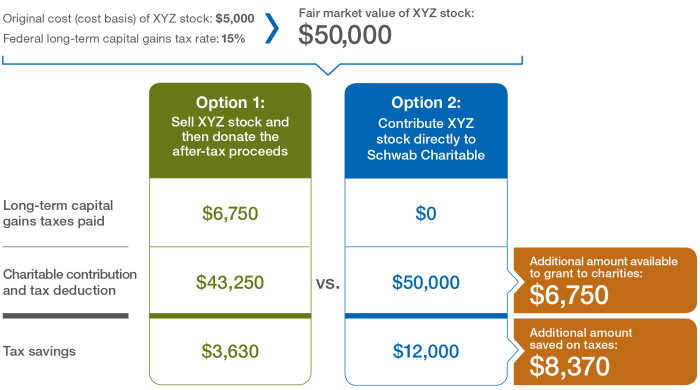
Chart showing strategy for charitable donations involving appreciated stock
This hypothetical example is only for illustrative purposes. The example does not take into account any state or local taxes or the Medicare net investment income surtax. The tax savings shown is the tax deduction, multiplied by the donor’s income tax rate (24% in this example), minus the long-term capital gains taxes paid. Reprinted from Schwabcharitable.org.

• IRA Qualified Charitable Distributions (QCD): This is an option only for donors over the age of 70 1/2. QCDs allow individuals to donate up to $100,000 annually directly from their IRA to charitable organizations. This reduces the value of the IRA, and the QCD does not count towards the donor’s taxable income. It also counts toward the annual required minimum distribution. 

• Donor Advised Fund (DAF): Picture a donor advised fund as your family foundation, without the headache and administrative hassle of setting up a family foundation. A DAF is a charitable account established at a public charity or community foundation that allows donors to recommend grants over time. The donor decides the timing of the donation, the charity that will receive the donation and the amount of the charitable donation made from the DAF. The donor claims the tax deduction upon funding of the DAF. There is not a requirement that the DAF distribute 5% of the fund each year, which may allow the DAF to grow, expanding the available dollars to donate to charities.

At CD Wealth Management, charitable giving is a significant part of our company’s culture. We believe in giving back with our time as well as our pocketbook. We support many causes in the Dallas-Fort Worth area, and we encourage team members to be involved in the community. Each year, during the holiday season, the company makes a charitable donation in each one of our team members’ names to their charity of choice, offering an additional thanks and helping a great cause at the same time.

Please do not hesitate to reach out to us to discuss your charitable options to help you determine the best way to give for your situation. If you are interested in taking part in NTX Giving Day, click here. (Please note that all funding options described above may not be available for NTX Giving Day.)

The CD Wealth Formula

We help our clients reach and maintain financial stability by following a specific plan, catered to each client. 

Our focus remains on long-term investing with a strategic allocation while maintaining a tactical approach. Our decisions to make changes are calculated and well thought out, looking at where we see the economy is heading. We are not guessing or market timing. We are anticipating and moving to those areas of strength in the economy — and in the stock market. 

We will continue to focus on the fact that what really matters right now is time in the market, not out of the market. That means staying the course and continuing to invest, even when the markets dip, to take advantage of potential market upturns. We continue to adhere to the tried-and-true disciplines of diversification, periodic rebalancing and looking forward, while not making investment decisions based on where we have been.

It is important to focus on the long-term goal, not on one specific data point or indicator. Long-term fundamentals are what matter. In markets and moments like these, it is essential to stick to the financial plan. Investing is about following a disciplined process over time.

Sources: Baird, BMO, Schwab

Promo for article titled Is a Roth IRA the Right Choice for You? Here’s What You Should Consider

This material contains an assessment of the market and economic environment at a specific point in time and is not intended to be a forecast of future events, or a guarantee of future results. Forward-looking statements are subject to certain risks and uncertainties. Actual results, performance, or achievements may differ materially from those expressed or implied. Information is based on data gathered from what we believe are reliable sources.

Using diversification as part of your investment strategy neither assures nor guarantees better performance and cannot protect against loss of principal due to changing market conditions.

Past performance is not a guarantee of future results.

The opinions expressed in this commentary are those of the author and may not necessarily reflect those held by Kestra Investment Services, LLC or Kestra Advisory Services, LLC. This is for general information only and is not intended to provide specific investment advice or recommendations for any individual. It is suggested that you consult your financial professional, attorney, or tax advisor with regard to your individual situation.

Securities offered through Kestra Investment Services, LLC (Kestra IS), member FINRA/SIPC. Investment Advisory Services offered through Kestra Advisory Services, LLC (Kestra AS) an affiliate of Kestra IS. CD Wealth Management and Bluespring Wealth Partners LLC* are affiliates of Kestra IS and Kestra AS.  Investor Disclosures: https://bit.ly/KF-Disclosures

*Bluespring Wealth Partners, LLC acquires and supports high quality investment adviser and wealth management companies throughout the United States.

Is a Roth IRA the Right Choice for You? Here’s What You Should Consider

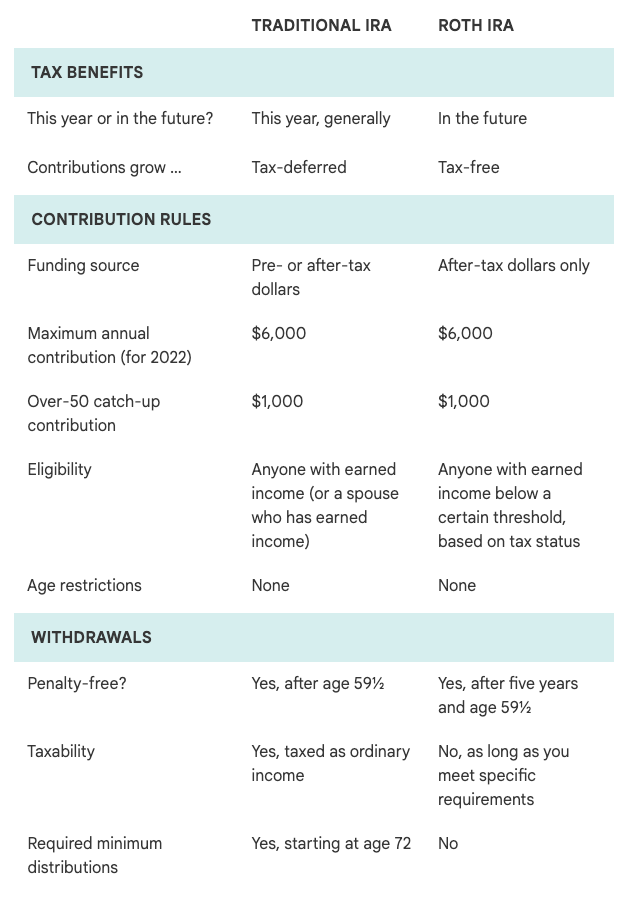
In the financial planning process, clients often ask us if it makes sense to open a Roth IRA or convert a traditional IRA to a Roth IRA. As a refresher: With a Roth IRA, you contribute after-tax dollars, your money grows tax-free, and you can generally make tax- and penalty-free withdrawals after age 59½. With a traditional IRA, you contribute pre- or after-tax dollars, your money grows tax-deferred, and withdrawals are taxed as current income after age 59½. Roth IRAs are best suited for individuals in a lower tax bracket who expect to be in a higher tax bracket when they start taking withdrawals later in life. A traditional IRA may be best suited for those who expect to be in the same or lower tax bracket when they start taking withdrawals in retirement.

There are three main distinctions between a traditional IRA and a Roth IRA: eligibility, tax treatment and withdrawal requirements. The chart below provides a good summary on the differences. 

• Eligibility – With both types of IRAs, the owner must have earned income to be eligible to contribute. For a Roth IRA, you must remain under a total income threshold to be eligible to contribute (income limits can be found here). There are no such limits with a traditional IRA; anyone at any income level can contribute.

• Tax treatments – Contributions to a Roth IRA won’t provide any immediate tax benefit because they are not deductible. Contributions to a traditional IRA may be deductible if you are not a participant in an employee-sponsored plan. Withdrawals from a Roth IRA can be tax-free if requirements are met. Withdrawals from a traditional IRA are typically fully taxable as ordinary income.

• Withdrawal requirements – Both traditional and Roth IRAs allow for withdrawals of any amount once you reach age 59½. Once the owner reaches age 72, traditional IRAs are subject to the required minimum distribution (RMD) rules, forcing money out of the IRA and triggering ordinary income. There are no RMD rules related to Roth IRAs; owners can leave the money in the Roth IRA to grow tax-free as long as they want. A Roth IRA’s beneficiaries generally will need to take RMDs to avoid penalties, although there is an exception for spouses.

Chart showing the differences between traditional and Roth IRAs

For those who are not eligible to contribute to a Roth IRA, there still is a way to take advantage of the tax-free growth. The Roth conversion, also known as a “back door Roth IRA,” allows a taxpayer to withdraw funds from a traditional IRA in a taxable distribution and then roll those monies into a Roth IRA. There are no income thresholds for a Roth conversion. If your tax bracket in retirement may be higher than your current tax rate, it may make sense to convert to a Roth IRA from a traditional IRA. This could happen if you accumulate significant savings in your retirement accounts or achieve top earnings later in your career. Here are five potential reasons to convert to a Roth IRA: 

1. Portfolio losses: By converting a traditional IRA to a Roth IRA, the tax will be assessed on the value on the date of the conversion. If you convert to a Roth IRA while the value is lower, the amount of tax owed will be less, and the rebound in value can grow tax free.

2. Anticipating higher tax brackets: If you expect your tax bracket to be higher in retirement, then you may prefer to pay tax on savings now, while you are in a lower tax bracket, and then access those funds tax-free in retirement.

3. Longer growth horizon: Roth IRAs have no RMD obligations, whereas traditional IRAs have RMD after the age of 72. Money in a Roth IRA can stay invested in the stock market longer, giving additional opportunities for growth.

4. Helping your heirs: If your traditional IRA is passed on to your heirs, they will also owe taxes on their withdrawals — and they must be completely withdrawn after 10 years. The Roth IRA withdrawals will be tax free, so you are effectively gifting tax savings to your heirs.

5. Paying for Medicare: If you are enrolled in Medicare Part B or D and your modified adjusted gross income (MAGI) is above a certain threshold, you pay a surcharge on top of your Medicare premium. Withdrawals from a traditional IRA are included in MAGI, while withdrawals from a Roth IRA are not. 

Keep in mind the two biggest drawbacks to a Roth IRA conversion are that you must pay income taxes on any pre-tax funds you convert in the year you make it, and you cannot change your mind once you convert. It generally makes sense to use taxable assets rather than proceeds from the converted IRA to pay the tax cost of the Roth IRA conversion. This is because — all things being equal — the rate of return is generally higher for a Roth IRA because no taxes are due for any gains inside the Roth IRA. 

Please remember that CD Wealth Management does not offer tax advice, but we work closely with your CPA and attorneys to ensure the right strategy is in place for you and your situation. 

The CD Wealth Formula

We help our clients reach and maintain financial stability by following a specific plan, catered to each client. 

Our focus remains on long-term investing with a strategic allocation while maintaining a tactical approach. Our decisions to make changes are calculated and well thought out, looking at where we see the economy is heading. We are not guessing or market timing. We are anticipating and moving to those areas of strength in the economy — and in the stock market. 

We will continue to focus on the fact that what really matters right now is time in the market, not out of the market. That means staying the course and continuing to invest, even when the markets dip, to take advantage of potential market upturns. We continue to adhere to the tried-and-true disciplines of diversification, periodic rebalancing and looking forward, while not making investment decisions based on where we have been.

It is important to focus on the long-term goal, not on one specific data point or indicator. Long-term fundamentals are what matter. In markets and moments like these, it is essential to stick to the financial plan. Investing is about following a disciplined process over time.

Sources: Fidelity, Schwab

Promo for an article titled The Importance of Compound Interest and Tax Planning on Your Portfolio

This material contains an assessment of the market and economic environment at a specific point in time and is not intended to be a forecast of future events, or a guarantee of future results. Forward-looking statements are subject to certain risks and uncertainties. Actual results, performance, or achievements may differ materially from those expressed or implied. Information is based on data gathered from what we believe are reliable sources.

Using diversification as part of your investment strategy neither assures nor guarantees better performance and cannot protect against loss of principal due to changing market conditions.

Past performance is not a guarantee of future results.

The opinions expressed in this commentary are those of the author and may not necessarily reflect those held by Kestra Investment Services, LLC or Kestra Advisory Services, LLC. This is for general information only and is not intended to provide specific investment advice or recommendations for any individual. It is suggested that you consult your financial professional, attorney, or tax advisor with regard to your individual situation.

Securities offered through Kestra Investment Services, LLC (Kestra IS), member FINRA/SIPC. Investment Advisory Services offered through Kestra Advisory Services, LLC (Kestra AS) an affiliate of Kestra IS. CD Wealth Management and Bluespring Wealth Partners LLC* are affiliates of Kestra IS and Kestra AS.  Investor Disclosures: https://bit.ly/KF-Disclosures

*Bluespring Wealth Partners, LLC acquires and supports high quality investment adviser and wealth management companies throughout the United States.

The Importance of Compound Interest and Tax Planning on Your Portfolio

Benjamin Franklin famously once said that “Money makes money. And the money that money makes, makes more money.” He was referring to compound interest. When interest you earn on a balance in a savings or investment account is reinvested, you earn even more money. You aren’t just earning interest on your principal balance; you are earning interest on your interest as well.

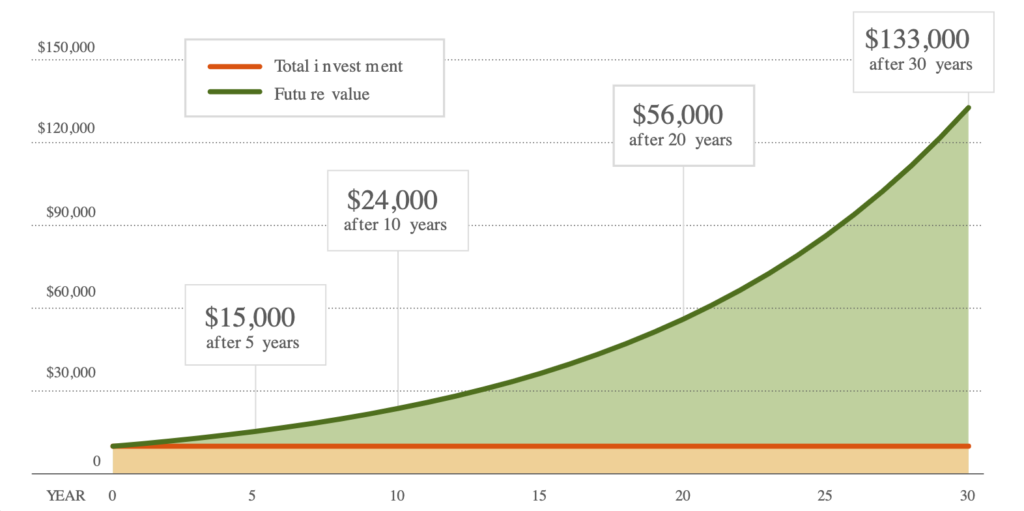
For example, if you make a one-time investment of $10,000, then earn 9% per year, the chart below shows the power of compounding your money. After 10 years. the initial $10,000 investment would be worth more than $24,000 — and after 30 years, it would be worth more than $133,000.

Chart showing returns on compound interest versus simple interest over time
Source: Investor.gov, as of November 4, 2021. This hypothetical example assumes the following: (1) starting investment of $10,000; (2) no additional pre-tax contributions; (3) an annual rate of return of 9%; (4) the ending values do not reflect taxes, fees or inflation. If they did, amounts would be lower. Earnings and pre-tax contributions are subject to taxes when withdrawn. Distributions before age 59 1/2 may also be subject to a 10% penalty. Contribution amounts are subject to IRS and Plan limits. Systematic investing does not ensure a profit or guarantee against a loss in a declining market. This example is for illustrative purposes only and does not represent the performance of any security. Consider your current and anticipated investment horizon when making an investment decision, as the illustration may not reflect this. The assumed rate of return used in this example is not guaranteed. Investments that have potential for 9% annual rate of return also come with risk of loss

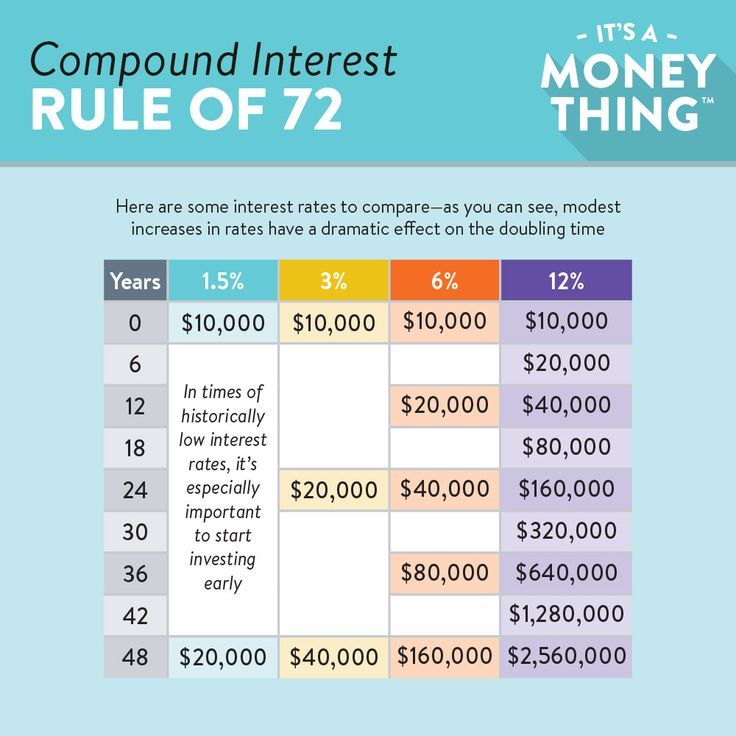
There is a shortcut to help you estimate the value of a future investment, called the Rule of 72. It’s a quick way to estimate approximately the number of years it will take to double your money using compound interest. As seen in the chart below, if you earn a 6% compounded return per year on your investment, then in about 12 years your money would be worth double. If you annualize 12% a year for 48 years, $10,000 could turn into over $2,500,000! To use the Rule of 72, simply divide 72 by the expected annual rate of return and that will provide you the number of years it would take to double your investment.

Chart explaining the Rule of 72 as it regards compound interest

Simple interest is interest that is earned based solely on the principal amount and is not reinvested. For example, if you have $1,000 and earn a 5% annual interest rate, you will get $50 a year in simple interest. In the second year, you would earn another $50. To calculate how long it would take to double your money with simple interest, the formula would be 1 divided by the rate of return. For example, if you made the same investment of $1,000 earning 5% simple interest, it would take you 20 years to double your money. Note that if you were able to reinvest the money and have it compounding, then it would take approximately 14.4 years to double.

It is important to consider tax implications prior to making any investment. If an investment is going to pay 10% interest on your principal and is in a taxable account, your actual return may be only 6% if you are in a top tax bracket and the income is taxed as ordinary income. If you are not able to reinvest the income, then the income becomes simple interest, and your money can take even longer to double. Suddenly, the 10% investment return that sounded great may not be nearly as good.

Taxes can dramatically impact your investment portfolio, both in the short and long term. There are different types of taxes on investments, and each one is taxed differently:

• Capital gains are profits from the sale of an asset. If you own the asset for more than one year and you sell for a gain, then you will pay long-term capital gains tax. The rate depends on your income level and can either be 0%, 10% or 20%. If you own the asset less than a year and sell it for a gain, then the gain will be taxed as ordinary income.

• Dividends usually are taxable income in the year that they are received. Even if you reinvest the dividend income, you pay tax on that income that year. There are two types of dividend income – qualified and non-qualified. Non-qualified dividends are taxed as ordinary income. Qualified dividends are taxed at either 0%, 15% or 20%, based on income level. 

• Investments in 401Ks or IRAs allow you to defer taxes while the money is inside the account. Taxes are paid when you make a withdrawal, and that money is then considered ordinary income and is taxed at your income level.

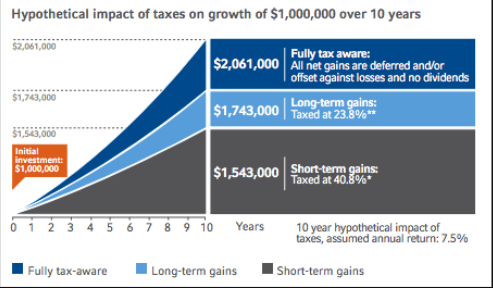
Portfolio design and allocation are very important in order to minimize the tax impact on your returns. Structuring the portfolio to have the least tax-efficient assets in retirement accounts helps ensure that those assets are being taxed at ordinary income levels. The chart below shows the difference that tax management can have in a portfolio over time. If your portfolio is managed inefficiently — if it is heavily traded and focused on short-term gains — a $1 million portfolio could miss out on as much as $500,000 of returns over a 10-year period. Compound interest is an extremely powerful tool — whether it is in a retirement account, such as a 401K or IRA, or a taxable account, earning qualified dividends that are reinvested. 

Chart showing the impact of taxes on investments over 10 years


The CD Wealth Formula

We help our clients reach and maintain financial stability by following a specific plan, catered to each client. 

Our focus remains on long-term investing with a strategic allocation while maintaining a tactical approach. Our decisions to make changes are calculated and well thought out, looking at where we see the economy is heading. We are not guessing or market timing. We are anticipating and moving to those areas of strength in the economy — and in the stock market. 

We will continue to focus on the fact that what really matters right now is time in the market, not out of the market. That means staying the course and continuing to invest, even when the markets dip, to take advantage of potential market upturns. We continue to adhere to the tried-and-true disciplines of diversification, periodic rebalancing and looking forward, while not making investment decisions based on where we have been.

It is important to focus on the long-term goal, not on one specific data point or indicator. Long-term fundamentals are what matter. In markets and moments like these, it is essential to stick to the financial plan. Investing is about following a disciplined process over time.

Sources: Fidelity, Forbes, Investopedia, Russell Investments

Promo for an article titled Student Debt, Loan Forgiveness and the Crazy Cost of College

This material contains an assessment of the market and economic environment at a specific point in time and is not intended to be a forecast of future events, or a guarantee of future results. Forward-looking statements are subject to certain risks and uncertainties. Actual results, performance, or achievements may differ materially from those expressed or implied. Information is based on data gathered from what we believe are reliable sources.

Using diversification as part of your investment strategy neither assures nor guarantees better performance and cannot protect against loss of principal due to changing market conditions.

Past performance is not a guarantee of future results.

The opinions expressed in this commentary are those of the author and may not necessarily reflect those held by Kestra Investment Services, LLC or Kestra Advisory Services, LLC. This is for general information only and is not intended to provide specific investment advice or recommendations for any individual. It is suggested that you consult your financial professional, attorney, or tax advisor with regard to your individual situation.

Securities offered through Kestra Investment Services, LLC (Kestra IS), member FINRA/SIPC. Investment Advisory Services offered through Kestra Advisory Services, LLC (Kestra AS) an affiliate of Kestra IS. CD Wealth Management and Bluespring Wealth Partners LLC* are affiliates of Kestra IS and Kestra AS.  Investor Disclosures: https://bit.ly/KF-Disclosures

*Bluespring Wealth Partners, LLC acquires and supports high quality investment adviser and wealth management companies throughout the United States.

Student Debt, Loan Forgiveness and the Crazy Cost of College

Those of us with kids or grandkids are well aware of the crazy cost of college today. Between 1980 and 2020, the average price of tuition, fees and room and board for an undergraduate degree increased 169%. In 1980, the price to attend a four-year college full time was roughly $10,000, adjusted for inflation. By 2020, the total price had increased to roughly $29,000!

Why have the costs of college gone up over time? There are many reasons: growing demand, pressure to go to college, rising financial aid, lower state funding, cost of administration and increasing student amenity packages to keep up. Aside from tuition payments, public colleges depend on funding from state and local governments. Typically, state and local funding make up about 44% of public four-year college revenues. However, economic downturns like we saw in 2008 and 2020 can lead to funding cuts. To make up for the lost dollars, universities must turn to other sources to raise monies, with the most direct source being higher tuition.

For most people, the cost of college may not be manageable – let alone the cost of graduate school or medical school.

More than half of bachelor’s degree recipients from public or private four-year colleges graduated with debt in 2020, with the average debt load being $28,400.

For college graduates with $50,000 or more of debt, the idea of one day owning a home and being debt-free feels like it’s a world away.

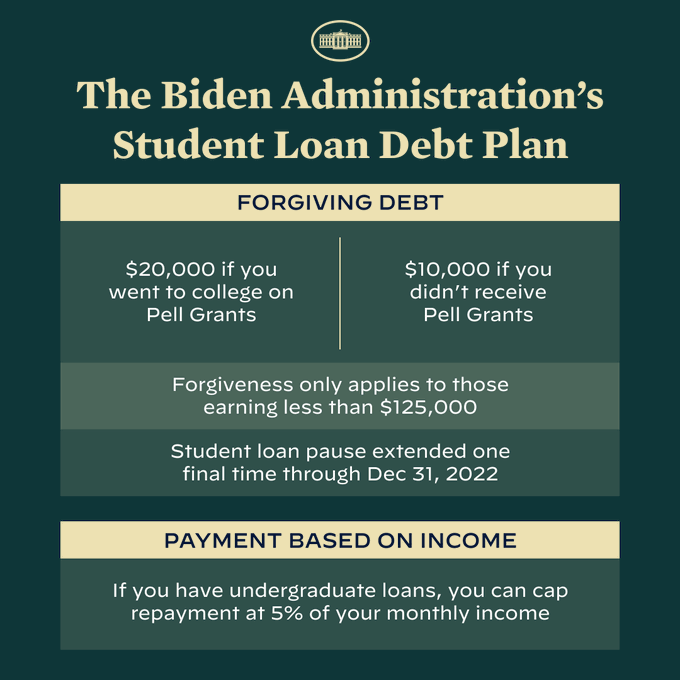
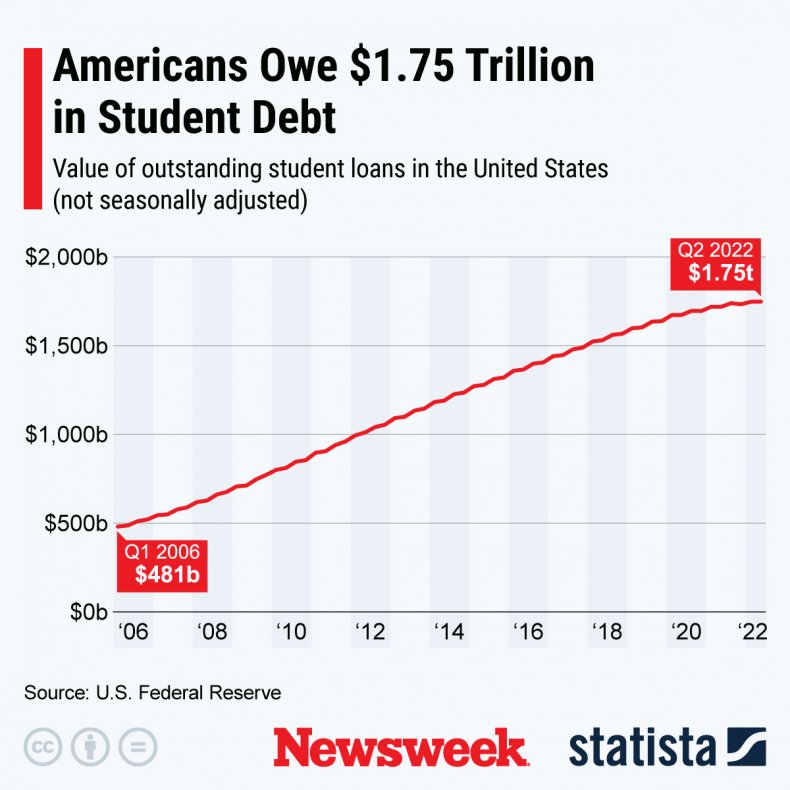
Even before President Biden was elected, one of his objectives was to provide student debt relief. Last week, he announced that the government will provide $20,000 in debt relief to Pell grant recipients and $10,000 for many other borrowers. Roughly 43 million Americans hold federal student loan debt, estimated at $1.75 trillion.

Chart showing the growth of student debt for college tuition from 2006 to 2022

Borrowers eligible for loan forgiveness must make less than $125,000 per year individually or $250,000 if married for the 2020 or 2021 tax year. Private loans will not be forgiven as part of the debt relief act. At the same time, the president also announced an extension of the pandemic pause on student loan payments through the end of the year, with payments resuming in January 2023. The Education Department said nearly 8 million borrowers are likely to have their loans forgiven automatically, and the remaining borrowers will have to apply for loan forgiveness. Current students also are eligible for loan cancellation, provided their loans were obtained before July 1, 2022.

There also is a new income-based repayment plan. For undergraduate loans, the relief act caps monthly payments at 5% of a borrower’s discretionary income; currently, borrowers must pay 10%. For borrowers with original loan balances of $12,000 or less, the balance will be forgiven after 10 years of payments; currently, they have to repay their loans for 20 years.

The plan will provide relief for borrowers at a time when the cost of education continues to surge. Critics question the fairness of the plan and warn about the potential impact on inflation should students with forgiven loans increase their spending. The debt forgiveness plan will not be like the $1,200 relief checks that the government sent out during the global pandemic, however they will be relieved of making loan payments over many years. Critics also believe that this relief bill penalizes those who scrimped and saved for college and worked jobs while in college to pay off their loans.

The elephant in the room remains the exorbitant cost of college, and many fear that government debt relief might encourage future students to take on even more debt, allowing colleges and universities to raise prices even further.

Chart showing the highlight's of Joe Biden's student loan debt plan for college costs, including tuition

Regardless of political beliefs, the affordability of higher education remains a larger issue. Between 2000 and 2021, the cost of college tuition increased at more than twice the pace of overall inflation, despite a slowdown in tuition hikes during the pandemic. As is most often the case with many bills passing Congress, only time will tell the full economic impact of the Student Relief Act. 

While the form for forgiveness is not available yet, federal student loan borrower updates can be received by subscribing via the Department of Education’s website here.   

The CD Wealth Formula

We help our clients reach and maintain financial stability by following a specific plan, catered to each client. 

Our focus remains on long-term investing with a strategic allocation while maintaining a tactical approach. Our decisions to make changes are calculated and well thought out, looking at where we see the economy is heading. We are not guessing or market timing. We are anticipating and moving to those areas of strength in the economy — and in the stock market. 

We will continue to focus on the fact that what really matters right now is time in the market, not out of the market. That means staying the course and continuing to invest, even when the markets dip, to take advantage of potential market upturns. We continue to adhere to the tried-and-true disciplines of diversification, periodic rebalancing and looking forward, while not making investment decisions based on where we have been.

It is important to focus on the long-term goal, not on one specific data point or indicator. Long-term fundamentals are what matter. In markets and moments like these, it is essential to stick to the financial plan. Investing is about following a disciplined process over time.

Sources: Forbes, CNBC, Newsweek, USA Today

Promo for an article titled Are Alternative Investments Too Good to Be True? Here's What You Should Know

This material contains an assessment of the market and economic environment at a specific point in time and is not intended to be a forecast of future events, or a guarantee of future results. Forward-looking statements are subject to certain risks and uncertainties. Actual results, performance, or achievements may differ materially from those expressed or implied. Information is based on data gathered from what we believe are reliable sources.

Using diversification as part of your investment strategy neither assures nor guarantees better performance and cannot protect against loss of principal due to changing market conditions.

Past performance is not a guarantee of future results.

The opinions expressed in this commentary are those of the author and may not necessarily reflect those held by Kestra Investment Services, LLC or Kestra Advisory Services, LLC. This is for general information only and is not intended to provide specific investment advice or recommendations for any individual. It is suggested that you consult your financial professional, attorney, or tax advisor with regard to your individual situation.

Securities offered through Kestra Investment Services, LLC (Kestra IS), member FINRA/SIPC. Investment Advisory Services offered through Kestra Advisory Services, LLC (Kestra AS) an affiliate of Kestra IS. CD Wealth Management and Bluespring Wealth Partners LLC* are affiliates of Kestra IS and Kestra AS.  Investor Disclosures: https://bit.ly/KF-Disclosures

*Bluespring Wealth Partners, LLC acquires and supports high quality investment adviser and wealth management companies throughout the United States.
Are Alternative Investments Too Good to Be True? Here’s What You Should Know

We have all been there before. You’re at a social event or party where you hear of a great opportunity to invest in some “private” deal or alternative investment. Maybe it is someone starting a business or an inventor with the next great idea — or even a new technology that may change the world. Some people may think these opportunities are like being invited to join an exclusive club for the rich and famous. Others may be searching for different ways to invest money outside of the liquid, public markets. 

Historically, these types of investments have been more accessible for the super-wealthy and made popular by Harvard or Yale endowments. They tend not to be correlated with the stock market and may offer the potential for high returns, but typically with much higher risk.

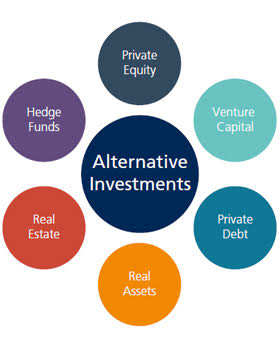
Opportunities such as these are called private investments or alternative investments — financial assets or investments outside the stock and bond market. Examples include private equity, hedge funds, venture capital, real estate, commodities and cryptocurrencies. Here’s a brief description of several alternative investments:

• Private equity funds are invested directly into companies rather than into publicly traded stocks or bonds. Private equity firms raise money from investors and institutions and invest those monies directly into non-traded companies. There are several different types of private equity investments, such as distressed funds, leveraged buyouts and “fund of funds,” for example. 

• Hedge funds are investment structures that pool monies together to invest in many different asset classes, and they are typically unconcerned with market direction. In its simplest form, a hedge fund is known as Long-Short. They go “long” by buying one stock in an industry, such as Ford, and “short” by selling another stock in the same industry, such as GM. Therefore, they are what is called market neutral.  Hedge funds, like private equity, take on many different types, such as macro, equity, value and distressed.

• Venture capital investment typically involves financing startup companies and businesses. This is similar to how private equity works, but venture capital invests more in startup and early-stage businesses, whereas private equity investments are usually in more developed companies. There are different forms of venture capital investments such as seed, early-stage and expansion investments.

• Real estate investments such as investment properties, office buildings, apartments or vacation homes also are considered alternative investments, as they are purchased outside of the publicly traded markets. There are many other types of alternative investments within real estate such as hard money loans, private notes, real estate partnerships and opportunity zone investments.  

• Commodities are investments that typically are available to investors of all experience levels and easier to purchase than other alternatives, such as gold, silver, oil or natural gas.

• Cryptocurrency has become a more recent phenomenon among alternative investments. Investors are putting money into Bitcoin or Ethereum or in the network blockchain, which is a digital ledger to track cryptocurrency movement and ownership. 

Graphic illustrating different investment types

The pros and cons of alternative investments

PROS:

• They are not correlated to the stock market. This means that they add diversification to your portfolio while attempting to minimize risk. As we briefly outlined above, there are many different types of alternative investments, and the more investments one owns, the more one can potentially further reduce volatility in the portfolio.

• There is a potential for increased returns. As with any risky investment, there are no guarantees or guaranteed returns. Proponents of alternative investments maintain that higher returns can be achieved through these types of investments — but with the potential for higher returns comes higher risk.

CONS:

• They lack liquidity. Alternative investments tend to be private, i.e., not publicly traded, and therefore, they are less liquid. This means that they may be difficult to exit, and your monies could be tied up for many years, giving you no access to those funds. During the Great Recession, for example, many alternative investments stopped any redemptions of their funds, and clients who needed the money had no access to those monies.

• They have high investment minimums. For many people, higher minimums may make such investments unavailable. If an investment requires a high minimum to participate and that investment makes up a large percentage of your net worth, then it may not be prudent to have that much of your nest egg in one, potentially illiquid investment.

• They have higher fees. Most alternative investments carry higher investment fees than publicly traded funds do. At the same time, alternative investment fees are not always transparent, nor are they regulated by the SEC. Fees vary based on the type of investment, so it is important to understand the fee structure and how the fund manager gets paid.

• They lack regulation. Alternative investments are not regulated by the SEC and are not subject to reporting requirements. In addition, the underlying assets are often difficult to value, which can be deceptive for pricing and price transparency. Because of the lack of regulation and transparency, this can lead to risk of fraudulent investments. When you buy a stock, index fund, mutual fund or bond, you know that what you are buying is a real asset.

• They are complex. Alternative investments are often complex instruments and may require a high level of due diligence. If you are considering an alternative investment, it is imperative to do the research and understand all tax implications as well. For example, you may be a limited partner requiring a K-1, which in turn may delay filing your taxes. If you have several private investments, you may receive several K-1s, and this could lead to increased fees for filing taxes.

In recent years, alternative investments have grown in popularity. During down markets, alternative investments seem to become more popular as investors look to invest in something other than stocks.

Since alternative investments don’t have the same liquidity, transparency and valuation requirements of publicly traded stocks and bonds, investors may think that alternatives offer more security. 

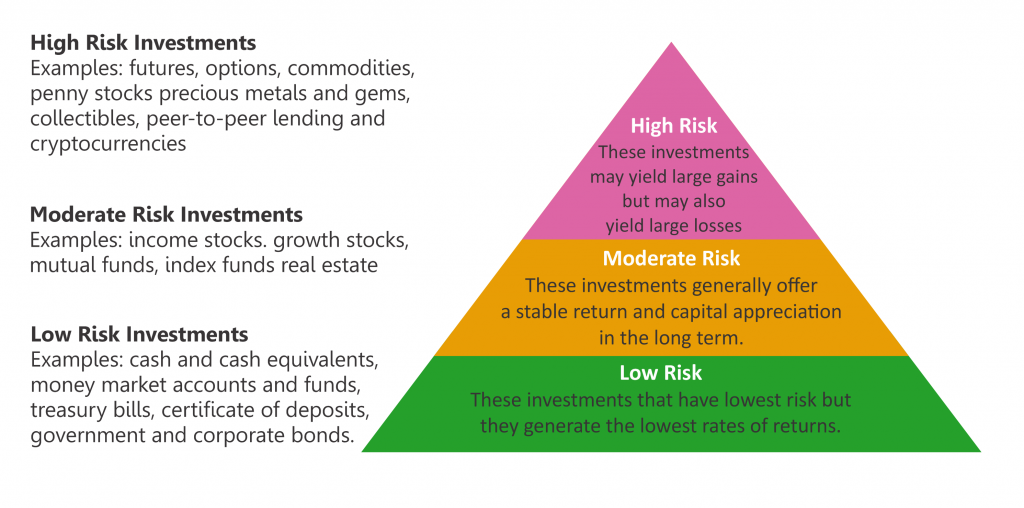
As seen in the pyramid below, alternative investments are higher on the risk scale, and therefore need to be well thought out and researched before investing capital. Please remember: If it sounds too good to be true, it normally is!

Pyramid chart ranking investment types according to risk

The CD Wealth Formula

We help our clients reach and maintain financial stability by following a specific plan, catered to each client. 

Our focus remains on long-term investing with a strategic allocation while maintaining a tactical approach. Our decisions to make changes are calculated and well thought out, looking at where we see the economy is heading. We are not guessing or market timing. We are anticipating and moving to those areas of strength in the economy — and in the stock market. 

We will continue to focus on the fact that what really matters right now is time in the market, not out of the market. That means staying the course and continuing to invest, even when the markets dip, to take advantage of potential market upturns. We continue to adhere to the tried-and-true disciplines of diversification, periodic rebalancing and looking forward, while not making investment decisions based on where we have been.

It is important to focus on the long-term goal, not on one specific data point or indicator. Long-term fundamentals are what matter. In markets and moments like these, it is essential to stick to the financial plan. Investing is about following a disciplined process over time.

Sources: Forbes, Investopedia

Promo for article titled Unpacking the Inflation Reduction Act: How Will it Affect You?

This material contains an assessment of the market and economic environment at a specific point in time and is not intended to be a forecast of future events, or a guarantee of future results. Forward-looking statements are subject to certain risks and uncertainties. Actual results, performance, or achievements may differ materially from those expressed or implied. Information is based on data gathered from what we believe are reliable sources.

Using diversification as part of your investment strategy neither assures nor guarantees better performance and cannot protect against loss of principal due to changing market conditions.

Past performance is not a guarantee of future results.

The opinions expressed in this commentary are those of the author and may not necessarily reflect those held by Kestra Investment Services, LLC or Kestra Advisory Services, LLC. This is for general information only and is not intended to provide specific investment advice or recommendations for any individual. It is suggested that you consult your financial professional, attorney, or tax advisor with regard to your individual situation.

Securities offered through Kestra Investment Services, LLC (Kestra IS), member FINRA/SIPC. Investment Advisory Services offered through Kestra Advisory Services, LLC (Kestra AS) an affiliate of Kestra IS. CD Wealth Management and Bluespring Wealth Partners LLC* are affiliates of Kestra IS and Kestra AS. Investor Disclosures: https://bit.ly/KF-Disclosures

*Bluespring Wealth Partners, LLC acquires and supports high quality investment adviser and wealth management companies throughout the United States.
Unpacking the Inflation Reduction Act: How Will It Affect You?

The Build Back Better Act that was so widely discussed at the beginning of the year has come to fruition in the form of the Inflation Reduction Act of 2022, which President Biden signed into law Tuesday. Its objective is to reduce inflation and the deficit, lower drug costs and increase investment in domestic energy production. The outcome of the Inflation Reduction Act will not be known for years to come, of course, but we want to discuss how some important parts of it may affect you.

What’s in the Inflation Reduction Act?

1. The bill introduces a 15% minimum corporate tax that applies to companies generating more than $1 billion in annual profit (based on a three-year average). Congress’ Joint Committee on Taxation estimates that fewer than 150 companies will be subject to the new rate. At the same time, there is a new 1% tax on stock buybacks. A stock buyback, or share repurchase, occurs when a company buys outstanding shares of its own stock to reduce the number of shares available on the open market. One reason companies may do this is to increase the value of the remaining shares available. It is an investment a company makes in itself when it believes its shares are trading too cheaply in the open market. The new 1% tax goes into effect in 2023, which could cause some companies to speed up buying shares this year and “tilt future capital deployment toward dividends,” Wells Fargo says.  

2. The act has the potential to save retirees a significant sum of money on healthcare costs. It allows Medicare to negotiate prices for certain drugs for the first time in 2026 — starting with 10 drugs, then expanding the list to 15 drugs in 2027 and 20 in 2029. The act caps out-of-pocket drug costs at $2,000 a year for Medicare beneficiaries, starting in 2025. Today, there is no cap on what people may spend. The act also caps insulin costs at $35 per month for those on Medicare. Additionally, all vaccines will be covered under Medicare part D. According to a recent study by the Center for Retirement Research, retirees spend about 25% of their Social Security on medical expenses, including Medicare premiums and out-of-pocket costs for prescription drugs.  

3. The Inflation Reduction Act allocates $80 billion over 10 years to increase IRS enforcement on taxpayers with more than $400,000 in income, with the goal to catch more tax cheaters. It is widely believed that this will dramatically increase the need for labor in our country, but with the unemployment rate at 3.5%, the question is: Where will the IRS find the new auditors needed?

Expected Results from the Inflation Reduction Act

REVENUE
15% corporate minimum tax: $313 billion*
Prescription drug pricing reform: $288 billion**
Enhanced IRS tax enforcement: $124 billion**
Total revenue raised: $725 billion

INVESTMENTS
Energy security & climate change investment: $369 billion***
Affordable Care Act extension: $64 billion**
Total investments: $433 billion

TOTAL DEFICIT REDUCTION: $292+ billion

* Joint Committee on Taxation, ** Congressional Budget Office, *** Both

4. The largest investment made by the Act relates to energy security and climate change, with billions of dollars going to expand wind and solar power production. Additional subsidies will be available for purchases of electric vehicles as well as funding for people to install energy-efficient heating and cooling systems in their homes. However, new rules make the EV tax credit harder to get, as there are limits as to the percentage of production that must occur in North America for the cars as well as for batteries. The credit is unavailable if the taxpayer’s adjusted gross income exceeds a threshold amount ($300,000 for taxpayers filing a joint return, $150,000 for single filers). There also is money available to oil companies to reduce greenhouse gas emissions and penalties for those that fail to do so.  

No one can predict the long-term results of the Inflation Reduction Act of 2022. The good news is that inflation appears to be easing on its own as global supply chain disruptions ease and the Federal Reserve’s tightening of money supply is working. There is little debate, though, that this bill will help reduce the deficit. Retirees stand to benefit heavily from the future reduction in drug costs. The legislation stands to create the single largest investment in climate and energy in the U.S. to date: roughly $369 billion, with estimates of cutting emissions by as much as 40% by 2030. At the end of the day, though, we won’t know for many years how the Inflation Reduction Act affects inflation or corporate profitability.

The CD Wealth Formula

We help our clients reach and maintain financial stability by following a specific plan, catered to each client. 

Our focus remains on long-term investing with a strategic allocation while maintaining a tactical approach. Our decisions to make changes are calculated and well thought out, looking at where we see the economy is heading. We are not guessing or market timing. We are anticipating and moving to those areas of strength in the economy — and in the stock market. 

We will continue to focus on the fact that what really matters right now is time in the market, not out of the market. That means staying the course and continuing to invest, even when the markets dip, to take advantage of potential market upturns. We continue to adhere to the tried-and-true disciplines of diversification, periodic rebalancing and looking forward, while not making investment decisions based on where we have been.

It is important to focus on the long-term goal, not on one specific data point or indicator. Long-term fundamentals are what matter. In markets and moments like these, it is essential to stick to the financial plan. Investing is about following a disciplined process over time.

Sources: CNBC, Investopedia, Financial Planning Magazine, Kestra Investment Management

Promo for an article titled Valuable Financial Advice for the Recent College Graduates in Your Life

This material contains an assessment of the market and economic environment at a specific point in time and is not intended to be a forecast of future events, or a guarantee of future results. Forward-looking statements are subject to certain risks and uncertainties. Actual results, performance, or achievements may differ materially from those expressed or implied. Information is based on data gathered from what we believe are reliable sources.

Using diversification as part of your investment strategy neither assures nor guarantees better performance and cannot protect against loss of principal due to changing market conditions.

Past performance is not a guarantee of future results.

The opinions expressed in this commentary are those of the author and may not necessarily reflect those held by Kestra Investment Services, LLC or Kestra Advisory Services, LLC. This is for general information only and is not intended to provide specific investment advice or recommendations for any individual. It is suggested that you consult your financial professional, attorney, or tax advisor with regard to your individual situation.

Securities offered through Kestra Investment Services, LLC (Kestra IS), member FINRA/SIPC. Investment Advisory Services offered through Kestra Advisory Services, LLC (Kestra AS) an affiliate of Kestra IS. CD Wealth Management and Bluespring Wealth Partners LLC* are affiliates of Kestra IS and Kestra AS.  Investor Disclosures: https://bit.ly/KF-Disclosures

*Bluespring Wealth Partners, LLC acquires and supports high quality investment adviser and wealth management companies throughout the United States.
Valuable Financial Advice for the Recent College Graduates in Your Life

It’s hard to believe that summer is almost over and it’s time for the kids to go back to school. For many who just graduated from college, it’s time to begin their first real job! As our adult children move from college to the real world, it’s a good time to make sure they are ready to succeed and to be responsible for their own financial lives.

For those who are planning to rent an apartment rather than moving back home after graduation, start-up costs can accumulate quickly, going well beyond the price of rent alone. There will be a deposit needed for utilities, the cost of setting up and maintaining internet access, and expenses such as furniture, kitchen supplies and moving costs. Being able to cover these costs will require a budget — the most basic of all financial tools, and the most critical for people who are starting life on their own.

It’s exciting when our children get their first job offer. The starting salary may sound great — and it may even include a signing bonus! But if they’re not thinking about how much money in taxes comes off the top first, it can be quite surprising and a substantial hit to the budget.

Let’s use the example of someone with a starting salary of $50,000. A single filer making $50,000 in 2022 falls into the 22% marginal federal tax bracket. This doesn’t include Social Security or Medicare taxes. For simplicity’s sake, let’s assume they withhold 20% for taxes out of their paycheck, so the $50,000 now drops down to $39,000 on an annualized basis or $3,250 per month. 

If the company has a 401K program that matches up to 3% of salary ($1,500 per year), they should contribute to get the “free money” from their company. (At a minimum, we recommend that they start out contributing 3% of their salary to their 401K so that they obtain the full match.) This will reduce their taxable salary from $50,000 to $48,500, since the $1,500 contribution into the 401K is not taxed. After taxes and retirement contributions, your child has to live on $3,200 per month. That amount of money must cover all other monthly expenses: rent, utilities, health insurance, car insurance, car payment, groceries, restaurants and entertainment.

This is where the budget comes into play. A great habit for them to start with is writing down everything that they spend so that they can see where the money goes and how fast it can disappear. If your adult child can stay on your health insurance (as they are allowed to do until age 26), then that will save them money each month. Once they are no longer living at home and they have a different permanent residence, they will need their own auto insurance. You also will want to make sure that they have renters’ insurance for their apartment to protect their belongings. This is relatively inexpensive, costing under $500 in many cases.

Debt is a silent killer for savings, eating away at assets each month. Credit card debt is the worst debt, with interest rates often exceeding 20%. If you have student loan and credit card debt, work on paying off the higher-interest debt first.

Student loans may take many years to pay off, so focus on eliminating credit card debt and then managing your spending going forward.

It’s important to discuss the concept of growing wealth with adult children who are starting their first jobs. As we mentioned earlier, many companies have 401Ks that match employee contributions. If a 22-year-old puts away $1,500 into a 401K every year until age 70 and earns an average of 5% annually, the value of that investment would be $300,000, not including the money from the match. The match equates to free money, and starting early sets them on a great path to earlier retirement. If their employer does not offer a 401K, starting an IRA or Roth IRA can accomplish the same goal initially.

The cost of adulting is not cheap. Buying a car, clothes for work and furniture are one-time expenses, which should be looked at as an investment and not a splurge. There will always be expenses that arise that can throw a wrench into the budget for those starting out, so we also recommend that your child begin a rainy-day fund for unexpected expenses.

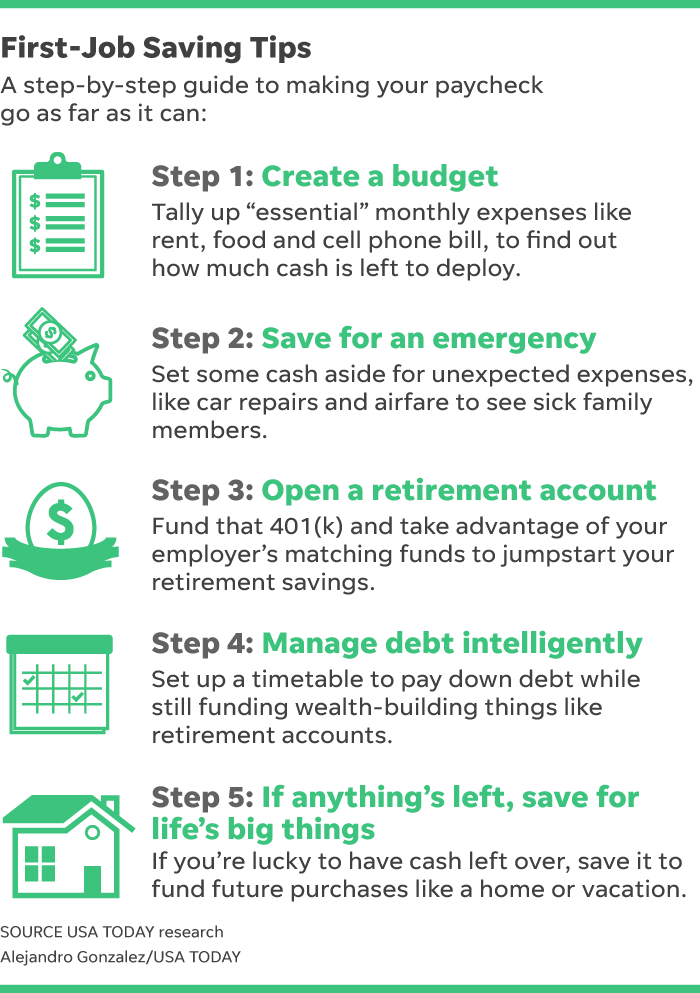
Chart listing tips for saving money when starting your career
Previously published by USA Today

We are here to help you and your family with these new and exciting endeavors. At all stages of life, budgeting is critical to your financial well-being. By helping your children start early and creating a habit right out of college, you can help them experience more financial freedom as adults.

The CD Wealth Formula

We help our clients reach and maintain financial stability by following a specific plan, catered to each client. 

Our focus remains on long-term investing with a strategic allocation while maintaining a tactical approach. Our decisions to make changes are calculated and well thought out, looking at where we see the economy is heading. We are not guessing or market timing. We are anticipating and moving to those areas of strength in the economy — and in the stock market. 

We will continue to focus on the fact that what really matters right now is time in the market, not out of the market. That means staying the course and continuing to invest, even when the markets dip, to take advantage of potential market upturns. We continue to adhere to the tried-and-true disciplines of diversification, periodic rebalancing and looking forward, while not making investment decisions based on where we have been.

It is important to focus on the long-term goal, not on one specific data point or indicator. Long-term fundamentals are what matter.  In markets and moments like these, it is essential to stick to the financial plan. Investing is about following a disciplined process over time.

Source: USA Today

Promo for article titled Are We in a Recession? Here Are the Indictors You Should be Watching

This material contains an assessment of the market and economic environment at a specific point in time and is not intended to be a forecast of future events, or a guarantee of future results. Forward-looking statements are subject to certain risks and uncertainties. Actual results, performance, or achievements may differ materially from those expressed or implied. Information is based on data gathered from what we believe are reliable sources.

Using diversification as part of your investment strategy neither assures nor guarantees better performance and cannot protect against loss of principal due to changing market conditions.

Past performance is not a guarantee of future results.

The opinions expressed in this commentary are those of the author and may not necessarily reflect those held by Kestra Investment Services, LLC or Kestra Advisory Services, LLC. This is for general information only and is not intended to provide specific investment advice or recommendations for any individual. It is suggested that you consult your financial professional, attorney, or tax advisor with regard to your individual situation.

Securities offered through Kestra Investment Services, LLC (Kestra IS), member FINRA/SIPC. Investment Advisory Services offered through Kestra Advisory Services, LLC (Kestra AS) an affiliate of Kestra IS. CD Wealth Management and Bluespring Wealth Partners LLC* are affiliates of Kestra IS and Kestra AS. Investor Disclosures: https://bit.ly/KF-Disclosures

*Bluespring Wealth Partners, LLC acquires and supports high quality investment adviser and wealth management companies throughout the United States.

Are We in a Recession? Here Are the Indicators You Should Be Watching

Reports last week indicated that gross domestic product (GDP) contracted by -0.9% for the second quarter of the year, the second consecutive quarter of negative GDP growth after the first-quarter decline of -1.6%. As a reminder, GDP is the monetary value of all finished goods and services produced within a country’s borders during a specific time period, adjusted for inflation. 

Many investors and economists accept that a recession is traditionally defined as two consecutive quarters of GDP decline. However, negative GDP growth alone may be insufficient to describe a recession. Typically, we see rising defaults from companies and individuals as well as higher unemployment during a recession. As we have often written before, the National Bureau of Economic Research — a private research organization and the official arbiter of identifying recessions in the U.S. — describes a recession as “a significant decline in economic activity, spread across the economy, lasting more than a few months.” This definition leaves a lot of room for interpretation. 

The following are other observable and measurable economic conditions that could be recession indicators: 

• Decline in real GDP: As stated above, we have seen two consecutive quarters of negative GDP growth. Expectations for GDP growth have continued to decrease. Annual GDP growth rates remain positive, but estimates continue to be lowered as the year progresses.  
• Decline in real income: Real median household income takes time to calculate due to revisions in inflation data. Data from May shows that personal income increased by .5%, disposable personal income increased by .5% and personal consumption expenditures increased by .2%. However, real disposal personal income decreased by .1%. Why the difference? Inflation. Remember, real income — also known as real wage — is how much money one makes after adjusting for inflation.   
• Decline in employment: The unemployment rate has remained steady at 3.6% for five months in a row and arguably represents near full employment for the economy. The low unemployment rate combined with the rise in wages may suggest that consumers are somewhat resilient to a potential recession and economic slowdown.
• Decline in industrial production: The industrial production index measures levels of production and capacity in the manufacturing, mining, electric and gas industries. Industrial production for June declined .2%, and prior months also were revised lower. The average monthly gain so far this year, however, remains positive at .4%. Industrial production increased at an annual rate of 6.1% for the second quarter. In a recession, we typically would see strong negative levels in the industrial production index.  
• Decline in wholesale/retail sales: The consumer has remained strong and resilient for the first half of the year. The most recent wholesale report showed an increase of .5% and an increase in 20.9% from the May 2021 level. The most recent retail sales report exceeded expectations and showed an increase of 1% from the previous month and 8.4% above June 2021. 

If a recession were to occur, remember that not all recessions are the same. Recessions generally fall into three categories: 

• Asset bubble recession: Think of the recession from the technology bubble in 2000 or the great financial crisis of 2008, caused by the housing crisis. This typically leads to a larger financial crisis and results in steep market declines. 
• Geopolitically driven recession: These are based on events such as the oil embargo of 1973-1974 or the COVID recession of 2020. They are typically the shortest in duration because they are event-driven.  
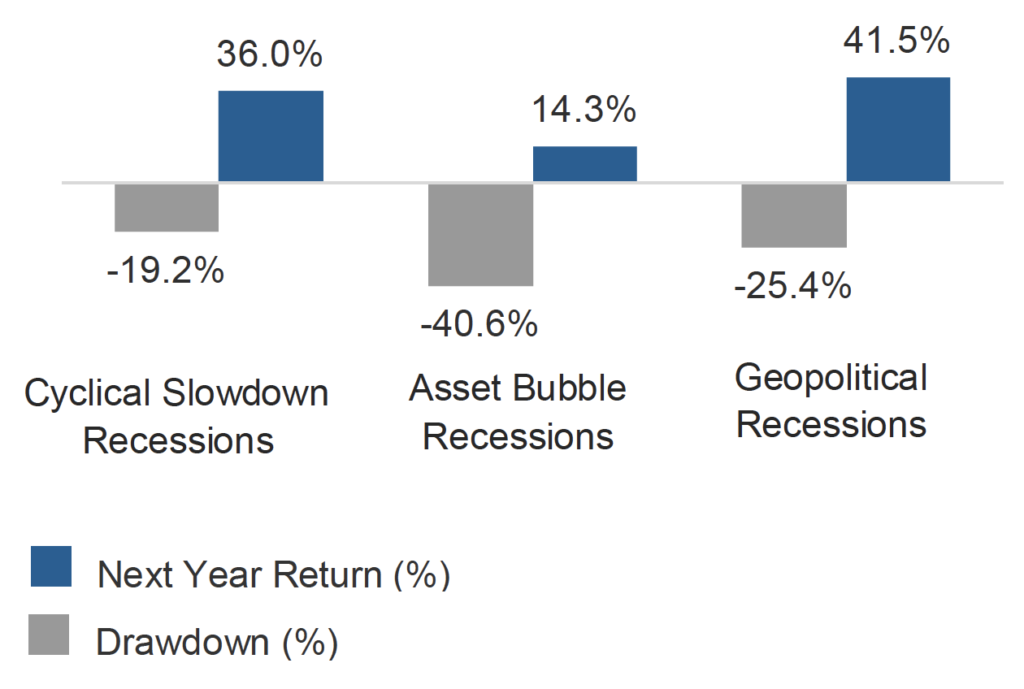
• Cyclical slowdown recession: This type of recession is usually the least extreme and occurs when there is a shift in supply and demand. As the chart below shows, cyclical slowdown recessions going back to 1947 decline 19.2% on average and have a very strong return the following year.

Average Equity Drawdown and Recovery During Recessions since 1947

Chart showing average equity drawdown and recovery during recessions since 1947
Source: Bloomberg and National Bureau of Economic Research. Published by AssetMark.

While the probability of a recession has increased, recessions in and of themselves are unavoidable. The economic indicators listed above will continue to provide us measurable data about the U.S. economy.

In spite of two consecutive quarters of negative GDP growth, the labor market remains strong, consumers seem resilient today, and output shows that supply-chain issues may be resolving themselves, especially with automobiles. Remember, recessions don’t last forever, and neither do bear markets.

Our focus remains on long-term investing with a strategic allocation while maintaining a tactical approach. Our decisions to make changes are calculated and well thought out, looking at where we see the economy is heading. We are not guessing or market timing. We are anticipating and moving to those areas of strength in the economy and the stock market. 

We will continue to focus on the fact that what really matters right now is time in the market, not out of the market. That means staying the course and continuing to invest, even when the markets dip to take advantage of potential market upturns. We continue to adhere to the tried-and-true disciplines of diversification, periodic rebalancing and looking forward, while not making investment decisions based on where we have been.

It is important to focus on the long-term goal, not on one specific data point or indicator. Long-term fundamentals are what matter. In markets and moments like these, it is essential to stick to the financial plan. Investing is about following a disciplined process over time.

Sources: AssetMark, Investopedia, Lord Abbett

Promo for article titled The Portfolio Changes We're Making as the Third Quarter Begins

This material contains an assessment of the market and economic environment at a specific point in time and is not intended to be a forecast of future events, or a guarantee of future results. Forward-looking statements are subject to certain risks and uncertainties. Actual results, performance, or achievements may differ materially from those expressed or implied. Information is based on data gathered from what we believe are reliable sources.

Using diversification as part of your investment strategy neither assures nor guarantees better performance and cannot protect against loss of principal due to changing market conditions.

Past performance is not a guarantee of future results.

The opinions expressed in this commentary are those of the author and may not necessarily reflect those held by Kestra Investment Services, LLC or Kestra Advisory Services, LLC. This is for general information only and is not intended to provide specific investment advice or recommendations for any individual. It is suggested that you consult your financial professional, attorney, or tax advisor with regard to your individual situation.

Securities offered through Kestra Investment Services, LLC (Kestra IS), member FINRA/SIPC. Investment Advisory Services offered through Kestra Advisory Services, LLC (Kestra AS) an affiliate of Kestra IS. CD Wealth Management and Bluespring Wealth Partners LLC* are affiliates of Kestra IS and Kestra AS.  Investor Disclosures: https://bit.ly/KF-Disclosures

*Bluespring Wealth Partners, LLC acquires and supports high quality investment adviser and wealth management companies throughout the United States.

The Portfolio Changes We’re Making as the Third Quarter Begins

This is a big week for the stock market: Earnings season is under way with many of the large-cap names reporting this week, the Federal Reserve raised interest rates another 75 basis points (.75%), and second-quarter GDP estimates are set to be released. Many economists predict that this will be the second consecutive quarter of negative GDP growth, signaling to many that we are in a recession. 

However, the National Bureau of Economic Research defines a recession as a significant decline in economic activity that is spread across the economy and lasts more than a few months. The bureau does not define it as two consecutive quarters of negative GDP growth. Nonetheless, the stock market — which is a leading indicator — has been signaling for most of this year that the economy is slowing and a recession is possible. 

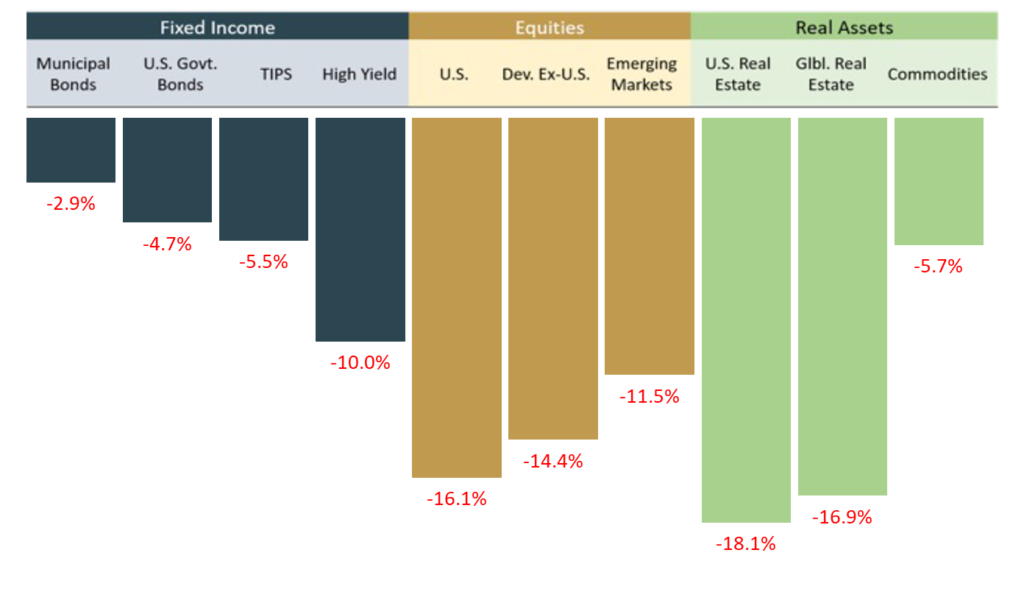
The chart below is a stark reminder of how the market performed the first half of 2022. There are many reasons for the broad-based declines in all asset classes – the ongoing war in Ukraine, China’s zero-COVID policy, fears of economic slowdown and — lest we forget — inflation. Stock markets look forward, pricing in what investors think will happen, not what is happening right now. As such, current stock and bond prices already reflect the significant economic slowdown, if not a full recession. Bear markets do end, and when they do, a bull market will ensue.

Q2 2022 Index Returns

Chart showing index returns for the first half of 2022 by sector
Past performance is not a reliable indicator of current or future results. Indexes are unmanaged and not subject to fees. It is not possible to invest directly in an index. Note: Views are from a U.S. dollar perspective. Source: Kestra Investment Management with data from FactSet. Index proxies: Bloomberg Municipal Bond Index, Bloomberg US AGG Bond Index, S&P US TIPS, ICE BofA US High Yield, S&P 500, MSCI World ex USA, MSCI EM, Dow Jones US Select REIT, Dow Jones Global X US & Bloomberg Commodity Index. Data as of July 15, 2022. 

Knowing that bear markets will end and that they do not last as long as bull markets, we are in the process of reallocating and rebalancing our client portfolios to account for where we think the market is heading, not where it has been. We are making the following changes:

1. Earlier this year, we took additional profits in technology and healthcare and transitioned into broader value-based equities as well as mid-cap stocks for further diversification. From a long-term perspective, we believe strongly in both the technology and healthcare sectors and maintain broad exposure to both. Typically, in the late business cycle and entering a recession, we see growth moderating, credit tightening up, earnings coming under pressure and inventories growing as sales fall. With earnings season under way, we already have seen many Wall Street analysts and companies reduce earnings forecasts based on the strong dollar and the weakening economy. This must happen for the market to reach a bottom.

2. As we have written in the past, one of the positives of a down market is the ability to tax-loss harvest. Tax-loss harvesting does not always have to occur at year end. As a reminder, under current tax law, it’s possible to offset current capital gains with capital losses you’ve incurred during the year or carried over from a prior tax return. Capital gains are the profits you realize when you sell an investment for more than paid for it, while capital losses are the losses you realize when you sell an investment for less than you paid for it.

Short-term capital gains are taxed as ordinary income rates, whereas long-term capital gains are taxed at a lower capital gains rate. Being able to reduce the tax on both short- and long-term capital gains by harvesting losses can help offset the gains one incurs from taking profits. Harvesting the loss has no effect on the portfolio value, since one can use the proceeds from the sale to buy a similar investment. This allows the investor to maintain similar asset allocation and reduce federal income taxes. We want to take advantage now of several holdings trading at a loss and swap out those holdings to capture the loss while maintaining similar asset class exposure. We swapped out our small- and mid-cap funds, as well as the international fund, to harvest the current losses.

3. From a fixed-income perspective, we shortened the duration of the portfolio late last year as we anticipated higher interest rates in 2022. This has played out as we envisioned. While the fixed-income markets have not been spared the downdraft of the overall markets, we feel that most of the interest-rate change is accounted for in the bond market. Therefore, we are increasing the overall maturity of the portfolio to capture the higher yields that the market offers. At the same time, we are substituting a tax-free municipal bond position instead of a taxable bond fund, as municipal bonds offer great value in this market.

Our focus remains on long-term investing with a strategic allocation while maintaining a tactical approach. Our decisions to make changes are calculated and well thought out, looking at where we see the economy is heading.

We are not guessing or market timing. We are anticipating and moving to areas of strength in the economy and in the stock market. We strategically have new cash on the sidelines and buy in for clients on down days or dips in the market – as one does with a 401K. 

In the short term, the sentiment and the outlook for the global economy remain negative. Economists are debating whether the United States is in a recession, and if so, what this means. Regardless, we continually speak with our clients about staying the course and not listening to the noise. Even if we entera recession, every recession ultimately ends and expansion ensues, with an accompanying bull market.

We will continue to drive home the fact that what really matters right now is time in the market, not out of the market. That means staying the course and continuing to invest, even when the markets dip, to take advantage of potential market upturns. We continue to adhere to the tried-and-true disciplines of diversification, periodic rebalancing and looking forward, while not making investment decisions based on where we have been.

It is important to focus on the long-term goal, not on one specific data point or indicator. In markets and moments like these, it is essential to stick to the financial plan. Investing is about following a disciplined process over time.

It all starts with a solid financial plan for the long run that understands the level of risk that is acceptable for each client. Regarding investments, we believe in diversification and in having different asset classes that allow you to stay invested. The best option is to stick with a broadly diversified portfolio that can help you to achieve your specific financial goals — regardless of market volatility. Long-term fundamentals are what matter.

Source: Kestra Investment Management

Promo for article titled Midterm Elections Are Around the Corner. What Does This Mean for the Market?

This material contains an assessment of the market and economic environment at a specific point in time and is not intended to be a forecast of future events, or a guarantee of future results. Forward-looking statements are subject to certain risks and uncertainties. Actual results, performance, or achievements may differ materially from those expressed or implied. Information is based on data gathered from what we believe are reliable sources.

Using diversification as part of your investment strategy neither assures nor guarantees better performance and cannot protect against loss of principal due to changing market conditions.

Past performance is not a guarantee of future results.

The opinions expressed in this commentary are those of the author and may not necessarily reflect those held by Kestra Investment Services, LLC or Kestra Advisory Services, LLC. This is for general information only and is not intended to provide specific investment advice or recommendations for any individual. It is suggested that you consult your financial professional, attorney, or tax advisor with regard to your individual situation.

Securities offered through Kestra Investment Services, LLC (Kestra IS), member FINRA/SIPC. Investment Advisory Services offered through Kestra Advisory Services, LLC (Kestra AS) an affiliate of Kestra IS. CD Wealth Management and Bluespring Wealth Partners LLC* are affiliates of Kestra IS and Kestra AS. Investor Disclosures: https://bit.ly/KF-Disclosures

*Bluespring Wealth Partners, LLC acquires and supports high quality investment adviser and wealth management companies throughout the United States.
What Does a Stronger U.S. Dollar Mean for You?

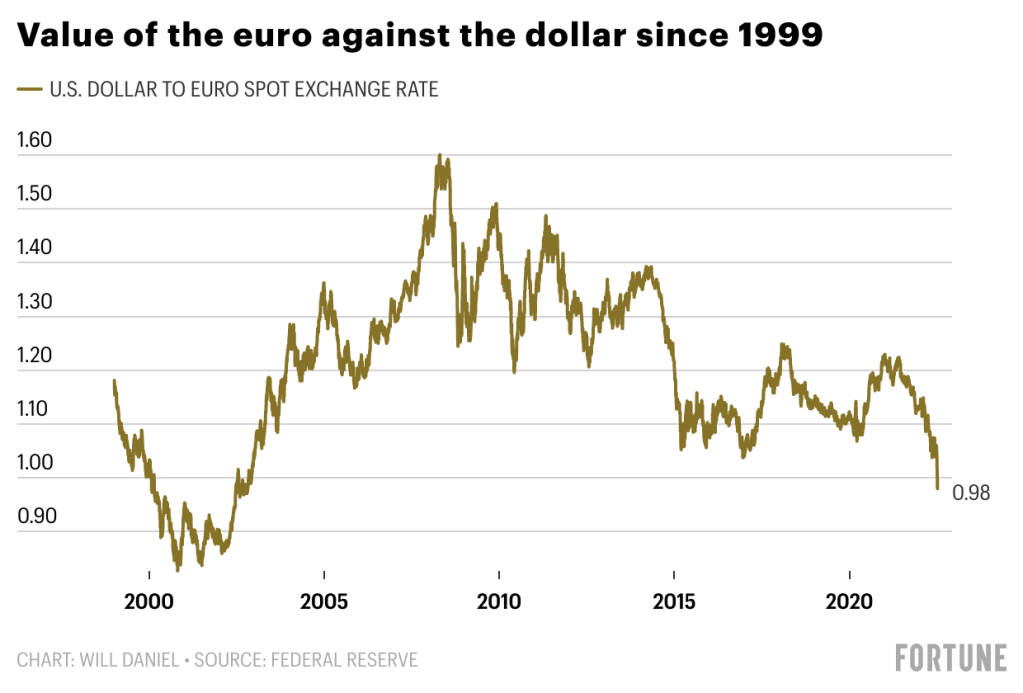
For the first time in nearly two decades, the exchange rate between the euro and the dollar is roughly the same. The parity in the two currencies comes after the euro has plunged almost 20% in value over the last 14 months compared to the dollar. This year, the U.S. dollar has gained against most major currencies, as the Fed’s interest rate hikes have made the dollar a safe haven for investors worldwide who are seeking protection against surging global inflation. 

The chart below shows the value of the euro compared to the dollar since 1999 and the wild swings that may occur in the currency markets. 

Source: Fortune

When the Federal Reserve raises rates, as it has done several times this year, Treasury yields also tend to move higher. This attracts more money into the U.S. from international investors, who in turn buy dollar-denominated bonds in hopes of obtaining higher yields than they can obtain in their own countries. The higher the yield, the better the return. The Federal Reserve has raised rates more aggressively in 2022 than many other central banks around the globe.

Another potential dynamic causing the strength of the U.S. dollar is the idea that the U.S. is a safe haven for investments, compared to many other countries. Russia’s war with Ukraine has caused considerable geopolitical and economic uncertainty in Europe. At the same time, China’s zero-COVID policy has been another drag on the global economy. While there is uncertainty in the U.S. regarding a potential recession, the bond market (i.e., U.S. Treasuries) remains a safe investment compared to other countries, boosting the dollar’s attractiveness.

Why does the strength of the U.S. dollar matter? For those traveling overseas, a strong dollar is quite advantageous. A stronger American dollar goes much farther abroad and provides more buying power. Everything is cheaper for Americans traveling out of the country. 

From an investment standpoint, the implications may be different. U.S.-based companies that have large international businesses are likely to suffer from a stronger dollar, primarily because converting overseas profits earned in weaker currencies into U.S. dollars can weigh on sales as well as earnings. Income from foreign sales will decrease in value on balance sheets because the foreign currency value has lost value. At the same time, domestically produced goods become more expensive abroad as the dollar increases compared to the currency where the goods are being shipped and then sold, driving down earnings.

On the other hand, goods produced abroad and imported to the United States will be cheaper with a stronger dollar. For example, a luxury car made in Italy will fall in price in dollars with the current parity between the dollar and the euro. If a car costs 70,000 euros and the exchange rate is 1.35, then it costs $94,500. However, if the exchange rate falls to 1.12, it would cost just $78,400.

Many companies will employ hedging techniques that may help improve gross profit margins and recover some of the lost revenue from the strong dollar. Some companies may sell their products overseas, and that may help them recover lost revenue from lower production costs. It also is important to note that currency swings of this magnitude tend to be short-lived. 

Promo for an article titled How Will the Economy Fare in the Second Half of 2022?

So, what can we learn from all this? While the U.S. dollar is at parity with the euro for the first time in over 20 years, it is critical to remember that the overarching approach to investing in stocks and bonds is based on long-term fundamentals. There will be quarter-to-quarter fluctuations, currency headwinds and currency tailwinds with every company that performs business in multiple countries. The primary focus is to look at the underlying fundamentals of the businesses and not become consumed with shorter-term currency moves that may affect business for a quarter or two. In the meantime, if you have a trip planned overseas, enjoy the benefits of a stronger dollar.

We will continue to focus on the fact that what really matters right now is time in the market, not out of the market. That means staying the course and continuing to invest, even when the markets dip to take advantage of potential market upturns. We continue to adhere to the tried-and-true disciplines of diversification, periodic rebalancing and looking forward, while not making investment decisions based on where we have been. It is important to focus on the long-term goal, not on one specific data point or indicator. In markets and moments like these, it is essential to stick to the financial plan. Investing is about following a disciplined process over time.

At the end of the day, investors will be well-served to remove emotion from their investment decisions and remember that over time, markets tend to rise. During volatile markets, it is important to remember that the fear of losing money is stronger than the joy of making money. Investor emotions can have a big impact on retirement outcomes. Market corrections and bear markets are normal; nothing goes up in a straight line. 

Making market decisions based on what might happen may be detrimental to long-term performance. The key is to stay invested and stick with the financial plan. Markets go up and down over time, and downturns present opportunities to purchase stocks at a lower value.

It all starts with a solid financial plan for the long run that understands the level of risk that is acceptable for each client. Regarding investments, we believe in diversification and in having different asset classes that allow you to stay invested. The best option is to stick with a broadly diversified portfolio that can help you to achieve your own specific financial goals — regardless of market volatility. Long-term fundamentals are what matter.

Sources: CNBC, Fortune, Investopedia, MSN

Promo for an article titled Understanding the Importance of Market Liquidity

This material contains an assessment of the market and economic environment at a specific point in time and is not intended to be a forecast of future events, or a guarantee of future results. Forward-looking statements are subject to certain risks and uncertainties. Actual results, performance, or achievements may differ materially from those expressed or implied. Information is based on data gathered from what we believe are reliable sources.

Using diversification as part of your investment strategy neither assures nor guarantees better performance and cannot protect against loss of principal due to changing market conditions.

Past performance is not a guarantee of future results.

The opinions expressed in this commentary are those of the author and may not necessarily reflect those held by Kestra Investment Services, LLC or Kestra Advisory Services, LLC. This is for general information only and is not intended to provide specific investment advice or recommendations for any individual. It is suggested that you consult your financial professional, attorney, or tax advisor with regard to your individual situation.

Securities offered through Kestra Investment Services, LLC (Kestra IS), member FINRA/SIPC. Investment Advisory Services offered through Kestra Advisory Services, LLC (Kestra AS) an affiliate of Kestra IS. CD Wealth Management and Bluespring Wealth Partners LLC* are affiliates of Kestra IS and Kestra AS.  Investor Disclosures: https://bit.ly/KF-Disclosures

*Bluespring Wealth Partners, LLC acquires and supports high quality investment adviser and wealth management companies throughout the United States.