What kind of growth can investors expect in 2022?

In all, 2021 was a solid year for the financial markets. The economy’s ability to adapt to the pandemic, the vaccine rollout, additional financial stimulus and easy monetary policy all supported strong performance. Growth in large-cap U.S. equities was primarily driven by gains among the S&P 500’s largest tech holdings. Severe supply-chain bottlenecks and a surge in energy prices supported a strong commodity performance. Small-cap U.S. equities trailed their large-cap counterparts but still produced returns greater than their 20-year average of 11%.

Outside the U.S., equities in developed markets had another strong year. Emerging markets, on the other hand, were hurt after a correction in the Chinese stock market and continued lockdown measures. Finally, U.S. fixed income decreased as long-term interest rates ended the year higher than where they started.
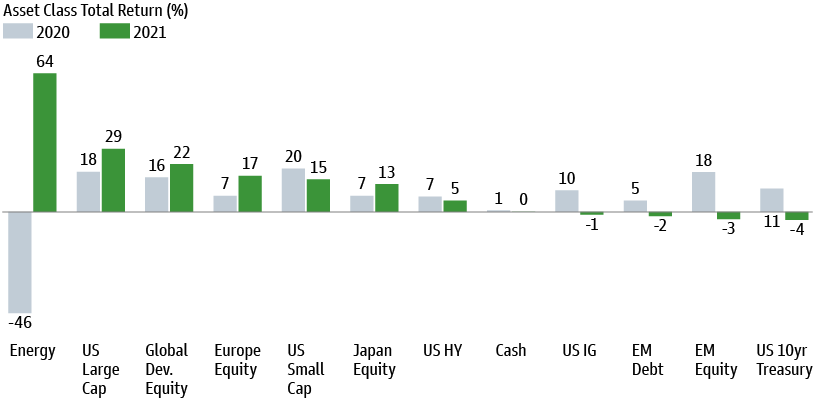
Chart showing 2021 returns by asset class


The Chinese stock market had a correction in 2021, and questions remain about the Chinese economy. The property market downturn, triggered by the collapse of Evergrande, is a large drag on China’s economic growth. In the past, downside growth risks in China have been quickly countered by monetary and fiscal stimulus. This time may be different as signals point toward Chinese leaders being worried about excessive leverage in the property sector. With China’s 2022 growth projections being around 5%, this may take some pressure off global inflation.

In 2022, the central narrative will be how markets react to the Federal Reserve and other major central banks transitioning away from an extraordinary 18-month period of stimulus. Return and income-seekers will need to navigate a backdrop of favorable but moderating growth, high valuations, low and rising yields, and ongoing COVID-related question marks — in particular, an uncertain path for inflation.

The U.S. economy is poised for a year of moderating but above-trend economic growth. Robust household income and accumulated savings leave the consumer in a strong position heading into the year. Businesses have record levels of cash on hand, which may lead to record levels of investment. Unemployment is at 4.2%, and wages are up. Excess cash has been moving into the equity markets, and in 2021, inflows into equities were more than the past 19 years combined.
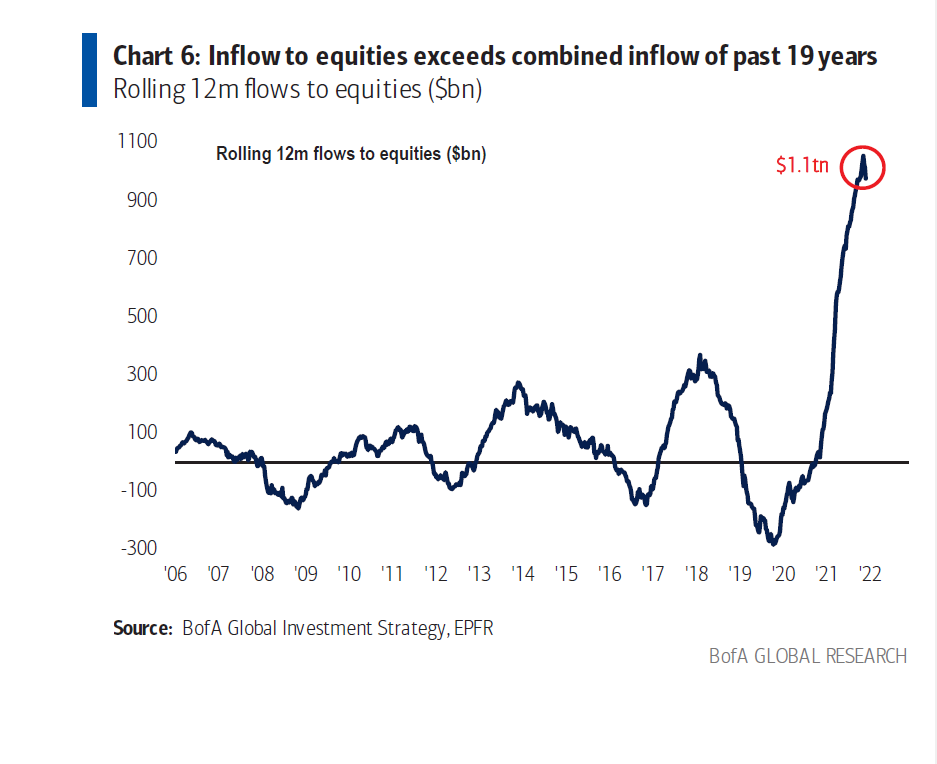
Chart showing inflow to equities


Inflation remains the primary focus for most investors. Moderating demand, rebalancing demand from goods to services and healing the supply side should allow inflation to rates to reduce in the second half of the year. Wage inflation and strong labor demand are the key risks to this scenario. At the same time, we are keeping a close watch on fiscal policy. For now, President Biden’s Build Back Better plan is on ice. If this plan were to be resurrected, we would watch closely and keep you informed every step of the way.

So, what can we learn from all this? We are hopeful that 2022 will be a turning point in the global pandemic and that policy makers will wean economies and markets off fiscal and monetary stimulus. Vaccine manufacturing continues to ramp up, and new therapeutics to fight COVID continue to be available in the U.S. and abroad. Inflationary pressures should ease but still settle at an elevated level than the recent past. We believe that diversification and the discipline to stay invested over the long-term are more important than ever. We are optimistic for a successful 2022!

From a portfolio perspective, we continue to adhere to the tried-and-true disciplines of diversification, periodic rebalancing and looking forward, while not making investment decisions based on where we have been. Making market decisions based on what might happen may be detrimental to long-term performance. 

The key is to stay invested and stick with the financial plan. Markets go up and down over time, and downturns present opportunities to purchase stocks at a lower value. As we say each week, it is important to stay the course. and focus on the long-term goal, not on one specific data point or indicator.

It all starts with a solid financial plan for the long run that understands the level of risk that is acceptable for each client. Regarding investments, we believe in diversification and having different asset classes that allow you to stay invested. The best option is to stick with a broadly diversified portfolio that can help you to achieve your own specific financial goals — regardless of market volatility. Long-term fundamentals are what matter.

Sources: BofA Global Investment Strategy, Blackrock, Bloomberg, JP Morgan, Russell Investments

Promo for article on the formula for wealth

This material contains an assessment of the market and economic environment at a specific point in time and is not intended to be a forecast of future events, or a guarantee of future results. Forward-looking statements are subject to certain risks and uncertainties. Actual results, performance, or achievements may differ materially from those expressed or implied. Information is based on data gathered from what we believe are reliable sources.

Using diversification as part of your investment strategy neither assures nor guarantees better performance and cannot protect against loss of principal due to changing market conditions.

Past performance is not a guarantee of future results.

The opinions expressed in this commentary are those of the author and may not necessarily reflect those held by Kestra Investment Services, LLC or Kestra Advisory Services, LLC. This is for general information only and is not intended to provide specific investment advice or recommendations for any individual. It is suggested that you consult your financial professional, attorney, or tax advisor with regard to your individual situation.

Securities offered through Kestra Investment Services, LLC (Kestra IS), member FINRA/SIPC. Investment Advisory Services offered through Kestra Advisory Services, LLC (Kestra AS) an affiliate of Kestra IS. Kestra IS and Kestra AS are not affiliated with CD Wealth Management. Investor Disclosures: https://bit.ly/KF-Disclosures

This year-end financial checklist will help you plan and save

As 2021 comes to an end, the time has come to review some year-end strategies to ensure that your wealth plan reflects any changes in your circumstances or your goals, the economic landscape and current tax environment. We recommend that you review the following checklist for planning strategies to consider; some may apply to you, while others may not. We recommend speaking with your CPA or accountant to review as well.

Income tax strategies

• Traditional year-end planning focuses on deferring income to a future year and accelerating deductions into the current year. However, if you anticipate that your marginal income tax rates will increase next year — whether due to increased income or changes in tax legislation — you may consider accelerating income into 2021 and deferring deductions to 2022.

• If you anticipate being in a lower taxable income bracket in 2022:

Defer income and any sale of capital gain property (if possible) to postpone taxable income.

— If you are itemizing on your tax return, bunch your medical expenses in the current year to meet the percentage of your adjusted gross income needed to claim those deductions.

— Make your January mortgage payment in December so that you can deduct the interest on your 2021 tax return.

Tax-related investment strategies

Tax-loss harvesting is the strategy of selling securities at a loss to offset a capital gain tax liability. It involves selling a taxable investment that has declined in value, replacing it with a similar investment and using the loss incurred to offset any gains. 

— Short-term losses are best used to offset short-term gains, and long-term losses can be used to offset long-term gains. Losses can help offset $3,000 of income on a joint tax return in one year.

— Be aware that the IRS wash-sale rule dictates that you must wait at least 31 days before buying back a holding that is sold for a loss.

• Make sure you have satisfied your required minimum distribution (RMD). Once you turn 72 years old, you are required to take minimum distributions from your traditional IRAs and most employer-sponsored retirement plans. 

— RMDs were not required in 2020 after Congress passed the CARES Act in response to the pandemic, but minimum distributions resumed in 2021, and failure to take them may result in a 50% penalty.

— You may have an RMD for an inherited IRA, depending on when you inherited it. (Tax laws have changed for newly inherited IRAs.) 

Promo for an article called The RMD Deadline is Approaching — Here is What You Need to Know

Retirement planning strategies

• Maximize your IRA contributions. You may be able to deduct annual contributions of up to $6,000 to your traditional IRA and $6,000 to your spouse’s IRA ($7,000 if over age 50).

• Make a Roth contribution if you qualify under the applicable income limits.

• Consider increasing or maximizing your 401(k) contribution. For 2021, the maximum is $19,500 for those who are younger than 50 and $26,000 for those who are 50 or older.

• Consider contributing to a Roth 401(k) plan if your plan allows.

• Consider setting up a Roth IRA for each of your children who have earned income during the year.

• Determine the optimal time to begin taking Social Security benefits if you over age 62. 

Gifting strategies

• Consider making gifts up to $15,000 per person as allowed under the federal annual gift tax exclusion. In 2022, the gift tax exclusion is projected to increase to $16,000 per person.

• Take advantage of the ability to deduct up to 100% of adjusted gross income (AGI) for a cash gift to a public charity in 2021. 

• Create a donor advised fund for an immediate income tax deduction and provide immediate and future benefits to a charity over time.

• If you already have a donor advised fund, consider gifting appreciated assets that have been held longer than one year to get the fair market value income tax deduction while avoiding income tax on the appreciation.

• Combine multiple years of charitable giving into a single year to exceed the standard deduction threshold.

• If you are over age 70 ½ (or 72, depending on your date of birth), consider making a direct transfer from an IRA to a public charity. The distribution is excludable from gross income. 

Wrapping up 2021, planning for 2022

• Work with your CPA to provide capital gains and investment income information for a more accurate year-end projection.

• Check your Health Savings Account contributions for 2021. If you qualify, you can contribute up to $3,600 (individual) or $7,200 (family), plus an additional $1,000 catch-up if you are over 55.

• Discuss major life events with CD Wealth Management to confirm you have clarity in your current situation.

• Double-check your beneficiary designations for employer-sponsored retirement plans, IRAs, Roth IRAs, annuities, life insurance policies, etc.

• Review that you have a trusted contact on each of your accounts to help protect assets against fraud. 

Promo for an article called Great News for Retirees: Social Security Gets a Boost

So, what can we learn from all this? The end of year is a perfect time to review your financial planning needs. This includes reviewing the investment portfolio, assessing year-end tax planning opportunities, reviewing retirement goals and managing your wealth transfer and legacy plans. The checklist above includes just some of the items that may apply to your family. We are happy to meet to discuss any of the above to ensure that you remain on track with your financial profile.

From a portfolio perspective, we continue to adhere to the tried-and-true disciplines of diversification, periodic rebalancing and looking forward, while not making investment decisions based on where we have been. Making market decisions based on what might happen may be detrimental to long-term performance. The key is to stay invested and stick with the financial plan. Markets go up and down over time, and downturns present opportunities to purchase stocks at a lower value. As we say each week, it is important to stay the course and focus on the long-term goal, not on one specific data point or indicator.

It all starts with a solid financial plan for the long run that understands the level of risk that is acceptable for each client. Regarding investments, we believe in diversification and having different asset classes that allow you to stay invested. The best option is to stick with a broadly diversified portfolio that can help you to achieve your own specific financial goals — regardless of market volatility. Long-term fundamentals are what matter.

Sources: BNY Mellon, Forbes, RBC

Promo for article on the formula for wealth

This material contains an assessment of the market and economic environment at a specific point in time and is not intended to be a forecast of future events, or a guarantee of future results. Forward-looking statements are subject to certain risks and uncertainties. Actual results, performance, or achievements may differ materially from those expressed or implied. Information is based on data gathered from what we believe are reliable sources.

Using diversification as part of your investment strategy neither assures nor guarantees better performance and cannot protect against loss of principal due to changing market conditions.

Past performance is not a guarantee of future results.

The opinions expressed in this commentary are those of the author and may not necessarily reflect those held by Kestra Investment Services, LLC or Kestra Advisory Services, LLC. This is for general information only and is not intended to provide specific investment advice or recommendations for any individual. It is suggested that you consult your financial professional, attorney, or tax advisor with regard to your individual situation.

Securities offered through Kestra Investment Services, LLC (Kestra IS), member FINRA/SIPC. Investment Advisory Services offered through Kestra Advisory Services, LLC (Kestra AS) an affiliate of Kestra IS. Kestra IS and Kestra AS are not affiliated with CD Wealth Management. Investor Disclosures: https://bit.ly/KF-Disclosures

Saving for college? What you need to know about 529 plans

Last week, we wrote about Social Security and retirement. This week, we are focusing on the opposite end of the lifecycle spectrum: planning for college. With the price of college continuing to rise, saving enough money to pay for four years of education can feel like an overwhelming task. 
 
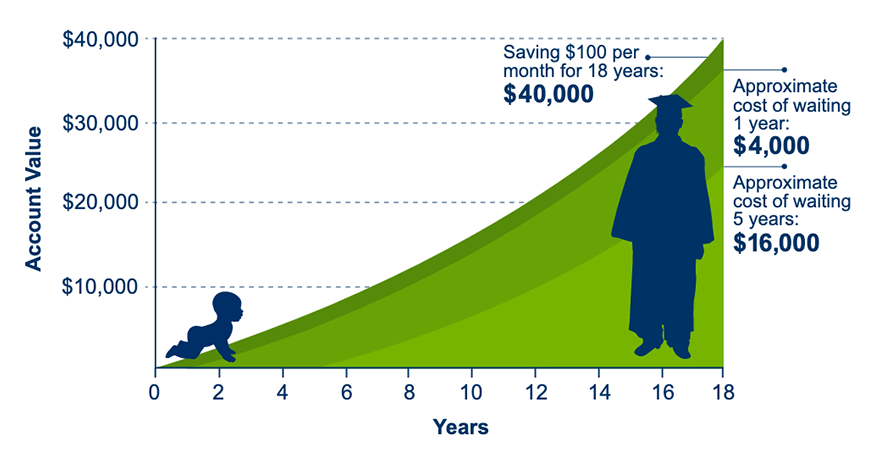
In 2019-2020, the average cost of a year at an in-state public university was roughly $22,000, while a year of private school was more than $50,000. By the time today’s newborns are set to enroll in college, four years at an in-state public university probably will cost more than $265,000. The longer you wait to start saving for college, the less time you allow for compound growth, and therefore, you will spend more of your own money, rather than letting your money work for you. It is never too early to begin saving for the educational objectives of your family, whether that means for your kids or your grandkids.

Chart showing hypothetical growth of a college savings fund starting at a child's birth versus waiting one or five years to start saving

The most common and most popular way to save for college tuition is through a 529 plan, named after the section in the Internal Revenue Code that authorizes qualified tuition plans. A 529 account is an education investment account with rules and guidelines set by individual states. Each state negotiates the fees for management and mutual funds separately. If you live in a state that does not have an income tax (like Texas), you can choose to invest in any state’s 529 plan.

Each year, you can invest up to $15,000 per parent or $30,000 per couple into a 529 plan. Grandparents — or anyone else, such as a family member or friend — also can contribute the same amount to a 529 plan. A 529 account can be super funded with one-time contributions of $75,000 per person or $150,000 per couple; this uses up five years of annual gifting. 

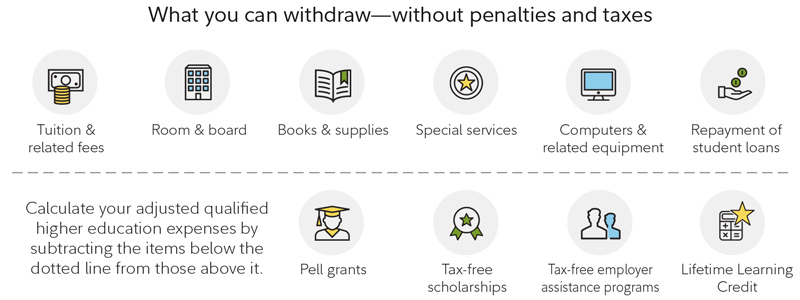
Earnings in 529 plans are not taxed under the federal tax code. Withdrawals for eligible expenses are tax-free, and many states allow 529 contributions to be deducted from state income taxes. If withdrawals are used for purposes other than qualified education expenses, the earnings can be subject to a 10% federal tax penalty and, if applicable, state income tax. The chart below highlights qualified expenses that can be taken from a 529 plan. As always, please consult your CPA for tax questions.

Chart explaining expenses that can be covered tax-free with 529 plans

The Tax Cuts and Jobs Act of 2017 provided investors additional options for how they can spend their 529 dollars. You can now use up to $10,000 per year from 529 accounts to pay private tuition for children attending kindergarten through 12th grade.

Additionally, 529 plans offer several other great benefits, including:

Federal and state tax breaks

* As long as the money is used for qualified higher education expenses, no taxes are owed on 529 plan earnings.

* If you live in a state with a state income tax and you use that state’s plan, you avoid state taxes as well.

Age-based investment options

* 529 plans offer investments based on the age of the student and your family’s risk tolerance. Age-based plans automatically adjust the risk level from aggressive to conservative as the student gets closer to college.

No income-based restrictions

* No matter what your income level is, you can contribute to a 529 plan.

Flexibility of use

529 plans can be used for college, graduate school, trade schools and kindergarten through 12th grade. If there are leftover funds available, the money can remain in the 529 plan for another beneficiary (such as a sibling or grandchild), or a parent can use it for continuing education or for paying down student loan debt.

Ability to change investments

Federal tax law allows the account holder to change investments once a year or when there is a change of beneficiary.

Wealth transfer using a 529 plan

* Contributing to a 529 plan can also help grandparents or others reduce the size of their taxable estate while helping fund a grandchild’s education.

* Money held inside a 529 plan is outside of one’s estate. 

+++

So, what can we learn from all this? A 529 plan allows you to save for a wide range of academic needs while also taking advantage of state and federal tax benefits. College savings plans are easy to set up, and anyone may contribute to them. The IRS allows individuals to fund five years of gifting at one time to frontload the plans and allow the investments more time to grow.

From a portfolio perspective, we continue to adhere to the tried-and-true disciplines of diversification, periodic rebalancing and looking forward, while not making investment decisions based on where we have been. Making market decisions based on what might happen may be detrimental to long-term performance. The key is to stay invested and stick with the financial plan. Markets go up and down over time, and downturns present opportunities to purchase stocks at a lower value.  

More and more noise is creeping into the markets today – worries about inflation, higher energy prices, slower growth, possible stagflation, etc. The amount of liquidity in the markets remains at record levels. There still exists a chance that we see additional stimulus into the economy through an infrastructure package and possibly even a social spending package. While questions exist about the state of the economy, there remain many positives about our global economy and reasons to be optimistic. As we say each week, it is important to stay the course, focus on the long-term goal and not focus on one specific data point or one indicator.

It all starts with a solid financial plan for the long run that understands the level of risk that is acceptable for each client. Regarding investments, we believe in diversification and having different asset classes that allow you to stay invested. The best option is to stick with a broadly diversified portfolio that can help you to achieve your own specific financial goals — regardless of market volatility. Long-term fundamentals are what matter.

Sources: American Funds, Fidelity, College Board

Promo for an article about Social Security benefits

This material contains an assessment of the market and economic environment at a specific point in time and is not intended to be a forecast of future events, or a guarantee of future results. Forward-looking statements are subject to certain risks and uncertainties. Actual results, performance, or achievements may differ materially from those expressed or implied. Information is based on data gathered from what we believe are reliable sources.

Using diversification as part of your investment strategy neither assures nor guarantees better performance and cannot protect against loss of principal due to changing market conditions.

Past performance is not a guarantee of future results.

The opinions expressed in this commentary are those of the author and may not necessarily reflect those held by Kestra Investment Services, LLC or Kestra Advisory Services, LLC. This is for general information only and is not intended to provide specific investment advice or recommendations for any individual. It is suggested that you consult your financial professional, attorney, or tax advisor with regard to your individual situation.

Securities offered through Kestra Investment Services, LLC (Kestra IS), member FINRA/SIPC. Investment Advisory Services offered through Kestra Advisory Services, LLC (Kestra AS) an affiliate of Kestra IS. Kestra IS and Kestra AS are not affiliated with CD Wealth Management. Investor Disclosures: https://bit.ly/KF-Disclosures

The formula for wealth is simple, and it’s non-negotiable

Note: The author first published this piece on Forbes.com.

There is no shortage of intelligence among investment experts on the formulas you should follow to build wealth: saving for college, evaluating exchange-traded funds, determining how long your money will last, for example.

These are the kind of mathematical-plus-analytical insights you pay a good wealth-management professional to understand on your behalf. They include modeling based on inflation rates, rates of return and percentage of stocks vs. bonds, among other variables. Ideally, unless you are truly interested in getting in the weeds, you shouldn’t need to understand the specifics of algorithms.

In my experience, there is a much easier formula for building wealth, and it doesn’t take an advanced degree for you to understand it. In order to successfully build and maintain wealth, the following must be true:

Money (x) Time (x) Strength of Plan (x) Discipline > Poor Choices

There’s a reason this formula includes so much multiplication. If any of the values representing the four key ingredients — money, time, strength of plan or discipline — equal zero, then the product of the formula also will be zero, and you will not be successful.

Money and time are obvious ingredients; the more money you invest and the more time you leave it invested, the better your chances. The strength of your plan matters a great deal, too, and that’s why it’s so important to choose a wealth manager who understands your situation and your goals.

But the fourth ingredient, discipline, often is the difference between just “making ends meet” in retirement and leaving a legacy that ensures your family is secure for generations to come. If there is zero discipline in your approach, you will end up with zero wealth.

Remember: Zero multiplied by any number equals zero

Promotion for article titled What's the cost of missing out on the market's best days?

When wealth managers talk about discipline, we talk about trust, intentionality and focus:

* Investors must trust the investment plan and the planner’s capability to stay on top of the markets, the economy and the outlook as it pertains to each client.

* Investors must be intentional about following the plan, about living within its parameters and about recognizing changing life circumstances that might alter the outlook.

* Investors must focus on what they can control — and not on what they can’t control, keeping the big picture in mind as the market moves up and down over time.

As with any other human pursuit, the most successful people are the ones who have the discipline to follow their plan to reach their goals. They know themselves well, and they are honest with themselves always.

Every wealth manager has a list of former clients who wouldn’t listen, who thought they knew better than their planning professional because they’d heard about a hot tip, an IPO or the latest trend in get-rich-quick trading. (Honestly, some of their schemes are just fancier-sounding versions of Beanie Babies and baseball cards).

You are paying your wealth manager to do a job for you, but you have a role to play as well. Emotion can cloud people’s minds where their finances are concerned, and without discipline, even the best-laid plans will fizzle.

Which brings us to this hard truth: Money doesn’t equal intelligence. Don’t confuse being rich for being wealthy — or for being smart.

It’s true that being smart can help you make money. But so can being born into a rich family. Money alone doesn’t equate to wealth, and if it is not treated with a disciplined approach — one that removes emotion from the process — it will be fleeting.

No matter which formula you try to use.

Promo for an article titled A Closer Look at Socially Responsible Investing

A PDF version of this article is available here.

This material contains an assessment of the market and economic environment at a specific point in time and is not intended to be a forecast of future events, or a guarantee of future results. Forward-looking statements are subject to certain risks and uncertainties. Actual results, performance, or achievements may differ materially from those expressed or implied. Information is based on data gathered from what we believe are reliable sources.

Using diversification as part of your investment strategy neither assures nor guarantees better performance and cannot protect against loss of principal due to changing market conditions.

Past performance is not a guarantee of future results.

The opinions expressed in this commentary are those of the author and may not necessarily reflect those held by Kestra Investment Services, LLC or Kestra Advisory Services, LLC. This is for general information only and is not intended to provide specific investment advice or recommendations for any individual. It is suggested that you consult your financial professional, attorney, or tax advisor with regard to your individual situation.

Securities offered through Kestra Investment Services, LLC (Kestra IS), member FINRA/SIPC. Investment Advisory Services offered through Kestra Advisory Services, LLC (Kestra AS) an affiliate of Kestra IS. Kestra IS and Kestra AS are not affiliated with CD Wealth Management. Investor Disclosures: https://bit.ly/KF-Disclosures

Capital gains strategies, regardless of Biden’s plan

Last Friday, President Biden unveiled detailed explanations on how the administration plans to pay for the new $6 trillion budget. The biggest surprise in the proposal is that the administration is seeking a retroactive effective date on a capital gains tax rate hike from 20% to 39.6% for households making more than $1 million. If you add in the net investment income tax for high-income earners, this raises the top long-term capital gains tax rate to 43.4%, up from the current 23.8%.

“This proposal would be effective for gains required to be recognized after the date of the announcement,” the Treasury Department said, referring to an address to Congress on April 28. The purpose of the backdating proposal is to avoid a sell-off ahead of the capital-gains rate hike, if it were to be approved.

A historical review of legislation suggests tax-rate decreases are easier to implement on a retroactive basis from a policy and political standpoint. With life’s only certainties being death and taxes, the tax implications of a transaction would ideally be known at the time of the event — and not retroactive.

As we wrote about last week, tax changes are far from certain, and a lot of ideas are being thrown around in Washington. We are approaching our financial planning with maximum flexibility. It is safer to plan for what we know, rather than what we don’t know, and that is our approach. We believe the proposals in their current state will not pass through Congress, but we also cannot begin to predict precisely what will pass. 

Having said that, the following are capital gains tax strategies that we already use for your benefit: 

1. Donating appreciated securities to charity or a donor advised fund. This is a tax-smart way for those who are charitably inclined to donate money. The market value of the security on the date of donation is a charitable tax deduction, and there are no capital gains taxes on the donated assets.

2. Tax loss harvesting. This strategy involves realizing tax losses on holdings and then using those losses to offset realized gains. Any remaining losses incurred in a year can be carried over to subsequent years and help offset future capital gains.

3. Converting traditional IRA assets to Roth IRA. This works well for those in lower income tax brackets. Investing in stocks with higher growth potential in a Roth IRA will negate any taxation of future capital gains. There are no taxes in the year of the gain, and the money can be withdrawn tax-free at retirement (if certain rules are followed). Also, assets in an inherited Roth IRA are tax-free to beneficiaries upon withdrawal if the five-year rule was met prior to death. This includes capital gains that were realized in the account along the way. 

So, what can we learn from all this? Avoiding potentially higher capital gains rates may be a good idea, if it makes sense in the context of your overall financial plan. It is important to remember that the proposed tax changes are just that — proposals, not laws. Changes can and will occur, and there is no guarantee that the proposal or introduced bills will become law. In our opinion, as of today, a wait-and-see approach is the best path until we have further clarity. However, concern about changes in estate tax law is a good reason to consult with estate attorneys to discuss the current plan. We will be ready and proactive if tax law changes occur.

From an investment portfolio perspective, we continue to adhere to the tried-and-true disciplines of diversification, periodic rebalancing and looking forward, not making investment decisions based on where we have been.

Making market decisions based on what might happen may be detrimental to long-term performance. The key is to stay invested and stick with the financial plan. Markets go up and down over time, and downturns present opportunities to purchase stocks at a lower value. 

It all starts with a solid financial plan for the long run that understands the level of risk that is acceptable for each client. Regarding investments, we believe in diversification and having different asset classes that allow you to stay invested. The best option is to stick with a broadly diversified portfolio that can help you to achieve your own specific financial goals — regardless of market volatility. Long-term fundamentals are what matter. 

Sources: National Law Review, The Hill, New York Times

This material contains an assessment of the market and economic environment at a specific point in time and is not intended to be a forecast of future events, or a guarantee of future results. Forward-looking statements are subject to certain risks and uncertainties. Actual results, performance, or achievements may differ materially from those expressed or implied. Information is based on data gathered from what we believe are reliable sources.

Using diversification as part of your investment strategy neither assures nor guarantees better performance and cannot protect against loss of principal due to changing market conditions.

Past performance is not a guarantee of future results.

The opinions expressed in this commentary are those of the author and may not necessarily reflect those held by Kestra Investment Services, LLC or Kestra Advisory Services, LLC. This is for general information only and is not intended to provide specific investment advice or recommendations for any individual. It is suggested that you consult your financial professional, attorney, or tax advisor with regard to your individual situation.

Securities offered through Kestra Investment Services, LLC (Kestra IS), member FINRA/SIPC. Investment Advisory Services offered through Kestra Advisory Services, LLC (Kestra AS) an affiliate of Kestra IS. Kestra IS and Kestra AS are not affiliated with CD Wealth Management. Investor Disclosures: https://bit.ly/KF-Disclosures