Where Do Negotiations Stand as the Debt-Ceiling Deadline Approaches?

With a week left until the June 1 debt-ceiling deadline, the president and congressional leaders have been negotiating to raise the ceiling and enact some hopeful budget reforms. As we all know, Congress often waits until right before a deadline to take action, but that doesn’t mean there won’t be angst and potential volatility in the markets as we get closer to the deadline.

A default or funding delay in the U.S. Treasury market would have global impacts. As the map below indicates, few nations have a debt ceiling similar to the United States. Our Treasury market is the deepest and most liquid of any nation in the world and a central component of the global financial system. Over the past 22 years, the U.S. has needed to increase the debt ceiling 22 times. Denmark, the only other developed country with a debt ceiling, has increased only once, and it did so out of precaution, not necessity.
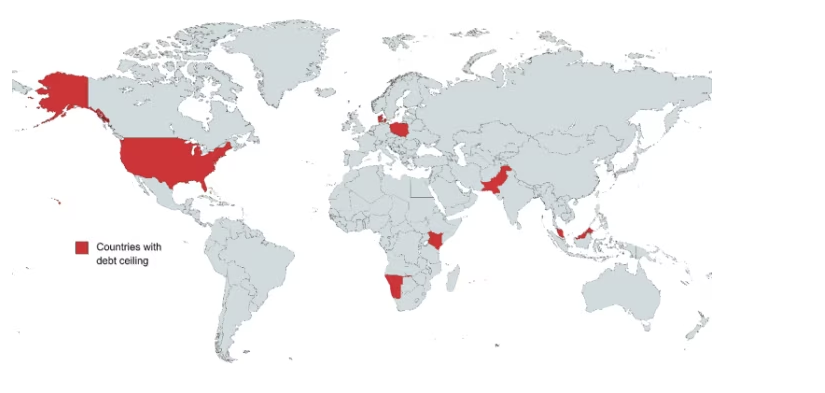
World map showing the countries with a debt ceiling, including the United States.
Source: Charles Schwab, created with mapchart.net as of 5/12/23

We knew coming into 2023 that the two parties would have a standoff over the debt ceiling. We have a divided government and deteriorating fiscal environment. Since January, when the debt ceiling was first breached, the U.S. Treasury has been using extraordinary measures to avoid breaching the debt ceiling.

Spending has increased this year due to higher interest costs and larger payments tied to inflation; those of you who are on Social Security can attest to the nice increase in your monthly payment. At the same time, tax revenues have fallen 6% over the last year, causing the debt ceiling date to be moved up from late July or early August.

What does each party want from the negotiations?

House Republicans are calling for a cap on discretionary (nonessential) spending, rescinding unspent COVID monies and energy-permitting reform. In exchange for those items, they are willing to raise the debt ceiling. Democrats are calling for “clean” legislation, an increase in the debt ceiling without any policy provisions or conditions attached. They do not want spending cuts, especially to Medicare or Social Security, and neither side politically can afford to cut those two government provisions.

Republicans have passed a bill out of the House that would raise the debt ceiling but would also mandate $4.8 trillion in spending cuts. As of now, this bill does not have the votes to pass the Senate. The most likely outcome is a cap on discretionary spending and pulling back in unspent COVID dollars. The biggest discretionary spending item is defense spending. The White House has proposed keeping this flat from fiscal 2023 to 2024 and then a 1% increase in 2025. The chart below shows the impact of proposed curbs on discretionary spending in dollar terms.

Discretionary Spending

FY, Billions of dollars
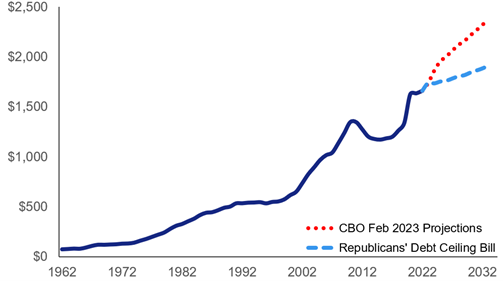
Chart showing discretionary spending since 1962 with projections based on Republicans' bill.


As we get closer to the deadline, most economists and political talking heads are anticipating this turning into a two-step process. The first step would provide a short-term debt ceiling increase. The second step would fill in details and would be paired with another increase in the debt ceiling to get past the 2024 presidential election. While it feels like we are in unchartered territory and Congress has never been this acrimonious, we have been here before. As a matter of fact, Congress has been able to come to a resolution 78 times in the past 63 years.

The political debate is about how to raise the debt ceiling, not whether to raise the debt ceiling.

The actual threat of a default of the U.S. debt is extremely low. It is important to know that the deadline is not the same as the default date. The U.S. Treasury is expected to have a small cushion of funds on June 1 that should provide several additional days of breathing room.

On June 15, the Treasury department has a large tax collection from quarterly payments. This may be more akin to a government shutdown, where the Treasury would have to prioritize other government spending but would have enough funds for Medicare, Social Security, defense, etc. We are entering a period of fiscal restraint and austerity compared to the last few years, as we have become accustomed to the environment of fiscal stimulus and cutting taxes.

It is more important than ever to focus on what we can control at times like these. We shared this illustration last week, but it is worth repeating. What drives market returns is the right side of the seesaw: time in the market, controlling your behavior, savings rate and asset allocation.

What Drives Investment Returns
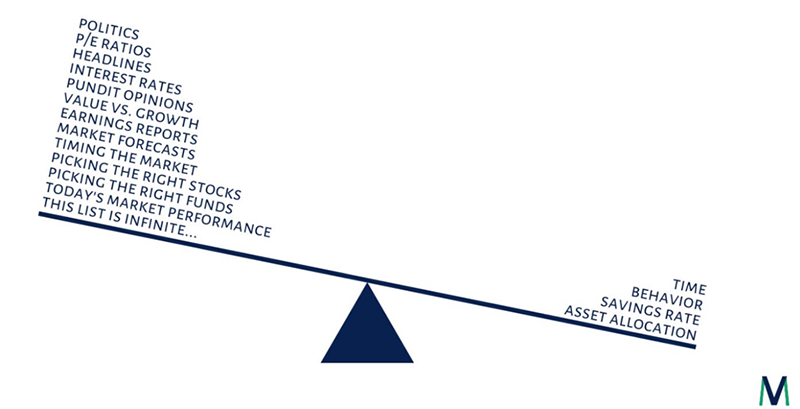
Illustration sharing the idea that time, behavior, savings rate and asset allocation are the factors that drive investment returns.


The CD Wealth Formula

We help our clients reach and maintain financial stability by following a specific plan, catered to each client. 

Our focus remains on long-term investing with a strategic allocation while maintaining a tactical approach. Our decisions to make changes are calculated and well thought out, looking at where we see the economy is heading. We are not guessing or market timing. We are anticipating and moving to those areas of strength in the economy — and in the stock market. 

We will continue to focus on the fact that what really matters right now is time in the market, not out of the market. That means staying the course and continuing to invest, even when the markets dip, to take advantage of potential market upturns. We continue to adhere to the tried-and-true disciplines of diversification, periodic rebalancing and looking forward, while not making investment decisions based on where we have been.

It is important to focus on the long-term goal, not on one specific data point or indicator. Long-term fundamentals are what matter. In markets and moments like these, it is essential to stick to the financial plan. Investing is about following a disciplined process over time.

Sources: Baird, Fidelity, Schwab

Promo for article titled Here's What Investors Should Know If Congress Doesn't Raise the Debt Ceiling.

This material contains an assessment of the market and economic environment at a specific point in time and is not intended to be a forecast of future events, or a guarantee of future results. Forward-looking statements are subject to certain risks and uncertainties. Actual results, performance, or achievements may differ materially from those expressed or implied. Information is based on data gathered from what we believe are reliable sources.

Using diversification as part of your investment strategy neither assures nor guarantees better performance and cannot protect against loss of principal due to changing market conditions.

Past performance is not a guarantee of future results.

The opinions expressed in this commentary are those of the author and may not necessarily reflect those held by Kestra Investment Services, LLC or Kestra Advisory Services, LLC. This is for general information only and is not intended to provide specific investment advice or recommendations for any individual. It is suggested that you consult your financial professional, attorney, or tax advisor with regard to your individual situation.

Securities offered through Kestra Investment Services, LLC (Kestra IS), member FINRA/SIPC. Investment Advisory Services offered through Kestra Advisory Services, LLC (Kestra AS) an affiliate of Kestra IS. CD Wealth Management and Bluespring Wealth Partners LLC* are affiliates of Kestra IS and Kestra AS.  Investor Disclosures: https://bit.ly/KF-Disclosures

*Bluespring Wealth Partners, LLC acquires and supports high quality investment adviser and wealth management companies throughout the United States.

Fidelity Investments and Fidelity Institutional® (together “Fidelity”) is an independent company, unaffiliated with Kestra Financial or CD Wealth Management. Fidelity is a service provider to both. There is no form of legal partnership, agency affiliation, or similar relationship between your financial advisor and Fidelity, nor is such a relationship created or implied by the information herein. Fidelity has not been involved with the preparation of the content supplied by CD Wealth Management and does not guarantee, or assume any responsibility for, its content. Fidelity Investments is a registered service mark of FMR LLC. Fidelity Institutional provides clearing, custody, or other brokerage services through National Financial Services LLC or Fidelity Brokerage Services LLC, Members NYSE, SIPC.

Here’s What Investors Should Know If Congress Doesn’t Raise the Debt Ceiling

It seems like the stock market can’t get away from the never-ending drama that emanates from our nation’s capital. Congress has always raised the debt ceiling when needed, but concerns are building as the sides remain far apart and political divisiveness is as bad as ever.

The standoff has heightened uncertainty about the economy, as default would risk sending bond yields higher — and stocks and the U.S. dollar lower. Volatility is likely to increase in the financial markets. This is the scenario that played out in the 2011 debt-ceiling fight, and it is likely that we will see it happen if history repeats itself.

If no deal is reached, the Treasury has a couple of options:

1. Technical default. This is defined as an extended period of non-payment of interest and principal on the debt. In the U.S., assuming an agreement was eventually reached, investors would receive interest and principal payments, likely with accrued interest.  

2. Creative possibilities. The Treasury could issue premium bonds that would generate a price above par, giving the Treasury additional cash. Another option could be that the Treasury could invoke Section 4 of the 14th Amendment, which some argue could give the president authority to order the nation’s debts be paid, regardless of the debt ceiling.

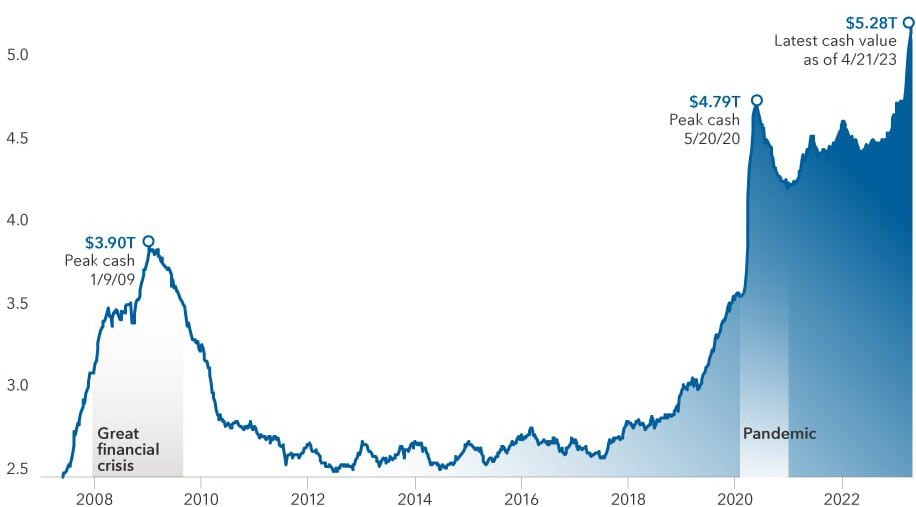
The other big debate revolves around whether the Fed will continue to raise rates to combat inflation. One of the benefits of higher rates from the Fed has been the return of attractive cash and short-term fixed-income returns. The chart below shows the massive inflows into money market funds since the pandemic.

There is now more than $5.2 trillion invested in the money market. With money market rates close to 5%, it is understandable that investors have moved monies from their regional or national bank to take advantage of the higher savings rates. Yields for very short-term Treasuries are elevated compared to those even a few months farther out, as investors shy away from the risk that interest on Treasury bills could be deferred.

ICI Money Market Fund Assets (USD Trillions)

Chart showing that money market fund assets are over 5.2 trillion dollars.
Sources: Capital Group, Bloomberg. Data as of April 21, 2023

A big question facing investors is just how long short-term bond yields may remain at historically high levels. If inflation remains sticky, we may be in for higher rates than the market has priced in. This would give investors the ability to earn more on cash and short-term CDs and Treasuries for a longer time — which may cause some investors to time their reentry into the market since they are earning near 5% on cash and cash equivalents.

You always want to have emergency cash sitting in something, and right now that’s giving you a nice return. When the Fed decides to cut interest rates, whether later this year or next year, money market, short-term Treasury and CD rates will fall as well. When rates fall, bond prices will rise, which is what we saw often before the Fed raised rates in March 2022. If this were to happen, as many believe it will, bond returns will be additive to total return.

The picture below is important to remember during times like these. What drives investment returns is the right side of the seesaw: time in the market, investment behavior (not making rash decisions), saving more than spending and diversification in the portfolio. The items on the left side of the seesaw — politics, media, news, headlines, opinions from talking heads — are just noise. 

Noise does not drive long-term investment returns. To participate in the upside of the bull market, you must survive and stay invested through a potential recession or debt-ceiling crisis. If there is not an agreement and we see volatility pick up — or a market sell-off — think back to the picture below and remember the four things that matter for long-term investment performance.

What Drives Investment Returns

An illustration emphasizing that time, behavior, savings rate and asset allocation are the important factors leading to investment returns.

The CD Wealth Formula

We help our clients reach and maintain financial stability by following a specific plan, catered to each client. 

Our focus remains on long-term investing with a strategic allocation while maintaining a tactical approach. Our decisions to make changes are calculated and well thought out, looking at where we see the economy is heading. We are not guessing or market timing. We are anticipating and moving to those areas of strength in the economy — and in the stock market. 

We will continue to focus on the fact that what really matters right now is time in the market, not out of the market. That means staying the course and continuing to invest, even when the markets dip, to take advantage of potential market upturns. We continue to adhere to the tried-and-true disciplines of diversification, periodic rebalancing and looking forward, while not making investment decisions based on where we have been.

It is important to focus on the long-term goal, not on one specific data point or indicator. Long-term fundamentals are what matter. In markets and moments like these, it is essential to stick to the financial plan. Investing is about following a disciplined process over time.

Sources: Baird, Bloomberg

Promo for an article titled What Investors Should Know About the Fed's 10th Straight Rate Increase.

This material contains an assessment of the market and economic environment at a specific point in time and is not intended to be a forecast of future events, or a guarantee of future results. Forward-looking statements are subject to certain risks and uncertainties. Actual results, performance, or achievements may differ materially from those expressed or implied. Information is based on data gathered from what we believe are reliable sources.

Using diversification as part of your investment strategy neither assures nor guarantees better performance and cannot protect against loss of principal due to changing market conditions.

Past performance is not a guarantee of future results.

The opinions expressed in this commentary are those of the author and may not necessarily reflect those held by Kestra Investment Services, LLC or Kestra Advisory Services, LLC. This is for general information only and is not intended to provide specific investment advice or recommendations for any individual. It is suggested that you consult your financial professional, attorney, or tax advisor with regard to your individual situation.

Securities offered through Kestra Investment Services, LLC (Kestra IS), member FINRA/SIPC. Investment Advisory Services offered through Kestra Advisory Services, LLC (Kestra AS) an affiliate of Kestra IS. CD Wealth Management and Bluespring Wealth Partners LLC* are affiliates of Kestra IS and Kestra AS.  Investor Disclosures: https://bit.ly/KF-Disclosures

*Bluespring Wealth Partners, LLC acquires and supports high quality investment adviser and wealth management companies throughout the United States.

Fidelity Investments and Fidelity Institutional® (together “Fidelity”) is an independent company, unaffiliated with Kestra Financial or CD Wealth Management. Fidelity is a service provider to both. There is no form of legal partnership, agency affiliation, or similar relationship between your financial advisor and Fidelity, nor is such a relationship created or implied by the information herein. Fidelity has not been involved with the preparation of the content supplied by CD Wealth Management and does not guarantee, or assume any responsibility for, its content. Fidelity Investments is a registered service mark of FMR LLC. Fidelity Institutional provides clearing, custody, or other brokerage services through National Financial Services LLC or Fidelity Brokerage Services LLC, Members NYSE, SIPC.

What Investors Should Know After the Fed’s 10th Straight Rate Increase

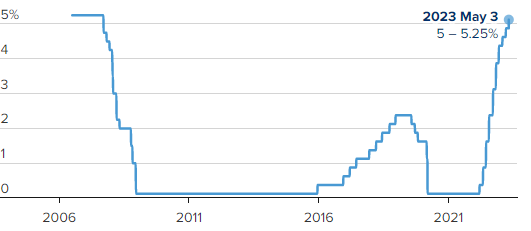
Last week, the Federal Reserve bank raised interest rates another 25 basis points (0.25 percentage point), taking the Fed Funds rate to 5%. This was the 10th time the Fed has raised rates since March 2022. However, this time the Fed hinted that the tightening cycle is nearing or at an end. The Fed has made no indication that it will reduce rates anytime soon, and some Fed governors are still talking about possible rate hikes. Still, the stock and bond markets are signaling that they will probably begin to reduce interest rates later this year or early next year.

Federal Funds Target Rate Crests 5%

The range hasn’t been this high since August 2007.

Chart showing the Federal Funds rate since 2006.
Note: From December 2008 to present, the chart shows the midpoint of the Federal Reserve’s target range. Chart: Gabriel Cortes/CNBC. Source: Federal Reserve Bank of New York. Historic data as of May 3, 2023.

In the face of higher interest rates, the stock market has continued to hang tough despite continued regional bank worries with First Republic Bank failing last week and increasing concern about the commercial real estate market. Over the last month, the S&P 500 has remained steady and traded in a narrow range. What might surprise you is that going back over the past 52 weeks, the S&P 500 was virtually flat, despite the negative headlines of record high inflation, a bond market crash, aggressive Fed hikes, the war in Ukraine, lockdowns in China and two of the three largest bank failures ever.

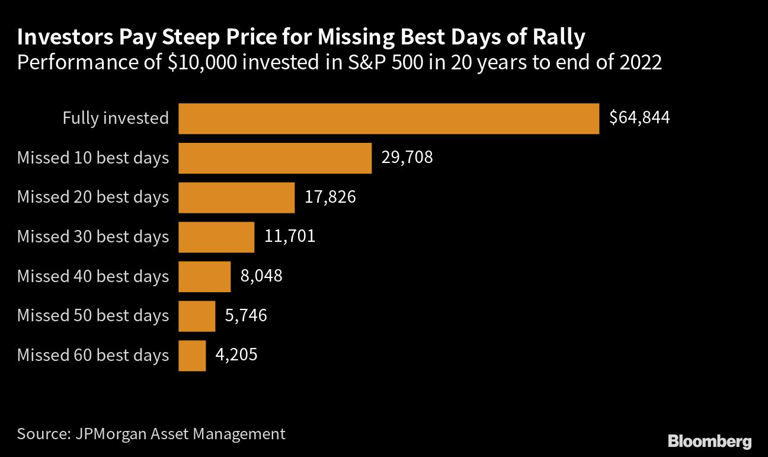
That is not to say that there hasn’t been volatility over the past year, but as we always preach, staying invested pays off. If you chose to get out back in October, when the market was hitting its bottom, you would have missed the market’s move to get back to where you were last May. The chart below is another strong reminder why we advocate for staying invested, especially when times are the toughest.

Chart showing the cost of being not invested when the market is recovering.

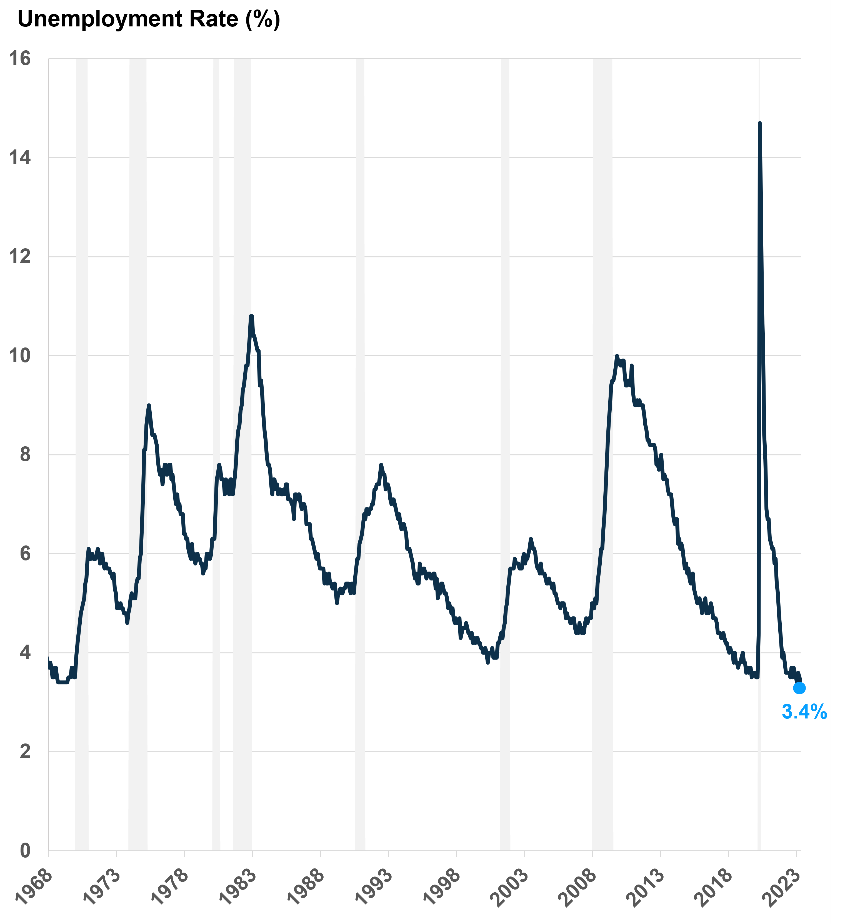
The April employment data suggests that the economy remains strong and resilient. The economy created 253,000 jobs in April, well above economists’ expectations. For the first four months of 2023, the economy created more than 1.1 million jobs. The unemployment rate has fallen to 3.4%, the lowest level since 1969! 

The biggest reason that the employment picture matters is that consumption makes up about 70% of the economy. Consumption is driven by income, and income is made up of strong employment, wage growth and hours worked. Even better news is that income growth is running above inflation. That means people have more money in their pockets, which is a positive for the economy.

Unemployment Rate at Lowest Level Since 1969

Chart showing the unemployment rate since 1968.
Data source: Carson Investment Research, FRED 5/5/2023. Shaded areas indicate U.S. recessions. @sonusvarghese

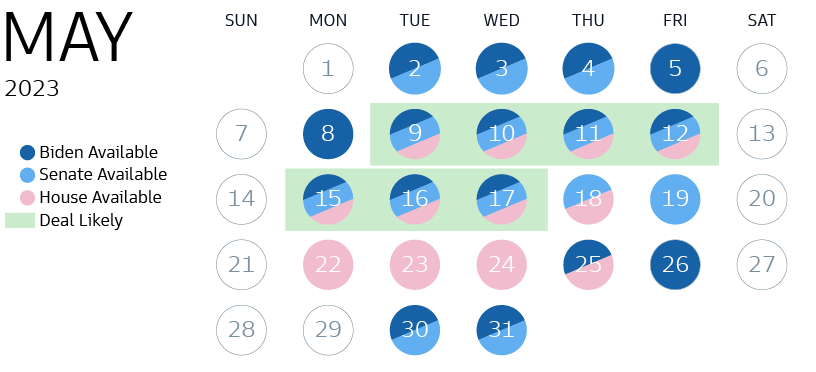
There is no sign of an economic slowdown yet, with one big caveat: the debt ceiling. As we wrote recently, all eyes are on the debt-ceiling negotiations, and the clock is ticking. Treasury Secretary Janet Yellen informed Congress last week that cash balances are estimated to be depleted by early June. The Senate, House and President Biden have seven calendar days of overlap for discussion before then.

Days With House and Senate in Session and President Biden Available

Calendar showing when Congress and the President have overlapping availability in May.

We remain hopeful that a resolution will be reached, though political games raise the likelihood of a time-sensitive outcome, possibly with the need to extend the deadline. Should there be a need to extend the deadline, there may be additional volatility. We will continue to monitor the negotiations and the economy closely and keep you informed.

The CD Wealth Formula

We help our clients reach and maintain financial stability by following a specific plan, catered to each client. 

Our focus remains on long-term investing with a strategic allocation while maintaining a tactical approach. Our decisions to make changes are calculated and well thought out, looking at where we see the economy is heading. We are not guessing or market timing. We are anticipating and moving to those areas of strength in the economy — and in the stock market. 

We will continue to focus on the fact that what really matters right now is time in the market, not out of the market. That means staying the course and continuing to invest, even when the markets dip, to take advantage of potential market upturns. We continue to adhere to the tried-and-true disciplines of diversification, periodic rebalancing and looking forward, while not making investment decisions based on where we have been.

It is important to focus on the long-term goal, not on one specific data point or indicator. Long-term fundamentals are what matter. In markets and moments like these, it is essential to stick to the financial plan. Investing is about following a disciplined process over time.

Sources: Bloomberg, Carson, CNBC, JP Morgan

Promo for an article titled Should Investors Worry About a Recession Or Focus on the Recovery?

This material contains an assessment of the market and economic environment at a specific point in time and is not intended to be a forecast of future events, or a guarantee of future results. Forward-looking statements are subject to certain risks and uncertainties. Actual results, performance, or achievements may differ materially from those expressed or implied. Information is based on data gathered from what we believe are reliable sources.

Using diversification as part of your investment strategy neither assures nor guarantees better performance and cannot protect against loss of principal due to changing market conditions.

Past performance is not a guarantee of future results.

The opinions expressed in this commentary are those of the author and may not necessarily reflect those held by Kestra Investment Services, LLC or Kestra Advisory Services, LLC. This is for general information only and is not intended to provide specific investment advice or recommendations for any individual. It is suggested that you consult your financial professional, attorney, or tax advisor with regard to your individual situation.

Securities offered through Kestra Investment Services, LLC (Kestra IS), member FINRA/SIPC. Investment Advisory Services offered through Kestra Advisory Services, LLC (Kestra AS) an affiliate of Kestra IS. CD Wealth Management and Bluespring Wealth Partners LLC* are affiliates of Kestra IS and Kestra AS.  Investor Disclosures: https://bit.ly/KF-Disclosures

*Bluespring Wealth Partners, LLC acquires and supports high quality investment adviser and wealth management companies throughout the United States.

Fidelity Investments and Fidelity Institutional® (together “Fidelity”) is an independent company, unaffiliated with Kestra Financial or CD Wealth Management. Fidelity is a service provider to both. There is no form of legal partnership, agency affiliation, or similar relationship between your financial advisor and Fidelity, nor is such a relationship created or implied by the information herein. Fidelity has not been involved with the preparation of the content supplied by CD Wealth Management and does not guarantee, or assume any responsibility for, its content. Fidelity Investments is a registered service mark of FMR LLC. Fidelity Institutional provides clearing, custody, or other brokerage services through National Financial Services LLC or Fidelity Brokerage Services LLC, Members NYSE, SIPC.

Should Investors Worry About a Recession – Or Focus on the Recovery?

Are we in a recession — or will we be in a recession soon? Will it be a hard or soft landing? Will the debt ceiling push us into a recession? How bad will it be on the stock market? 

These questions weigh on the minds of investors, business owners and decision makers — and the noise seems to grow louder each day. The Federal Reserve has been raising rates aggressively to combat inflation with the hopes of slowing the economy and wage growth. Essentially, the Fed is hoping for an economic slowdown and more layoffs. 

Doesn’t that sound like a recession?

Taking a step back, it’s important to understand that an economy is not the same thing as the stock market. The fate of one does not offer a direct read-through to the other.

Economic data is backward-looking by nature, while the stock market is anticipating where companies are headed and what their future valuation should be. Historically, the stock market has anticipated (and therefore priced in) improving economic conditions before they arrive. This makes market timing difficult and reinforces the importance of weathering the downturn. 

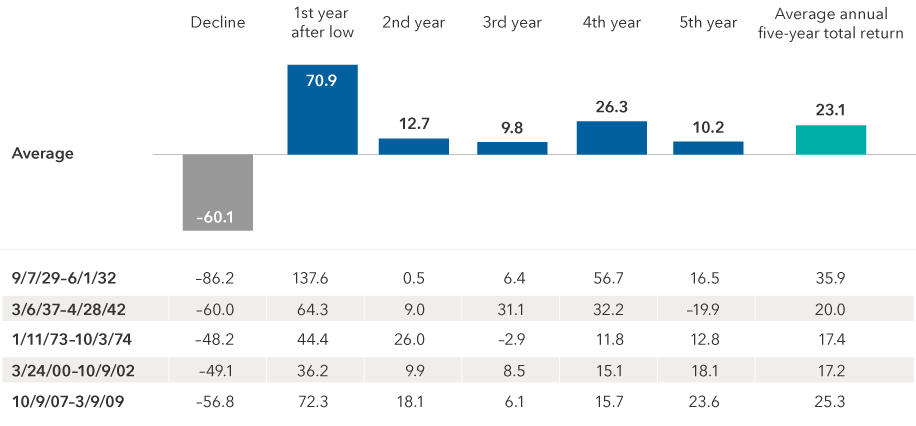
We fully recognize that downturns are not pleasant, but the markets historically have come out the other side much stronger. In the past, the stock market has tended to anticipate recoveries, rebounding ahead of any turn in the economy.

Returns Following the 5 Largest Market Declines Since 1929

Chart showing Returns Following the 5 Largest Market Declines Since 1929.
Sources: Capital Group, RIMES, Standard & Poor’s. As of 12/31/22. Market downturns are based on the five largest declines in the value of the S&P 500 (excluding dividends and/or distributions) with 100% recovery after each decline. The return of the five years after a low is a 12-month return based on the date of the low. 

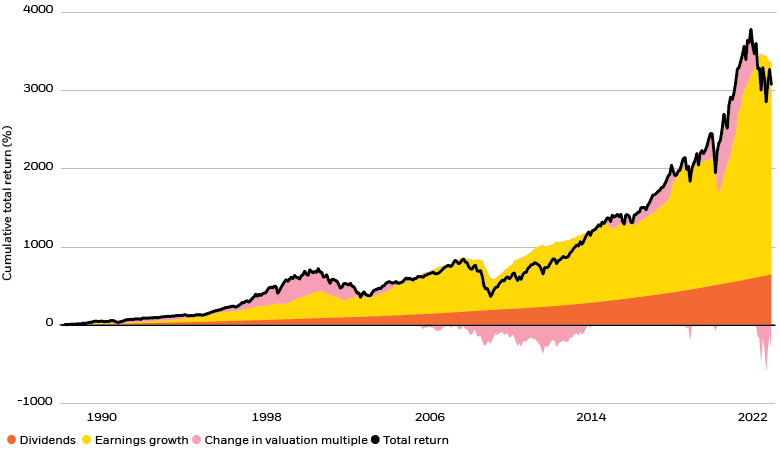
Companies’ underlying fundamentals – revenue, profitability, cash flow, assets and liabilities — are the key determinants of stock returns across time. In other words, earnings are the key contributor to total return. For companies that reinvest earnings into revenue growth, better margins help investors weather the storm of a potential recession and come out stronger. Even as uncertainty clouds the big picture, companies that can maintain earnings growth throughout market cycles will remain prized, and their stock prices rewarded.

Fundamentals Dictate Long-Term Returns

S&P 500 Index sources of total return, 1988-2022

Chart showing S&P 500 Index sources of total return, 1988-2022.
Source: BlackRock, with data from Refinitiv, Feb 28, 1988-Dec 30, 2022. Chart shows the cumulative total return of the S&P 500 Index attributable to EPS growth, dividend yield and change in valuation multiple. Past performance is not indicative of current or future results.

So, if we have a recession, what happens next? The U.S. still has a solid labor market. Household balance sheets remain strong. Inflation is moderating, and the Fed is near the end of the rate-hike cycle. This means strong wages and consumer confidence could boost consumer spending, providing additional help to a range of industries. 

Economists already predict that the Federal Reserve will have to begin lowering the Fed Funds rate later this year or next to stimulate the economy. A housing recovery could ensue, as mortgage rates could then begin to drop. Lower mortgage rates could provide a tailwind to construction spending and spending for other durable goods, like household appliances.

This may be the most widely anticipated recession in decades. Many investors remain focused on the timing and severity of the next recession. What if the recession is already priced into the market? Investors may be better served to prepare for what happens after a potential recession — and how we can benefit from the recovery instead of listening to the drumbeat of headlines about when a recession could happen.

The CD Wealth Formula

We help our clients reach and maintain financial stability by following a specific plan, catered to each client. 

Our focus remains on long-term investing with a strategic allocation while maintaining a tactical approach. Our decisions to make changes are calculated and well thought out, looking at where we see the economy is heading. We are not guessing or market timing. We are anticipating and moving to those areas of strength in the economy — and in the stock market. 

We will continue to focus on the fact that what really matters right now is time in the market, not out of the market. That means staying the course and continuing to invest, even when the markets dip, to take advantage of potential market upturns. We continue to adhere to the tried-and-true disciplines of diversification, periodic rebalancing and looking forward, while not making investment decisions based on where we have been.

It is important to focus on the long-term goal, not on one specific data point or indicator. Long-term fundamentals are what matter. In markets and moments like these, it is essential to stick to the financial plan. Investing is about following a disciplined process over time.

Sources: Capital Group, Blackrock, S&P

Promo for an article titled What Does the Debt-Ceiling Standoff Mean for Investors and the Markets?

This material contains an assessment of the market and economic environment at a specific point in time and is not intended to be a forecast of future events, or a guarantee of future results. Forward-looking statements are subject to certain risks and uncertainties. Actual results, performance, or achievements may differ materially from those expressed or implied. Information is based on data gathered from what we believe are reliable sources.

Using diversification as part of your investment strategy neither assures nor guarantees better performance and cannot protect against loss of principal due to changing market conditions.

Past performance is not a guarantee of future results.

The opinions expressed in this commentary are those of the author and may not necessarily reflect those held by Kestra Investment Services, LLC or Kestra Advisory Services, LLC. This is for general information only and is not intended to provide specific investment advice or recommendations for any individual. It is suggested that you consult your financial professional, attorney, or tax advisor with regard to your individual situation.

Securities offered through Kestra Investment Services, LLC (Kestra IS), member FINRA/SIPC. Investment Advisory Services offered through Kestra Advisory Services, LLC (Kestra AS) an affiliate of Kestra IS. CD Wealth Management and Bluespring Wealth Partners LLC* are affiliates of Kestra IS and Kestra AS.  Investor Disclosures: https://bit.ly/KF-Disclosures

*Bluespring Wealth Partners, LLC acquires and supports high quality investment adviser and wealth management companies throughout the United States.

Fidelity Investments and Fidelity Institutional® (together “Fidelity”) is an independent company, unaffiliated with Kestra Financial or CD Wealth Management. Fidelity is a service provider to both. There is no form of legal partnership, agency affiliation, or similar relationship between your financial advisor and Fidelity, nor is such a relationship created or implied by the information herein. Fidelity has not been involved with the preparation of the content supplied by CD Wealth Management and does not guarantee, or assume any responsibility for, its content. Fidelity Investments is a registered service mark of FMR LLC. Fidelity Institutional provides clearing, custody, or other brokerage services through National Financial Services LLC or Fidelity Brokerage Services LLC, Members NYSE, SIPC.
What Does the Debt-Ceiling Standoff Mean for Investors and the Markets?

In January, we wrote about the impending debt ceiling and the Congressional showdown that was likely to occur. The current debt limit of $31.4 trillion was surpassed early in the year, and at that point, the U.S. government was not able to issue any new debt. It has been relying on emergency funds to meet short-term obligations. According to Congressional budget forecasts, emergency funding could run out as early as June.

Lawmakers often wait to the last minute to pass legislation, and the scene is set for what could be one of the most contentious debt ceiling showdowns in recent history.

The debt ceiling is the maximum amount the federal government can borrow to finance obligations that lawmakers and presidents have already approved. Increasing the debt ceiling does not authorize new spending commitments; rather, it allows the government to meet its existing obligations. 

Congress established the debt ceiling more than 100 years ago, and it has been modified more than 100 times since World War II. Its purpose was to make it easier for the federal government to borrow money, but it has become a political battleground that makes its way into the news every few years. Each time the ceiling comes up for debate in Congress, lawmakers wrestle over the ability to restrict the growth of borrowing.

If the government were no longer able to borrow, it would not have enough money to pay its bills in full, including interest on the national debt. It would probably have to delay payments or default on some of its commitments, potentially affecting Social Security payments and federal worker salaries, for example. Thankfully, this has never happened, so no one knows exactly how the Treasury would handle the situation. 

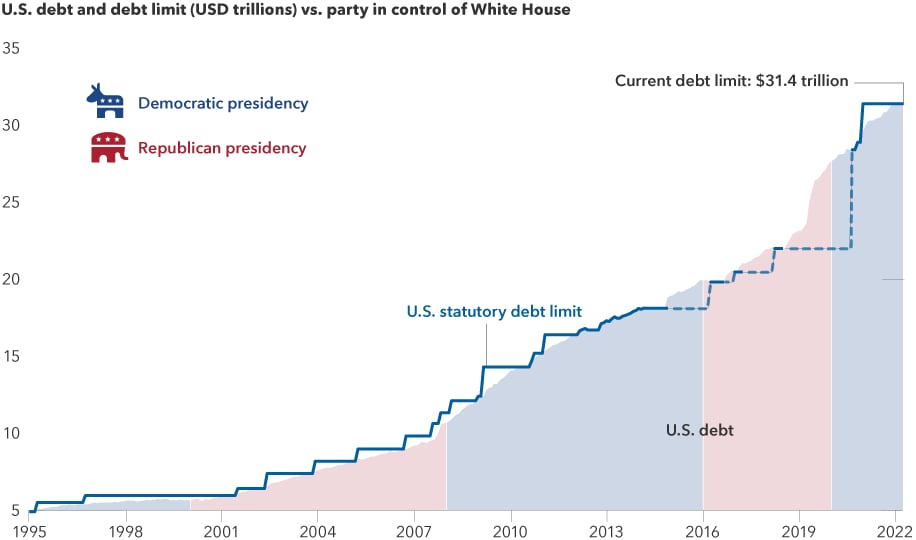
When Congress is divided, as it is today, a standoff can occur — and the creditworthiness of the U.S. government is at stake. These showdowns are not new; they have occurred under the control of both political parties and have always been resolved before the government had to default. The closest we have come to default was in 2011, when Standard & Poor’s downgraded the U.S. credit rating. In 2013, negotiations led to a 16-day government shutdown, and in 2018, we saw a shutdown of three days, followed later by a 35-day shutdown.

Debt Ceiling Showdowns Occur Regardless of Who Controls the White House

Chart showing that debt ceiling issues do not depend on party in power
Sources: Capital Group, Refinitiv Datastream, Standard & Poor’s, U.S. Department of the Treasury. Periods in which the statutory limit has been suspended are reflected by a dotted line.

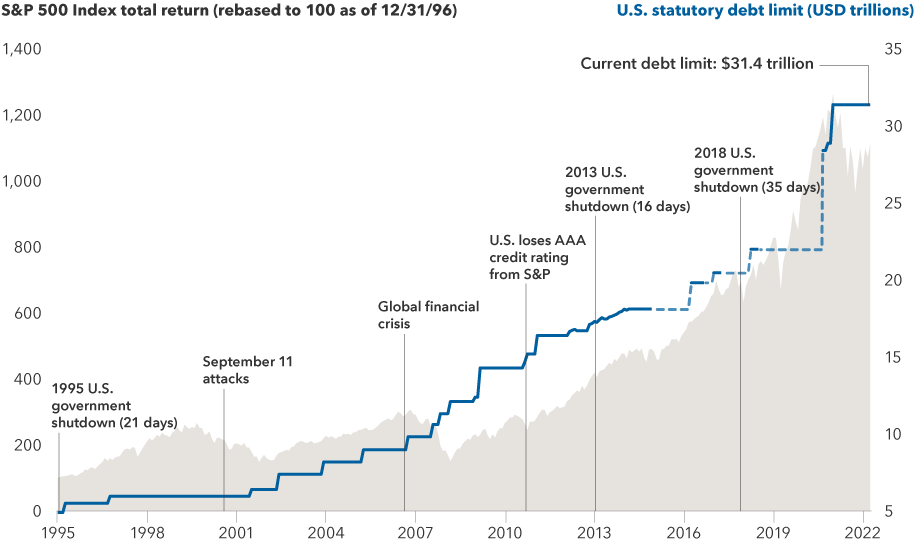
Over time, these showdowns did not tend to have a significant long-term impact. Even if the debt ceiling creates volatility in the market, now is not the time to take impulsive action. Well-managed companies adjust to shifting conditions, and the best companies ultimately learn to thrive, even in times of crisis. Markets have survived a great variety of disruptions in the past. The chart below shows different debt-ceiling showdowns. Over the long run, the market has trended up, despite the short-term volatility caused by debt disruption.

Markets Have Powered Through Debt-Ceiling Standoffs in the Past

Chart showing how the market fared after previous fights over the debt ceiling
Sources: Capital Group, Refinitiv Datastream, Standard & Poor’s, U.S. Department of the Treasury. Periods in which the statutory limit has been suspended are reflected by a dotted line. Past results are not predictive of results in future periods.

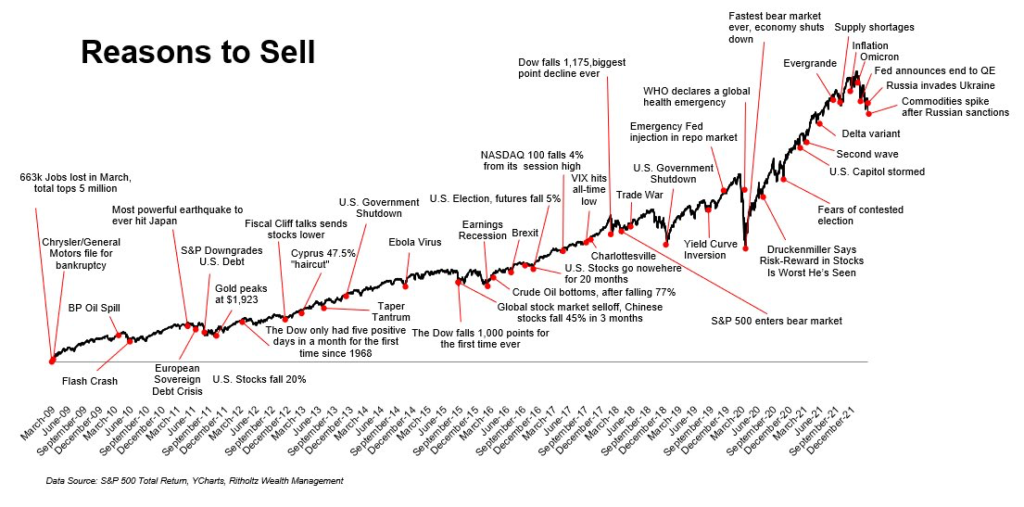
The markets have historically been resilient. Even if this crisis is new, market volatility is not. Investors who stay the course have historically benefited over the long term. The chart below goes back only to 2009, but it is very telling. See how many events could have been a cause to panic or sell. Clearly, COVID accounts for the largest drop in the chart, but you will be hard-pressed to find the 2011 and 2013 debt crises. Those 15% to 20% drops in the market are barely noticeable. 

More importantly, as the chart above shows, the trend is up and to the right for those who stay invested. Over time, the market tends to go up, despite a multitude of reasons to sell. Over the next many weeks, we will hear a lot of noise about the impending debt showdown. If the U.S. misses a payment in June, it can and will cause a short-term shock to the markets. 

This is not a time to panic, but a time to potentially put additional monies to work in the market — if cash is available and part of the overall financial plan. Hindsight has shown that these are buying opportunities — but of course, past performance is not a guarantee for future success.

Chart showing reasons to sell stocks, most if not all unrelated to the debt ceiling

The CD Wealth Formula

We help our clients reach and maintain financial stability by following a specific plan, catered to each client. 

Our focus remains on long-term investing with a strategic allocation while maintaining a tactical approach. Our decisions to make changes are calculated and well thought out, looking at where we see the economy is heading. We are not guessing or market timing. We are anticipating and moving to those areas of strength in the economy — and in the stock market. 

We will continue to focus on the fact that what really matters right now is time in the market, not out of the market. That means staying the course and continuing to invest, even when the markets dip, to take advantage of potential market upturns. We continue to adhere to the tried-and-true disciplines of diversification, periodic rebalancing and looking forward, while not making investment decisions based on where we have been.

It is important to focus on the long-term goal, not on one specific data point or indicator. Long-term fundamentals are what matter. In markets and moments like these, it is essential to stick to the financial plan. Investing is about following a disciplined process over time.

Sources: Capital Group, S&P, Ritzholtz

Promo for article titled An Introduction to ChatGPT With Some Assistance from ChatGPT

This material contains an assessment of the market and economic environment at a specific point in time and is not intended to be a forecast of future events, or a guarantee of future results. Forward-looking statements are subject to certain risks and uncertainties. Actual results, performance, or achievements may differ materially from those expressed or implied. Information is based on data gathered from what we believe are reliable sources.

Using diversification as part of your investment strategy neither assures nor guarantees better performance and cannot protect against loss of principal due to changing market conditions.

Past performance is not a guarantee of future results.

The opinions expressed in this commentary are those of the author and may not necessarily reflect those held by Kestra Investment Services, LLC or Kestra Advisory Services, LLC. This is for general information only and is not intended to provide specific investment advice or recommendations for any individual. It is suggested that you consult your financial professional, attorney, or tax advisor with regard to your individual situation.

Securities offered through Kestra Investment Services, LLC (Kestra IS), member FINRA/SIPC. Investment Advisory Services offered through Kestra Advisory Services, LLC (Kestra AS) an affiliate of Kestra IS. CD Wealth Management and Bluespring Wealth Partners LLC* are affiliates of Kestra IS and Kestra AS.  Investor Disclosures: https://bit.ly/KF-Disclosures

*Bluespring Wealth Partners, LLC acquires and supports high quality investment adviser and wealth management companies throughout the United States.

Fidelity Investments and Fidelity Institutional® (together “Fidelity”) is an independent company, unaffiliated with Kestra Financial or CD Wealth Management. Fidelity is a service provider to both. There is no form of legal partnership, agency affiliation, or similar relationship between your financial advisor and Fidelity, nor is such a relationship created or implied by the information herein. Fidelity has not been involved with the preparation of the content supplied by CD Wealth Management and does not guarantee, or assume any responsibility for, its content. Fidelity Investments is a registered service mark of FMR LLC. Fidelity Institutional provides clearing, custody, or other brokerage services through National Financial Services LLC or Fidelity Brokerage Services LLC, Members NYSE, SIPC.
An Introduction to ChatGPT, With Some Assistance From ChatGPT

Lately, it seems everywhere you turn there is talk of ChatGPT. (We even asked ChatGPT to help us write this article! ☺︎)

What is ChatGPT?

If you go directly to the source and ask ChatGPT what it is, you’ll get the following answer:

“I am an AI language model trained by OpenAI. I am a computer program designed to process and generate human-like text. I do not have my own thoughts or feelings, but I can analyze and understand written and spoken language, and I can use that understanding to respond to questions and prompts. I can also generate original texts based on a given prompt. I am trained on a large dataset of human-generated text and can use that knowledge to answer any questions and engage in conversations on a wide range of topics.”

Clear as mud, right?

ChatGPT is a powerful artificial-intelligence chatbot that allows you to ask it questions using everyday language, rather than using search terms. ChatGPT responds in a conversational manner.

As opposed to Siri or Alexa, these neural networks are trained on huge quantities of information from the internet of deep learning. (GPT stands for generative pre-trained transformer.)

The model behind ChatGPT was trained on all sorts of web content including websites, books, social media, news articles and more. It has been trained to provide answers to questions based on feelings, to auto-detect words and to provide outputs based on the inputs given to the users. The models have also been trained to chat with humans, continuously reinforcing learning from the feedback it receives from humans. Over time, it shifts its pattern and its responses based on the inputs and feedback.

How can you use ChatGPT?

Access ChatGPT by going to chat.openai.com or by downloading the app. If it is your first time, you will need to set up a free account with OpenAI and register with your email address and phone number. There is no limit to how much you can use ChatGPT in a day. Recently, OpenAI added a premium service, costing $20 per month, for heavy users to limit downtime and gain priority access to new features with faster response times.

Using the ChatGPT chatbot is fairly simple; all you need to do is type in your text and receive the information. The key is to be creative and see how ChatGPT responds to different prompts. If you don’t get the intended result, try rewording your question or give ChatGPT further instructions.

Promo for an article titled Artificial Intelligence is Changing the World — Here's What You Should Know

How are others using ChatGPT?

ChatGPT won’t answer every possible question, as it does have safeguards in place to “build a safe and beneficial artificial general intelligence.” In addition to answering simple questions, the model has many functions. It can compose essays, describe art in great detail, have philosophical conversations and even write code. Some of the most common uses of the tool include:

Generating ideas and brainstorming. This can be helpful with your next blog post, new recipes or party ideas.
Finding personalized recommendations. ChatGPT can act as your shopping assistant or offer you movie recommendations tailored to your likes or dislikes.
Understanding complicated topics. ChatGPT can give you a succinct, clear overview in layman’s terms.
Employing a writing assistant. It can provide customized content that you can use in a variety of situations.
Translating a language. As of now, ChatGPT can translate text into 95 different languages.
Getting assistance with travel plans. It can help with everything from finding flights and accommodations to suggesting popular destinations, attractions and restaurants.
Advancing your career. ChatGPT can help you with job searches, interview preparation and even career advice.

What are the disadvantages?

Despite its advanced capabilities, ChatGPT is not without its limitations. Among its top limitations are:

Lack of common sense. While it can generate human-like responses, ChatGPT does not possess human-level common sense and lacks background knowledge that we may have. This means that it can provide nonsensical or inaccurate responses to certain questions or situations.
Lack of emotional intelligence. It does not possess true emotional intelligence. ChatGPT cannot detect emotional cues or respond appropriately to complex situations.
Limitations in understanding context. ChatGPT doesn’t get sarcasm or humor, and it can struggle to grasp subtle forms of communication.
Limitations of handling multiple tasks at once. As of now, ChatGPT performs best when given a single task or objective.
Limited knowledge. Although ChatGPT has access to a vast amount of information, it is not able to access all of the knowledge that humans have.
Computational costs and power. ChatGPT is highly complex and sophisticated. It requires substantial resources to operate efficiently, which means it can be expensive.

What’s the future of ChatGPT?

The obsession with AI is not slowing down anytime soon. It will be fascinating to watch how ChatGPT continues to be integrated into other applications and uses. ChatGPT has the potential to be transformative not only in the personal space but also the business landscape. The ability to automate routine tasks, provide data analysis, support multiple languages and improve data accuracy could change the way resources are allocated – i.e., more jobs for computers and fewer jobs for humans.

The future impact will depend on how quickly and effectively businesses adopt the technology and integrate it into their companies. Ultimately, ChatGPT and AI are not going away, so we will need to learn how to use them effectively — and quickly.

The CD Wealth Formula

We help our clients reach and maintain financial stability by following a specific plan, catered to each client. 

Our focus remains on long-term investing with a strategic allocation while maintaining a tactical approach. Our decisions to make changes are calculated and well thought out, looking at where we see the economy is heading. We are not guessing or market timing. We are anticipating and moving to those areas of strength in the economy — and in the stock market. 

We will continue to focus on the fact that what really matters right now is time in the market, not out of the market. That means staying the course and continuing to invest, even when the markets dip, to take advantage of potential market upturns. We continue to adhere to the tried-and-true disciplines of diversification, periodic rebalancing and looking forward, while not making investment decisions based on where we have been.

It is important to focus on the long-term goal, not on one specific data point or indicator. Long-term fundamentals are what matter. In markets and moments like these, it is essential to stick to the financial plan. Investing is about following a disciplined process over time.

Sources: CNBC, DigitalTrends, Forbes, Investopedia

Promo for an article titled Second-Quarter Outlook: What We're Watching in the Months Ahead

This material contains an assessment of the market and economic environment at a specific point in time and is not intended to be a forecast of future events, or a guarantee of future results. Forward-looking statements are subject to certain risks and uncertainties. Actual results, performance, or achievements may differ materially from those expressed or implied. Information is based on data gathered from what we believe are reliable sources.

Using diversification as part of your investment strategy neither assures nor guarantees better performance and cannot protect against loss of principal due to changing market conditions.

Past performance is not a guarantee of future results.

The opinions expressed in this commentary are those of the author and may not necessarily reflect those held by Kestra Investment Services, LLC or Kestra Advisory Services, LLC. This is for general information only and is not intended to provide specific investment advice or recommendations for any individual. It is suggested that you consult your financial professional, attorney, or tax advisor with regard to your individual situation.

Securities offered through Kestra Investment Services, LLC (Kestra IS), member FINRA/SIPC. Investment Advisory Services offered through Kestra Advisory Services, LLC (Kestra AS) an affiliate of Kestra IS. CD Wealth Management and Bluespring Wealth Partners LLC* are affiliates of Kestra IS and Kestra AS.  Investor Disclosures: https://bit.ly/KF-Disclosures

*Bluespring Wealth Partners, LLC acquires and supports high quality investment adviser and wealth management companies throughout the United States.

Fidelity Investments and Fidelity Institutional® (together “Fidelity”) is an independent company, unaffiliated with Kestra Financial or CD Wealth Management. Fidelity is a service provider to both. There is no form of legal partnership, agency affiliation, or similar relationship between your financial advisor and Fidelity, nor is such a relationship created or implied by the information herein. Fidelity has not been involved with the preparation of the content supplied by CD Wealth Management and does not guarantee, or assume any responsibility for, its content. Fidelity Investments is a registered service mark of FMR LLC. Fidelity Institutional provides clearing, custody, or other brokerage services through National Financial Services LLC or Fidelity Brokerage Services LLC, Members NYSE, SIPC.
Second-Quarter Investment Outlook: What We’re Watching in the Months Ahead

As we move into the second quarter of the year, we want to provide a recap of the first quarter and our thoughts on what we see for the months ahead. As is typical with the markets, the first three months of 2023 were anything but dull:

• After raising rates last year by 425 basis points (4.25%), the Federal Reserve raised rates again by 25 basis points in both February and March.
• The money supply, measured by M2, went negative, and quantitative tightening basically went unnoticed. 
• The yield curve remains inverted. (Remember, every recession has been preceded by an inverted yield curve, but not every inverted yield curve leads to a recession.)
Gold prices are near all-time highs.
• Egg prices soared to historic levels.
• The war in Ukraine entered its second year with no apparent end in sight. 
• Capping it all off, significant bank failures in both the U.S. and Europe triggered a short sell-off and revived worries of the 2008-2009 financial crisis.

Through all of this, the market was higher for the first quarter, led by the NASDAQ and large-cap technology stocks. Last year’s laggards – technology, consumer discretionary and communication services – turned into first-quarter leaders, while last year’s leaders — energy and utilities — were the laggards. 

Money market funds soared with total inflows of $5.1 trillion, far exceeding the pandemic peak of $3.2 trillion. This was a result of the Fed raising rates nine times over the last year as well as a lack of confidence in small and regional banks following the Silicon Valley Bank fallout. We expect to see a dramatic tightening in lending standards enacted this year. Small to mid-size banks are likely to be subject to stricter regulations, such as higher capital and liquidity requirements, periodic stress testing and restrictions on types of investments banks can employ in their bond portfolios (similar to the largest financial institutions).

With stricter lending standards, the strong will get stronger — not just banks, but also in other industries where companies have strong cash flow and fund their own growth.

Looking ahead, the equity environment remains focused on inflation, residual banking turmoil, the Fed and interest rates and the prospect of a recession, both here and abroad. We continue to watch the labor market — which showed strength in March with the unemployment rate near a 50-year low — consumer liquidity constraints, commercial real estate markets and how these factors play out on corporate earnings and ultimately margins. 

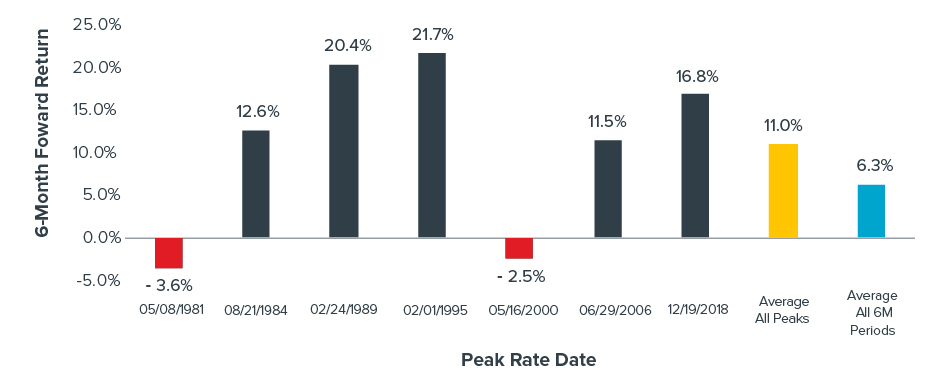
Expectations about the Fed and interest rates have shifted in the wake of the banking crisis, and the market is forecasting that we may be close to peak rates for the current cycle. If that is the case, equities could benefit. The chart below shows that in the six-month periods after federal funds have peaked, stocks gained an average of 11%. In the seven such cycles going back to 1981, five were positive and losses were relatively small in the two periods where stocks were negative.

Russell 1000 6-Month Forward Returns Following Peak Rates

Chart showing 6-month forward returns after peak rates since 1981
Source: Bloomberg, as of 3/22/2023


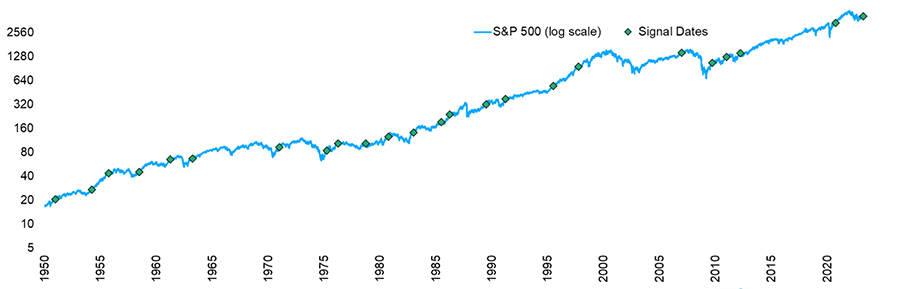
Stocks have had two consecutive quarters of strong returns. History shows that consecutive 5% quarters rarely happen in the middle of a bear market. More often than not, they happen at the start of a new bull market. As the chart below shows, the rare signal suggests the potential for more strength. Two quarters later, stocks have been higher 21 out of the past 23 times after this bullish signal.

Back-to-Back 5% Quarterly Gains Rarely Lead to New Bear Markets

Consecutive 5% Quarterly Gains for the S&P 500

Chart showing consecutive quarterly gains for the S&P 500
Source: Carson Investment Research, FactSet 3/31/2023 (1950-Current)

We expect volatility to continue as overall market sentiment is historically low. The consumer remains strong, despite increased credit card debt and decreased savings levels. For now, the positives outweigh the negatives in the current market. The Fed seems to be nearly through raising rates, inflation continues to fall, global manufacturing is rebounding, China continues to reopen, and employment remains strong. The key for investors is to remain calm and look past the turbulence — and be ready to act when opportunities arise.

The CD Wealth Formula

We help our clients reach and maintain financial stability by following a specific plan, catered to each client. 

Our focus remains on long-term investing with a strategic allocation while maintaining a tactical approach. Our decisions to make changes are calculated and well thought out, looking at where we see the economy is heading. We are not guessing or market timing. We are anticipating and moving to those areas of strength in the economy — and in the stock market. 

We will continue to focus on the fact that what really matters right now is time in the market, not out of the market. That means staying the course and continuing to invest, even when the markets dip, to take advantage of potential market upturns. We continue to adhere to the tried-and-true disciplines of diversification, periodic rebalancing and looking forward, while not making investment decisions based on where we have been.

It is important to focus on the long-term goal, not on one specific data point or indicator. Long-term fundamentals are what matter. In markets and moments like these, it is essential to stick to the financial plan. Investing is about following a disciplined process over time.

Sources: BofA Merrill, Carson, Horizon

Promo for an article titled Doing Your Taxes? What You Should Know About Bonuses, Extensions

This material contains an assessment of the market and economic environment at a specific point in time and is not intended to be a forecast of future events, or a guarantee of future results. Forward-looking statements are subject to certain risks and uncertainties. Actual results, performance, or achievements may differ materially from those expressed or implied. Information is based on data gathered from what we believe are reliable sources.

Using diversification as part of your investment strategy neither assures nor guarantees better performance and cannot protect against loss of principal due to changing market conditions.

Past performance is not a guarantee of future results.

The opinions expressed in this commentary are those of the author and may not necessarily reflect those held by Kestra Investment Services, LLC or Kestra Advisory Services, LLC. This is for general information only and is not intended to provide specific investment advice or recommendations for any individual. It is suggested that you consult your financial professional, attorney, or tax advisor with regard to your individual situation.

Securities offered through Kestra Investment Services, LLC (Kestra IS), member FINRA/SIPC. Investment Advisory Services offered through Kestra Advisory Services, LLC (Kestra AS) an affiliate of Kestra IS. CD Wealth Management and Bluespring Wealth Partners LLC* are affiliates of Kestra IS and Kestra AS. Investor Disclosures: https://bit.ly/KF-Disclosures

*Bluespring Wealth Partners, LLC acquires and supports high quality investment adviser and wealth management companies throughout the United States.

The Tax Deadline Is Almost Here — What You Should Know About Bonuses and Extensions

For most people, this year’s deadline to file federal income tax returns is Tuesday, April 18. Victims of winter storms in New York have until May 15 to file their returns, and storm victims in Mississippi and Arkansas have until July 31. The deadline has been postponed until Oct. 16 for disaster-area taxpayers in most of California, parts of Alabama and Georgia. Please make sure you double-check your filing deadline if you are in any of the affected areas on the IRS website’s Tax Relief in Disaster Situations page.

Often, employers often pay bonuses to their employees early in the year. Being awarded a bonus on top of your pay is a nice sign of appreciation, but it also comes with an uncertain tax situation, and you may owe more taxes than you planned. Bonuses, tips and commissions are considered supplemental wages, and they are subject to taxes with their own rules for withholding. If you receive a separate bonus check, it falls into one of two categories:

• For amounts under $1 million, employers withhold 22%.
• For amounts over $1 million, employers withhold 22% for the first $1 million and 37% for the remainder.

A bonus is treated as regular income. If you are in a tax bracket that is less than 22%, your employer will have over-withheld, and you may receive a refund for the difference. If you are in the tax bracket over 22% (income of $41,775 to $89,075 for single filers and $83,550 to $178,150 for married filing jointly), your employer will have under-withheld, and you may owe the difference between what was withheld and your total tax.

If your bonus is included in your regular paycheck, then it will withhold taxes using the aggregate method, which uses the total amount to calculate the withholding. For example, if you normally withhold 35% of your pay for taxes, the amount of withholding on your bonus also will be 35%. This tends to be a more accurate method for taxes and is less likely to leave you with a surprise bill at tax time.

Promo for an article titled What You Need to Know to Get Ready for Tax Season

Regardless of which method your employer uses for bonuses, a bonus is subject to state tax if applicable, as well as Social Security and Medicare taxes. If you are deferring income into a 401(k), a portion of the bonus may be withheld for that as well — an important consideration if you don’t want to frontload your 401(k) and have most of the money invested early in the year. We are happy to guide you on how to spread the payment into the 401(k) over the year.

While there is no way of fully eliminating the tax burden of a bonus, you may be able to lower it.

A couple of strategies to reduce tax payments down the road are:

• Find ways to reduce your taxable income such as maxing out contributions to your 401(k) or HSA. If the bonus significantly increases your taxable income, consider bunching charitable donations.
• If you don’t have a work-sponsored retirement plan, contributions to an IRA can reduce your tax burden. These contributions can be made until the filing deadline in April.
• Review your W-2. You may be able to time when you receive the bonus or defer the bonus for tax purposes. You also may raise your withholding on your regular wages if you know that your bonus is going to be larger.

It is important to remember that filing for an extension does not provide you any additional time to pay the tax if you owe more than what you withheld. When you file an extension, you must estimate the tax you owe, and this should be paid by the April filing date. If you don’t, you may owe interest and possibly penalties as well. If you are expecting a refund, the IRS encourages you to file your return as soon as possible and anticipates most tax refunds to be issued within 21 days of the IRS receiving the return.

The CD Wealth Formula

We help our clients reach and maintain financial stability by following a specific plan, catered to each client. 

Our focus remains on long-term investing with a strategic allocation while maintaining a tactical approach. Our decisions to make changes are calculated and well thought out, looking at where we see the economy is heading. We are not guessing or market timing. We are anticipating and moving to those areas of strength in the economy — and in the stock market. 

We will continue to focus on the fact that what really matters right now is time in the market, not out of the market. That means staying the course and continuing to invest, even when the markets dip, to take advantage of potential market upturns. We continue to adhere to the tried-and-true disciplines of diversification, periodic rebalancing and looking forward, while not making investment decisions based on where we have been.

It is important to focus on the long-term goal, not on one specific data point or indicator. Long-term fundamentals are what matter. In markets and moments like these, it is essential to stick to the financial plan. Investing is about following a disciplined process over time.

Sources: Broadridge, Investopedia, CNBC

Promo for an article titled The Importance of Compound Interest and Tax Planning on Your Portfolio

This material contains an assessment of the market and economic environment at a specific point in time and is not intended to be a forecast of future events, or a guarantee of future results. Forward-looking statements are subject to certain risks and uncertainties. Actual results, performance, or achievements may differ materially from those expressed or implied. Information is based on data gathered from what we believe are reliable sources.

Using diversification as part of your investment strategy neither assures nor guarantees better performance and cannot protect against loss of principal due to changing market conditions.

Past performance is not a guarantee of future results.

The opinions expressed in this commentary are those of the author and may not necessarily reflect those held by Kestra Investment Services, LLC or Kestra Advisory Services, LLC. This is for general information only and is not intended to provide specific investment advice or recommendations for any individual. It is suggested that you consult your financial professional, attorney, or tax advisor with regard to your individual situation.

Securities offered through Kestra Investment Services, LLC (Kestra IS), member FINRA/SIPC. Investment Advisory Services offered through Kestra Advisory Services, LLC (Kestra AS) an affiliate of Kestra IS. CD Wealth Management and Bluespring Wealth Partners LLC* are affiliates of Kestra IS and Kestra AS.  Investor Disclosures: https://bit.ly/KF-Disclosures

*Bluespring Wealth Partners, LLC acquires and supports high quality investment adviser and wealth management companies throughout the United States.

Fidelity Investments and Fidelity Institutional® (together “Fidelity”) is an independent company, unaffiliated with Kestra Financial or CD Wealth Management. Fidelity is a service provider to both. There is no form of legal partnership, agency affiliation, or similar relationship between your financial advisor and Fidelity, nor is such a relationship created or implied by the information herein. Fidelity has not been involved with the preparation of the content supplied by CD Wealth Management and does not guarantee, or assume any responsibility for, its content. Fidelity Investments is a registered service mark of FMR LLC. Fidelity Institutional provides clearing, custody, or other brokerage services through National Financial Services LLC or Fidelity Brokerage Services LLC, Members NYSE, SIPC.
Will the Fed Change Its Approach to Rate Hikes After the Banking Crisis?

It has been almost three weeks since the wake-up call from the failure of Silicon Valley Bank, the 16th-largest bank in the U.S. Two days later, Signature Bank also failed. With the fear of contagion spreading, European banks also came under pressure, forcing regulators to step in and shore up financial institutions. Recently, Swiss giant UBS agreed to acquire rival Credit Suisse to help restore confidence in the global banking system.

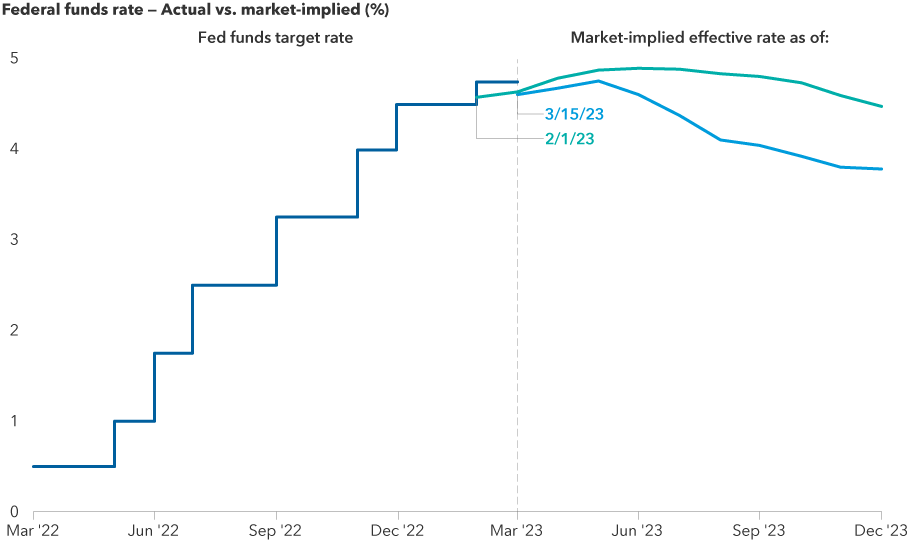
For more than a year, investors have been wondering what would allow the Federal Reserve to alter its path of aggressive rate hikes to slow down the economy and inflation. Thanks to the banking crisis, it appears we have the answer. The interest-rate outlook for the balance of 2023 and beyond appears to be dramatically changed. 

These events have led to an economic environment in which the Fed is tempering its hawkish tone and may even start cutting rates before the end of the year. (A hawk in the financial world is associated with aggressive monetary policy that favors higher interest rates to curb inflation.) While the Fed did raise the Fed funds rate by another 25 basis points last week, the central bank omitted language referring to the need for “ongoing” rate increases. The blue line in the chart below illustrates the sentiment shift from economists, reflecting a new potential path for the Fed. The latest Summary of Economic Projections suggests that Fed governors expect only one more rate hike this year.

SVB Collapse Has Drastically Altered Interest Rate Expectations

Chart showing that the SVB Collapse Has Drastically Altered Interest Rate Expectations
Sources: Capital Group, Bloomberg Index Services Ltd., Refinitiv DataStream, U.S. Federal Reserve. Fed funds target rate reflects the upper bound of the Federal Open Market Committee’s target range for overnight lending among U.S. banks. As of intraday, March 15, 2023.

Since SVB’s failure, we have seen short-term Treasury yields plummet. The yield on the 2-year Treasury fell almost a full percentage point (100 basis points) over a three-day period, marking the largest decline since the Black Monday crash of 1987. The rapid decline in bond yields over the past three weeks means investors expect the Fed to cut rates as expectations for economic growth and inflation fall. 

Another potential explanation for the falling yields is that more economists are predicting the possibility of a recession than before SVB’s troubles emerged. We have seen a dispersion between CD rates and Treasury yields since the SVB collapse; CD rates have remained elevated due to potential banking issues, while Treasury rates have remained depressed. Investors fled smaller regional banks and put excess cash into Treasury bonds, backed by the full faith and credit of the U.S. government, forcing rates lower.

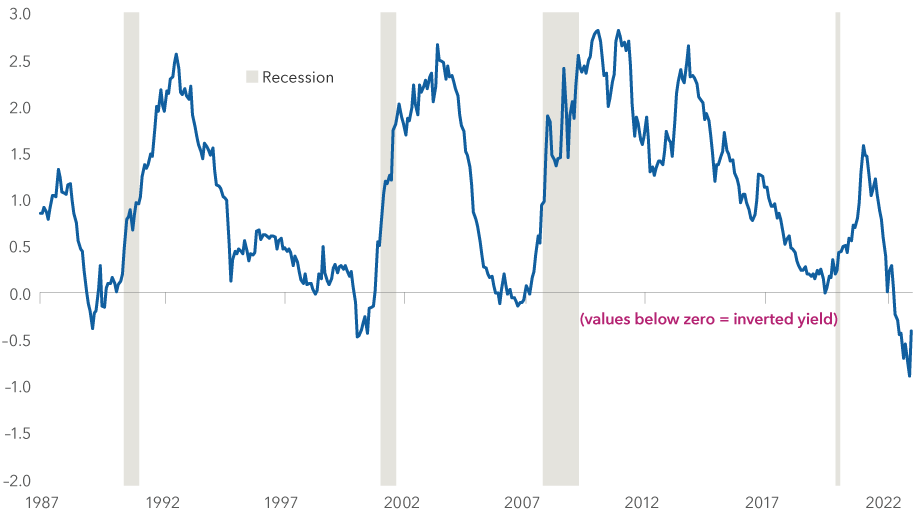
One of the strongest recessionary indicators remains the inverted yield curve. This is when the short-term U.S. Treasury bond yields are higher than the longer dated bonds. The yield curve first inverted in July and remains inverted today. The spread between the 10- and 2-year Treasury has decreased significantly since the SVB collapse, another sign that the bond market is forecasting a recession. In the four previous recent recessions, the yield spread between the 2- and 10-year bond reversed to a normal yield curve, and then the recession started.

Inverted Yield Curve Warns of Recession Risk

Difference between 10- and 2-year U.S. Treasury yields (%)

Chart showing the difference between 10- and 2-year U.S. Treasury yields (%)
Sources: Capital Group, Bloomberg Index Services Ltd., National Bureau of Economic Research, Refinitiv DataStream. As of March 17, 2023.

The Fed has a small window in which to avoid a recession. It still is targeting 2% inflation, but the costs associated with allowing inflation to remain high have become more severe since the SVB collapse. The current economic environment may be transitioning from an “asset crunch” to a “credit crunch,” which will inherently slow down economic growth and bring down inflation. We will continue to monitor the ongoing banking environment and keep you informed. As with any crisis, this one also presents potential investment opportunities, especially for those investors with long-term horizons.

The CD Wealth Formula

We help our clients reach and maintain financial stability by following a specific plan, catered to each client. 

Our focus remains on long-term investing with a strategic allocation while maintaining a tactical approach. Our decisions to make changes are calculated and well thought out, looking at where we see the economy is heading. We are not guessing or market timing. We are anticipating and moving to those areas of strength in the economy — and in the stock market. 

We will continue to focus on the fact that what really matters right now is time in the market, not out of the market. That means staying the course and continuing to invest, even when the markets dip, to take advantage of potential market upturns. We continue to adhere to the tried-and-true disciplines of diversification, periodic rebalancing and looking forward, while not making investment decisions based on where we have been.

It is important to focus on the long-term goal, not on one specific data point or indicator. Long-term fundamentals are what matter. In markets and moments like these, it is essential to stick to the financial plan. Investing is about following a disciplined process over time.

Sources: Capital Group, Schwab

Promo for article titled Taking Stock of the Federal Reserve's Fight Against Inflation

This material contains an assessment of the market and economic environment at a specific point in time and is not intended to be a forecast of future events, or a guarantee of future results. Forward-looking statements are subject to certain risks and uncertainties. Actual results, performance, or achievements may differ materially from those expressed or implied. Information is based on data gathered from what we believe are reliable sources.

Using diversification as part of your investment strategy neither assures nor guarantees better performance and cannot protect against loss of principal due to changing market conditions.

Past performance is not a guarantee of future results.

The opinions expressed in this commentary are those of the author and may not necessarily reflect those held by Kestra Investment Services, LLC or Kestra Advisory Services, LLC. This is for general information only and is not intended to provide specific investment advice or recommendations for any individual. It is suggested that you consult your financial professional, attorney, or tax advisor with regard to your individual situation.

Securities offered through Kestra Investment Services, LLC (Kestra IS), member FINRA/SIPC. Investment Advisory Services offered through Kestra Advisory Services, LLC (Kestra AS) an affiliate of Kestra IS. CD Wealth Management and Bluespring Wealth Partners LLC* are affiliates of Kestra IS and Kestra AS.  Investor Disclosures: https://bit.ly/KF-Disclosures

*Bluespring Wealth Partners, LLC acquires and supports high quality investment adviser and wealth management companies throughout the United States.

Fidelity Investments and Fidelity Institutional® (together “Fidelity”) is an independent company, unaffiliated with Kestra Financial or CD Wealth Management. Fidelity is a service provider to both. There is no form of legal partnership, agency affiliation, or similar relationship between your financial advisor and Fidelity, nor is such a relationship created or implied by the information herein. Fidelity has not been involved with the preparation of the content supplied by CD Wealth Management and does not guarantee, or assume any responsibility for, its content. Fidelity Investments is a registered service mark of FMR LLC. Fidelity Institutional provides clearing, custody, or other brokerage services through National Financial Services LLC or Fidelity Brokerage Services LLC, Members NYSE, SIPC.

Taking Stock of the Federal Reserve’s Fight Against Inflation

We continue to watch the battle of the Federal Reserve vs. inflation play out in front of us. Will inflation continue to drop? Did the Fed move too early in reducing rate hikes? Will the Fed continue to raise rates longer if inflation remains persistent? Will additional rate hikes cause further pressure on the regional banks? 

The Federal Reserve is facing one of its most difficult policy decisions as it grapples with stubborn inflation data and a simmering bank crisis. The Fed announced Wednesday it is raising rates another 25 basis points; the Federal Funds rate is now 4.75% to 5%.

Inflation started picking up in the spring of 2021 as the economy came roaring back from the pandemic. At first, the Fed dismissed the resurgent price spikes as temporary or transitory, assuming they would resolve themselves when supply chains returned to normal. As we know now, supply bottlenecks lasted longer than expected, and inflation is still the main topic of conversation almost two years later.

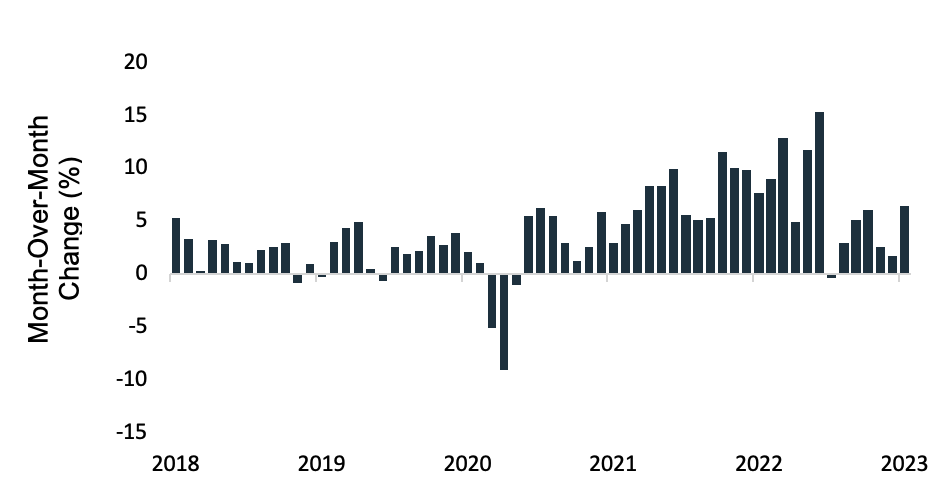
By June of last year, the consumer price index was 9.1% higher than the year before and the highest in four decades. The Fed raised rates for the first time a year ago, in March 2022, and it has now raised rates nine times. Inflation has edged lower since the peak in mid-2022. However, the Fed has not yet won the war with inflation; new data show an upturn in inflation and a stronger-than-expected economy.

Consumer Price Index: All Items, Month Over Month

Chart showing Consumer Price Index: All Items, Month Over Month
Source: Kestra Investment Management, U.S. Bureau of Labor Statistics. Data as of Feb. 28.

A concern is that inflation may prove harder to slow than initially thought. Households have increasingly shifted spending away from physical goods to experiences, such as traveling, restaurants and entertainment. Inflationary pressures also have shifted from goods to services. With all these moving parts, what are the factors that make up inflation?

Inflation can be separated into three broad categories – goods, shelter and wages. Right now, each group is fighting its own fight:

• Goods prices include a variety of tangible items such as eggs, cars or gasoline. Prices of goods tend to move quicker than others. We have all experienced a quick rise in gas prices. More recently, the egg shortage due to the avian flu has caused prices to rise dramatically. Consumer durable goods — those that don’t have to be purchased frequently, such as appliances, computers or televisions — are lower than they were a year ago, and leading indicators suggest further price easing still is to come.

• Shelter prices consist of two major components: home prices and rents. Both tend to move more slowly than prices of goods. We are starting to see signs of easing in this category. As of January, existing U.S. home sales had decreased for 12 consecutive months. In January, the median sales price of existing homes increased by 1.3%, the smallest gain since February 2012. 

Year-Over-Year Median Sales Price of Existing Homes

Chart showing Year-Over-Year Median Sales Price of Existing Homes
Source: Kestra Investment Management, U.S. National Association of Realtors. Data as of Feb. 28.

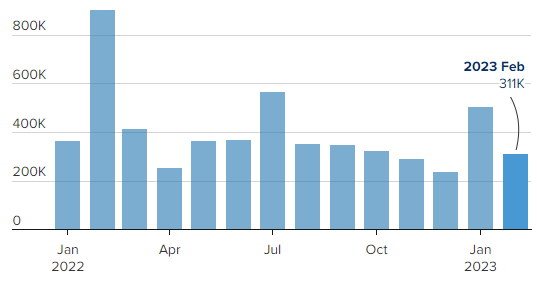
• Wages tend to move much more slowly, and once they are elevated, become more difficult for the Fed to reduce. Jobs remain plentiful as employers added 517,000 jobs in January and 311,000 in February. The unemployment rate moved up to 3.6% but remains close to historically low levels. Average hourly earnings rose 4.6% from a year ago, but this was less than expected and may be a sign of easing wage pressures.

Monthly Job Creation in the U.S.

January 2022 through February 2023

Chart showing Monthly Job Creation in the U.S.
Chart: Gabriel Cortes/CNBC. Source: U.S. Bureau of Labor Statistics via FRED. Data last published March 10.

The Federal Reserve has a tough battle on its hands between inflation, the recession and the banking crisis. How much can the Fed raise rates now that several banks have collapsed under the weight of eight interest rate hikes in a year?

The fight over the Fed being data-dependent, how much to continue raising rates and how much to keep the economy from a hard landing into a recession will lead to continued volatility and turbulence. It is important to remember that it does take time — typically 12 to 18 months — for rate hikes to work their way through the economy, and the Fed is taking that into consideration. 

It is also important to remember that the stock market is forward-looking and efficient. Publicly known data is already priced into the market. It is the unknown economic data and the Fed’s reaction that we will continue to monitor and keep you updated about along the way. 

The CD Wealth Formula

We help our clients reach and maintain financial stability by following a specific plan, catered to each client. 

Our focus remains on long-term investing with a strategic allocation while maintaining a tactical approach. Our decisions to make changes are calculated and well thought out, looking at where we see the economy is heading. We are not guessing or market timing. We are anticipating and moving to those areas of strength in the economy — and in the stock market. 

We will continue to focus on the fact that what really matters right now is time in the market, not out of the market. That means staying the course and continuing to invest, even when the markets dip, to take advantage of potential market upturns. We continue to adhere to the tried-and-true disciplines of diversification, periodic rebalancing and looking forward, while not making investment decisions based on where we have been.

It is important to focus on the long-term goal, not on one specific data point or indicator. Long-term fundamentals are what matter. In markets and moments like these, it is essential to stick to the financial plan. Investing is about following a disciplined process over time.

Sources: AP, CNBC, Kestra Investment Management

Promo for article titled Artificial Intelligence Is Changing the World — Here’s What You Should Know

This material contains an assessment of the market and economic environment at a specific point in time and is not intended to be a forecast of future events, or a guarantee of future results. Forward-looking statements are subject to certain risks and uncertainties. Actual results, performance, or achievements may differ materially from those expressed or implied. Information is based on data gathered from what we believe are reliable sources.

Using diversification as part of your investment strategy neither assures nor guarantees better performance and cannot protect against loss of principal due to changing market conditions.

Past performance is not a guarantee of future results.

The opinions expressed in this commentary are those of the author and may not necessarily reflect those held by Kestra Investment Services, LLC or Kestra Advisory Services, LLC. This is for general information only and is not intended to provide specific investment advice or recommendations for any individual. It is suggested that you consult your financial professional, attorney, or tax advisor with regard to your individual situation.

Securities offered through Kestra Investment Services, LLC (Kestra IS), member FINRA/SIPC. Investment Advisory Services offered through Kestra Advisory Services, LLC (Kestra AS) an affiliate of Kestra IS. CD Wealth Management and Bluespring Wealth Partners LLC* are affiliates of Kestra IS and Kestra AS.  Investor Disclosures: https://bit.ly/KF-Disclosures
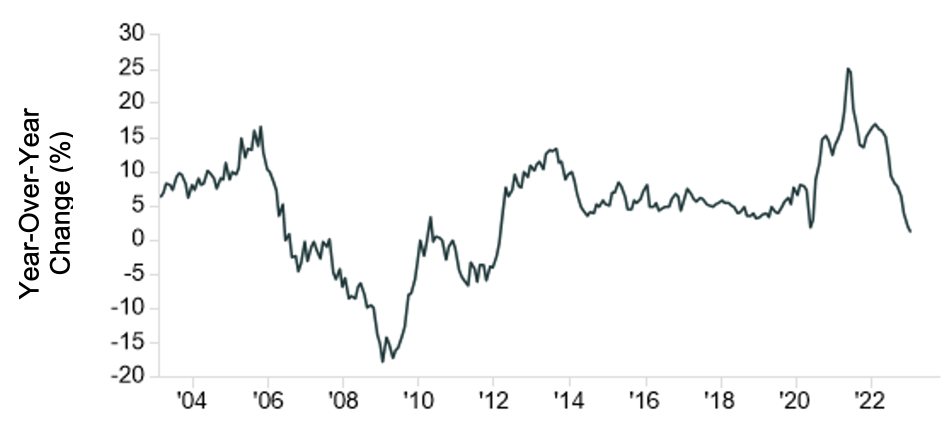
*Bluespring Wealth Partners, LLC acquires and supports high quality investment adviser and wealth management companies throughout the United States.

Fidelity Investments and Fidelity Institutional® (together “Fidelity”) is an independent company, unaffiliated with Kestra Financial or CD Wealth Management. Fidelity is a service provider to both. There is no form of legal partnership, agency affiliation, or similar relationship between your financial advisor and Fidelity, nor is such a relationship created or implied by the information herein. Fidelity has not been involved with the preparation of the content supplied by CD Wealth Management and does not guarantee, or assume any responsibility for, its content. Fidelity Investments is a registered service mark of FMR LLC. Fidelity Institutional provides clearing, custody, or other brokerage services through National Financial Services LLC or Fidelity Brokerage Services LLC, Members NYSE, SIPC.