How to Talk with Your Aging Parents About Planning for the Future

Holidays serve as a good reminder to enjoy the time we get to have with our family, especially our parents and older relatives. We are hopeful it also can be a time to have meaningful conversations with loved ones.

For those of us with aging parents, it’s hard to watch them grow older. After all, we are used to them taking care of us, not the other way around. Through the financial planning process, we often work to understand financial considerations for family members and parents, whether that means an inheritance or financial responsibility for loved ones. If you have not had the conversation with your parents, now is the time. The baby boomer generation and their parents come from a time when people typically did not discuss certain “off-limits” topics, but finances, health care and other issues are no longer taboo.

How do I start the conversation with my parents?

Each family situation is unique; the conversations you may need or want to have can look different from other families. It’s not wise to put the conversation off until your loved ones start to experience health declines, because then you will be forced to make decisions on the fly. You should not feel pressured to have the entire conversation in one sitting — break the conversations up into different days or over the course of several months. Also, it is helpful to plan for the conversation. Ask yourself what you hope to accomplish, what concerns you want to discuss and what the ideal outcome is before you begin.

Planning helps reduce the anxiety of having the conversation and sets you and your family up for success. It is helpful to approach the process as a partnership. Use “we” statements so they don’t feel targeted and understand you are in this together for their wellbeing.

Uncomfortable conversations take time, patience and perseverance. Do not take it personally if the conversation doesn’t go the way you envisioned; this is not about you, after all.

Pick a time, space and place where you and your family won’t feel rushed. Consider a neutral location and anticipate interruptions. Minimize distractions if possible by turning off the TV and your phones. Remember to reframe your language to reinforce that this is a partnership and you only want to help.

Don’t make the initial conversation all about the money, especially if you know they are guarded or view discussing money as taboo. Focus on their wishes and on what they want, and be non-judgmental as they open up to you.

What do I ask my parents?

Here are some conversation topics to consider:

“Let’s talk about where you keep your money.” Make sure you understand the whereabouts of your parents’ financial accounts – bank accounts, brokerage accounts, outside investments — so you know who to turn to in case of emergency. Know how much is in the accounts, who has access to them and how they are titled.

“Can you show me where you keep your records?” It may be beneficial for you to make a copy of records such as tax returns, titles to property and insurance policies. Also, make note of the names of their CPA and estate attorney.

“Do you have a safety deposit box at the bank?” Find out what bank they use and where the key is located. Ask how the safety deposit box is titled – is it joint or individual? Find out what is in the box and if any of the items have been appraised.

“Who are your doctors and what prescriptions do you take?” Having a list of their doctors and their contact information will be very helpful in case of emergency. If you live in the same city as your parents, you may have to accompany them to their appointments and be their advocate as they age.

“Do you have a will or estate documents?” Review the following documents with your parents to see if they are prepared: power of attorney (both financial and health care), advanced health care directives, living trust, DNR and a will. Also, discuss if they have any directives regarding specific items that they want passed on or charitable requests to be made.
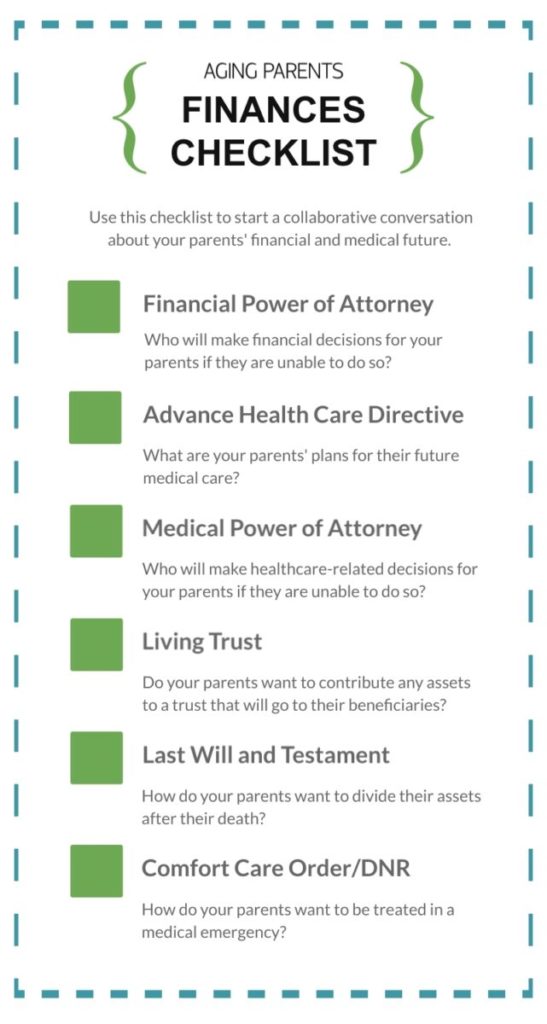
Checklist of tips to start a collaborative conversation about agin parents' financial and medical future

“Let’s talk about future plans, like long-term care.” Finding out if your parents have long-term care insurance is vital. Those turning 65 today have almost a 70% chance of needing some type of long-term care. Ask them what they expect as they get older: Do they expect a child to be the primary caregiver? Do they want to stay in their home? Do they want to move to an independent living facility that has different levels of care as they progress in age?

What happens if my parents get scammed?

The elderly lose billions of dollars a year to scammers. The question is not whether your parents will be contacted by a scammer, but whether they will be able to recognize the threat when they are contacted. Here are some tips to help you protect them:

Stay connected regularly. Talk to them about the risks of sharing their personal information online, over the phone or by mail. If they think that they have been scammed, have them contact you immediately. They may be embarrassed that this happened to them, but the longer they remain silent, the worse the situation could become.

Set up alerts. They should receive alerts if their account have been hacked or if the bank detects suspicious activity.

Save copies of their correspondence. This will be helpful to share with the authorities, the bank, or credit card companies if they have been scammed.

Encourage an open dialogue. Remember that some people will be ashamed or embarrassed to tell family members that they have been scammed. Remind your parents you are there to help. Show compassion during this stressful time.

Teach digital hygiene. Help them learn to spot suspicious emails, texts and websites. They should look over messages and websites to make sure they are legitimate. They should never share their personal information online or over the phone unless they are certain who they are dealing with. Teach them how to look at an email sender’s address. Discuss that texts they may receive about their password from “Amazon” or “Netflix” are more than likely scams and it is OK to delete them without responding.

It’s important to have a plan in place to address your loved ones’ finances, health and wellness, housing and care and end-of-life plans and wishes. We encourage you to take the first step, if you haven’t already, and open a dialogue with your parents and loved ones. Remember, this is about progress, not perfection. Get the ball rolling, start a conversation, and then keep moving forward.

The CD Wealth Formula

We help our clients reach and maintain financial stability by following a specific plan, catered to each client. 

Our focus remains on long-term investing with a strategic allocation while maintaining a tactical approach. Our decisions to make changes are calculated and well thought out, looking at where we see the economy is heading. We are not guessing or market timing. We are anticipating and moving to those areas of strength in the economy — and in the stock market. 

We will continue to focus on the fact that what really matters right now is time in the market, not out of the market. That means staying the course and continuing to invest, even when the markets dip, to take advantage of potential market upturns. We continue to adhere to the tried-and-true disciplines of diversification, periodic rebalancing and looking forward, while not making investment decisions based on where we have been.

It is important to focus on the long-term goal, not on one specific data point or indicator. Long-term fundamentals are what matter. In markets and moments like these, it is essential to stick to the financial plan. Investing is about following a disciplined process over time.

Sources: AARP, CNBC, Fidelity, Kiplinger

Promo for article titled Here's What You Should Know About Asset Allocations and Volatility

This material contains an assessment of the market and economic environment at a specific point in time and is not intended to be a forecast of future events, or a guarantee of future results. Forward-looking statements are subject to certain risks and uncertainties. Actual results, performance, or achievements may differ materially from those expressed or implied. Information is based on data gathered from what we believe are reliable sources.

Using diversification as part of your investment strategy neither assures nor guarantees better performance and cannot protect against loss of principal due to changing market conditions.

Past performance is not a guarantee of future results.

The opinions expressed in this commentary are those of the author and may not necessarily reflect those held by Kestra Investment Services, LLC or Kestra Advisory Services, LLC. This is for general information only and is not intended to provide specific investment advice or recommendations for any individual. It is suggested that you consult your financial professional, attorney, or tax advisor with regard to your individual situation.

Securities offered through Kestra Investment Services, LLC (Kestra IS), member FINRA/SIPC. Investment Advisory Services offered through Kestra Advisory Services, LLC (Kestra AS) an affiliate of Kestra IS. CD Wealth Management and Bluespring Wealth Partners LLC* are affiliates of Kestra IS and Kestra AS.  Investor Disclosures: https://bit.ly/KF-Disclosures

*Bluespring Wealth Partners, LLC acquires and supports high quality investment adviser and wealth management companies throughout the United States.

Social Security’s Biggest Benefit Jump in 40 Years Is Coming Next Year

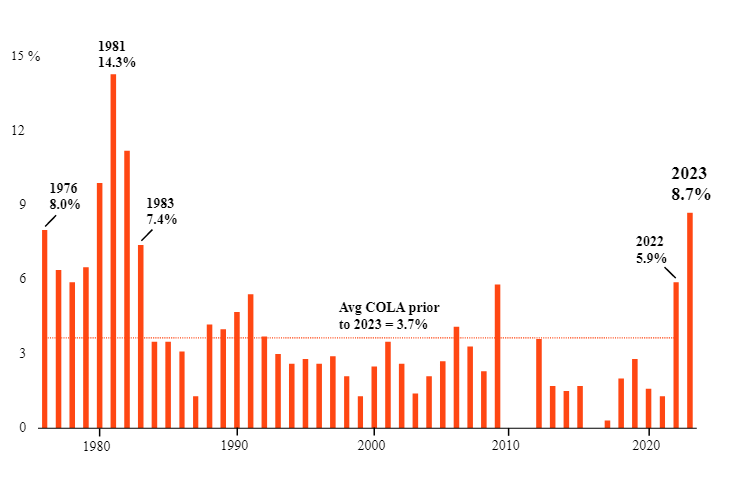
As we approach the end of the year, the IRS and Social Security Administration have released their 2023 adjustments. High inflation has led to a high cost of living adjustment (COLA) that will hit Social Security benefits next year: The 8.7% increase is the largest ever granted to today’s retirees, and it comes on the heels of a sizable 5.9% increase in 2022. The last time COLA exceeded 6% was more than 40 years ago, during double-digit inflation. As shown in the chart below, the average COLA before 2023 was 3.7%, and over the last decade, the average increase was only 1.9%.

2023 COLA is the highest ever for today’s retirees

Social Security cost of living adjustments, 1976-2023

Chart showing each Social Security adjustment since 1976
Source:  Social Security Administration 2023

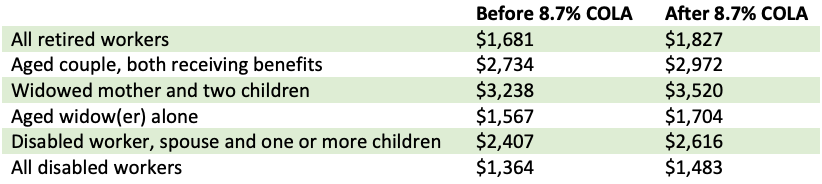
On average, Social Security benefits will go up more than $140 per month – from $1,681 to $1,827 — and the average disability benefit will increase by $119 per month. To find out exactly how much you will receive next year from Social Security, you can calculate the change by multiplying your net Social Security benefit by 8.7%. The chart below provides average Social Security benefits for different recipients and may help provide further clarity.

Estimated average monthly Social Security benefits in 2023

The table shows the average monthly Social Security benefits for different qualifying recipients both before and after the 8.7% cost of living adjustment.

Chart showing average Social Security benefits before and after the 2023 adjustment
Table: Gabriel Cortes/CNBC; Source: Social Security Administration

The threshold for the taxation of Social Security benefits is not indexed to inflation and remains constant. As the benefit and other retirement income adjusts upward over time, more people will cross the threshold and pay more in taxes for their benefits. An individual’s Social Security income is taxed based on a combined income formula that includes wage income, interest, dividends, pension payments and taxable distributions from 401Ks and IRAs. If your combined income is above $34,000 for a single person and $44,000 for a couple, up to 85% of your benefit could be taxed.

The COLA should not influence the timing of when you file for Social Security. COLA takes effect automatically for all clients 62 or older, regardless of whether they are currently collecting or have filed for benefits before Dec. 31. Before age 62, an individual’s future benefit is adjusted for inflation through a different methodology. 

The decision to start collecting benefits should be driven only by your circumstances, such as age, life expectancy, marital status and cash flow needs.

There are tradeoffs to consider for filing earlier or later than full retirement age; filing early permanently reduces the amount of monthly benefit, for example.

The IRS announced on Friday that due to higher inflation, it is raising contribution limits for retirement savings plans for 2023 based on cost-of-living adjustments. According to Mercer, the limit increases are the largest ever.

Individual contributions to 401Ks or similar retirement plans will see a $2,000 jump to $22,500, for those under the age of 50. Those who are 50 or older will be permitted to contribute an additional $7,500 per year, for a total of $30,000. At the same time, the IRS raised the limit for contributions to a pre-tax or Roth IRA to $6,500, up from $6,000, where it has been the last four years. Those 50 and older can still make an additional $1,000 catch-up contribution, which is not adjusted for inflation.

Income limits for a Roth IRA will increase as well. The income range for married couples filing jointly increases to $218,000 to $228,000 (from $204,000 to $214,000). For those filing as single, the income phase-out range for Roth IRAs increases to $138,000 to $153,000. SEP IRA contribution limits will go up to $66,000 from $61,000. 

This year’s COLA can help you keep up with higher costs. In the short run, managing withdrawals from the portfolio may help smooth out the tax bumps during a period of high inflation. In the long term, however, tax planning should be a multi-year approach and strategic in nature.

Whether you are planning for the next year or next decade, managing taxes throughout retirement needs to be well thought out, working with your financial advisor and tax professional to understand the tax impact of any planning decisions.

The CD Wealth Formula

We help our clients reach and maintain financial stability by following a specific plan, catered to each client. 

Our focus remains on long-term investing with a strategic allocation while maintaining a tactical approach. Our decisions to make changes are calculated and well thought out, looking at where we see the economy is heading. We are not guessing or market timing. We are anticipating and moving to those areas of strength in the economy — and in the stock market. 

We will continue to focus on the fact that what really matters right now is time in the market, not out of the market. That means staying the course and continuing to invest, even when the markets dip, to take advantage of potential market upturns. We continue to adhere to the tried-and-true disciplines of diversification, periodic rebalancing and looking forward, while not making investment decisions based on where we have been.

It is important to focus on the long-term goal, not on one specific data point or indicator. Long-term fundamentals are what matter.  In markets and moments like these, it is essential to stick to the financial plan. Investing is about following a disciplined process over time.

Sources:  Blackrock, CNBC, Fidelity, Social Security Administration

Promo for an article titled Here’s What You Should Know About Asset Allocations and Volatility

This material contains an assessment of the market and economic environment at a specific point in time and is not intended to be a forecast of future events, or a guarantee of future results. Forward-looking statements are subject to certain risks and uncertainties. Actual results, performance, or achievements may differ materially from those expressed or implied. Information is based on data gathered from what we believe are reliable sources.

Using diversification as part of your investment strategy neither assures nor guarantees better performance and cannot protect against loss of principal due to changing market conditions.

Past performance is not a guarantee of future results.

The opinions expressed in this commentary are those of the author and may not necessarily reflect those held by Kestra Investment Services, LLC or Kestra Advisory Services, LLC. This is for general information only and is not intended to provide specific investment advice or recommendations for any individual. It is suggested that you consult your financial professional, attorney, or tax advisor with regard to your individual situation.

Securities offered through Kestra Investment Services, LLC (Kestra IS), member FINRA/SIPC. Investment Advisory Services offered through Kestra Advisory Services, LLC (Kestra AS) an affiliate of Kestra IS. CD Wealth Management and Bluespring Wealth Partners LLC* are affiliates of Kestra IS and Kestra AS. Investor Disclosures: https://bit.ly/KF-Disclosures

*Bluespring Wealth Partners, LLC acquires and supports high quality investment adviser and wealth management companies throughout the United States.
Worried About Retirement in a Down Market? Consider These Strategies

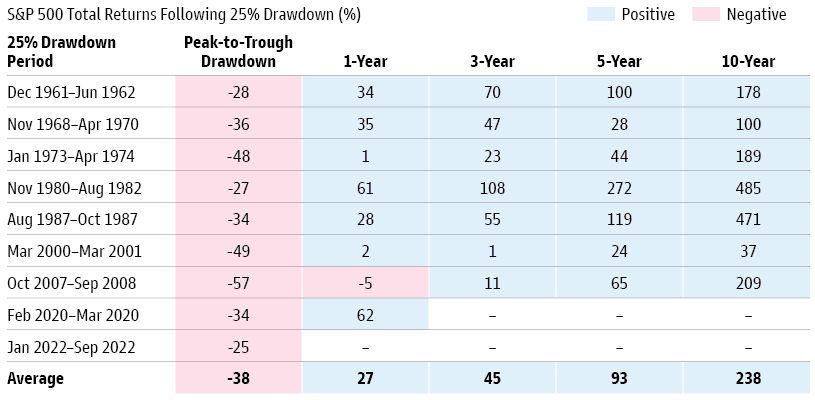
The S&P 500 reached a new low last week, closing 25% down from its January peak. Markets may fall even more from here: Since 1961, the average peak-to-trough decline during drawdowns of 25% or more has been 38%. However, historical drawdowns of 25% or more have delivered a forward one-year return of 27% on average, with longer investment time frames proving even more compelling. 

Timing the bottom of this market is difficult, if not impossible, for those considering going to the sideline and waiting to get back in after the market falls further. History suggests that those who stay the course have been rewarded.  

Chart showing S&P 500 market performance during and after drawdowns of 25% or more since 1961
Source: Bloomberg and Goldman Sachs Asset Management. As of October 6, 2022

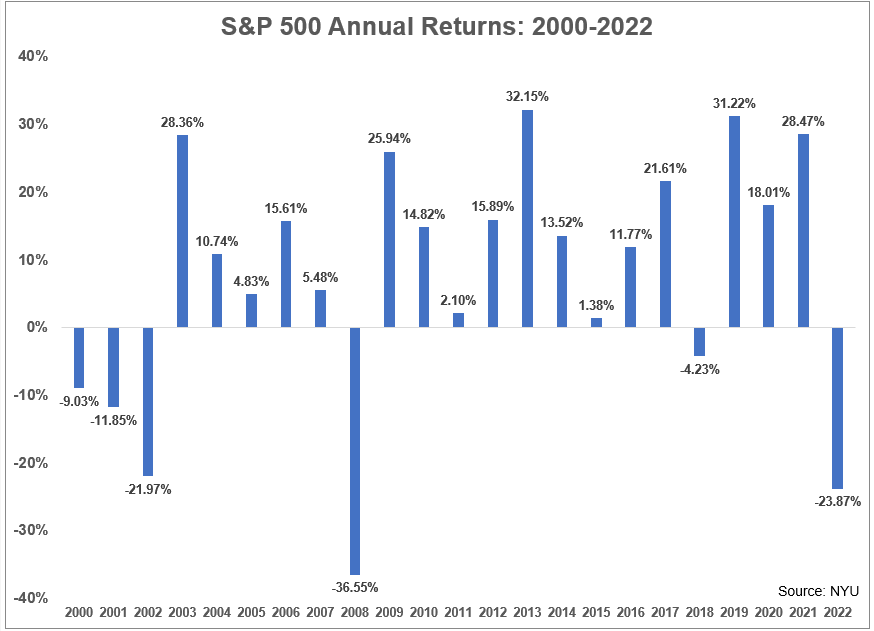
We read a lot about market returns averaging 8% to 10% per year, but as the chart shows below, such returns are not common at all. The 8% to 10% average comes from many years of outsized returns, followed by weak or negative returns and a few years of average returns. If you are not invested in the market or decide to move to the sidelines, it becomes much harder to obtain average returns. We cannot control the sequence of returns – i.e., what the market does on a yearly basis. It’s no secret that investing is not predictable; the market can be up 10% one year and down 10% the next year.

Chart showing S&P 500 Annual Returns from 2000 to 2002

When you are in the accumulation phase, the sequencing of returns does not have a significant impact on your ending balance. However, when you are entering retirement or taking annual distributions from the portfolio, the sequence of returns can make a big difference. A down market early in retirement — on top of taking distributions from the portfolio — can eat into your wealth through no fault of your own, other than bad timing. 

While we can’t control bear markets, we can control how we respond to them. The key to overcoming sequence-of-return risk is to draw down as little as possible during that down period. Here are some strategies for the newly or nearly retired to consider:

Revisit your need for distributions:

Take another look at how you are planning to fund your expenses and consider alternate strategies to minimize how much you take out. For example:

Healthcare expenses: If you funded an HSA account, make sure you use those funds for qualified health expenses before withdrawing from the portfolio.

Charitable giving: Consider making a large gift to a donor-advised fund during an up year in the market. That fund will become your charitable checkbook so that you do not have to tap into the portfolio during down years in the market.

Flexible withdrawals: Consider taking out more during up markets and pulling back when the market is struggling. This could help you ride out the down market by withdrawing as little as possible.

Build up cash accounts

One way to limit how much you need from retirement accounts is to build up liquidity in your cash accounts. By maintaining short-term cash and cash equivalents — such as CDs, fixed income, and money market accounts — you can keep from having to draw down your retirement funds prematurely. For the first time in many years, money market rates and short term bond rates offer attractive yields, and you can get paid to be in cash with those monies.

Be wary of debt

It makes sense to enter retirement with as little debt as possible. Excessive debt in retirement can affect not only your financial health, but also your physical and mental health as well, due to the strain of paying off debt without income from work.

Know your retirement account options

Once you reach a certain age (72) or older and have a traditional IRA or 401K, the IRS requires you to take an annual required minimum distribution (RMD). Roth IRAs do not have RMDs, allowing you to withdraw funds without penalty or tax. It may make sense before retirement to convert some or all of a traditional IRA to a Roth IRA. This does require that you pay tax on the conversion amount at the time of the conversion. During a down market, doing a Roth conversion can reduce the taxes that you will pay since the value of the IRA is down, and it allows a future market recovery to happen in a tax-free account. 

We fully recognize that bear markets are painful and challenging for all investors. Planning for retirement is a long road trip. On most long road trips, you are bound to run into some trouble — unexpected pit stops, flat tires or even a cracked windshield. But these bumps don’t last for the whole trip, and they do not ruin the overall journey. It is more important than ever to keep perspective and realize that these down markets don’t last forever, and good times have historically lasted much longer than the bad.

The CD Wealth Formula

We help our clients reach and maintain financial stability by following a specific plan, catered to each client. 

Our focus remains on long-term investing with a strategic allocation while maintaining a tactical approach. Our decisions to make changes are calculated and well thought out, looking at where we see the economy is heading. We are not guessing or market timing. We are anticipating and moving to those areas of strength in the economy — and in the stock market. 

We will continue to focus on the fact that what really matters right now is time in the market, not out of the market. That means staying the course and continuing to invest, even when the markets dip, to take advantage of potential market upturns. We continue to adhere to the tried-and-true disciplines of diversification, periodic rebalancing and looking forward, while not making investment decisions based on where we have been.

It is important to focus on the long-term goal, not on one specific data point or indicator. Long-term fundamentals are what matter. In markets and moments like these, it is essential to stick to the financial plan. Investing is about following a disciplined process over time.

Sources: Goldman Sachs, Kestra Asset Management, Robert Baird, NYU

Promo for article titled Fourth-Quarter Outlook: Midterms, More Volatility and the Fed

This material contains an assessment of the market and economic environment at a specific point in time and is not intended to be a forecast of future events, or a guarantee of future results. Forward-looking statements are subject to certain risks and uncertainties. Actual results, performance, or achievements may differ materially from those expressed or implied. Information is based on data gathered from what we believe are reliable sources.

Using diversification as part of your investment strategy neither assures nor guarantees better performance and cannot protect against loss of principal due to changing market conditions.

Past performance is not a guarantee of future results.

The opinions expressed in this commentary are those of the author and may not necessarily reflect those held by Kestra Investment Services, LLC or Kestra Advisory Services, LLC. This is for general information only and is not intended to provide specific investment advice or recommendations for any individual. It is suggested that you consult your financial professional, attorney, or tax advisor with regard to your individual situation.

Securities offered through Kestra Investment Services, LLC (Kestra IS), member FINRA/SIPC. Investment Advisory Services offered through Kestra Advisory Services, LLC (Kestra AS) an affiliate of Kestra IS. CD Wealth Management and Bluespring Wealth Partners LLC* are affiliates of Kestra IS and Kestra AS.  Investor Disclosures: https://bit.ly/KF-Disclosures

*Bluespring Wealth Partners, LLC acquires and supports high quality investment adviser and wealth management companies throughout the United States.

This year-end financial checklist will help you plan and save

As 2021 comes to an end, the time has come to review some year-end strategies to ensure that your wealth plan reflects any changes in your circumstances or your goals, the economic landscape and current tax environment. We recommend that you review the following checklist for planning strategies to consider; some may apply to you, while others may not. We recommend speaking with your CPA or accountant to review as well.

Income tax strategies

• Traditional year-end planning focuses on deferring income to a future year and accelerating deductions into the current year. However, if you anticipate that your marginal income tax rates will increase next year — whether due to increased income or changes in tax legislation — you may consider accelerating income into 2021 and deferring deductions to 2022.

• If you anticipate being in a lower taxable income bracket in 2022:

Defer income and any sale of capital gain property (if possible) to postpone taxable income.

— If you are itemizing on your tax return, bunch your medical expenses in the current year to meet the percentage of your adjusted gross income needed to claim those deductions.

— Make your January mortgage payment in December so that you can deduct the interest on your 2021 tax return.

Tax-related investment strategies

Tax-loss harvesting is the strategy of selling securities at a loss to offset a capital gain tax liability. It involves selling a taxable investment that has declined in value, replacing it with a similar investment and using the loss incurred to offset any gains. 

— Short-term losses are best used to offset short-term gains, and long-term losses can be used to offset long-term gains. Losses can help offset $3,000 of income on a joint tax return in one year.

— Be aware that the IRS wash-sale rule dictates that you must wait at least 31 days before buying back a holding that is sold for a loss.

• Make sure you have satisfied your required minimum distribution (RMD). Once you turn 72 years old, you are required to take minimum distributions from your traditional IRAs and most employer-sponsored retirement plans. 

— RMDs were not required in 2020 after Congress passed the CARES Act in response to the pandemic, but minimum distributions resumed in 2021, and failure to take them may result in a 50% penalty.

— You may have an RMD for an inherited IRA, depending on when you inherited it. (Tax laws have changed for newly inherited IRAs.) 

Promo for an article called The RMD Deadline is Approaching — Here is What You Need to Know

Retirement planning strategies

• Maximize your IRA contributions. You may be able to deduct annual contributions of up to $6,000 to your traditional IRA and $6,000 to your spouse’s IRA ($7,000 if over age 50).

• Make a Roth contribution if you qualify under the applicable income limits.

• Consider increasing or maximizing your 401(k) contribution. For 2021, the maximum is $19,500 for those who are younger than 50 and $26,000 for those who are 50 or older.

• Consider contributing to a Roth 401(k) plan if your plan allows.

• Consider setting up a Roth IRA for each of your children who have earned income during the year.

• Determine the optimal time to begin taking Social Security benefits if you over age 62. 

Gifting strategies

• Consider making gifts up to $15,000 per person as allowed under the federal annual gift tax exclusion. In 2022, the gift tax exclusion is projected to increase to $16,000 per person.

• Take advantage of the ability to deduct up to 100% of adjusted gross income (AGI) for a cash gift to a public charity in 2021. 

• Create a donor advised fund for an immediate income tax deduction and provide immediate and future benefits to a charity over time.

• If you already have a donor advised fund, consider gifting appreciated assets that have been held longer than one year to get the fair market value income tax deduction while avoiding income tax on the appreciation.

• Combine multiple years of charitable giving into a single year to exceed the standard deduction threshold.

• If you are over age 70 ½ (or 72, depending on your date of birth), consider making a direct transfer from an IRA to a public charity. The distribution is excludable from gross income. 

Wrapping up 2021, planning for 2022

• Work with your CPA to provide capital gains and investment income information for a more accurate year-end projection.

• Check your Health Savings Account contributions for 2021. If you qualify, you can contribute up to $3,600 (individual) or $7,200 (family), plus an additional $1,000 catch-up if you are over 55.

• Discuss major life events with CD Wealth Management to confirm you have clarity in your current situation.

• Double-check your beneficiary designations for employer-sponsored retirement plans, IRAs, Roth IRAs, annuities, life insurance policies, etc.

• Review that you have a trusted contact on each of your accounts to help protect assets against fraud. 

Promo for an article called Great News for Retirees: Social Security Gets a Boost

So, what can we learn from all this? The end of year is a perfect time to review your financial planning needs. This includes reviewing the investment portfolio, assessing year-end tax planning opportunities, reviewing retirement goals and managing your wealth transfer and legacy plans. The checklist above includes just some of the items that may apply to your family. We are happy to meet to discuss any of the above to ensure that you remain on track with your financial profile.

From a portfolio perspective, we continue to adhere to the tried-and-true disciplines of diversification, periodic rebalancing and looking forward, while not making investment decisions based on where we have been. Making market decisions based on what might happen may be detrimental to long-term performance. The key is to stay invested and stick with the financial plan. Markets go up and down over time, and downturns present opportunities to purchase stocks at a lower value. As we say each week, it is important to stay the course and focus on the long-term goal, not on one specific data point or indicator.

It all starts with a solid financial plan for the long run that understands the level of risk that is acceptable for each client. Regarding investments, we believe in diversification and having different asset classes that allow you to stay invested. The best option is to stick with a broadly diversified portfolio that can help you to achieve your own specific financial goals — regardless of market volatility. Long-term fundamentals are what matter.

Sources: BNY Mellon, Forbes, RBC

Promo for article on the formula for wealth

This material contains an assessment of the market and economic environment at a specific point in time and is not intended to be a forecast of future events, or a guarantee of future results. Forward-looking statements are subject to certain risks and uncertainties. Actual results, performance, or achievements may differ materially from those expressed or implied. Information is based on data gathered from what we believe are reliable sources.

Using diversification as part of your investment strategy neither assures nor guarantees better performance and cannot protect against loss of principal due to changing market conditions.

Past performance is not a guarantee of future results.

The opinions expressed in this commentary are those of the author and may not necessarily reflect those held by Kestra Investment Services, LLC or Kestra Advisory Services, LLC. This is for general information only and is not intended to provide specific investment advice or recommendations for any individual. It is suggested that you consult your financial professional, attorney, or tax advisor with regard to your individual situation.

Securities offered through Kestra Investment Services, LLC (Kestra IS), member FINRA/SIPC. Investment Advisory Services offered through Kestra Advisory Services, LLC (Kestra AS) an affiliate of Kestra IS. Kestra IS and Kestra AS are not affiliated with CD Wealth Management. Investor Disclosures: https://bit.ly/KF-Disclosures

Great news for retirees: Social Security gets a huge boost

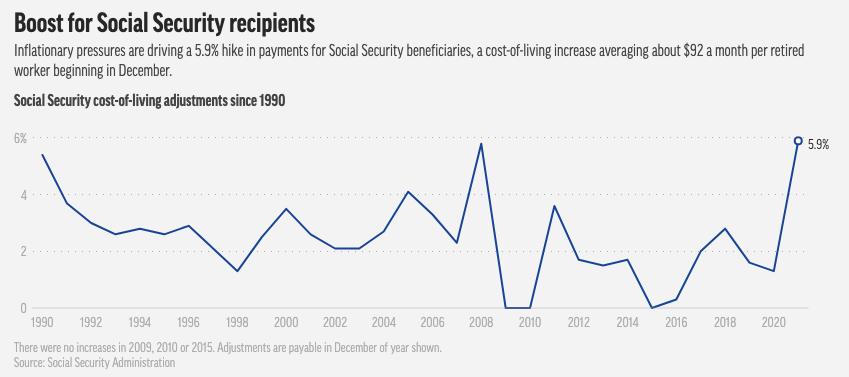
Millions of retirees received great news this last week: Social Security and Supplemental Security Income will get a 5.9% boost in benefits for 2022. This is the largest cost-of-living adjustment in almost 40 years. For the past 10 years, the annual average inflation adjustment has been 1.65%.

Roughly 50% of all seniors live in households where Social Security provides at least half of their income, and 25% rely on their monthly payments for all their income. With the increase for 2022, the average Social Security payment for a retired worker will be $1,657 per month, and a typical couple’s benefit would rise by $154 to $2,753 per month. The large increase will help retirees keep up with the rising costs of food, gas and other goods and services, as the current CPI — measuring the year-over-year change in consumer prices — is up 5.4%. 

Graphic showing Social Security benefit increases since 1990

How does Social Security work — and how do I access my statement?

Social Security is financed by payroll taxes that are collected from workers and their employers. Both employees and employers pay 6.2% on wages, up to a maximum amount, which is adjusted yearly for inflation. (In 2022, the maximum amount will be $147,000.) The payroll taxes are paid into the Social Security system so that at retirement age, any time after age 62, workers who are entitled to benefits can decide if they want to begin taking Social Security or delay taking benefits up until age 70. For every year you delay taking benefits between age 62 and 70, the estimated monthly payment grows by about 8%. As part of the financial planning process, we discuss taking Social Security at age 67 versus age 70 because while each situation is different, the break-even scenario is age 81. This means that if you live past age 81, you would be better off financially if you wait until age 70 to begin taking Social Security benefits.

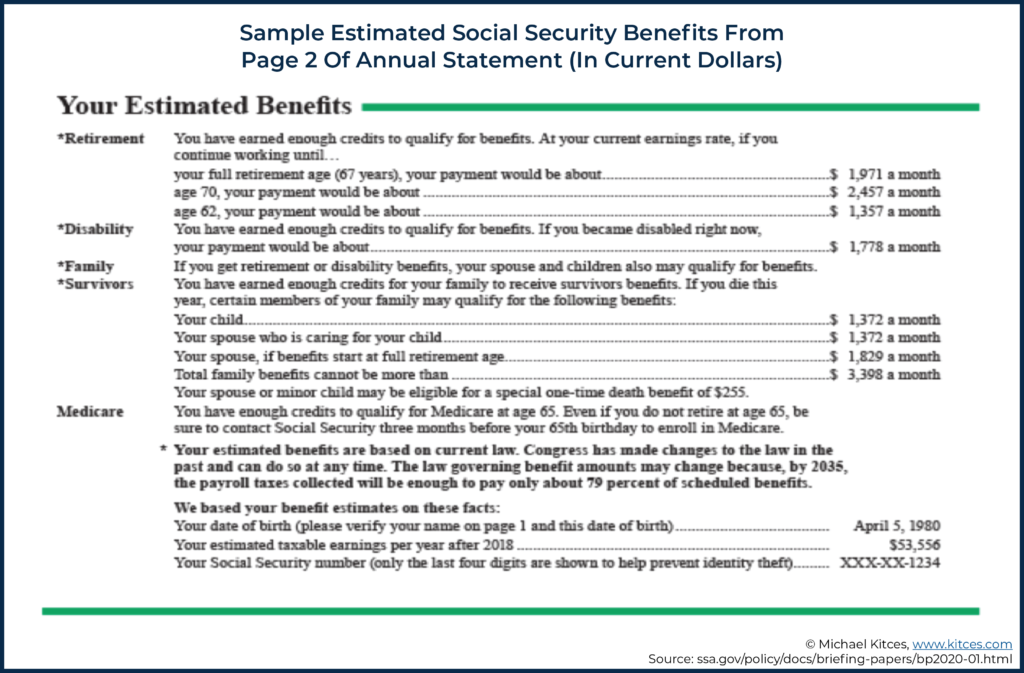
In 2011, the Social Security Administration stopped mailing annual statements to people’s homes. To access your statement, go to www.ssa.gov and create an account if you have not already done so. Page 2 of the statement (shown below) includes a summary of the estimated retirement, disability, family survivors and Medicare benefits based on the average earnings over a person’s entire work history. These benefits are not adjusted for inflation and are reported in current dollars, not future dollars. In other words, there are no inflation adjustments being applied to the benefit amounts, even though they may not be claimed for many years. The main area to study is the retirement section, where you can view the payment amounts if you take benefits at age 62, 66 or 67 (depending on your date of birth) and at age 70.

Sample of Page 2 of the Social Security statement

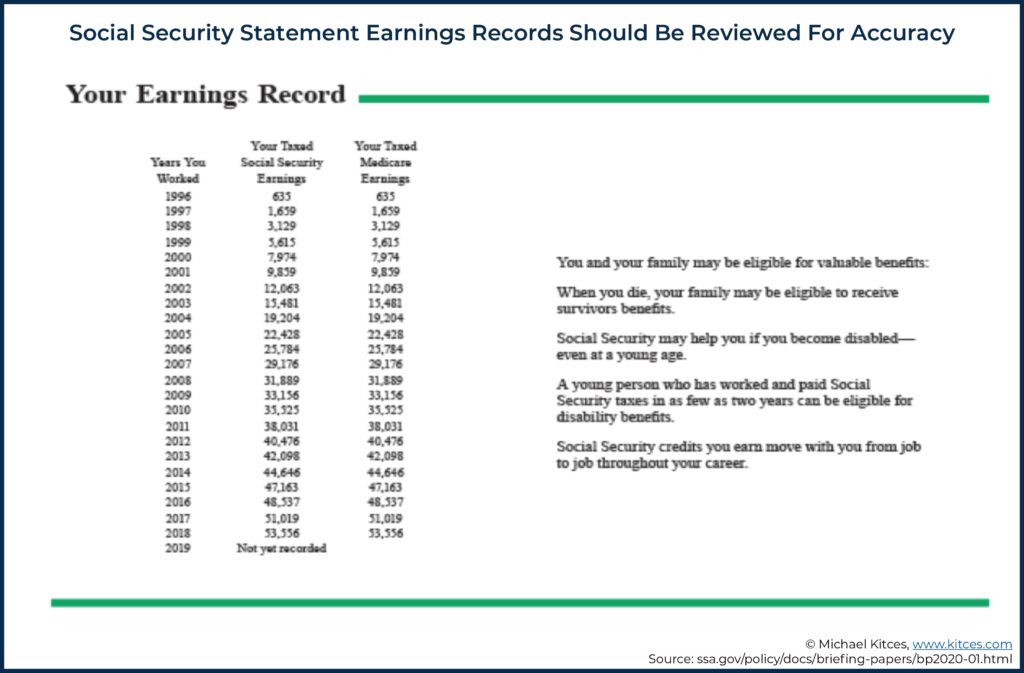
It is important to review the earnings record on Page 3 of the Social Security statement (shown below). Your benefits are based on the 35 calendar years in which your income was the highest. If you have fewer than 35 years of earnings, each year with no earnings will be entered as zero. Years with zero income can be replaced with higher-income years in the future. We recommend reviewing this page to make sure the annual income reported is accurate. In the event of an error or omission, you should gather evidence (W-2s, pay stubs or tax returns) and contact the Social Security Administration to have it corrected.

Sample of Page 3 of the Social Security statement

Social Security benefits that you receive at retirement are not tax-free. A married couple with a combined income of more than $32,000 may have to pay income tax on up to 50% of their benefits. Higher-income earners may have to pay tax on up to 85% of their benefits. Depending on where you live, you also may have to pay state income taxes on your benefits.

Married people can take what is called a spousal benefit, worth up to 50% of the other spouse’s Social Security benefit. If one spouse is a high wage earner and the other has not worked or has a very low Social Security benefit, taking half of the higher earner’s benefit may result in higher monthly income at retirement.

So, what can we learn from all this? Social Security benefits are an important part of most retirement plans. Even in situations where individuals are fortunate enough to avoid relying on benefits, you still should ensure you receive the correct amount. Reviewing your benefits is a critical step of the financial planning process.

From a portfolio perspective, we continue to adhere to the tried-and-true disciplines of diversification, periodic rebalancing and looking forward, while not making investment decisions based on where we have been. Making market decisions based on what might happen may be detrimental to long-term performance. The key is to stay invested and stick with the financial plan. Markets go up and down over time, and downturns present opportunities to purchase stocks at a lower value. 

More and more noise is creeping into the markets today – worries about inflation, higher energy prices, slower growth, possible stagflation, etc. The amount of liquidity in the markets remains at record levels. There still exists a chance that we will see additional stimulus into the economy through an infrastructure package and possibly even a social spending package. While questions do exist about the state of the economy, there remain many positives about our global economy and reasons to be optimistic. As we say each week, it is important to stay the course and focus on the long-term goal, not on one specific data point or one indicator.

It all starts with a solid financial plan for the long run that understands the level of risk that is acceptable for each client. Regarding investments, we believe in diversification and having different asset classes that allow you to stay invested. The best option is to stick with a broadly diversified portfolio that can help you achieve your own specific financial goals, regardless of market volatility. Long-term fundamentals are what matter.

Sources: Associated Press, CNBC, Kitces

Promo for article about energy prices, interest rates and inflation

This material contains an assessment of the market and economic environment at a specific point in time and is not intended to be a forecast of future events, or a guarantee of future results. Forward-looking statements are subject to certain risks and uncertainties. Actual results, performance, or achievements may differ materially from those expressed or implied. Information is based on data gathered from what we believe are reliable sources.

Using diversification as part of your investment strategy neither assures nor guarantees better performance and cannot protect against loss of principal due to changing market conditions.

Past performance is not a guarantee of future results.

The opinions expressed in this commentary are those of the author and may not necessarily reflect those held by Kestra Investment Services, LLC or Kestra Advisory Services, LLC. This is for general information only and is not intended to provide specific investment advice or recommendations for any individual. It is suggested that you consult your financial professional, attorney, or tax advisor with regard to your individual situation.

Securities offered through Kestra Investment Services, LLC (Kestra IS), member FINRA/SIPC. Investment Advisory Services offered through Kestra Advisory Services, LLC (Kestra AS) an affiliate of Kestra IS. Kestra IS and Kestra AS are not affiliated with CD Wealth Management. Investor Disclosures: https://bit.ly/KF-Disclosures