How to Talk with Your Aging Parents About Planning for the Future

Holidays serve as a good reminder to enjoy the time we get to have with our family, especially our parents and older relatives. We are hopeful it also can be a time to have meaningful conversations with loved ones.

For those of us with aging parents, it’s hard to watch them grow older. After all, we are used to them taking care of us, not the other way around. Through the financial planning process, we often work to understand financial considerations for family members and parents, whether that means an inheritance or financial responsibility for loved ones. If you have not had the conversation with your parents, now is the time. The baby boomer generation and their parents come from a time when people typically did not discuss certain “off-limits” topics, but finances, health care and other issues are no longer taboo.

How do I start the conversation with my parents?

Each family situation is unique; the conversations you may need or want to have can look different from other families. It’s not wise to put the conversation off until your loved ones start to experience health declines, because then you will be forced to make decisions on the fly. You should not feel pressured to have the entire conversation in one sitting — break the conversations up into different days or over the course of several months. Also, it is helpful to plan for the conversation. Ask yourself what you hope to accomplish, what concerns you want to discuss and what the ideal outcome is before you begin.

Planning helps reduce the anxiety of having the conversation and sets you and your family up for success. It is helpful to approach the process as a partnership. Use “we” statements so they don’t feel targeted and understand you are in this together for their wellbeing.

Uncomfortable conversations take time, patience and perseverance. Do not take it personally if the conversation doesn’t go the way you envisioned; this is not about you, after all.

Pick a time, space and place where you and your family won’t feel rushed. Consider a neutral location and anticipate interruptions. Minimize distractions if possible by turning off the TV and your phones. Remember to reframe your language to reinforce that this is a partnership and you only want to help.

Don’t make the initial conversation all about the money, especially if you know they are guarded or view discussing money as taboo. Focus on their wishes and on what they want, and be non-judgmental as they open up to you.

What do I ask my parents?

Here are some conversation topics to consider:

“Let’s talk about where you keep your money.” Make sure you understand the whereabouts of your parents’ financial accounts – bank accounts, brokerage accounts, outside investments — so you know who to turn to in case of emergency. Know how much is in the accounts, who has access to them and how they are titled.

“Can you show me where you keep your records?” It may be beneficial for you to make a copy of records such as tax returns, titles to property and insurance policies. Also, make note of the names of their CPA and estate attorney.

“Do you have a safety deposit box at the bank?” Find out what bank they use and where the key is located. Ask how the safety deposit box is titled – is it joint or individual? Find out what is in the box and if any of the items have been appraised.

“Who are your doctors and what prescriptions do you take?” Having a list of their doctors and their contact information will be very helpful in case of emergency. If you live in the same city as your parents, you may have to accompany them to their appointments and be their advocate as they age.

“Do you have a will or estate documents?” Review the following documents with your parents to see if they are prepared: power of attorney (both financial and health care), advanced health care directives, living trust, DNR and a will. Also, discuss if they have any directives regarding specific items that they want passed on or charitable requests to be made.
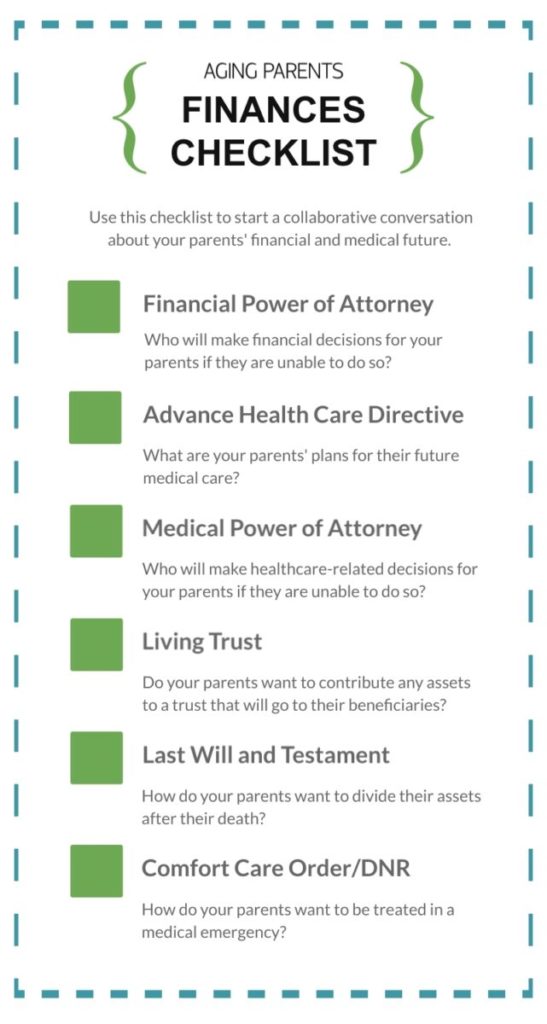
Checklist of tips to start a collaborative conversation about agin parents' financial and medical future

“Let’s talk about future plans, like long-term care.” Finding out if your parents have long-term care insurance is vital. Those turning 65 today have almost a 70% chance of needing some type of long-term care. Ask them what they expect as they get older: Do they expect a child to be the primary caregiver? Do they want to stay in their home? Do they want to move to an independent living facility that has different levels of care as they progress in age?

What happens if my parents get scammed?

The elderly lose billions of dollars a year to scammers. The question is not whether your parents will be contacted by a scammer, but whether they will be able to recognize the threat when they are contacted. Here are some tips to help you protect them:

Stay connected regularly. Talk to them about the risks of sharing their personal information online, over the phone or by mail. If they think that they have been scammed, have them contact you immediately. They may be embarrassed that this happened to them, but the longer they remain silent, the worse the situation could become.

Set up alerts. They should receive alerts if their account have been hacked or if the bank detects suspicious activity.

Save copies of their correspondence. This will be helpful to share with the authorities, the bank, or credit card companies if they have been scammed.

Encourage an open dialogue. Remember that some people will be ashamed or embarrassed to tell family members that they have been scammed. Remind your parents you are there to help. Show compassion during this stressful time.

Teach digital hygiene. Help them learn to spot suspicious emails, texts and websites. They should look over messages and websites to make sure they are legitimate. They should never share their personal information online or over the phone unless they are certain who they are dealing with. Teach them how to look at an email sender’s address. Discuss that texts they may receive about their password from “Amazon” or “Netflix” are more than likely scams and it is OK to delete them without responding.

It’s important to have a plan in place to address your loved ones’ finances, health and wellness, housing and care and end-of-life plans and wishes. We encourage you to take the first step, if you haven’t already, and open a dialogue with your parents and loved ones. Remember, this is about progress, not perfection. Get the ball rolling, start a conversation, and then keep moving forward.

The CD Wealth Formula

We help our clients reach and maintain financial stability by following a specific plan, catered to each client. 

Our focus remains on long-term investing with a strategic allocation while maintaining a tactical approach. Our decisions to make changes are calculated and well thought out, looking at where we see the economy is heading. We are not guessing or market timing. We are anticipating and moving to those areas of strength in the economy — and in the stock market. 

We will continue to focus on the fact that what really matters right now is time in the market, not out of the market. That means staying the course and continuing to invest, even when the markets dip, to take advantage of potential market upturns. We continue to adhere to the tried-and-true disciplines of diversification, periodic rebalancing and looking forward, while not making investment decisions based on where we have been.

It is important to focus on the long-term goal, not on one specific data point or indicator. Long-term fundamentals are what matter. In markets and moments like these, it is essential to stick to the financial plan. Investing is about following a disciplined process over time.

Sources: AARP, CNBC, Fidelity, Kiplinger

Promo for article titled Here's What You Should Know About Asset Allocations and Volatility

This material contains an assessment of the market and economic environment at a specific point in time and is not intended to be a forecast of future events, or a guarantee of future results. Forward-looking statements are subject to certain risks and uncertainties. Actual results, performance, or achievements may differ materially from those expressed or implied. Information is based on data gathered from what we believe are reliable sources.

Using diversification as part of your investment strategy neither assures nor guarantees better performance and cannot protect against loss of principal due to changing market conditions.

Past performance is not a guarantee of future results.

The opinions expressed in this commentary are those of the author and may not necessarily reflect those held by Kestra Investment Services, LLC or Kestra Advisory Services, LLC. This is for general information only and is not intended to provide specific investment advice or recommendations for any individual. It is suggested that you consult your financial professional, attorney, or tax advisor with regard to your individual situation.

Securities offered through Kestra Investment Services, LLC (Kestra IS), member FINRA/SIPC. Investment Advisory Services offered through Kestra Advisory Services, LLC (Kestra AS) an affiliate of Kestra IS. CD Wealth Management and Bluespring Wealth Partners LLC* are affiliates of Kestra IS and Kestra AS.  Investor Disclosures: https://bit.ly/KF-Disclosures

*Bluespring Wealth Partners, LLC acquires and supports high quality investment adviser and wealth management companies throughout the United States.

The Year-End RMD Deadline Is Almost Here. Are You Ready?

If you are 72 or older, you should have recently received a letter that outlines the required minimum distribution (RMD) you must take from your retirement accounts. This is happening because when you reach age 72, IRS rules require you to make annual withdrawals from the following types of tax-deferred retirement accounts: 401(k), 403(b), 457(b), Traditional IRAs, SEP IRAs and SIMPLE IRAs.

Why do RMDs exist?

If you have been saving part of your income in any of the tax-advantaged retirement accounts listed above, you have not paid income tax on those dollars. The government lets you delay paying taxes, but RMDs are how the government ensures it will eventually get its tax dollars on that income. For investors, the benefit of tax deferral is that while we know we’ll pay income tax eventually, we can pay less in retirement than we would during our working years.

Still, it is not unusual for people to find themselves in the same tax bracket — or even a higher one — in retirement. Income from investments outside of retirement accounts, combined with Social Security and RMDs, can add up quickly. At the end of the day though, the difference in tax brackets may not be as big as once projected when comparing retirement and non-retirement income.

When do I need to start taking withdrawals?

You must start taking RMDs when you turn 72 — or continue to take RMDs if you reached age 70 ½ before Jan. 1, 2020. Your first required withdrawal doesn’t have to be made until April 1 of the year after you turn 72. After your first withdrawal, the IRS requires you take RMDs by Dec. 31 each year.

The first time you take an RMD, if you were to wait until April 1 of the following year, then you would have to take a second distribution that same year. Doing so could affect Social Security and Medicare benefits and could lead to a higher-than-anticipated tax bracket.

There is one exception: People still working after age 72 usually may delay taking RMDs from their employer-sponsored plan until they retire. (If you are in that situation, please double-check with the IRS and your company.) However, if you own 5% or more of the business sponsoring the retirement plan, RMDs must begin once you turn 72, regardless of your retirement status.

How much am I required to withdraw?

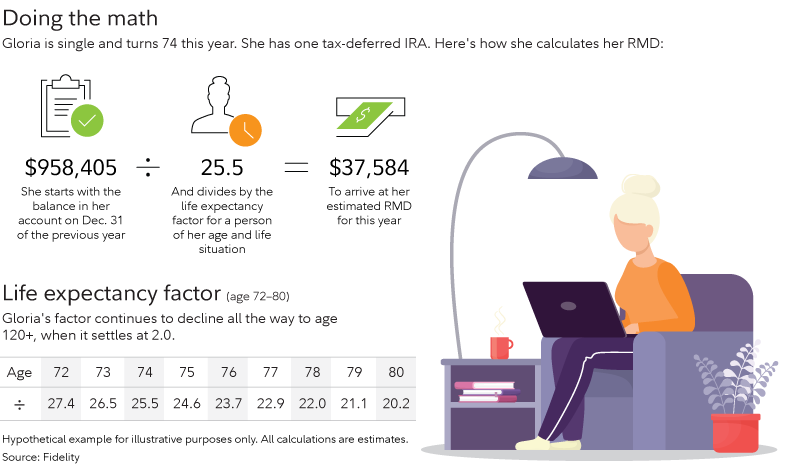
Your required minimum distribution is based on your account value on Dec. 31 of the previous year. The IRS calculates RMDs by taking the sum of your tax-deferred retirement accounts and dividing it by a number based on life expectancy. The chart below illustrates how your RMD is calculated. As you age, the denominator gets smaller each year, so as you grow older, you are required to take out more money the following year. The cost of miscalculating or failing to withdraw the full amount is steep: The IRS charges a 50% penalty on any withdrawals not taken!

Chart detailing how an RMD is calculated

How can I minimize the tax impact of RMDs?

If you are 70 ½ or older, you can contribute up to $100,000 per year in a qualified charitable donation (QCD). For married couples, each spouse can make a QCD up to $100,000 — for a potential total of $200,000. QCDs can be made only to certain charitable organizations, and they cannot be made to donor advised funds. If you make a donation that exceeds the RMD, the extra distribution can’t be carried over to meet the distribution the following year.

The RMD is the smallest amount you must withdraw from your retirement account after you reach a certain age. If you have multiple retirement accounts, you may withdraw money from each account or from one account, as long as you ensure that the required minimum amount is withdrawn. Each dollar withdrawn is taxed as ordinary income.

Depending on your tax bracket, it may make sense to take money out of your retirement accounts before age 72. Once you reach age 59 ½, you can take money out of your retirement accounts without a 10% penalty, but you will still owe taxes on the money taken out. It is very important to spend time with your financial team so you understand your options to maximize your income and avoid a costly tax mistake.

The CD Wealth Formula

We help our clients reach and maintain financial stability by following a specific plan, catered to each client. 

Our focus remains on long-term investing with a strategic allocation while maintaining a tactical approach. Our decisions to make changes are calculated and well thought out, looking at where we see the economy is heading. We are not guessing or market timing. We are anticipating and moving to those areas of strength in the economy — and in the stock market. 

We will continue to focus on the fact that what really matters right now is time in the market, not out of the market. That means staying the course and continuing to invest, even when the markets dip, to take advantage of potential market upturns. We continue to adhere to the tried-and-true disciplines of diversification, periodic rebalancing and looking forward, while not making investment decisions based on where we have been.

It is important to focus on the long-term goal, not on one specific data point or indicator. Long-term fundamentals are what matter. In markets and moments like these, it is essential to stick to the financial plan. Investing is about following a disciplined process over time.

Sources: Fidelity, Schwab, Securian

Promo for article titled Social Security's Biggest Benefit Jump in 40 Years Is Coming Next Year

This material contains an assessment of the market and economic environment at a specific point in time and is not intended to be a forecast of future events, or a guarantee of future results. Forward-looking statements are subject to certain risks and uncertainties. Actual results, performance, or achievements may differ materially from those expressed or implied. Information is based on data gathered from what we believe are reliable sources.

Using diversification as part of your investment strategy neither assures nor guarantees better performance and cannot protect against loss of principal due to changing market conditions.

Past performance is not a guarantee of future results.

The opinions expressed in this commentary are those of the author and may not necessarily reflect those held by Kestra Investment Services, LLC or Kestra Advisory Services, LLC. This is for general information only and is not intended to provide specific investment advice or recommendations for any individual. It is suggested that you consult your financial professional, attorney, or tax advisor with regard to your individual situation.

Securities offered through Kestra Investment Services, LLC (Kestra IS), member FINRA/SIPC. Investment Advisory Services offered through Kestra Advisory Services, LLC (Kestra AS) an affiliate of Kestra IS. CD Wealth Management and Bluespring Wealth Partners LLC* are affiliates of Kestra IS and Kestra AS.  Investor Disclosures: https://bit.ly/KF-Disclosures

*Bluespring Wealth Partners, LLC acquires and supports high quality investment adviser and wealth management companies throughout the United States.

Social Security’s Biggest Benefit Jump in 40 Years Is Coming Next Year

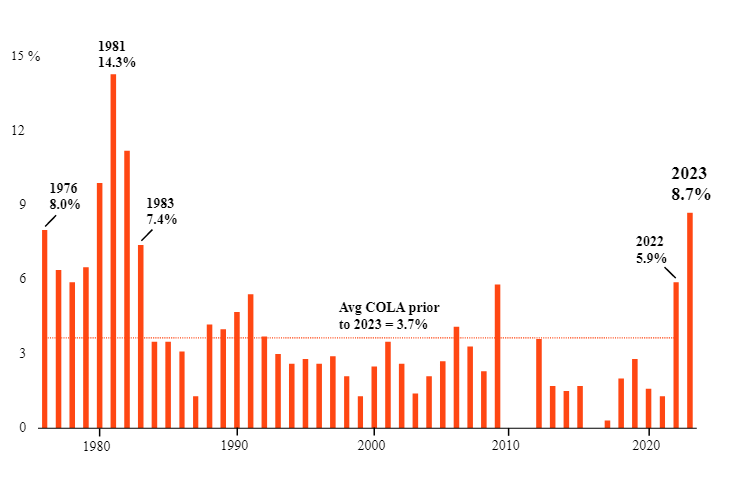
As we approach the end of the year, the IRS and Social Security Administration have released their 2023 adjustments. High inflation has led to a high cost of living adjustment (COLA) that will hit Social Security benefits next year: The 8.7% increase is the largest ever granted to today’s retirees, and it comes on the heels of a sizable 5.9% increase in 2022. The last time COLA exceeded 6% was more than 40 years ago, during double-digit inflation. As shown in the chart below, the average COLA before 2023 was 3.7%, and over the last decade, the average increase was only 1.9%.

2023 COLA is the highest ever for today’s retirees

Social Security cost of living adjustments, 1976-2023

Chart showing each Social Security adjustment since 1976
Source:  Social Security Administration 2023

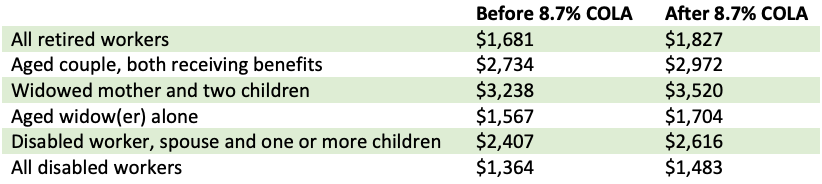
On average, Social Security benefits will go up more than $140 per month – from $1,681 to $1,827 — and the average disability benefit will increase by $119 per month. To find out exactly how much you will receive next year from Social Security, you can calculate the change by multiplying your net Social Security benefit by 8.7%. The chart below provides average Social Security benefits for different recipients and may help provide further clarity.

Estimated average monthly Social Security benefits in 2023

The table shows the average monthly Social Security benefits for different qualifying recipients both before and after the 8.7% cost of living adjustment.

Chart showing average Social Security benefits before and after the 2023 adjustment
Table: Gabriel Cortes/CNBC; Source: Social Security Administration

The threshold for the taxation of Social Security benefits is not indexed to inflation and remains constant. As the benefit and other retirement income adjusts upward over time, more people will cross the threshold and pay more in taxes for their benefits. An individual’s Social Security income is taxed based on a combined income formula that includes wage income, interest, dividends, pension payments and taxable distributions from 401Ks and IRAs. If your combined income is above $34,000 for a single person and $44,000 for a couple, up to 85% of your benefit could be taxed.

The COLA should not influence the timing of when you file for Social Security. COLA takes effect automatically for all clients 62 or older, regardless of whether they are currently collecting or have filed for benefits before Dec. 31. Before age 62, an individual’s future benefit is adjusted for inflation through a different methodology. 

The decision to start collecting benefits should be driven only by your circumstances, such as age, life expectancy, marital status and cash flow needs.

There are tradeoffs to consider for filing earlier or later than full retirement age; filing early permanently reduces the amount of monthly benefit, for example.

The IRS announced on Friday that due to higher inflation, it is raising contribution limits for retirement savings plans for 2023 based on cost-of-living adjustments. According to Mercer, the limit increases are the largest ever.

Individual contributions to 401Ks or similar retirement plans will see a $2,000 jump to $22,500, for those under the age of 50. Those who are 50 or older will be permitted to contribute an additional $7,500 per year, for a total of $30,000. At the same time, the IRS raised the limit for contributions to a pre-tax or Roth IRA to $6,500, up from $6,000, where it has been the last four years. Those 50 and older can still make an additional $1,000 catch-up contribution, which is not adjusted for inflation.

Income limits for a Roth IRA will increase as well. The income range for married couples filing jointly increases to $218,000 to $228,000 (from $204,000 to $214,000). For those filing as single, the income phase-out range for Roth IRAs increases to $138,000 to $153,000. SEP IRA contribution limits will go up to $66,000 from $61,000. 

This year’s COLA can help you keep up with higher costs. In the short run, managing withdrawals from the portfolio may help smooth out the tax bumps during a period of high inflation. In the long term, however, tax planning should be a multi-year approach and strategic in nature.

Whether you are planning for the next year or next decade, managing taxes throughout retirement needs to be well thought out, working with your financial advisor and tax professional to understand the tax impact of any planning decisions.

The CD Wealth Formula

We help our clients reach and maintain financial stability by following a specific plan, catered to each client. 

Our focus remains on long-term investing with a strategic allocation while maintaining a tactical approach. Our decisions to make changes are calculated and well thought out, looking at where we see the economy is heading. We are not guessing or market timing. We are anticipating and moving to those areas of strength in the economy — and in the stock market. 

We will continue to focus on the fact that what really matters right now is time in the market, not out of the market. That means staying the course and continuing to invest, even when the markets dip, to take advantage of potential market upturns. We continue to adhere to the tried-and-true disciplines of diversification, periodic rebalancing and looking forward, while not making investment decisions based on where we have been.

It is important to focus on the long-term goal, not on one specific data point or indicator. Long-term fundamentals are what matter.  In markets and moments like these, it is essential to stick to the financial plan. Investing is about following a disciplined process over time.

Sources:  Blackrock, CNBC, Fidelity, Social Security Administration

Promo for an article titled Here’s What You Should Know About Asset Allocations and Volatility

This material contains an assessment of the market and economic environment at a specific point in time and is not intended to be a forecast of future events, or a guarantee of future results. Forward-looking statements are subject to certain risks and uncertainties. Actual results, performance, or achievements may differ materially from those expressed or implied. Information is based on data gathered from what we believe are reliable sources.

Using diversification as part of your investment strategy neither assures nor guarantees better performance and cannot protect against loss of principal due to changing market conditions.

Past performance is not a guarantee of future results.

The opinions expressed in this commentary are those of the author and may not necessarily reflect those held by Kestra Investment Services, LLC or Kestra Advisory Services, LLC. This is for general information only and is not intended to provide specific investment advice or recommendations for any individual. It is suggested that you consult your financial professional, attorney, or tax advisor with regard to your individual situation.

Securities offered through Kestra Investment Services, LLC (Kestra IS), member FINRA/SIPC. Investment Advisory Services offered through Kestra Advisory Services, LLC (Kestra AS) an affiliate of Kestra IS. CD Wealth Management and Bluespring Wealth Partners LLC* are affiliates of Kestra IS and Kestra AS. Investor Disclosures: https://bit.ly/KF-Disclosures

*Bluespring Wealth Partners, LLC acquires and supports high quality investment adviser and wealth management companies throughout the United States.

Worried About Retirement in a Down Market? Consider These Strategies

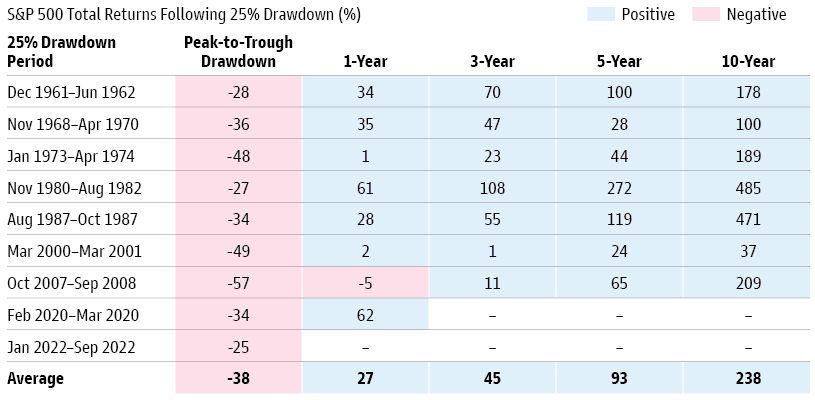
The S&P 500 reached a new low last week, closing 25% down from its January peak. Markets may fall even more from here: Since 1961, the average peak-to-trough decline during drawdowns of 25% or more has been 38%. However, historical drawdowns of 25% or more have delivered a forward one-year return of 27% on average, with longer investment time frames proving even more compelling. 

Timing the bottom of this market is difficult, if not impossible, for those considering going to the sideline and waiting to get back in after the market falls further. History suggests that those who stay the course have been rewarded.  

Chart showing S&P 500 market performance during and after drawdowns of 25% or more since 1961
Source: Bloomberg and Goldman Sachs Asset Management. As of October 6, 2022

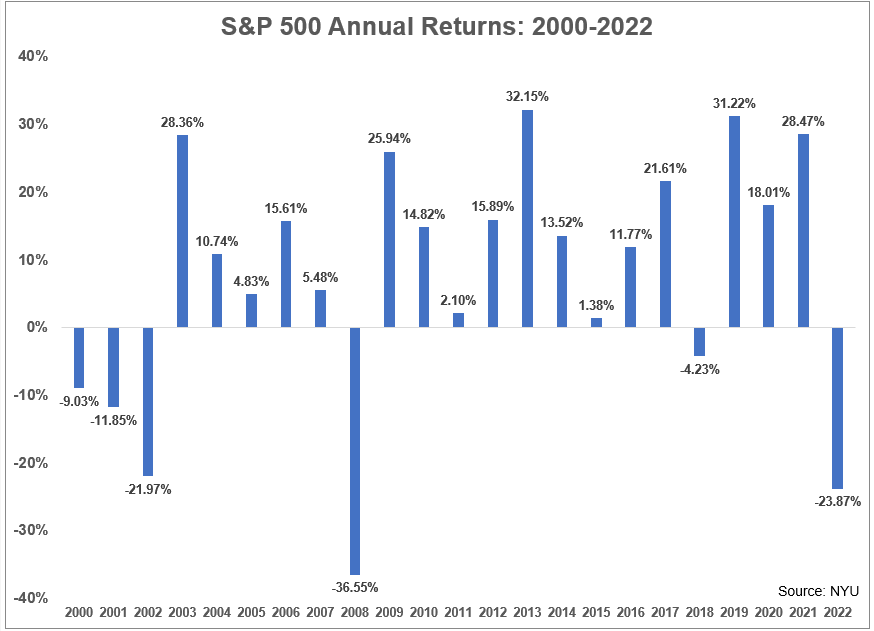
We read a lot about market returns averaging 8% to 10% per year, but as the chart shows below, such returns are not common at all. The 8% to 10% average comes from many years of outsized returns, followed by weak or negative returns and a few years of average returns. If you are not invested in the market or decide to move to the sidelines, it becomes much harder to obtain average returns. We cannot control the sequence of returns – i.e., what the market does on a yearly basis. It’s no secret that investing is not predictable; the market can be up 10% one year and down 10% the next year.

Chart showing S&P 500 Annual Returns from 2000 to 2002

When you are in the accumulation phase, the sequencing of returns does not have a significant impact on your ending balance. However, when you are entering retirement or taking annual distributions from the portfolio, the sequence of returns can make a big difference. A down market early in retirement — on top of taking distributions from the portfolio — can eat into your wealth through no fault of your own, other than bad timing. 

While we can’t control bear markets, we can control how we respond to them. The key to overcoming sequence-of-return risk is to draw down as little as possible during that down period. Here are some strategies for the newly or nearly retired to consider:

Revisit your need for distributions:

Take another look at how you are planning to fund your expenses and consider alternate strategies to minimize how much you take out. For example:

Healthcare expenses: If you funded an HSA account, make sure you use those funds for qualified health expenses before withdrawing from the portfolio.

Charitable giving: Consider making a large gift to a donor-advised fund during an up year in the market. That fund will become your charitable checkbook so that you do not have to tap into the portfolio during down years in the market.

Flexible withdrawals: Consider taking out more during up markets and pulling back when the market is struggling. This could help you ride out the down market by withdrawing as little as possible.

Build up cash accounts

One way to limit how much you need from retirement accounts is to build up liquidity in your cash accounts. By maintaining short-term cash and cash equivalents — such as CDs, fixed income, and money market accounts — you can keep from having to draw down your retirement funds prematurely. For the first time in many years, money market rates and short term bond rates offer attractive yields, and you can get paid to be in cash with those monies.

Be wary of debt

It makes sense to enter retirement with as little debt as possible. Excessive debt in retirement can affect not only your financial health, but also your physical and mental health as well, due to the strain of paying off debt without income from work.

Know your retirement account options

Once you reach a certain age (72) or older and have a traditional IRA or 401K, the IRS requires you to take an annual required minimum distribution (RMD). Roth IRAs do not have RMDs, allowing you to withdraw funds without penalty or tax. It may make sense before retirement to convert some or all of a traditional IRA to a Roth IRA. This does require that you pay tax on the conversion amount at the time of the conversion. During a down market, doing a Roth conversion can reduce the taxes that you will pay since the value of the IRA is down, and it allows a future market recovery to happen in a tax-free account. 

We fully recognize that bear markets are painful and challenging for all investors. Planning for retirement is a long road trip. On most long road trips, you are bound to run into some trouble — unexpected pit stops, flat tires or even a cracked windshield. But these bumps don’t last for the whole trip, and they do not ruin the overall journey. It is more important than ever to keep perspective and realize that these down markets don’t last forever, and good times have historically lasted much longer than the bad.

The CD Wealth Formula

We help our clients reach and maintain financial stability by following a specific plan, catered to each client. 

Our focus remains on long-term investing with a strategic allocation while maintaining a tactical approach. Our decisions to make changes are calculated and well thought out, looking at where we see the economy is heading. We are not guessing or market timing. We are anticipating and moving to those areas of strength in the economy — and in the stock market. 

We will continue to focus on the fact that what really matters right now is time in the market, not out of the market. That means staying the course and continuing to invest, even when the markets dip, to take advantage of potential market upturns. We continue to adhere to the tried-and-true disciplines of diversification, periodic rebalancing and looking forward, while not making investment decisions based on where we have been.

It is important to focus on the long-term goal, not on one specific data point or indicator. Long-term fundamentals are what matter. In markets and moments like these, it is essential to stick to the financial plan. Investing is about following a disciplined process over time.

Sources: Goldman Sachs, Kestra Asset Management, Robert Baird, NYU

Promo for article titled Fourth-Quarter Outlook: Midterms, More Volatility and the Fed

This material contains an assessment of the market and economic environment at a specific point in time and is not intended to be a forecast of future events, or a guarantee of future results. Forward-looking statements are subject to certain risks and uncertainties. Actual results, performance, or achievements may differ materially from those expressed or implied. Information is based on data gathered from what we believe are reliable sources.

Using diversification as part of your investment strategy neither assures nor guarantees better performance and cannot protect against loss of principal due to changing market conditions.

Past performance is not a guarantee of future results.

The opinions expressed in this commentary are those of the author and may not necessarily reflect those held by Kestra Investment Services, LLC or Kestra Advisory Services, LLC. This is for general information only and is not intended to provide specific investment advice or recommendations for any individual. It is suggested that you consult your financial professional, attorney, or tax advisor with regard to your individual situation.

Securities offered through Kestra Investment Services, LLC (Kestra IS), member FINRA/SIPC. Investment Advisory Services offered through Kestra Advisory Services, LLC (Kestra AS) an affiliate of Kestra IS. CD Wealth Management and Bluespring Wealth Partners LLC* are affiliates of Kestra IS and Kestra AS.  Investor Disclosures: https://bit.ly/KF-Disclosures

*Bluespring Wealth Partners, LLC acquires and supports high quality investment adviser and wealth management companies throughout the United States.
Tips for Planning Charitable Donations, on North Texas Giving Day and Beyond

Today is NTX Giving Day in North Texas. It’s an annual tradition through which the Communities Foundation of Texas connects donors with charities in need and fulfills its mission to put giving to work throughout our local communities.

What a great time to think about making charitable donations for both philanthropic and tax purposes! No matter your interests, making gifts to causes you care about can be one of the most meaningful uses of your money. In the end, what really matters is helping an organization that matters to you. The tax benefits from a donation are just icing on the cake.

Along with the intangible rewards that come from helping others, charitable giving may offer a financial benefit for you and your family.

Most donations to charitable organizations come in the form of checks and credit card payments. However, there may be more efficient ways to donate, which in turn help both the charity as well as your pocketbook. Understanding the benefits for different type of donations is important. Here are some options to consider:

• Cash, check or credit card: This is the most simple and straightforward way of donating to charity. It is important to keep a bank record or a receipt from the charity to substantiate a cash gift. Annual income tax deduction limits for gifts to public charities are 30% of adjusted gross income (AGI) for contributions of non-cash assets, if held for more than one year, and 60% of AGI for contributions of cash. If contributions are made in excess of those limits, the excess may be carried over for up to five years. If you do not have appreciated assets to give or want to give cash, it may be beneficial to combine or “bunch” two years’ worth of charitable contributions into one year so you can take advantage of itemizing deductions.  

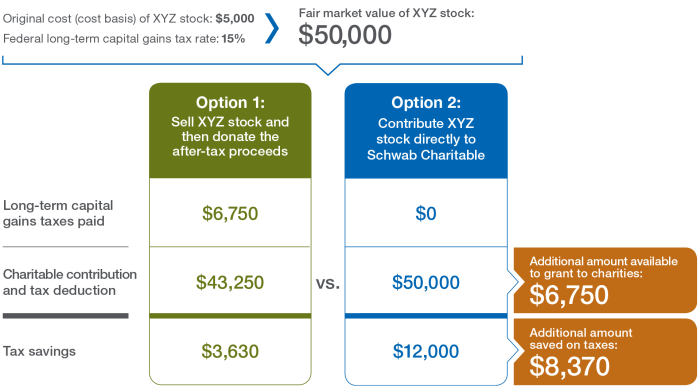
• Appreciated stock: If you donate stock that you have held for at least 12 months, you can deduct the full value of the investment without having to pay capital gains on the appreciation. The current fair market value of the stock is deducted from your taxable income. Often, clients may donate the stock with the biggest winnings, which maximizes savings on capital gains, and then buy back the same stock with cash, which in turn, raises the cost basis. As the chart below shows, if you were to sell appreciated stock and then donate cash to charity (compared to gifting appreciated stock), not only would you save on taxes (the charity does not pay capital gains tax), but the charity would also receive additional monies!  

Chart showing strategy for charitable donations involving appreciated stock
This hypothetical example is only for illustrative purposes. The example does not take into account any state or local taxes or the Medicare net investment income surtax. The tax savings shown is the tax deduction, multiplied by the donor’s income tax rate (24% in this example), minus the long-term capital gains taxes paid. Reprinted from Schwabcharitable.org.

• IRA Qualified Charitable Distributions (QCD): This is an option only for donors over the age of 70 1/2. QCDs allow individuals to donate up to $100,000 annually directly from their IRA to charitable organizations. This reduces the value of the IRA, and the QCD does not count towards the donor’s taxable income. It also counts toward the annual required minimum distribution. 

• Donor Advised Fund (DAF): Picture a donor advised fund as your family foundation, without the headache and administrative hassle of setting up a family foundation. A DAF is a charitable account established at a public charity or community foundation that allows donors to recommend grants over time. The donor decides the timing of the donation, the charity that will receive the donation and the amount of the charitable donation made from the DAF. The donor claims the tax deduction upon funding of the DAF. There is not a requirement that the DAF distribute 5% of the fund each year, which may allow the DAF to grow, expanding the available dollars to donate to charities.

At CD Wealth Management, charitable giving is a significant part of our company’s culture. We believe in giving back with our time as well as our pocketbook. We support many causes in the Dallas-Fort Worth area, and we encourage team members to be involved in the community. Each year, during the holiday season, the company makes a charitable donation in each one of our team members’ names to their charity of choice, offering an additional thanks and helping a great cause at the same time.

Please do not hesitate to reach out to us to discuss your charitable options to help you determine the best way to give for your situation. If you are interested in taking part in NTX Giving Day, click here. (Please note that all funding options described above may not be available for NTX Giving Day.)

The CD Wealth Formula

We help our clients reach and maintain financial stability by following a specific plan, catered to each client. 

Our focus remains on long-term investing with a strategic allocation while maintaining a tactical approach. Our decisions to make changes are calculated and well thought out, looking at where we see the economy is heading. We are not guessing or market timing. We are anticipating and moving to those areas of strength in the economy — and in the stock market. 

We will continue to focus on the fact that what really matters right now is time in the market, not out of the market. That means staying the course and continuing to invest, even when the markets dip, to take advantage of potential market upturns. We continue to adhere to the tried-and-true disciplines of diversification, periodic rebalancing and looking forward, while not making investment decisions based on where we have been.

It is important to focus on the long-term goal, not on one specific data point or indicator. Long-term fundamentals are what matter. In markets and moments like these, it is essential to stick to the financial plan. Investing is about following a disciplined process over time.

Sources: Baird, BMO, Schwab

Promo for article titled Is a Roth IRA the Right Choice for You? Here’s What You Should Consider

This material contains an assessment of the market and economic environment at a specific point in time and is not intended to be a forecast of future events, or a guarantee of future results. Forward-looking statements are subject to certain risks and uncertainties. Actual results, performance, or achievements may differ materially from those expressed or implied. Information is based on data gathered from what we believe are reliable sources.

Using diversification as part of your investment strategy neither assures nor guarantees better performance and cannot protect against loss of principal due to changing market conditions.

Past performance is not a guarantee of future results.

The opinions expressed in this commentary are those of the author and may not necessarily reflect those held by Kestra Investment Services, LLC or Kestra Advisory Services, LLC. This is for general information only and is not intended to provide specific investment advice or recommendations for any individual. It is suggested that you consult your financial professional, attorney, or tax advisor with regard to your individual situation.

Securities offered through Kestra Investment Services, LLC (Kestra IS), member FINRA/SIPC. Investment Advisory Services offered through Kestra Advisory Services, LLC (Kestra AS) an affiliate of Kestra IS. CD Wealth Management and Bluespring Wealth Partners LLC* are affiliates of Kestra IS and Kestra AS.  Investor Disclosures: https://bit.ly/KF-Disclosures

*Bluespring Wealth Partners, LLC acquires and supports high quality investment adviser and wealth management companies throughout the United States.
Is a Roth IRA the Right Choice for You? Here’s What You Should Consider

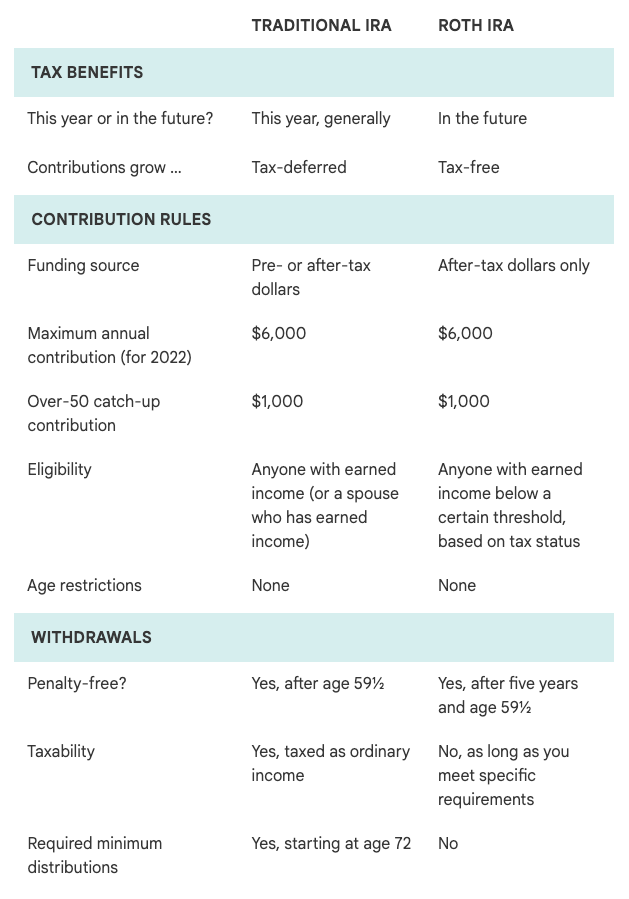
In the financial planning process, clients often ask us if it makes sense to open a Roth IRA or convert a traditional IRA to a Roth IRA. As a refresher: With a Roth IRA, you contribute after-tax dollars, your money grows tax-free, and you can generally make tax- and penalty-free withdrawals after age 59½. With a traditional IRA, you contribute pre- or after-tax dollars, your money grows tax-deferred, and withdrawals are taxed as current income after age 59½. Roth IRAs are best suited for individuals in a lower tax bracket who expect to be in a higher tax bracket when they start taking withdrawals later in life. A traditional IRA may be best suited for those who expect to be in the same or lower tax bracket when they start taking withdrawals in retirement.

There are three main distinctions between a traditional IRA and a Roth IRA: eligibility, tax treatment and withdrawal requirements. The chart below provides a good summary on the differences. 

• Eligibility – With both types of IRAs, the owner must have earned income to be eligible to contribute. For a Roth IRA, you must remain under a total income threshold to be eligible to contribute (income limits can be found here). There are no such limits with a traditional IRA; anyone at any income level can contribute.

• Tax treatments – Contributions to a Roth IRA won’t provide any immediate tax benefit because they are not deductible. Contributions to a traditional IRA may be deductible if you are not a participant in an employee-sponsored plan. Withdrawals from a Roth IRA can be tax-free if requirements are met. Withdrawals from a traditional IRA are typically fully taxable as ordinary income.

• Withdrawal requirements – Both traditional and Roth IRAs allow for withdrawals of any amount once you reach age 59½. Once the owner reaches age 72, traditional IRAs are subject to the required minimum distribution (RMD) rules, forcing money out of the IRA and triggering ordinary income. There are no RMD rules related to Roth IRAs; owners can leave the money in the Roth IRA to grow tax-free as long as they want. A Roth IRA’s beneficiaries generally will need to take RMDs to avoid penalties, although there is an exception for spouses.

Chart showing the differences between traditional and Roth IRAs

For those who are not eligible to contribute to a Roth IRA, there still is a way to take advantage of the tax-free growth. The Roth conversion, also known as a “back door Roth IRA,” allows a taxpayer to withdraw funds from a traditional IRA in a taxable distribution and then roll those monies into a Roth IRA. There are no income thresholds for a Roth conversion. If your tax bracket in retirement may be higher than your current tax rate, it may make sense to convert to a Roth IRA from a traditional IRA. This could happen if you accumulate significant savings in your retirement accounts or achieve top earnings later in your career. Here are five potential reasons to convert to a Roth IRA: 

1. Portfolio losses: By converting a traditional IRA to a Roth IRA, the tax will be assessed on the value on the date of the conversion. If you convert to a Roth IRA while the value is lower, the amount of tax owed will be less, and the rebound in value can grow tax free.

2. Anticipating higher tax brackets: If you expect your tax bracket to be higher in retirement, then you may prefer to pay tax on savings now, while you are in a lower tax bracket, and then access those funds tax-free in retirement.

3. Longer growth horizon: Roth IRAs have no RMD obligations, whereas traditional IRAs have RMD after the age of 72. Money in a Roth IRA can stay invested in the stock market longer, giving additional opportunities for growth.

4. Helping your heirs: If your traditional IRA is passed on to your heirs, they will also owe taxes on their withdrawals — and they must be completely withdrawn after 10 years. The Roth IRA withdrawals will be tax free, so you are effectively gifting tax savings to your heirs.

5. Paying for Medicare: If you are enrolled in Medicare Part B or D and your modified adjusted gross income (MAGI) is above a certain threshold, you pay a surcharge on top of your Medicare premium. Withdrawals from a traditional IRA are included in MAGI, while withdrawals from a Roth IRA are not. 

Keep in mind the two biggest drawbacks to a Roth IRA conversion are that you must pay income taxes on any pre-tax funds you convert in the year you make it, and you cannot change your mind once you convert. It generally makes sense to use taxable assets rather than proceeds from the converted IRA to pay the tax cost of the Roth IRA conversion. This is because — all things being equal — the rate of return is generally higher for a Roth IRA because no taxes are due for any gains inside the Roth IRA. 

Please remember that CD Wealth Management does not offer tax advice, but we work closely with your CPA and attorneys to ensure the right strategy is in place for you and your situation. 

The CD Wealth Formula

We help our clients reach and maintain financial stability by following a specific plan, catered to each client. 

Our focus remains on long-term investing with a strategic allocation while maintaining a tactical approach. Our decisions to make changes are calculated and well thought out, looking at where we see the economy is heading. We are not guessing or market timing. We are anticipating and moving to those areas of strength in the economy — and in the stock market. 

We will continue to focus on the fact that what really matters right now is time in the market, not out of the market. That means staying the course and continuing to invest, even when the markets dip, to take advantage of potential market upturns. We continue to adhere to the tried-and-true disciplines of diversification, periodic rebalancing and looking forward, while not making investment decisions based on where we have been.

It is important to focus on the long-term goal, not on one specific data point or indicator. Long-term fundamentals are what matter. In markets and moments like these, it is essential to stick to the financial plan. Investing is about following a disciplined process over time.

Sources: Fidelity, Schwab

Promo for an article titled The Importance of Compound Interest and Tax Planning on Your Portfolio

This material contains an assessment of the market and economic environment at a specific point in time and is not intended to be a forecast of future events, or a guarantee of future results. Forward-looking statements are subject to certain risks and uncertainties. Actual results, performance, or achievements may differ materially from those expressed or implied. Information is based on data gathered from what we believe are reliable sources.

Using diversification as part of your investment strategy neither assures nor guarantees better performance and cannot protect against loss of principal due to changing market conditions.

Past performance is not a guarantee of future results.

The opinions expressed in this commentary are those of the author and may not necessarily reflect those held by Kestra Investment Services, LLC or Kestra Advisory Services, LLC. This is for general information only and is not intended to provide specific investment advice or recommendations for any individual. It is suggested that you consult your financial professional, attorney, or tax advisor with regard to your individual situation.

Securities offered through Kestra Investment Services, LLC (Kestra IS), member FINRA/SIPC. Investment Advisory Services offered through Kestra Advisory Services, LLC (Kestra AS) an affiliate of Kestra IS. CD Wealth Management and Bluespring Wealth Partners LLC* are affiliates of Kestra IS and Kestra AS.  Investor Disclosures: https://bit.ly/KF-Disclosures

*Bluespring Wealth Partners, LLC acquires and supports high quality investment adviser and wealth management companies throughout the United States.

Student Debt, Loan Forgiveness and the Crazy Cost of College

Those of us with kids or grandkids are well aware of the crazy cost of college today. Between 1980 and 2020, the average price of tuition, fees and room and board for an undergraduate degree increased 169%. In 1980, the price to attend a four-year college full time was roughly $10,000, adjusted for inflation. By 2020, the total price had increased to roughly $29,000!

Why have the costs of college gone up over time? There are many reasons: growing demand, pressure to go to college, rising financial aid, lower state funding, cost of administration and increasing student amenity packages to keep up. Aside from tuition payments, public colleges depend on funding from state and local governments. Typically, state and local funding make up about 44% of public four-year college revenues. However, economic downturns like we saw in 2008 and 2020 can lead to funding cuts. To make up for the lost dollars, universities must turn to other sources to raise monies, with the most direct source being higher tuition.

For most people, the cost of college may not be manageable – let alone the cost of graduate school or medical school.

More than half of bachelor’s degree recipients from public or private four-year colleges graduated with debt in 2020, with the average debt load being $28,400.

For college graduates with $50,000 or more of debt, the idea of one day owning a home and being debt-free feels like it’s a world away.

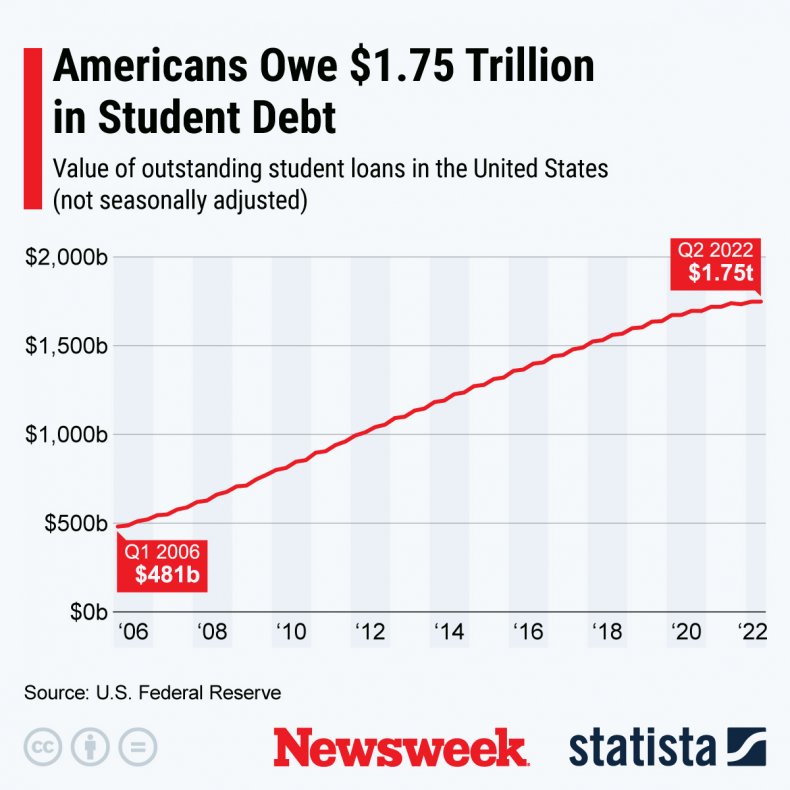
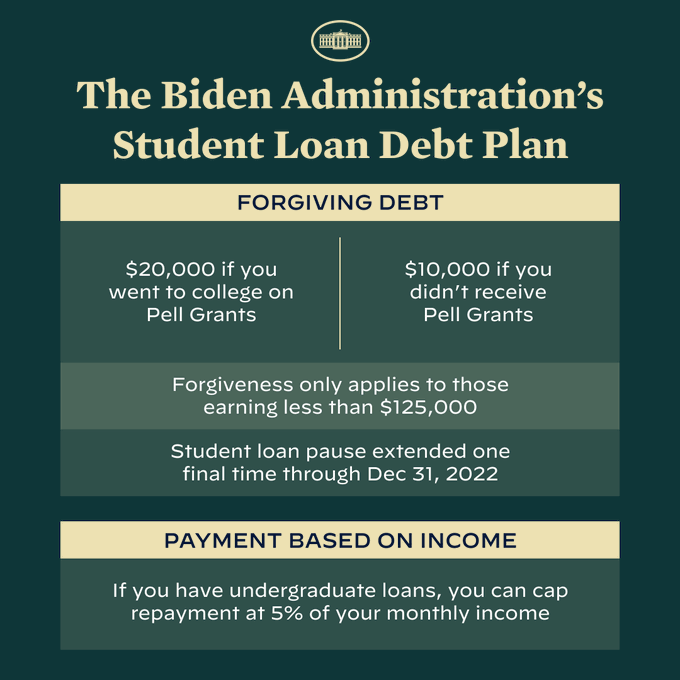
Even before President Biden was elected, one of his objectives was to provide student debt relief. Last week, he announced that the government will provide $20,000 in debt relief to Pell grant recipients and $10,000 for many other borrowers. Roughly 43 million Americans hold federal student loan debt, estimated at $1.75 trillion.

Chart showing the growth of student debt for college tuition from 2006 to 2022

Borrowers eligible for loan forgiveness must make less than $125,000 per year individually or $250,000 if married for the 2020 or 2021 tax year. Private loans will not be forgiven as part of the debt relief act. At the same time, the president also announced an extension of the pandemic pause on student loan payments through the end of the year, with payments resuming in January 2023. The Education Department said nearly 8 million borrowers are likely to have their loans forgiven automatically, and the remaining borrowers will have to apply for loan forgiveness. Current students also are eligible for loan cancellation, provided their loans were obtained before July 1, 2022.

There also is a new income-based repayment plan. For undergraduate loans, the relief act caps monthly payments at 5% of a borrower’s discretionary income; currently, borrowers must pay 10%. For borrowers with original loan balances of $12,000 or less, the balance will be forgiven after 10 years of payments; currently, they have to repay their loans for 20 years.

The plan will provide relief for borrowers at a time when the cost of education continues to surge. Critics question the fairness of the plan and warn about the potential impact on inflation should students with forgiven loans increase their spending. The debt forgiveness plan will not be like the $1,200 relief checks that the government sent out during the global pandemic, however they will be relieved of making loan payments over many years. Critics also believe that this relief bill penalizes those who scrimped and saved for college and worked jobs while in college to pay off their loans.

The elephant in the room remains the exorbitant cost of college, and many fear that government debt relief might encourage future students to take on even more debt, allowing colleges and universities to raise prices even further.

Chart showing the highlight's of Joe Biden's student loan debt plan for college costs, including tuition

Regardless of political beliefs, the affordability of higher education remains a larger issue. Between 2000 and 2021, the cost of college tuition increased at more than twice the pace of overall inflation, despite a slowdown in tuition hikes during the pandemic. As is most often the case with many bills passing Congress, only time will tell the full economic impact of the Student Relief Act. 

While the form for forgiveness is not available yet, federal student loan borrower updates can be received by subscribing via the Department of Education’s website here.   

The CD Wealth Formula

We help our clients reach and maintain financial stability by following a specific plan, catered to each client. 

Our focus remains on long-term investing with a strategic allocation while maintaining a tactical approach. Our decisions to make changes are calculated and well thought out, looking at where we see the economy is heading. We are not guessing or market timing. We are anticipating and moving to those areas of strength in the economy — and in the stock market. 

We will continue to focus on the fact that what really matters right now is time in the market, not out of the market. That means staying the course and continuing to invest, even when the markets dip, to take advantage of potential market upturns. We continue to adhere to the tried-and-true disciplines of diversification, periodic rebalancing and looking forward, while not making investment decisions based on where we have been.

It is important to focus on the long-term goal, not on one specific data point or indicator. Long-term fundamentals are what matter. In markets and moments like these, it is essential to stick to the financial plan. Investing is about following a disciplined process over time.

Sources: Forbes, CNBC, Newsweek, USA Today

Promo for an article titled Are Alternative Investments Too Good to Be True? Here's What You Should Know

This material contains an assessment of the market and economic environment at a specific point in time and is not intended to be a forecast of future events, or a guarantee of future results. Forward-looking statements are subject to certain risks and uncertainties. Actual results, performance, or achievements may differ materially from those expressed or implied. Information is based on data gathered from what we believe are reliable sources.

Using diversification as part of your investment strategy neither assures nor guarantees better performance and cannot protect against loss of principal due to changing market conditions.

Past performance is not a guarantee of future results.

The opinions expressed in this commentary are those of the author and may not necessarily reflect those held by Kestra Investment Services, LLC or Kestra Advisory Services, LLC. This is for general information only and is not intended to provide specific investment advice or recommendations for any individual. It is suggested that you consult your financial professional, attorney, or tax advisor with regard to your individual situation.

Securities offered through Kestra Investment Services, LLC (Kestra IS), member FINRA/SIPC. Investment Advisory Services offered through Kestra Advisory Services, LLC (Kestra AS) an affiliate of Kestra IS. CD Wealth Management and Bluespring Wealth Partners LLC* are affiliates of Kestra IS and Kestra AS.  Investor Disclosures: https://bit.ly/KF-Disclosures

*Bluespring Wealth Partners, LLC acquires and supports high quality investment adviser and wealth management companies throughout the United States.
Valuable Financial Advice for the Recent College Graduates in Your Life

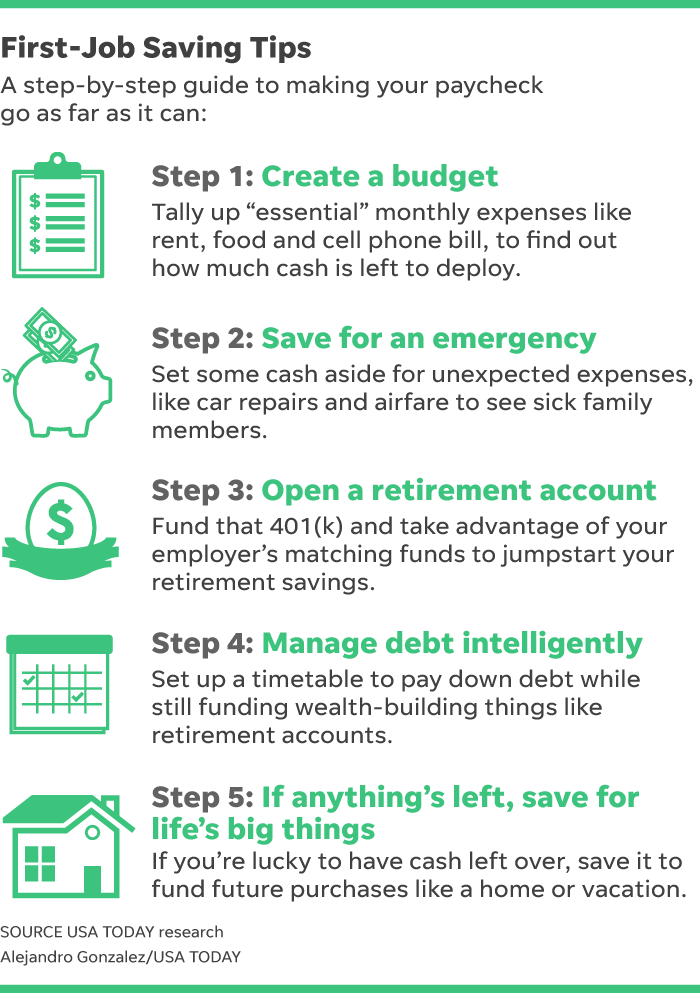
It’s hard to believe that summer is almost over and it’s time for the kids to go back to school. For many who just graduated from college, it’s time to begin their first real job! As our adult children move from college to the real world, it’s a good time to make sure they are ready to succeed and to be responsible for their own financial lives.

For those who are planning to rent an apartment rather than moving back home after graduation, start-up costs can accumulate quickly, going well beyond the price of rent alone. There will be a deposit needed for utilities, the cost of setting up and maintaining internet access, and expenses such as furniture, kitchen supplies and moving costs. Being able to cover these costs will require a budget — the most basic of all financial tools, and the most critical for people who are starting life on their own.

It’s exciting when our children get their first job offer. The starting salary may sound great — and it may even include a signing bonus! But if they’re not thinking about how much money in taxes comes off the top first, it can be quite surprising and a substantial hit to the budget.

Let’s use the example of someone with a starting salary of $50,000. A single filer making $50,000 in 2022 falls into the 22% marginal federal tax bracket. This doesn’t include Social Security or Medicare taxes. For simplicity’s sake, let’s assume they withhold 20% for taxes out of their paycheck, so the $50,000 now drops down to $39,000 on an annualized basis or $3,250 per month. 

If the company has a 401K program that matches up to 3% of salary ($1,500 per year), they should contribute to get the “free money” from their company. (At a minimum, we recommend that they start out contributing 3% of their salary to their 401K so that they obtain the full match.) This will reduce their taxable salary from $50,000 to $48,500, since the $1,500 contribution into the 401K is not taxed. After taxes and retirement contributions, your child has to live on $3,200 per month. That amount of money must cover all other monthly expenses: rent, utilities, health insurance, car insurance, car payment, groceries, restaurants and entertainment.

This is where the budget comes into play. A great habit for them to start with is writing down everything that they spend so that they can see where the money goes and how fast it can disappear. If your adult child can stay on your health insurance (as they are allowed to do until age 26), then that will save them money each month. Once they are no longer living at home and they have a different permanent residence, they will need their own auto insurance. You also will want to make sure that they have renters’ insurance for their apartment to protect their belongings. This is relatively inexpensive, costing under $500 in many cases.

Debt is a silent killer for savings, eating away at assets each month. Credit card debt is the worst debt, with interest rates often exceeding 20%. If you have student loan and credit card debt, work on paying off the higher-interest debt first.

Student loans may take many years to pay off, so focus on eliminating credit card debt and then managing your spending going forward.

It’s important to discuss the concept of growing wealth with adult children who are starting their first jobs. As we mentioned earlier, many companies have 401Ks that match employee contributions. If a 22-year-old puts away $1,500 into a 401K every year until age 70 and earns an average of 5% annually, the value of that investment would be $300,000, not including the money from the match. The match equates to free money, and starting early sets them on a great path to earlier retirement. If their employer does not offer a 401K, starting an IRA or Roth IRA can accomplish the same goal initially.

The cost of adulting is not cheap. Buying a car, clothes for work and furniture are one-time expenses, which should be looked at as an investment and not a splurge. There will always be expenses that arise that can throw a wrench into the budget for those starting out, so we also recommend that your child begin a rainy-day fund for unexpected expenses.

Chart listing tips for saving money when starting your career
Previously published by USA Today

We are here to help you and your family with these new and exciting endeavors. At all stages of life, budgeting is critical to your financial well-being. By helping your children start early and creating a habit right out of college, you can help them experience more financial freedom as adults.

The CD Wealth Formula

We help our clients reach and maintain financial stability by following a specific plan, catered to each client. 

Our focus remains on long-term investing with a strategic allocation while maintaining a tactical approach. Our decisions to make changes are calculated and well thought out, looking at where we see the economy is heading. We are not guessing or market timing. We are anticipating and moving to those areas of strength in the economy — and in the stock market. 

We will continue to focus on the fact that what really matters right now is time in the market, not out of the market. That means staying the course and continuing to invest, even when the markets dip, to take advantage of potential market upturns. We continue to adhere to the tried-and-true disciplines of diversification, periodic rebalancing and looking forward, while not making investment decisions based on where we have been.

It is important to focus on the long-term goal, not on one specific data point or indicator. Long-term fundamentals are what matter.  In markets and moments like these, it is essential to stick to the financial plan. Investing is about following a disciplined process over time.

Source: USA Today

Promo for article titled Are We in a Recession? Here Are the Indictors You Should be Watching

This material contains an assessment of the market and economic environment at a specific point in time and is not intended to be a forecast of future events, or a guarantee of future results. Forward-looking statements are subject to certain risks and uncertainties. Actual results, performance, or achievements may differ materially from those expressed or implied. Information is based on data gathered from what we believe are reliable sources.

Using diversification as part of your investment strategy neither assures nor guarantees better performance and cannot protect against loss of principal due to changing market conditions.

Past performance is not a guarantee of future results.

The opinions expressed in this commentary are those of the author and may not necessarily reflect those held by Kestra Investment Services, LLC or Kestra Advisory Services, LLC. This is for general information only and is not intended to provide specific investment advice or recommendations for any individual. It is suggested that you consult your financial professional, attorney, or tax advisor with regard to your individual situation.

Securities offered through Kestra Investment Services, LLC (Kestra IS), member FINRA/SIPC. Investment Advisory Services offered through Kestra Advisory Services, LLC (Kestra AS) an affiliate of Kestra IS. CD Wealth Management and Bluespring Wealth Partners LLC* are affiliates of Kestra IS and Kestra AS. Investor Disclosures: https://bit.ly/KF-Disclosures

*Bluespring Wealth Partners, LLC acquires and supports high quality investment adviser and wealth management companies throughout the United States.
What portfolio changes are we making to start the second quarter?

As we enter the second quarter of 2022, we want to pause and look back at the difficult start to the year. The “Santa Claus rally” at the end of 2021 seems like a long time ago. Stock prices began to sink right from the first trading day of the year, and the S&P 500 recorded its worst January since 2009. At the low point of the first quarter, the S&P 500 index closed almost 14% below its all-time high. The NASDAQ was down more than 20% during the first quarter, an official bear market. Looking below the surface, the average stock in the S&P 500, NASDAQ and Russell 2000 is down significantly more than the overall index.

Chart showing major indexes and drawdowns

At the same time, the bond market in the first quarter saw U.S. Treasury indexes decline more than 10%, and the Bloomberg US Aggregate Index fell almost 6%. Volatility in the bond market portfolio’s so-called risk-free assets came amid worsening inflation, central bank tightening and the impact of the war in Europe.

We are in the process of reallocating and rebalancing our client portfolios to account for the current economic cycle, as more and more leading economic indicators are pointing toward a recession overseas and possibly in the U.S. in the next six to 24 months.

We are making the following changes: 

1. In 2020, we increased the technology position in the portfolio to take advantage of the boom brought about by the global pandemic. In 2021, we took some profits in tech stocks and slightly reduced the exposure to a market weight level. From a long-term perspective, we continue to believe strongly in technology stocks. As we move from mid cycle to late cycle, we want to continue to trim technology stocks to slightly underweight and add back mid-cap stocks for additional diversification, both in market capitalization and also across economic sectors.

2. While international equities remain less expensive than their U.S. counterparts, the war in Europe and the pandemic’s continuing effects in China continue to weigh heavier on international stocks. We are reducing our international exposure slightly and in turn increasing our allocation to higher-dividend-yielding companies that have a broad exposure to the overall economy in sectors like energy, financials and industrials. At the same time, we are reducing exposure to small-cap stocks. Smaller stocks tend to benefit coming out of a recession rather than heading into a slowdown.

3. From a fixed-income perspective, we reduced our duration of the portfolio in December as we anticipated higher interest rates in 2022. At the same time, we increased our exposure to strategic fixed income to provide for additional income in bonds. We are not making any additional changes to fixed income now, as we believe a lot of the selling in fixed income that occurred in the first quarter is pricing in a worst-case scenario for bonds. 

Our focus remains on long-term investing with a strategic allocation while maintaining a tactical approach. Our decisions to make changes are calculated and well thought-out, looking at where we see the economy is heading. We are not guessing or market timing; we are anticipating and shifting to areas of strength in the economy and the stock market. We strategically have new cash on the sidelines, and we buy in for clients on down days or dips in the market, as one does with a 401(k).  We continually speak with our clients about staying the course and not listening to the noise.

In the short term, the outlook for the global economy continues to deteriorate, and sentiment remains negative. Many economists feel that the Federal Reserve is behind the curve in regard to raising rates to stem the inflation tide while working on soft landing the economy to avoid a recession. 

Promo for article titled You've Inherited an IRA. What Happens Next?

So, what can we learn from all this? Remember, a recession is a regular finale to a business cycle. Every expansion ultimately ends in a recession. We never encourage clients to time large-scale portfolio adjustments with recessions.

From a portfolio perspective, we continue to adhere to the tried-and-true disciplines of diversification, periodic rebalancing and looking forward, while not making investment decisions based on where we have been. As we say each week, it is important to stay the course and focus on the long-term goal, not on one specific data point or indicator. In markets and moments like these, it is essential to stick to the financial plan. Remember, first and foremost, that panic is not an investing strategy. Neither are “get in” or “get out” — those are just gambling on moments in time. Investing is about following a disciplined process over time.

At the end of the day, investors will be well-served to remove emotion from their investment decisions, and remember that over a longer time horizons, markets tend to rise. Market corrections are normal, as nothing goes up in a straight line. Making market decisions based on what might happen may be detrimental to long-term performance. The key is to stay invested and stick with the financial plan. Markets go up and down over time, and downturns present opportunities to purchase stocks at a lower value.

It all starts with a solid financial plan for the long run that understands the level of risk that is acceptable for each client. Regarding investments, we believe in diversification and having different asset classes that allow you to stay invested. The best option is to stick with a broadly diversified portfolio that can help you to achieve your own specific financial goals — regardless of market volatility. Long-term fundamentals are what matter.

Sources: Schwab, Bloomberg

Promo for article on the formula for wealth

This material contains an assessment of the market and economic environment at a specific point in time and is not intended to be a forecast of future events, or a guarantee of future results. Forward-looking statements are subject to certain risks and uncertainties. Actual results, performance, or achievements may differ materially from those expressed or implied. Information is based on data gathered from what we believe are reliable sources.

Using diversification as part of your investment strategy neither assures nor guarantees better performance and cannot protect against loss of principal due to changing market conditions.

Past performance is not a guarantee of future results.

The opinions expressed in this commentary are those of the author and may not necessarily reflect those held by Kestra Investment Services, LLC or Kestra Advisory Services, LLC. This is for general information only and is not intended to provide specific investment advice or recommendations for any individual. It is suggested that you consult your financial professional, attorney, or tax advisor with regard to your individual situation.

Securities offered through Kestra Investment Services, LLC (Kestra IS), member FINRA/SIPC. Investment Advisory Services offered through Kestra Advisory Services, LLC (Kestra AS) an affiliate of Kestra IS. CD Wealth Management and Bluespring Wealth Partners LLC* are affiliates of Kestra IS and Kestra AS.  Investor Disclosures: https://bit.ly/KF-Disclosures

*Bluespring Wealth Partners, LLC acquires and supports high quality investment adviser and wealth management companies throughout the United States.

Should investors own bonds in today’s market?

The bond market has been anything but sleepy to start the year. With inflation at its hottest level since the early 1980s and the Federal Reserve raising rates, the U.S. Treasury index had its worst start ever to the year. Historically, bonds provide diversification from equities during volatile markets. However, during the first quarter of 2022, bonds declined in tandem with stocks and have not provided the portfolio with the cushion that investors expect.

With more rate hikes coming this year, investors may be tempted to avoid bonds altogether. Historical returns suggest that even with the current headwinds of inflation and rising rates, bonds can still provide positive returns in an environment of rising interest rates.

What has caused bond prices to decrease?

Bond prices have an inverse relationship with interest rates. When interest rates rise, bond prices fall — and vice versa. For example: If interest rates are 0% and someone offers you a bond that has a 5% coupon, you would have to pay a premium to get the 5% income. However, if interest rates were to rise to 2% and that same person offered you the same bond, you would have to pay a smaller premium, because the price of the bond falls as the interest rate rises.

The Russia-Ukraine war has led to higher energy prices and higher commodity prices for wheat and corn. These increases put additional pressure on the Federal Reserve Bank to stabilize inflation and economic growth. As a result, selling in the bond market is taking place as the market anticipates the Fed raising rates an additional six times this year.

Amid such headwinds, why own bonds?

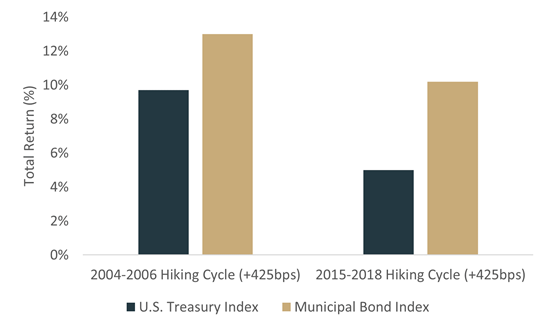
Bonds have historically provided an important buffer for portfolios during stock market downturns and corrections. In February and March of 2020, the S&P 500 index fell by almost 33% in a short period of time. As stocks fell, the Bloomberg U.S. Aggregate Bond Index rose, finishing 2020 up more than 7%. Bonds also have provided positive returns even as rates were being raised. During two of the most recent hiking cycles, both U.S. Treasuries and municipal bonds saw strong gains on a total return basis, as seen in the chart below.

How Bonds Have Performed When the Fed Was Raising Rates

Chart showing how bonds have performed when the Fed raised interest rates
Past performance is no guarantee of future results. Indexes are unmanaged and not subject to fees. It is not possible to invest directly in an index. U.S. Treasury Index, U.S. Municipal Bond Index. Source: Bloomberg

The longer the maturity of the bond or bond fund, the more sensitive the bonds are to interest rate changes. Diversification across maturities, sectors and credit risk can help mitigate portfolio risk during this more than volatile time in the bond market. For those who own individual bonds, rising rates present opportunities to purchase newer bonds as the current bonds are either called or redeemed. New bonds bring higher levels of interest income and potentially greater returns. In other words, rising rates may create some short-term pain but ultimately translate into longer-term gains.

So, what can we learn from all this? While every rising rate cycle may be different, fixed income has had positive returns most of the time during years of rising rates. Last week, we saw the yield curve invert for the first time since 2019. Remember, a recession is not a foregone conclusion. Even if a recession occurs in the next six months to two years, the stock market and bond market may continue to experience positive returns.

From a portfolio perspective, we continue to adhere to the tried-and-true disciplines of diversification, periodic rebalancing and looking forward, while not making investment decisions based on where we have been. As we say each week, it is important to stay the course and focus on the long-term goal, not on one specific data point or indicator. In markets and moments like these, it is essential to stick to the financial plan. Remember, first and foremost, that panic is not an investing strategy. Neither are “get in” or “get out” — those are just gambling on moments in time. Investing is about following a disciplined process over time.

At the end of the day, investors will be well-served to remove emotion from their investment decisions and remember that over a longer time horizon, markets tend to rise. Market corrections are normal, as nothing goes up in a straight line. Making market decisions based on what might happen may be detrimental to long-term performance. The key is to stay invested and stick with the financial plan. Markets go up and down over time, and downturns present opportunities to purchase stocks at a lower value.

It all starts with a solid financial plan for the long run that understands the level of risk that is acceptable for each client. Regarding investments, we believe in diversification and having different asset classes that allow you to stay invested. The best option is to stick with a broadly diversified portfolio that can help you to achieve your own specific financial goals — regardless of market volatility. Long-term fundamentals are what matter.

Sources: Kestra Financial, Bloomberg

Promo for an article titled What You Should Know About the Bond Market's Recession Signal

This material contains an assessment of the market and economic environment at a specific point in time and is not intended to be a forecast of future events, or a guarantee of future results. Forward-looking statements are subject to certain risks and uncertainties. Actual results, performance, or achievements may differ materially from those expressed or implied. Information is based on data gathered from what we believe are reliable sources.

Using diversification as part of your investment strategy neither assures nor guarantees better performance and cannot protect against loss of principal due to changing market conditions.

Past performance is not a guarantee of future results.

The opinions expressed in this commentary are those of the author and may not necessarily reflect those held by Kestra Investment Services, LLC or Kestra Advisory Services, LLC. This is for general information only and is not intended to provide specific investment advice or recommendations for any individual. It is suggested that you consult your financial professional, attorney, or tax advisor with regard to your individual situation.

Securities offered through Kestra Investment Services, LLC (Kestra IS), member FINRA/SIPC. Investment Advisory Services offered through Kestra Advisory Services, LLC (Kestra AS) an affiliate of Kestra IS. CD Wealth Management and Bluespring Wealth Partners LLC* are affiliates of Kestra IS and Kestra AS.  Investor Disclosures: https://bit.ly/KF-Disclosures

*Bluespring Wealth Partners, LLC acquires and supports high quality investment adviser and wealth management companies throughout the United States.