Your Year-End Financial Checklist: Moves To Make Before 2025 Ends

As we prepare to wrap up another year, it is the perfect time to review year-end planning strategies to ensure your wealth plan reflects changes in your circumstances or goals, the current tax environment, and the economic landscape.

The end of the year is an important time for making financial decisions that can have an impact in the year ahead — and for years to come. We recommend that you review the planning strategies below to consider and discuss.

Income Tax Strategies

Traditional year-end planning focuses on deferring income into a future year and accelerating deductions into the current year.

— If you anticipate being in a lower tax bracket next year:

• Defer income if possible so you can postpone paying the tax and have that income at a lower bracket.
• If you itemize on your tax return, bunch your medical expenses in the current year to meet the percentage of your adjusted gross income to claim those deductions.
• Make your January mortgage payment in December so you can deduct the interest on this year’s return.

Promo for an article titled Turning Investment Losses into Gains: The Art of Tax-Loss Harvesting.

Tax-Related Investment Strategies

— Tax-loss harvesting is the strategy of selling securities at a loss to offset a capital gain liability, either for today or in the future. Securities must be sold by Dec. 31, the last trading day of 2025, to realize a capital gain or loss.

• Harvest losses by selling taxable investments. To avoid the IRS wash-sale rule, you must wait at least 31 days before buying back a holding that’s sold for a loss.
• Harvest gains by selling taxable investments if you have a tax loss carryforward.

— Make sure that you have satisfied your required minimum distributions (RMD).

• If you fail to take your RMD, this may result in a 25% penalty. (This is down from 50%.)
• If you own an inherited IRA, RMD may be required separately for that account as well. If you inherited an IRA after 2019, it must be depleted by the end of the 10th year. If the original owner of the IRA was already taking RMDs at the time of death, you must take an annual distribution in years 1-9, in addition to making sure the IRA is fully depleted in year 10.
• Beneficiaries of a Roth IRA do not have to take RMDs. However, the 10-year rule still applies, and the entire account must be fully distributed by the end of the 10th year.

Promo for an article titled Before You Sell for a Loss, Make Sure You Know the Wash-Sale Rule.

Retirement Planning Strategies

— Maximize your IRA contributions. You may be able to deduct annual contributions of up to $7,000 to your traditional IRA and $7,000 to your spouse’s IRA ($8,000 if over the age of 50).

— Make a Roth IRA contribution if you qualify under the applicable income limits.

— Consider increasing or maximizing your 401(k) contribution; the maximum for 2025 is $23,500 for those under age 50 and $31,000 for those 50 and older. Contributing more to your 401(k) can reduce your adjusted gross income while boosting your long-term retirement savings.

— New in 2025: If you are between 60 and 63, you can contribute an additional amount to your employer-sponsored retirement plan.

— Consider making contributions to a Roth 401(k) if your plan allows.

— Consider setting up a Roth IRA for each of your children who have earned income during the year.

Gifting Strategies

— Consider making gifts up to $19,000 per person, as allowed under the federal annual gift tax exclusion. You can give up to $19,000 this year to as many people as you want without triggering gift taxes. Note: Payments made directly to educational and/or medical institutions on behalf of your intended beneficiary do not count towards your annual exclusion amount — or against your lifetime estate tax exclusion.

— Create a donor advised fund for an immediate income tax deduction and provide immediate and future benefits to charity over time.

— If you already have a donor advised fund or want to donate to a charity, consider gifting appreciated assets that have been held longer than one year to get the fair market value income tax deduction while avoiding income tax on the appreciation.

— If over the age of 70½, consider making a direct transfer from an IRA to a public charity. The distribution is excluded from gross income, and you can give up to $108,000 as a tax-free gift from your IRA, which may fully satisfy RMD requirements.

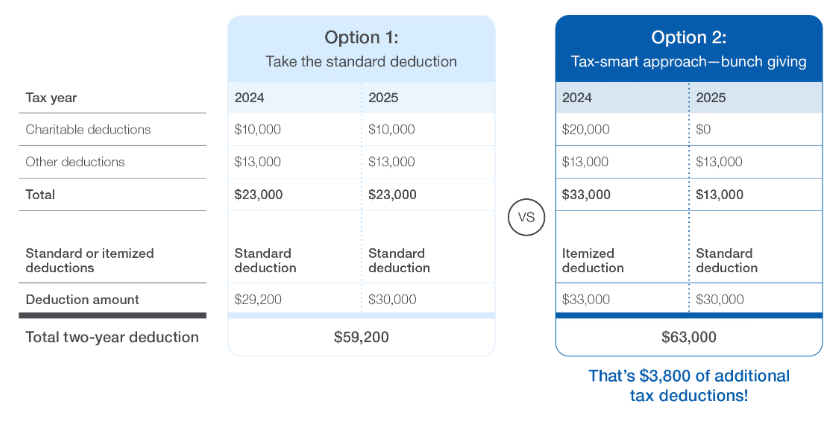
— Consider combining multiple years of charitable giving into a single year to exceed the standard deduction threshold. This is called “bunching.” The chart below illustrates how bunching can reduce taxes if executed properly.

Bunching in 2025

Scenario: Donor has income of $750K, is in the 35% income federal tax bracket, files jointly as a married couple, and itemizes deductions.
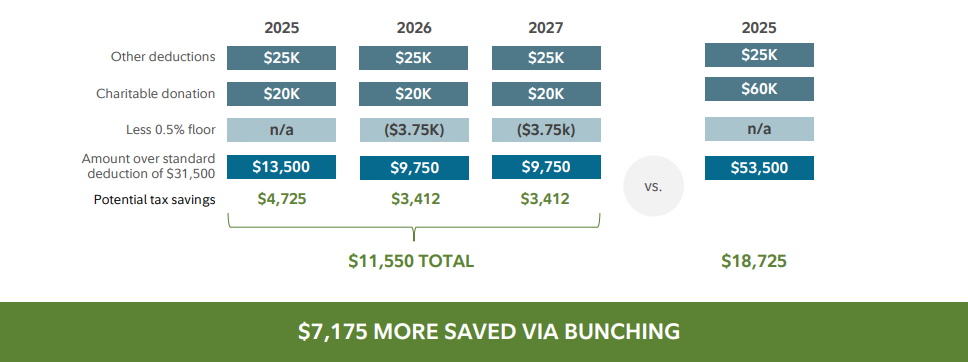
Source: Fidelity Charitable. This is a hypothetical example for illustrative purposes only. This example does not take into account other deductions. Information herein is not legal or tax advice. As with any tax-planning strategy, there may be additional considerations that pertain to your personal situation. Other strategies may provide more flexibility and similar savings. Please consult your tax advisor.

Wrapping up 2025, Planning for 2026

— Discuss major life events with CD Wealth to confirm you have clarity in your current situation.

— Communicate with your CPA to provide capital gains and investment income information for a more accurate year-end projection.

— Check your Health Savings Account (HSA) contributions for 2025. If you qualify, you can contribute up to $4,300 (individual) or $8,850 (family) — and an additional $1,000 catch-up if over the age of 55.

— Double-check your beneficiary designations for retirement plans, IRAs, Roth IRAs, annuities, and life insurance policies.

— If you do not already have identity theft protection, consider purchasing a service to help protect you and your family.

The end of the year is a perfect time to review your financial planning needs. This includes reviewing the investment portfolio, assessing year-end tax planning opportunities, reviewing retirement goals, and managing your legacy plans. The list above includes some of the items that may apply to you and your family. 

We are happy to meet to discuss any of the above to ensure you remain on track with your financial goals.

Promo for an article titled Here's Why the Stock Market Remains the Best Place to Build Wealth.

The CD Wealth Formula

We help our clients reach and maintain financial stability by following a specific plan, catered to each client. 

Our focus remains on long-term investing with a strategic allocation while maintaining a tactical approach. Our decisions to make changes are calculated and well thought out, looking at where we see the economy is heading. We are not guessing or market timing. We are anticipating and moving to those areas of strength in the economy — and in the stock market. 

We will continue to focus on the fact that what really matters right now is time in the market, not out of the market. That means staying the course and continuing to invest, even when the markets dip, to take advantage of potential market upturns. We continue to adhere to the tried-and-true disciplines of diversification, periodic rebalancing and looking forward, while not making investment decisions based on where we have been.

It is important to focus on the long-term goal, not on one specific data point or indicator. Long-term fundamentals are what matter. In markets and moments like these, it is essential to stick to the financial plan. Investing is about following a disciplined process over time.

Sources: Fidelity

What to Expect Now That the ‘Big Beautiful Bill’ Has Become Law

On July 4, President Trump signed the “One Big Beautiful Bill” into law, which cements most of the tax cuts embedded in the 2017 Tax Cuts and Jobs Act (TCJA), along with some significant additional tax changes.

However, the primary question remains: What will be the long-term impact of this bill on the deficit? Let’s uncover what is inside this new tax law.

Permanent Changes

The following provisions will become a permanent part of the tax code, initially introduced in the original Tax Cuts and Job Act.

• The seven tax brackets with a top rate of 37% and a bottom rate of 10% will remain the same.
• The mortgage interest deduction will remain at its current limit of $750,000 in mortgage debt for joint filers ($375,000 for single filers).
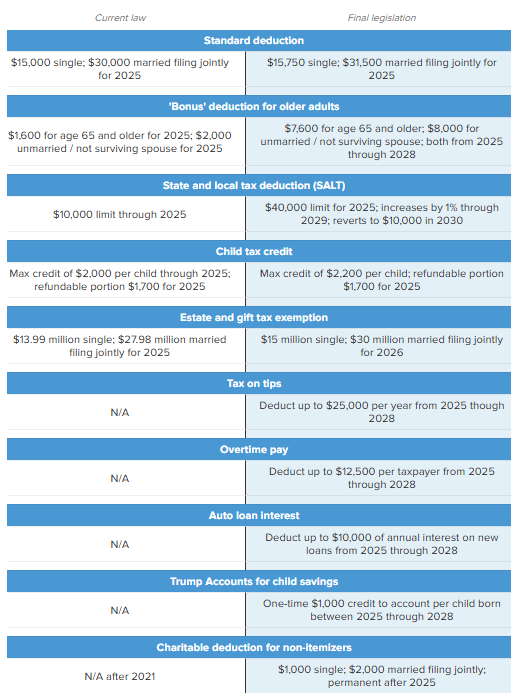
• The State and Local Tax (SALT) deduction had been capped at $10,000. This will increase to $40,000 and then revert to $10,000 in 2030. The higher SALT cap will phase out for incomes over $500,000.
• The standard deduction will be made permanent and increase to $15,750 for single filers and $31,500 for joint filers. These amounts will be indexed for inflation after 2025.
• The lifetime gift and estate tax exclusions will increase to $15 million for single filers and $30 million for those who are married and filing jointly. The exclusions will be indexed for inflation going forward.
• The Child Tax Credit will be permanent and will increase to $2,200 per child starting in 2025.
• Those who do not itemize deductions can claim a deduction for charitable contributions of up to $1,000 ($2,000 for couples) starting in 2026.

Temporary Provisions (4 Years)

The legislation includes numerous temporary deductions and credits that are valid for tax years 2025 to 2028 only.

• Workers can deduct up to $25,000 in qualifying tip income and $12,500 in overtime pay ($25,000 for joint filers). These deductions phase out with income over $150,000 ($300,000 for joint filers).
• People who are 65 or older will get an additional $6,000 deduction that begins to phase out at an income of $75,000 for single filers and $150,000 for joint filers. This is in addition to the $2,000 deduction for single filers and $3,200 for joint filers.
• The new law allows for a deduction of up to $10,000 of loan interest for purchased vehicles whose final assembly took place in the U.S. The deduction would apply for single taxpayers with adjusted gross income of $100,000 or less ($200,000 for people filing jointly).

What Else Is New?

Other additions include a savings account for children and expanded usage for health savings accounts and 529 plans.

• Parents and relatives can now contribute up to $5,000 a year to a new savings account, called Trump accounts. Initially acting like a non-deductible IRA, contributions can be made until the beneficiary reaches the age of 18. Then, the account would effectively convert to a traditional IRA. Additionally, parents of newborns born between Jan. 1, 2025, and Dec. 31, 2028, would qualify for $1,000 in federal money to start the account.
• The legislation expands the use of 529 funds to include miscellaneous expenses such as testing fees, tutoring outside the home, and educational therapies, as well as tax-free withdrawals for recognized postsecondary credential programs.
• The legislation also broadens HSA eligibility by including more health plan types and participant categories.

The legislation does not eliminate taxes on Social Security benefits, which remain taxable up to 85% for individuals with income greater than $34,000, or $44,000 for a couple. However, the $6,000 deduction for those 65 and older may help offset taxes on Social Security benefits for some over the next four years.

Key Individual Tax Changes

Chart outlining the changes to tax law from the Big Beautiful Bill.
Source: CNBC

As you review the new tax legislation, it may be the perfect time to review your financial planning needs as well. This includes revisiting your investment portfolio, assessing tax planning opportunities, reevaluating retirement goals and managing your wealth transfer and legacy plans.

This summary of the new legislation contains merely a portion of the items that may apply to your family. We are always happy to meet and discuss any of the above to ensure that you remain on track with your financial profile and your goals.

Promo for an article titled Transparency over Illusion — the case for liquid investments.

The CD Wealth Formula

We help our clients reach and maintain financial stability by following a specific plan, catered to each client. 

Our focus remains on long-term investing with a strategic allocation while maintaining a tactical approach. Our decisions to make changes are calculated and well thought out, looking at where we see the economy is heading. We are not guessing or market timing. We are anticipating and moving to those areas of strength in the economy — and in the stock market. 

We will continue to focus on the fact that what really matters right now is time in the market, not out of the market. That means staying the course and continuing to invest, even when the markets dip, to take advantage of potential market upturns. We continue to adhere to the tried-and-true disciplines of diversification, periodic rebalancing and looking forward, while not making investment decisions based on where we have been.

It is important to focus on the long-term goal, not on one specific data point or indicator. Long-term fundamentals are what matter. In markets and moments like these, it is essential to stick to the financial plan. Investing is about following a disciplined process over time.

Sources: CNBC, Fidelity, Schwab

Revisiting the Year’s Most Valuable Insights for Our Clients

As 2024 draws to a close, we wanted to take this occasion to look back at the articles we’ve produced for our clients so far this year and share the 10 most popular pieces, in case you missed any of them — or if you want to revisit and share them with friends and family.

Every two weeks, we thoughtfully craft these pieces with our clients in mind, broaching subjects we think are relevant and interesting. This is not syndicated content. We want you to find value in these letters — especially in times like these.

1. Understanding How a Living Trust Can Help Your Estate Planning

Senior couple, documents and sign contract for life insurance or home mortgage. Discussion, signature and retired elderly man and woman signing legal paperwork for will or loan application together.

June 20: A living trust is a flexible, popular tool that allows the estate to avoid probate and lets you control asset distribution after your death. Read more

2. Another Milestone for the Dow: What Could Happen Next?

Stock market data with uptrend vector. 3d render.

May 23: The Dow’s rise to 40,000 is a reminder that when it comes to investing, patience is the key. Read more

3. Here’s Why Investors Shouldn’t Panic Over the Market’s New Year’s Hangover

Index on a screen.

Jan. 12: We talk regularly about not timing the market, and we don’t see these circumstances any differently. Read more

4. Election Advice for Investors: Ignore the Noise, Focus on the Big Picture

American Social Unrest.

Oct. 31: Presidential elections historically have had very little impact on the stock market. Read more

5. What Investors Should Know About This Week’s Market Pullback

financial stock market graph chart of stock market investment trading screen.

Aug. 8: Remember that volatility is normal and that the market does not go up in a straight line. Read more

6. The Market’s Recovery Puts August Pullback in the Rearview Mirror

Businesswoman in suit drawing stock analytics interface on virtual screen. Business and financial success concept.

Aug. 22: More often than any other month, August is when we tend to see out-of-the-blue volatility in the stock market. Read more

7. Here’s How We’re Rebalancing the Portfolio as We Enter the Second Quarter

Smiling mature couple meeting with bank manager for investment. Beautiful mid adult woman with husband listening to businessman during meeting in conference room in modern office. Happy middle aged couple meeting loan advisor to buy a new home.

March 15: We think much of the pain from rising interest rates is behind us — and the key to navigating volatility remains being in a diversified portfolio. Read more

8. Investor Outlook: A Strong May, the First 100 Trading Days and 4 Scams to Watch

Male manager businessmen are looking at the tablet screen with the company's financial information and he is tense about the performance.

June 6: S&P 500 companies are enjoying their best earnings season in almost two years. Read more

9. The Fed’s Next Move: What Could Rate Cuts Mean for Investors?

Federal Reserve Chairman Jerome Powell speaking on stage.

Sept. 5: Investors who stay only in short-term investments may risk an opportunity to lock in higher yields. Read more

10. How To Make the Biggest Impact With Your Charitable Donation

Green donate button on the keyboard close-up. blurred in motion background.

Sept. 19: Giving can offer a financial benefit for you and your family — as well as the intangible rewards that come with helping others. Read more

The CD Wealth Formula

We help our clients reach and maintain financial stability by following a specific plan, catered to each client. 

Our focus remains on long-term investing with a strategic allocation while maintaining a tactical approach. Our decisions to make changes are calculated and well thought out, looking at where we see the economy is heading. We are not guessing or market timing. We are anticipating and moving to those areas of strength in the economy — and in the stock market. 

We will continue to focus on the fact that what really matters right now is time in the market, not out of the market. That means staying the course and continuing to invest, even when the markets dip, to take advantage of potential market upturns. We continue to adhere to the tried-and-true disciplines of diversification, periodic rebalancing and looking forward, while not making investment decisions based on where we have been.

It is important to focus on the long-term goal, not on one specific data point or indicator. Long-term fundamentals are what matter. In markets and moments like these, it is essential to stick to the financial plan. Investing is about following a disciplined process over time.

The Bull Market, a Big November & 2025 Inflation Adjustments

November was a big month for stocks! The Dow closed above 45,000 for the first time, and the S&P 500 hit 6,000 for the first time. Small-cap stocks rose almost 11% during the month.

Optimism over lower taxes, a stronger economy and strong earnings were the likely reasons for the month’s great showing. So far in 2024, the S&P has made 56 new all-time highs. The S&P is up more than 25% for the year — and for the first time since 1998, it’s up more than 20% in back-to-back years.

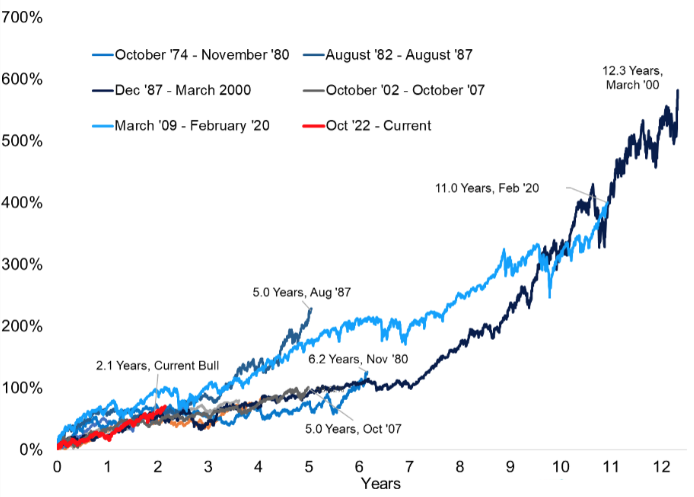
The current bull market is 26 months old and up more than 70% from lows in mid-October 2022. The good news is that once previous bull markets get to this point, there can still be additional room to go higher. Over the past 50 years, five other bull markets have lasted more than two years. The shortest lasted five years, and the longest lasted more than 12 years.

Bull Markets Beyond Their Second Birthday

Chart showing the duration of bull markets since 1950.
Source: FactSet, Carson Investment Research 12/6/24

Here are some fun market tidbits to end the year:

1. The “Santa Claus rally” is the typically encouraging period that includes the last five trading days of December and the first two trading days of the new year.
2. December typically is the S&P 500’s second-best month in an average election year, trailing only November.
3. On average, December is the third-best month, behind April and November.
4. Going back to 1950, December has been positive 75% of the time.

Santa brings gifts — and not always in the form of market returns. The IRS recently released its inflation adjustments for 2025 related to personal income tax, retirement contributions, estate taxes and Social Security benefits. While these changes won’t affect tax returns due in April, they will be very helpful in planning for 2025.

Personal Income Tax

The standard deduction is increasing in 2025, which could mean a bigger tax break for you. The new standard deduction for 2025 is:

• Married filing jointly: $30,000, an increase of $800
• Single taxpayers and married individuals filing separately: $15,000, up $400
• Heads of Households: $22,500, an increase of $600
• In addition, retired married couples (both age 65+) filing jointly, will receive an additional standard deduction of $3,200 ($1,600 each)! This may make it more difficult to itemize deductions in 2025. We will want to keep this in mind with charitable giving to consider a bunching strategy.

For tax year 2025, the top tax rate remains 37% with income greater than $751,600 for married filing jointly ($626,350 for single taxpayers). The other tax brackets are: 

• Incomes over $501,050 for married filing jointly ($250,525 for single): 35%
• Incomes over $394,600 for married filing jointly ($197,300 for single): 32%
• Incomes over $206,700 for married filing jointly ($103,350 for single): 24%
• Incomes over $96,950 for married filing jointly ($48,475 for single): 22%
• Incomes over $23,850 for married filing jointly ($11,925 for single): 12%
• Incomes less than $23,850 for married filing jointly ($11,925 or less for single): 10% 

Retirement Savings Contributions

The 401(k)-contribution limit is increasing by another $500 to $23,500. The maximum contribution for certain profit-sharing plans is increasing to $70,000.

Traditional and Roth IRA contribution limits are staying the same at $7,000. In 2025, for those under the age of 50, the cap will remain at $7,000. Married couples with income below $236,000 will be able to make a full Roth contribution in 2025 ($150,000 for those who are single). Phaseout ranges are changed for 2025; couples with income over $246,000 will not be eligible to contribute to a Roth IRA.

While catch-up contributions for participants 50 and older will remain at $7,500, the IRS is introducing a new super catch-up contribution limit for older employees. Beginning in 2025, individuals age 60-63 can contribute an additional $3,750 to their employer-sponsored retirement plans, for a total catch-up amount of $11,250.

The backdoor Roth IRA option remains a viable choice. The first step is to contribute to a Traditional IRA; this is a non-deductible contribution. After the traditional IRA contribution is completed, you can convert those funds to a Roth IRA.

If the original contribution to a traditional IRA was not deductible, then the conversion of that amount is non-taxable. However, any growth on that amount between the contribution and the conversion dates would be taxable. Completing the backdoor Roth transaction can be a tricky process, and you will want to consult your financial advisor and CPA.

Please make sure you adjust your 401(k) plan to account for the increased contribution limit.

Social Security

Social Security benefits will increase 2.5% in 2025, an average increase of almost $48 per month. This adjustment is smaller when compared to the 5%-8% increases that were in response to higher inflation in recent years. 

Estate Taxes and Gifting

The gift tax annual exclusion is increasing from $18,000 to $19,000 for 2025, the fourth consecutive year that the gift limit has increased. Individuals can gift up to this amount to any number of individuals in 2025 without incurring gift tax or using any of the taxpayer’s lifetime exemption. Married couples can use this exemption, allowing them to gift up to $38,000 annually to each recipient in 2025.

In addition, the lifetime exemption amount increased about $380,000 per person, to $13.99 million per individual. This increase means that a married couple can shield a total of $27.98 million from federal estate or gift tax. This exemption is still set to sunset by about 50% at the beginning of 2026. Remember, however, that certain kinds of planning strategies can take months or even years to implement.

Promo for an article titled How to Make the Biggest Impact With Your Charitable Donation.

The end of the year is a perfect time to review your financial planning needs. This includes reviewing the investment portfolio, assessing year-end tax planning opportunities, reviewing retirement goals, and managing your legacy plans. The above changes for 2025 may apply to you and your family. We are happy to meet to discuss any of the above to ensure that you remain on track with your financial goals.

The CD Wealth Formula

We help our clients reach and maintain financial stability by following a specific plan, catered to each client. 

Our focus remains on long-term investing with a strategic allocation while maintaining a tactical approach. Our decisions to make changes are calculated and well thought out, looking at where we see the economy is heading. We are not guessing or market timing. We are anticipating and moving to those areas of strength in the economy — and in the stock market. 

We will continue to focus on the fact that what really matters right now is time in the market, not out of the market. That means staying the course and continuing to invest, even when the markets dip, to take advantage of potential market upturns. We continue to adhere to the tried-and-true disciplines of diversification, periodic rebalancing and looking forward, while not making investment decisions based on where we have been.

It is important to focus on the long-term goal, not on one specific data point or indicator. Long-term fundamentals are what matter. In markets and moments like these, it is essential to stick to the financial plan. Investing is about following a disciplined process over time.

Sources: Baird, Carson, Fidelity, Schwab

Year-End Suggestions to Help You Save More and Reduce Your Taxes

With the election in the rearview mirror, we are entering the home stretch for 2024. The end of the year is an important time for making financial decisions that can have an impact not only in the new year ahead, but for years to come.

As 2025 approaches, now is the perfect time to review planning strategies to ensure that your wealth plan reflects any changes in your circumstances or goals, the current tax environment and the economic landscape.

We recommend that you review the checklist below for ideas to consider and discuss.

Income Tax Strategies

1. If you anticipate your marginal income tax bracket to increase next year, you may consider accelerating income into 2024 and deferring deductions to 2025.

2. If you anticipate being in a lower tax bracket next year:

• Defer income (if possible) to postpone paying the tax and to have that income at a lower bracket.
• If you itemize on your tax return, bunch your medical expenses in the current year to meet the percentage of your adjusted gross income to claim those deductions.
• Make your January mortgage payment in December so you can deduct the interest on this year’s return.

Tax-related Investment Strategies

1. Tax-loss harvesting is the strategy of selling securities at a loss to offset a capital gain liability, either for today or in the future. Securities must be sold by Dec. 31, the last trading day of 2024, to realize a capital gain or loss.

• Harvest losses by selling taxable investments. Note: You must wait at least 31 days before buying back a holding that is sold for a loss to avoid the IRS wash-sale rule.
• Harvest gains by selling taxable investments if you have a tax loss carryforward.

2. Ensure that you have satisfied your required minimum distributions (RMD).

• If you fail to take your RMD, this may result in a 25% penalty (down from 50%). 
• If you own an inherited IRA, an RMD may be required separately for that account as well. If you inherited an IRA after 2019, the inherited IRA must be depleted by the end of the 10th year. Beginning next year, certain beneficiaries must take an annual distribution over the 10-year period following inheritance, instead of waiting to distribute the entire amount until the 10th year.

Retirement Planning Strategies

1. Maximize your IRA contributions. You may be able to deduct annual contributions of up to $7,000 to your traditional IRA and $7,000 to your spouse’s IRA ($8,000 if over the age of 50).

2. Consider increasing or maximizing your 401(k) contribution. The maximum contribution in 2024 for those under 50 is $23,000, and for those over 50, the maximum contribution is $30,500. Boosting contributions to your 401(k) can lower your adjusted gross income while increasing your retirement savings.

3. Consider making contributions to a Roth 401(k) if your plan allows.

4. Consider setting up a Roth IRA for each of your children who have earned income during the year.

Gifting Strategies

1. Consider making gifts of up to $18,000 per person as allowed under the federal annual gift tax exclusion. You can give up to $18,000 this year to as many people as you want without triggering gift taxes. Payments made directly to educational and/or medical institutions on behalf of your intended beneficiary do not count towards your annual exclusion amount — or against your lifetime estate tax exclusion.

2. Create a donor advised fund for an immediate income tax deduction and provide immediate and future benefits to charity over time.

3. If you already have a donor advised fund or want to donate to a charity, consider gifting appreciated assets that have been held longer than one year to get the fair market value income tax deduction while avoiding income tax on the appreciation.

4. If you are over the age of 70½, consider making a direct transfer from an IRA to a public charity. The distribution is excluded from gross income, and you can give up to $105,000 as a tax-free gift from your IRA that may fully satisfy RMD requirements.

5. Consider combining multiple years of charitable giving into a single year to exceed the standard deduction threshold. This is called “bunching.” The chart below illustrates how it can reduce taxes if executed properly.

Wrapping Up 2024, Planning for 2025

1. Discuss major life events with your team at CD Wealth to confirm you have clarity in your current situation.

2. Communicate with your CPA to provide capital gains and investment income information for a more accurate year-end projection.

3. Check your Health Savings Account (HSA) contributions for 2025. If you qualify, you can contribute up to $4,300 (individual) or $8,550 (family), plus an additional $1,000 catch-up if you are over 55.

4. Double-check your beneficiary designations for retirement plans, IRAs, Roth IRAs, annuities and life insurance policies.

5. If you do not already have identity theft protection, consider purchasing a service to help protect you and your family. 

The end of the year is the perfect time to review your financial planning needs.

This includes reviewing the investment portfolio, assessing year-end tax planning opportunities, reviewing retirement goals, and managing your legacy plans.

The checklist above includes just some of the items that may apply to you and your family. We are happy to meet with you to discuss any of the above and to ensure that you stay on track with your financial goals.

Promo for an article titled How to Make the Biggest Impact with your charitable donation.

The CD Wealth Formula

We help our clients reach and maintain financial stability by following a specific plan, catered to each client. 

Our focus remains on long-term investing with a strategic allocation while maintaining a tactical approach. Our decisions to make changes are calculated and well thought out, looking at where we see the economy is heading. We are not guessing or market timing. We are anticipating and moving to those areas of strength in the economy — and in the stock market. 

We will continue to focus on the fact that what really matters right now is time in the market, not out of the market. That means staying the course and continuing to invest, even when the markets dip, to take advantage of potential market upturns. We continue to adhere to the tried-and-true disciplines of diversification, periodic rebalancing and looking forward, while not making investment decisions based on where we have been.

It is important to focus on the long-term goal, not on one specific data point or indicator. Long-term fundamentals are what matter. In markets and moments like these, it is essential to stick to the financial plan. Investing is about following a disciplined process over time.

Sources: Capital Group, Fidelity, Schwab

How To Make the Biggest Impact With Your Charitable Donation

Today is North Texas Giving Day, an important occasion in our community — and an annual reminder to think about making charitable donations for both philanthropic and tax purposes! No matter what your interests are, making gifts to causes you care about can be one of the most meaningful uses of your money. 

In the end, what really matters is helping an organization that matters to you. The tax benefits from a donation are just icing on the cake.

Charitable giving can offer a financial benefit for you and your family as well as the intangible rewards that come with helping others. Most donations to charitable organizations come in the form of checks or credit card payments. However, there may be more efficient ways to donate, which in turn can help both the charity and your pocketbook.

Understanding the benefits for different types of donations is important.

Cash, Check or Credit Card

These are the most simple and straightforward ways to donate to charity. It is important for you to keep a receipt from the charity or a bank record to substantiate cash gifts.

For contributions made in 2024, the annual income tax deduction limit for cash gifts to public charities is 60% of adjusted gross income (AGI). If you make contributions in excess of those limits, you can carry over the excess for up to five years until it is all used, but not beyond that time.

If you do not have appreciated assets to give or if you want to give cash, you may find that the total of your itemized deductions will be slightly below the standard deduction. In that case, it could be beneficial to combine or bunch several years of tax contributions into one year.

Appreciated Stock

With the stock market gains over the last two years, donating appreciated assets such as stock can have tremendous advantages. Donors can deduct gifts of stocks that have been held more than a year (long enough to qualify as long-term capital gains) at the fair market value, rather than at the purchase price.

The downside is that your deduction can offset only up to 30% of your AGI. If you donate stocks you have held for less than one year, you will receive a deduction for their cost basis, rather than fair market value. However, the deduction can offset up to 50% of AGI.

Often, donors may gift the stock with the biggest winnings, which maximizes savings on capital gains, and then buy back the same stock with cash — which in turn raises the cost basis. If you happen to own a stock or mutual fund for more than one year and do not have the cost basis, this holding can be ideal for donation to charity.

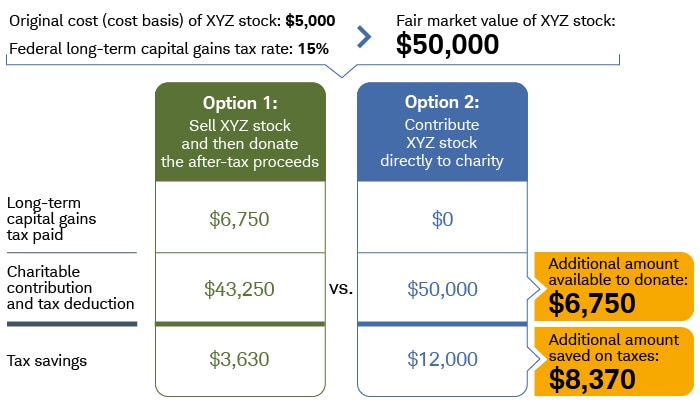
The chart below shows the difference between selling appreciated stock and then donating cash to charity, compared to gifting appreciated stock. Not only would the individual save on taxes, as the charity does not pay capital gains tax, but the charity would also receive additional monies!

This example is hypothetical and for illustrative purposes only. The example does not take into account any state or local taxes or the Medicare net investment income surtax. The tax savings shown is the tax deduction multiplied by the donor’s income tax rate (24% in this example) minus the long-term capital gains taxes paid.

IRA Qualified Charitable Distributions (QCD)

This is an option only for donors over the age of 70 1/2. Qualified Charitable Distributions allow individuals to donate up to $105,000 annually (up from $100,000 last year) directly from an IRA. Donor Advised Funds are excluded from this charitable donation; it must go to a qualified charity.

The QCD reduces the value of the IRA and does not count towards the donor’s taxable income. It also counts toward satisfying the annual required minimum distribution. In 2024, donors can also direct a one-time QCD of up to $53,000 to a charitable remainder trust or charitable gift annuity.

Donor Advised Fund (DAF)

Picture a donor advised fund as your family foundation, without the headache and administrative hassle of setting up a family foundation. A donor advised fund is a charitable account established at a public charity or community foundation that allows donors to recommend grants over time. The donor decides the timing of the donation, the charity that will receive the donation and the amount of the donation made from the DAF. The donor claims the tax deduction upon funding of the donor advised fund.

There is not a requirement that the DAF must distribute 5% of the fund each year, which may allow the DAF to grow, expanding the available dollars to donate to charities. Donor advised funds also can be a charity beneficiary of IRA assets.

Promo for an article called Here's Why Investors Should Keep Politics Out of the Portfolio.

At CD Wealth Management, charitable giving plays a significant part in our company’s culture. We believe in giving back to the community, with our time as well as our pocketbook. We support many causes in the Dallas/Fort Worth Metroplex and encourage our team members to get involved.

During the holiday season every year, we make a donation in each of our team members’ names to their charity of choice as a form of gratitude that also helps a great cause. It is part of who we are as a firm — and who we are as individuals. 

Please do not hesitate to reach out to us to discuss options to help you determine the best way to make the most of your charitable donations. Remember to visit the North Texas Giving Day website and look for your favorite charity. (Please note: all funding options above may not be available.)

The CD Wealth Formula

We help our clients reach and maintain financial stability by following a specific plan, catered to each client. 

Our focus remains on long-term investing with a strategic allocation while maintaining a tactical approach. Our decisions to make changes are calculated and well thought out, looking at where we see the economy is heading. We are not guessing or market timing. We are anticipating and moving to those areas of strength in the economy — and in the stock market. 

We will continue to focus on the fact that what really matters right now is time in the market, not out of the market. That means staying the course and continuing to invest, even when the markets dip, to take advantage of potential market upturns. We continue to adhere to the tried-and-true disciplines of diversification, periodic rebalancing and looking forward, while not making investment decisions based on where we have been.

It is important to focus on the long-term goal, not on one specific data point or indicator. Long-term fundamentals are what matter. In markets and moments like these, it is essential to stick to the financial plan. Investing is about following a disciplined process over time.

Sources: Fidelity, Schwab, Investopedia

How Your Donation Can Benefit Charity — and Your Finances — on NTX Giving Day

With NTX Giving Day just days away on Sept. 21, it’s a wonderful time to think about making charitable donations for both philanthropic and tax purposes! No matter what your interests are, making gifts to the causes you care about can be one of the most meaningful uses of your money. In the end, of course, what really matters is helping an organization that matters to you; the tax benefits are just icing on the cake.

Charitable giving can offer both a financial benefit for you and your family as well as the intangible rewards that come with helping others and your community. Most donations to charitable organizations come in the form of checks or credit card payments. However, there may be more efficient ways to donate that can help both the charity and your pocketbook.

It’s important to understand the benefits of different types of donations.

Cash, Check or Credit Card

This is the most simple and straightforward way of donating to charity. It is important to keep a bank record or a receipt from the charity to substantiate a cash gift. For contributions in 2023, the annual income tax deduction limits for cash gifts to public charities increased to 60% of adjusted gross income (AGI). If contributions are made in excess of those limits, the excess may be carried over for up to five years.

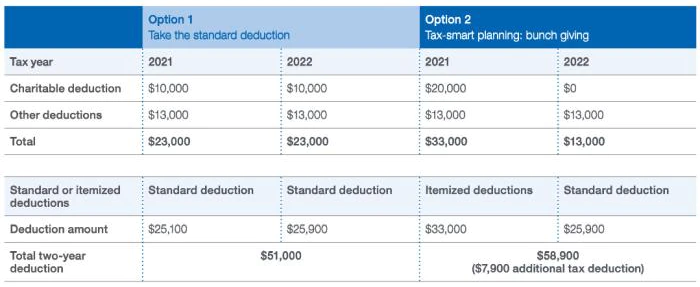
If you do not have appreciated assets to give or want to give cash, some donors may find that the total of their itemized deductions will be slightly below their standard deduction. In that case, it could be beneficial to combine or bunch several years of tax contributions into one year.

Chart showing the benefits of tax-smart donation planning.
Standard deduction amounts are for married filing jointly. This example is hypothetical and for illustrative purposes only.

Appreciated Stock

Given the recent increases in the standard deduction, donating appreciated assets such as stock can have tremendous advantages. Gifts of stocks that have been held long enough to qualify as long-term capital gains (more than one year) can be deducted at the fair market value rather than your original purchase price. The downside is that your deduction can offset only up to 30% of your adjusted gross income (AGI).

Stocks that have not been held long enough to qualify for long-term capital gains (less than one year) receive a deduction for their cost basis, rather than fair market value. However, the deduction can offset up to 50% of AGI. Often, clients may donate the stock with the biggest winnings, which maximizes savings on capital gains, and then buy back the same stock with cash, which in turn raises the cost basis.

The chart below shows the difference between selling appreciated stock and then donating cash to charity compared with gifting appreciated stock. Not only would the individual save on taxes, as the charity does not pay capital gains tax, but the charity would also receive additional monies!

Chart showing the benefits of gifting stock to charity.
This example is hypothetical and for illustrative purposes only. The example does not take into account any state or local taxes or the Medicare net investment income surtax. The tax savings shown is the tax deduction, multiplied by the donor’s income tax rate (24% in this example) minus the long-term capital gains taxes paid.

IRA Qualified Charitable Distributions (QCD)

This is an option only for donors over the age of 70 1/2. Qualified Charitable Distributions allow individuals to give up to $100,000 annually directly from their IRA to charitable organizations. Donor Advised Funds are excluded; the donation must go to a qualified charity.

The QCD reduces the value of the IRA and does not count towards the donor’s taxable income. It also counts towards satisfying the annual required minimum distribution. Starting in 2023, donors can also direct a one-time, $50,000 QCD to a charitable remainder trust or charitable gift annuity.

Donor Advised Fund (DAF)

Picture a Donor Advised Fund as having your own family foundation without the headache and administrative hassle of setting one up. A DAF is a charitable account established at a public charity or community foundation that allows donors to recommend grants over time.

The donor decides the timing of the donation, the charity that will receive the donation and the amount of the charitable donation made from the fund. The donor claims the tax deduction upon funding of the DAF. There is not a requirement that the DAF has to distribute 5% of the fund each year, which may allow the DAF to grow, expanding the available dollars to donate to charities. Donor advised funds also can be a charity beneficiary of IRA assets.

At CD Wealth Management, charitable giving plays a significant role in our company. We believe in giving back with our time as well as with our pocketbook.

We support many causes in North Texas and encourage our team to be involved and to give back. Each year, during the holiday season, we make charitable donations in each of our team members’ names to their charities of choice as an additional thanks and at the same time helping a great cause.

It is part of our culture, part of who we are as a firm and who we are as individuals. Please do not hesitate to reach out to us to discuss your charitable options to help you determine the best way to give for your situation.

On Thursday, Sept. 21, visit the NTX Giving Day website to join the tens of thousands of others helping charities in North Texas! (Please note: All funding options above may not be available through NTX Giving Day.)

The CD Wealth Formula

We help our clients reach and maintain financial stability by following a specific plan, catered to each client. 

Our focus remains on long-term investing with a strategic allocation while maintaining a tactical approach. Our decisions to make changes are calculated and well thought out, looking at where we see the economy is heading. We are not guessing or market timing. We are anticipating and moving to those areas of strength in the economy — and in the stock market. 

We will continue to focus on the fact that what really matters right now is time in the market, not out of the market. That means staying the course and continuing to invest, even when the markets dip, to take advantage of potential market upturns. We continue to adhere to the tried-and-true disciplines of diversification, periodic rebalancing and looking forward, while not making investment decisions based on where we have been.

It is important to focus on the long-term goal, not on one specific data point or indicator. Long-term fundamentals are what matter. In markets and moments like these, it is essential to stick to the financial plan. Investing is about following a disciplined process over time.

Source: Schwab

Promo for article titled September's Surprising Potential: 5 Reasons for Investor Optimism.

This material contains an assessment of the market and economic environment at a specific point in time and is not intended to be a forecast of future events, or a guarantee of future results. Forward-looking statements are subject to certain risks and uncertainties. Actual results, performance, or achievements may differ materially from those expressed or implied. Information is based on data gathered from what we believe are reliable sources.

Using diversification as part of your investment strategy neither assures nor guarantees better performance and cannot protect against loss of principal due to changing market conditions.

Past performance is not a guarantee of future results.

The opinions expressed in this commentary are those of the author and may not necessarily reflect those held by Kestra Investment Services, LLC or Kestra Advisory Services, LLC. This is for general information only and is not intended to provide specific investment advice or recommendations for any individual. It is suggested that you consult your financial professional, attorney, or tax advisor with regard to your individual situation.

Securities offered through Kestra Investment Services, LLC (Kestra IS), member FINRA/SIPC. Investment Advisory Services offered through Kestra Advisory Services, LLC (Kestra AS) an affiliate of Kestra IS. CD Wealth Management and Bluespring Wealth Partners LLC* are affiliates of Kestra IS and Kestra AS.  Investor Disclosures: https://bit.ly/KF-Disclosures

*Bluespring Wealth Partners, LLC acquires and supports high quality investment adviser and wealth management companies throughout the United States.

Fidelity Investments and Fidelity Institutional® (together “Fidelity”) is an independent company, unaffiliated with Kestra Financial or CD Wealth Management. Fidelity is a service provider to both. There is no form of legal partnership, agency affiliation, or similar relationship between your financial advisor and Fidelity, nor is such a relationship created or implied by the information herein. Fidelity has not been involved with the preparation of the content supplied by CD Wealth Management and does not guarantee, or assume any responsibility for, its content. Fidelity Investments is a registered service mark of FMR LLC. Fidelity Institutional provides clearing, custody, or other brokerage services through National Financial Services LLC or Fidelity Brokerage Services LLC, Members NYSE, SIPC.




Your Wealth Management Checklist to Help You Put 2022 to Bed

We are in the homestretch for 2022. It is the perfect time to review some year-end planning strategies to ensure your wealth plan reflects changes in your circumstances or goals, the current tax environment and the economic landscape. The end of the year is an important time for making financial decisions that can have an impact in the year ahead — and for years to come. 

First, a quick look back at 2022. From a market perspective, this has been a year that won’t be forgotten soon. Here are a few high-level takeaways:

• Bear markets happen. This will not be the last bear market we encounter. The key is to stay invested. Survive the bear market to reap the benefits of the bull markets that follow.

• Things can change quickly. For most of the last decade, we had a zero inflation and zero interest rate environment, but the economy slammed on the brakes — and rates rose drastically. For investors, 2021 was one of the best years and 2022 was one of the worst. However, bull markets can appear just as quickly as a bear markets.

• We went from TINA to TARA. For many years, there was no alternative to stocks (known as TINA, or There is No Alternative). Now, we are seeing TARA (There Are Reasonable Alternatives) with higher interest rates, bonds provide attractive opportunities and money market rates are soon to be over 4%.

• Investing is not easy. We are coming off an incredible decade for the stock market, yet it’s easy for investors to focus on how bad the last 10 months feel. Is that feeling worse than a good 10 years? Greed and fear are timeless. As billionaire investor Seth Klarman commented, “The stock market is the story of cycles and the human behavior that is responsible for overactions in both directions.”

As we prepare to put this year behind us, we recommend that you review the checklist below for planning strategies to consider and discuss.

Income Tax Strategies

Traditional year-end planning focuses on deferring income to a future year and accelerating deductions into the current year.

1. If you anticipate your marginal income tax bracket to increase, you may consider accelerating income into 2022 and deferring deductions to 2023.

2. If you anticipate being in a lower tax bracket next year:
     • Defer income to postpone paying the tax and have that income at a lower bracket, if possible.
     • Bunch your medical expenses in the current year to meet the percentage of your adjusted gross income to claim those deductions if you itemize on your tax return.
     • Make your January mortgage payment in December so you can deduct the interest on this year’s return.

Tax-related Investment Strategies

1. Tax loss harvesting is the strategy of selling securities at a loss to offset a capital gain liability, either for today or in the future.
     • Harvest losses by selling taxable investments. You must wait at least 31 days before buying back a holding sold for a loss to avoid the IRS wash-sale rule
     • Harvest gains by selling taxable investments if you have a tax loss carry forward.

2. Ensure that you have satisfied your required minimum distributions (RMD).
     • If you fail to take your RMD, this may result in a 50% penalty.
     • If you own an inherited IRA, a RMD may be required separately for that account as well.

Retirement Planning Strategies

1. Maximize your IRA contributions. You may be able to deduct annual contributions of up to $6,000 to your traditional IRA and $6,000 to your spouse’s IRA ($7,000 if over the age of 50).

2. Make a Roth IRA contribution if under the applicable income limits.

3. Consider increasing or maximizing your 401(k) contribution. Boosting contributions to your 401(k) can lower your adjusted gross income while increasing your retirement savings.

4. Consider making contributions to a Roth 401(k) if your plan allows.

5. Consider setting up a Roth IRA for each of your children who have earned income during the year.

Gifting Strategies

1. Consider making gifts up to $16,000 per person as allowed under the federal annual gift tax exclusion. You can give up to $16,000 this year to as many people as you want without triggering gift taxes. Payments made directly to educational and/or medical institutions on behalf of your intended beneficiary do not count towards your annual exclusion amount or against your lifetime estate tax exclusion.

2. Create a donor advised fund for an immediate income tax deduction and provide immediate and future benefits to charity over time.

3. If you already have a donor advised fund or want to donate to a charity, consider gifting appreciated assets that have been held longer than one year to get the fair market value income tax deduction while avoiding income tax on the appreciation.

4. If over the age of 70½, consider making a direct transfer from an IRA to a public charity. The distribution is excluded from gross income, and you can give up to $100,000 as a tax-free gift from your IRA that may fully satisfy RMD requirements. 

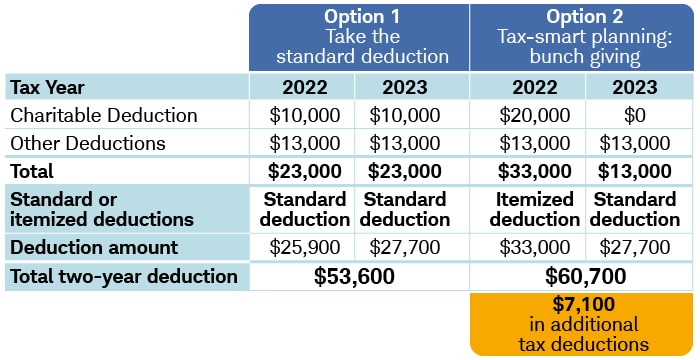
5. Consider combining multiple years of charitable giving into a single year to exceed the standard deduction threshold. This is called “bunching.” The chart below shows how the bunching strategy can reduce taxes if executed properly.

Hypothetical example of a married couple with no children.

Chart explaining the idea of bunching in context of charitable giving
Standard deduction amounts are for married filing jointly status.

Wrapping up 2022 and Planning for 2023

1. Discuss major life events with CD Wealth Management to confirm you have clarity in your current situation.

2. Communicate with your CPA to provide capital gains and investment income information for a more accurate year-end projection.

3. Check your Health Savings Account (HSA) contributions for 2022. If you qualify, you can contribute up to $3,600 (individual) or $7,200 (family) and an additional $1,000 catch up if over the age of 50.

4. Double-check your beneficiary designations for retirement plans, IRAs, Roth IRAs, annuities, life insurance policies, etc.

5. If you do not already have identity theft protection, consider purchasing a service to help protect you and your family.

The end of the year is a perfect time to review your financial planning needs. This includes reviewing the investment portfolio, assessing year-end tax planning opportunities, reviewing retirement goals, and managing your legacy plans. The checklist above includes just some of the items that may apply to you and your family. We are happy to meet to discuss any of the above to ensure that you remain on track with your financial goals.

The CD Wealth Formula

We help our clients reach and maintain financial stability by following a specific plan, catered to each client. 

Our focus remains on long-term investing with a strategic allocation while maintaining a tactical approach. Our decisions to make changes are calculated and well thought out, looking at where we see the economy is heading. We are not guessing or market timing. We are anticipating and moving to those areas of strength in the economy — and in the stock market. 

We will continue to focus on the fact that what really matters right now is time in the market, not out of the market. That means staying the course and continuing to invest, even when the markets dip, to take advantage of potential market upturns. We continue to adhere to the tried-and-true disciplines of diversification, periodic rebalancing and looking forward, while not making investment decisions based on where we have been.

It is important to focus on the long-term goal, not on one specific data point or indicator. Long-term fundamentals are what matter. In markets and moments like these, it is essential to stick to the financial plan. Investing is about following a disciplined process over time.

Sources: BNY Mellon, Baird, CNBC, Schwab

Promo for an article titled Year-End Market Predictions: Separating Fact from Fiction

This material contains an assessment of the market and economic environment at a specific point in time and is not intended to be a forecast of future events, or a guarantee of future results. Forward-looking statements are subject to certain risks and uncertainties. Actual results, performance, or achievements may differ materially from those expressed or implied. Information is based on data gathered from what we believe are reliable sources.

Using diversification as part of your investment strategy neither assures nor guarantees better performance and cannot protect against loss of principal due to changing market conditions.

Past performance is not a guarantee of future results.

The opinions expressed in this commentary are those of the author and may not necessarily reflect those held by Kestra Investment Services, LLC or Kestra Advisory Services, LLC. This is for general information only and is not intended to provide specific investment advice or recommendations for any individual. It is suggested that you consult your financial professional, attorney, or tax advisor with regard to your individual situation.

Securities offered through Kestra Investment Services, LLC (Kestra IS), member FINRA/SIPC. Investment Advisory Services offered through Kestra Advisory Services, LLC (Kestra AS) an affiliate of Kestra IS. CD Wealth Management and Bluespring Wealth Partners LLC* are affiliates of Kestra IS and Kestra AS.  Investor Disclosures: https://bit.ly/KF-Disclosures

*Bluespring Wealth Partners, LLC acquires and supports high quality investment adviser and wealth management companies throughout the United States.

Tips for Planning Charitable Donations, on North Texas Giving Day and Beyond

Today is NTX Giving Day in North Texas. It’s an annual tradition through which the Communities Foundation of Texas connects donors with charities in need and fulfills its mission to put giving to work throughout our local communities.

What a great time to think about making charitable donations for both philanthropic and tax purposes! No matter your interests, making gifts to causes you care about can be one of the most meaningful uses of your money. In the end, what really matters is helping an organization that matters to you. The tax benefits from a donation are just icing on the cake.

Along with the intangible rewards that come from helping others, charitable giving may offer a financial benefit for you and your family.

Most donations to charitable organizations come in the form of checks and credit card payments. However, there may be more efficient ways to donate, which in turn help both the charity as well as your pocketbook. Understanding the benefits for different type of donations is important. Here are some options to consider:

• Cash, check or credit card: This is the most simple and straightforward way of donating to charity. It is important to keep a bank record or a receipt from the charity to substantiate a cash gift. Annual income tax deduction limits for gifts to public charities are 30% of adjusted gross income (AGI) for contributions of non-cash assets, if held for more than one year, and 60% of AGI for contributions of cash. If contributions are made in excess of those limits, the excess may be carried over for up to five years. If you do not have appreciated assets to give or want to give cash, it may be beneficial to combine or “bunch” two years’ worth of charitable contributions into one year so you can take advantage of itemizing deductions.  

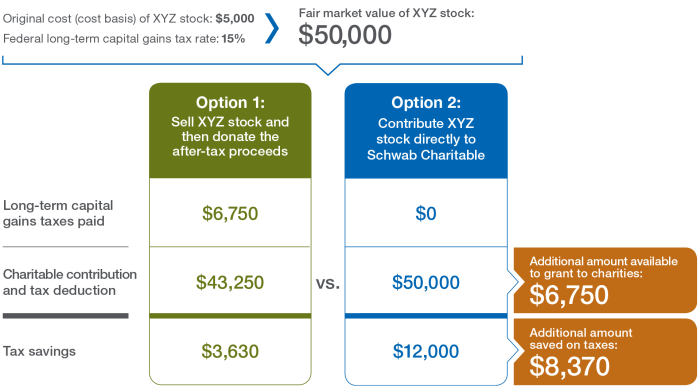
• Appreciated stock: If you donate stock that you have held for at least 12 months, you can deduct the full value of the investment without having to pay capital gains on the appreciation. The current fair market value of the stock is deducted from your taxable income. Often, clients may donate the stock with the biggest winnings, which maximizes savings on capital gains, and then buy back the same stock with cash, which in turn, raises the cost basis. As the chart below shows, if you were to sell appreciated stock and then donate cash to charity (compared to gifting appreciated stock), not only would you save on taxes (the charity does not pay capital gains tax), but the charity would also receive additional monies!  

Chart showing strategy for charitable donations involving appreciated stock
This hypothetical example is only for illustrative purposes. The example does not take into account any state or local taxes or the Medicare net investment income surtax. The tax savings shown is the tax deduction, multiplied by the donor’s income tax rate (24% in this example), minus the long-term capital gains taxes paid. Reprinted from Schwabcharitable.org.

• IRA Qualified Charitable Distributions (QCD): This is an option only for donors over the age of 70 1/2. QCDs allow individuals to donate up to $100,000 annually directly from their IRA to charitable organizations. This reduces the value of the IRA, and the QCD does not count towards the donor’s taxable income. It also counts toward the annual required minimum distribution. 

• Donor Advised Fund (DAF): Picture a donor advised fund as your family foundation, without the headache and administrative hassle of setting up a family foundation. A DAF is a charitable account established at a public charity or community foundation that allows donors to recommend grants over time. The donor decides the timing of the donation, the charity that will receive the donation and the amount of the charitable donation made from the DAF. The donor claims the tax deduction upon funding of the DAF. There is not a requirement that the DAF distribute 5% of the fund each year, which may allow the DAF to grow, expanding the available dollars to donate to charities.

At CD Wealth Management, charitable giving is a significant part of our company’s culture. We believe in giving back with our time as well as our pocketbook. We support many causes in the Dallas-Fort Worth area, and we encourage team members to be involved in the community. Each year, during the holiday season, the company makes a charitable donation in each one of our team members’ names to their charity of choice, offering an additional thanks and helping a great cause at the same time.

Please do not hesitate to reach out to us to discuss your charitable options to help you determine the best way to give for your situation. If you are interested in taking part in NTX Giving Day, click here. (Please note that all funding options described above may not be available for NTX Giving Day.)

The CD Wealth Formula

We help our clients reach and maintain financial stability by following a specific plan, catered to each client. 

Our focus remains on long-term investing with a strategic allocation while maintaining a tactical approach. Our decisions to make changes are calculated and well thought out, looking at where we see the economy is heading. We are not guessing or market timing. We are anticipating and moving to those areas of strength in the economy — and in the stock market. 

We will continue to focus on the fact that what really matters right now is time in the market, not out of the market. That means staying the course and continuing to invest, even when the markets dip, to take advantage of potential market upturns. We continue to adhere to the tried-and-true disciplines of diversification, periodic rebalancing and looking forward, while not making investment decisions based on where we have been.

It is important to focus on the long-term goal, not on one specific data point or indicator. Long-term fundamentals are what matter. In markets and moments like these, it is essential to stick to the financial plan. Investing is about following a disciplined process over time.

Sources: Baird, BMO, Schwab

Promo for article titled Is a Roth IRA the Right Choice for You? Here’s What You Should Consider

This material contains an assessment of the market and economic environment at a specific point in time and is not intended to be a forecast of future events, or a guarantee of future results. Forward-looking statements are subject to certain risks and uncertainties. Actual results, performance, or achievements may differ materially from those expressed or implied. Information is based on data gathered from what we believe are reliable sources.

Using diversification as part of your investment strategy neither assures nor guarantees better performance and cannot protect against loss of principal due to changing market conditions.

Past performance is not a guarantee of future results.

The opinions expressed in this commentary are those of the author and may not necessarily reflect those held by Kestra Investment Services, LLC or Kestra Advisory Services, LLC. This is for general information only and is not intended to provide specific investment advice or recommendations for any individual. It is suggested that you consult your financial professional, attorney, or tax advisor with regard to your individual situation.

Securities offered through Kestra Investment Services, LLC (Kestra IS), member FINRA/SIPC. Investment Advisory Services offered through Kestra Advisory Services, LLC (Kestra AS) an affiliate of Kestra IS. CD Wealth Management and Bluespring Wealth Partners LLC* are affiliates of Kestra IS and Kestra AS.  Investor Disclosures: https://bit.ly/KF-Disclosures

*Bluespring Wealth Partners, LLC acquires and supports high quality investment adviser and wealth management companies throughout the United States.

It’s tax time: What you should know before you file your return

The April 15 deadline to file federal tax returns is approaching quickly, but the practice of tax planning shouldn’t be limited to once a year. Whether you are preparing your own returns or working with a CPA, staying informed about policy changes and regularly assessing your financial situation can help you build strategies that align with your goals.

What tax documents might you need?

• W-2: If you work for an employer, this form tells you how much you earned and how much was deducted for taxes and other withholdings.
• 1099-NEC (MISC): If you are a contract employee, this form tells you how much you earned.
• 1099-INT and 1099-DIV: If you earned interest from savings or investments, you may receive this form. The 1099-DIV reports dividends and distributions from investments.
• Consolidated 1099: This brokerage tax form will show income from dividends, both qualified and non-qualified, as well as any capital gains and losses that occurred during the year.
• 1099-R: If you take a distribution from your retirement account, this form shows the amount of distribution and amount of taxes withheld.
• 5498: This form reports your total annual contributions to an IRA account and identifies the type of retirement account you have.
• 1098: If you own a home and pay mortgage interest, you will receive this form, which shows how much interest you paid and can deduct.
• 1098-T: If you have a dependent in college, you will receive this form, which reports how much qualified tuition and expense was paid during the year.
• K-1: If you have any limited partner investments, you will receive this form, which shows each partner’s share of the earnings, losses, deductions and credits.

Do you know your tax bracket?

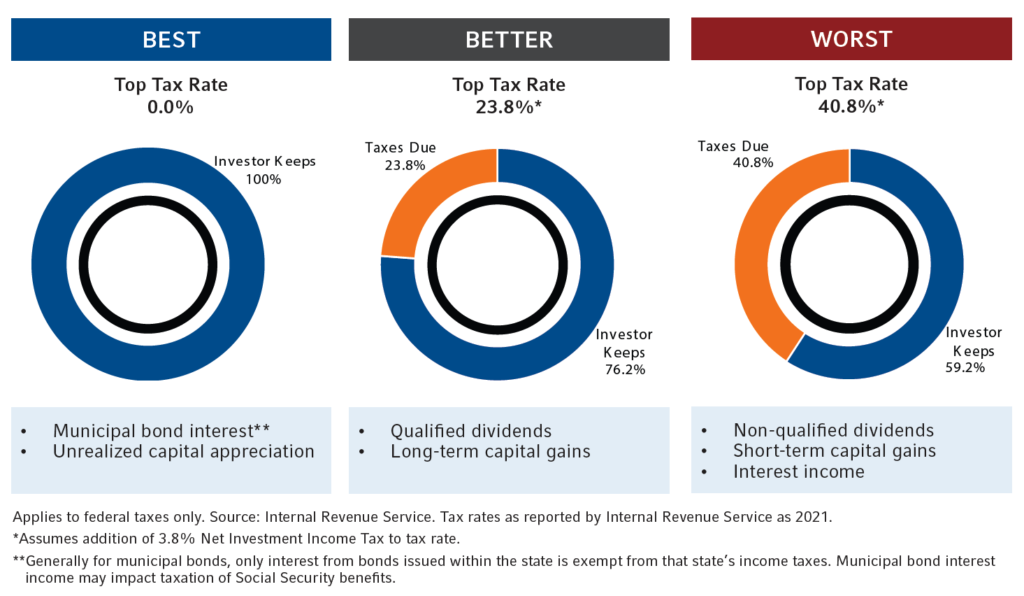
No one wants to pay more taxes than they must. Although the tax code has been simplified over the years, it remains incredibly complex. The number of tax brackets has been reduced significantly; knowing your bracket can help you determine the most tax-efficient investments to make. As shown in the chart below, investors in a high tax bracket may choose to own municipal bonds to reduce taxable income. If you are in a low tax bracket, you may be able to take advantage of lower capital gains rates and pay less on investments sold for a gain. As always, we recommend speaking with your CPA or accountant to review your options.

Did you know that not all investments are taxed the same?

TIP: Where your returns come from matters

Chart showing tax rates for types of investments

If you are in a higher tax bracket, the following strategies may make sense:
• If over age 70, using IRA monies to make charitable distributions to help reduce taxable income
• Delaying taking Social Security income to age 70
• Lumping charitable contributions together in one year to take advantage of itemizing on taxes

If you are in a lower tax bracket, the following strategies may make sense:
• Increasing withdrawals from IRAs up to the level of the current tax bracket
• Converting an IRA to a Roth IRA in a year of lower income taxes
• Deferring income and sale of capital gain property to postpone taxable income
• Bunching medical expenses in the current year to meet the percentage of your adjusted gross income to claim those deductions

How can you maximize your savings?

Regardless of your tax bracket, tax loss harvesting is a strategy worth understanding. With current market volatility, certain investments may have unrealized losses. Tax loss harvesting is the strategy of selling securities at a loss to offset a capital gain tax liability. You do not have to wait until year-end to deploy this strategy, and harvesting losses now allows you to offset taxable gains when the market rebounds. 

Another common strategy is to maximize IRA contributions before April 15. If you currently contribute pre-tax money to a 401K and are not maximizing, consider increasing your contribution to reduce taxable income and help you long term for retirement planning. 

You also may contribute to an IRA for your spouse if he or she is not working. The contributions may not be tax-deductible if you are both working — but this could be a good long-term strategy nonetheless. If you do not have a 401K, contributing to an IRA, Roth IRA or SEP IRA may help reduce taxable income. You may be able to deduct annual contributions of up to $6,000 to your traditional IRA and $6,000 to your spouse’s IRA ($7,000 if over age 50).

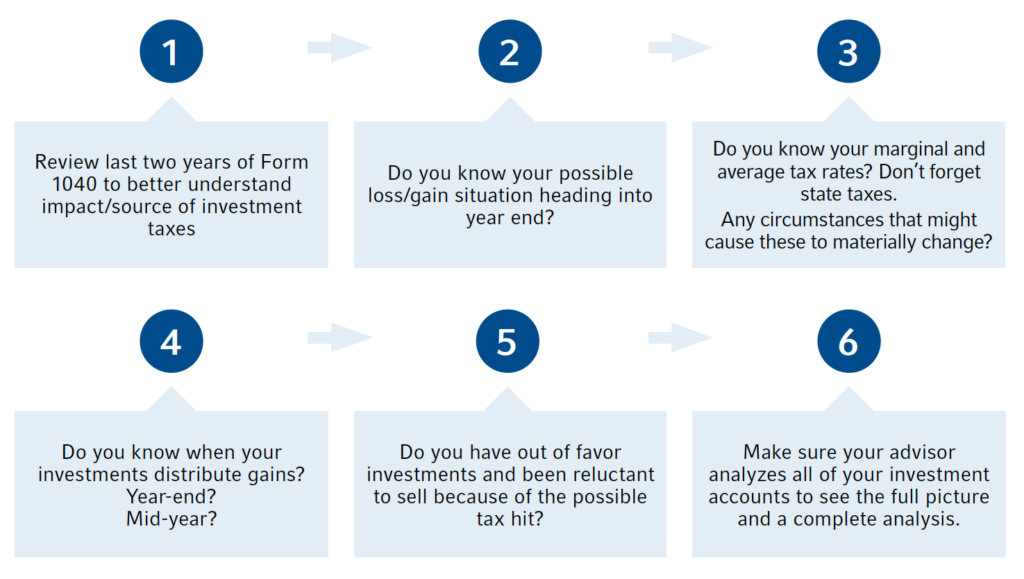
Here are some steps you and your advisor can consider before the end of the year:

Chart outlining financial planning steps such as 1. Review last two years of Form 1040 to better understand impact/source of investment taxes, 2. Do you know your possible los/gain situation heading into year end? 3. Do you know your marginal and average tax rates? Don't forget state taxes. Any circumstances that might cause these to materially change> 4. Do you know when your investments distribute gains? Year end? Mid-year? 5. Do you have out of favor investments and been reluctant to sell because of the possible tax hit? Make sure your advisor analyzes all of your investment accounts to see the full picture and a complete analysis.

Tax planning is not just a once-a-year event. The chart above is a good illustration of how we are constantly evaluating current circumstances to help guide our clients with potential tax saving strategies as part of the wealth planning process. We want to ensure you that along with your CPA, we are evaluating the landscape for tax changes and strategies that may help save future dollars and keep money in your pocket.

So, what can we learn from all this? As you prepare to file your taxes before April 15, it is a perfect time to review your financial and wealth planning needs. This includes reviewing the investment portfolio, assessing ongoing tax-planning opportunities, reviewing retirement goals and managing your wealth transfer and legacy plans. The information above represents just some of the items that may apply to you and your family. We are happy to meet to discuss any of the above to ensure that you remain on track with your financial profile.

From a portfolio perspective, we continue to adhere to the tried-and-true disciplines of diversification, periodic rebalancing and looking forward, while not making investment decisions based on where we have been. As we say each week, it is important to stay the course and focus on the long-term goal, not on one specific data point or indicator.

In markets and moments like these, it is essential to stick to the financial plan.

Panic is not an investing strategy. Neither are “get in” or “get out” — those sentiments are just gambling on moments. Investing is a disciplined process, done over time. At the end of the day, investors will be well served to remove emotion from their investment decisions and to remember that over the long term, markets tend to rise. Market corrections are normal, as nothing goes up in a straight line. 

The key is to stay invested and stick with the financial plan. Markets go up and down over time, and downturns present opportunities to purchase stocks at a lower value.

It all starts with a solid financial plan for the long run that understands the level of risk that is acceptable for each client. Regarding investments, we believe in diversification and having different asset classes that allow you to stay invested. The best option is to stick with a broadly diversified portfolio that can help you to achieve your own specific financial goals — regardless of market volatility. Long-term fundamentals are what matter.

Sources: IRS, Russell Investments, U.S. News

Promo for an article titled What Does Russia's Invasion of Ukraine Mean for Investors?

This material contains an assessment of the market and economic environment at a specific point in time and is not intended to be a forecast of future events, or a guarantee of future results. Forward-looking statements are subject to certain risks and uncertainties. Actual results, performance, or achievements may differ materially from those expressed or implied. Information is based on data gathered from what we believe are reliable sources.

Using diversification as part of your investment strategy neither assures nor guarantees better performance and cannot protect against loss of principal due to changing market conditions.

Past performance is not a guarantee of future results.

The opinions expressed in this commentary are those of the author and may not necessarily reflect those held by Kestra Investment Services, LLC or Kestra Advisory Services, LLC. This is for general information only and is not intended to provide specific investment advice or recommendations for any individual. It is suggested that you consult your financial professional, attorney, or tax advisor with regard to your individual situation.

Securities offered through Kestra Investment Services, LLC (Kestra IS), member FINRA/SIPC. Investment Advisory Services offered through Kestra Advisory Services, LLC (Kestra AS) an affiliate of Kestra IS. CD Wealth Management and Bluespring Wealth Partners LLC* are affiliates of Kestra IS and Kestra AS.  Investor Disclosures: https://bit.ly/KF-Disclosures

*Bluespring Wealth Partners, LLC acquires and supports high quality investment adviser and wealth management companies throughout the United States.