Here’s What Investors Need To Know About Banking Turmoil in the U.S.

Last week, the financial markets experienced a shock not seen since the days of the Great Financial Crisis in 2008. The second-largest bank failure on record happened when Silicon Valley Bank (SVB) shut its doors on Friday after it was unable to meet the demands for its customers to redeem their money. SVB was a nearly 40-year-old bank that primarily served the tech world along with private equity and venture capitalists. 

Clearly, the sudden nature of SVB’s collapse caught the banking world by surprise. Within 48 hours, the bank went from trading over $300 per share to being shut down. Venture capital companies helped lead the run on the bank, withdrawing more than $42 billion by Thursday. The bank was mismanaged in many ways, and its management has questions to answer. SVB took in a large amount of deposits from 2019 through 2021. With those monies, the bank purchased longer-dated Treasuries to earn interest on the cash and help with the spread on what it was lending out. 

Over the last 12 months, the Fed has raised interest rates eight times. When rates rise, bond prices fall. Longer-dated bonds have more volatility, so their prices tend to fall more than shorter-maturity bonds. 

Last week, when SVB clients started to demand their monies as rumors of the bank’s losses mounted, the bank had to sell more bonds at a large loss due to the rise in rates. SVB had not put proper hedges in place to manage interest rate risk and exposed its clients to these losses. We do not believe that this is an industrywide issue or that there will be runs on other banks. 

Could other banks have a similar fate to SVB? The short answer is yes. But remember: After both the Great Depression and the Great Financial Crisis, processes and procedures were put in place for this very reason.

A large percentage of the bank’s deposits were uninsured, i.e., over the FDIC-insured limits of $250,000 per person and $500,000 for a married couple. Many companies used SVB for their banking, and companies like Roku had an estimated $487 million in deposits at SVB. Smaller tech companies also had their cash there and are now trying to figure out a way to meet payroll. 

The Federal Reserve said it is taking actions to protect the U.S. economy by strengthening public confidence in the banking system. This step will ensure that the banking system continues to perform its vital roles of protecting deposits and providing access to credit to households and businesses in a manner that promotes strong and sustainable economic growth.

Depositors will have access to all of their money starting Monday, March 13. No losses associated with the resolution of SVB will be assumed by the taxpayer.

The Fed also announced a similar systemic risk exception for New York-based Signature Bank. All depositors of this institution will be made whole. As with the resolution of SVB, no losses will be assumed by the taxpayer.

Shareholders and certain unsecured debtholders will not be protected. Senior management has also been removed. Any losses to the Deposit Insurance Fund to support uninsured depositors will be recovered by a special assessment on banks, as required by law.

As the week progresses, we should learn more about what the government, Federal Reserve or FDIC may do to continue to calm the waters.

Biggest Bank Failures
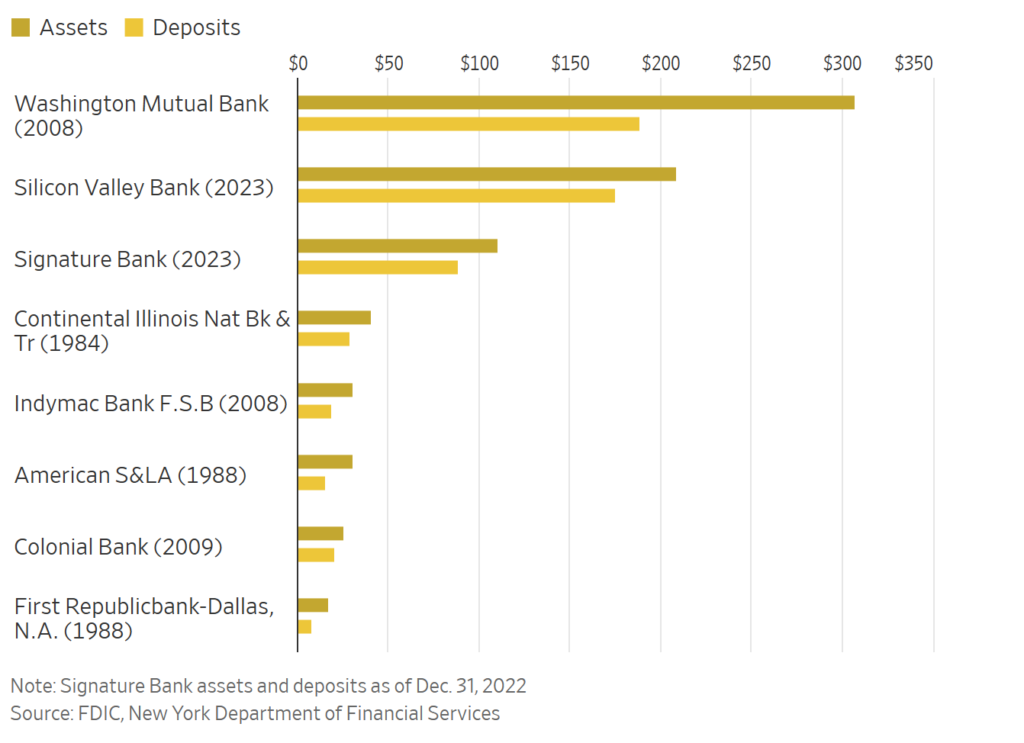
Chart showing the largest U.S. bank failures

We want to remind and reassure you of the financial strength of Fidelity and the power of independence and team behind CD Wealth Management. The chart below outlines the approach CD Wealth takes with our clients. We do not take custody of any assets. We are the team that works with you to create your plan, oversee your monies and guide you on a daily basis. We invest your assets in the public, liquid markets. Your assets are custodied, or held, at Fidelity Institutional®. Fidelity is not a bank like SVB, or even Chase, Bank of America or Wells Fargo. Fidelity does not take in deposits to then make loans for homes, mortgages, businesses, etc. It is not investing your monies in bonds to make a spread on deposits as banks are. 

Fidelity is a clearing house to hold your monies, whether in cash, stocks, bonds, mutual funds or exchange traded funds. It is important to understand and feel confident that institutions like Fidelity and Vanguard are not in the same business as commercial banks. That is why we choose to use them and not blur the lines between banking and investment management.
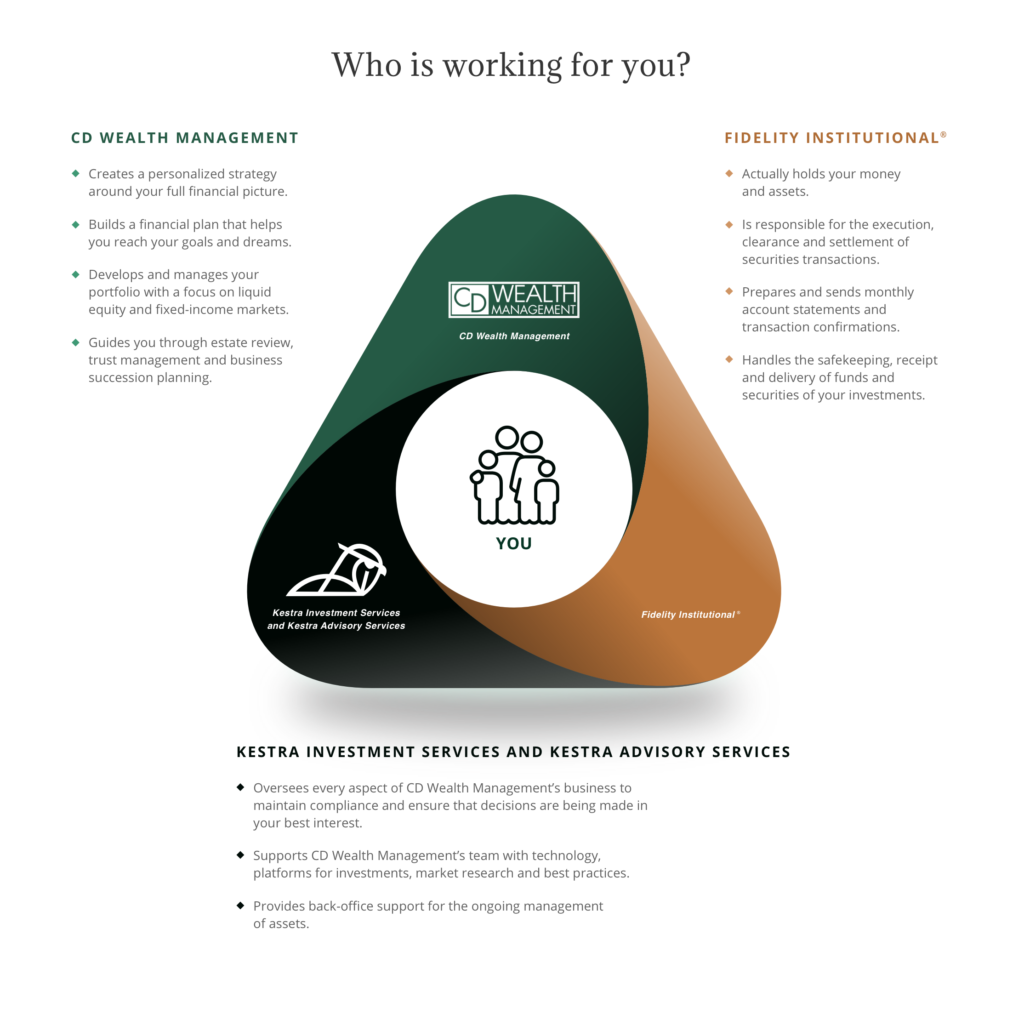
Chart showing the relationship between CD Wealth, Fidelity and Kestra

Please know that we have full faith and confidence in the banking system today. Most importantly, we have full faith and confidence in where your monies are being held (Fidelity Institutional®) and in the money markets where your monies are being invested. Please do not hesitate to reach out with any questions that you have.

The CD Wealth Formula

We help our clients reach and maintain financial stability by following a specific plan, catered to each client. 

Our focus remains on long-term investing with a strategic allocation while maintaining a tactical approach. Our decisions to make changes are calculated and well thought out, looking at where we see the economy is heading. We are not guessing or market timing. We are anticipating and moving to those areas of strength in the economy — and in the stock market. 

We will continue to focus on the fact that what really matters right now is time in the market, not out of the market. That means staying the course and continuing to invest, even when the markets dip, to take advantage of potential market upturns. We continue to adhere to the tried-and-true disciplines of diversification, periodic rebalancing and looking forward, while not making investment decisions based on where we have been.

It is important to focus on the long-term goal, not on one specific data point or indicator. Long-term fundamentals are what matter.  In markets and moments like these, it is essential to stick to the financial plan. Investing is about following a disciplined process over time.

Sources: Bloomberg, CNBC, FDIC, CD Wealth Management

Promo for an article titled Artificial Intelligence Is Changing the World — Here's What You Should Know

This material contains an assessment of the market and economic environment at a specific point in time and is not intended to be a forecast of future events, or a guarantee of future results. Forward-looking statements are subject to certain risks and uncertainties. Actual results, performance, or achievements may differ materially from those expressed or implied. Information is based on data gathered from what we believe are reliable sources.

Using diversification as part of your investment strategy neither assures nor guarantees better performance and cannot protect against loss of principal due to changing market conditions.

Past performance is not a guarantee of future results.

The opinions expressed in this commentary are those of the author and may not necessarily reflect those held by Kestra Investment Services, LLC or Kestra Advisory Services, LLC. This is for general information only and is not intended to provide specific investment advice or recommendations for any individual. It is suggested that you consult your financial professional, attorney, or tax advisor with regard to your individual situation.

Securities offered through Kestra Investment Services, LLC (Kestra IS), member FINRA/SIPC. Investment Advisory Services offered through Kestra Advisory Services, LLC (Kestra AS) an affiliate of Kestra IS. CD Wealth Management and Bluespring Wealth Partners LLC* are affiliates of Kestra IS and Kestra AS. Investor Disclosures: https://bit.ly/KF-Disclosures

*Bluespring Wealth Partners, LLC acquires and supports high quality investment adviser and wealth management companies throughout the United States.

Fidelity Investments and Fidelity Institutional® (together “Fidelity”) is an independent company, unaffiliated with Kestra Financial or CD Wealth Management. Fidelity is a service provider to both. There is no form of legal partnership, agency affiliation, or similar relationship between your financial advisor and Fidelity, nor is such a relationship created or implied by the information herein. Fidelity has not been involved with the preparation of the content supplied by CD Wealth Management and does not guarantee, or assume any responsibility for, its content. Fidelity Investments is a registered service mark of FMR LLC. Fidelity Institutional provides clearing, custody, or other brokerage services through National Financial Services LLC or Fidelity Brokerage Services LLC, Members NYSE, SIPC.

Artificial Intelligence Is Changing the World — Here’s What You Should Know

The rise of artificial intelligence has become a major theme in the first few months of 2023. AI has played a large role in our everyday lives for some time now, but aside from comments by companies like Nvidia, Microsoft and Google in their conference calls, many investors may know little about it.

History of Artificial Intelligence

AI is defined as “the study and development of computer systems that can copy intelligent behavior.” In a primitive form, the concept of AI goes back to the Age of Antiquity, but modern AI began in the 1950s with work by John McCarthy, Alan Turing and other computer scientists who sought to prove that computers could be programmed to mimic humans’ problem-solving capabilities. 

The surge in the field of AI has been fueled by exponentially growing amounts of data and data-processing capabilities that allow computers to better manipulate the numbers. As computers have become faster and able to process more data, AI has become more relevant. (Those of us who were teenagers in the 1980s might remember the question “Shall we play a game?” from the movie WarGames, in which AI shows through simulation that no one would win in a nuclear war.)

Types of Artificial Intelligence

There are two broad types of artificial intelligence: Narrow AI and General AI

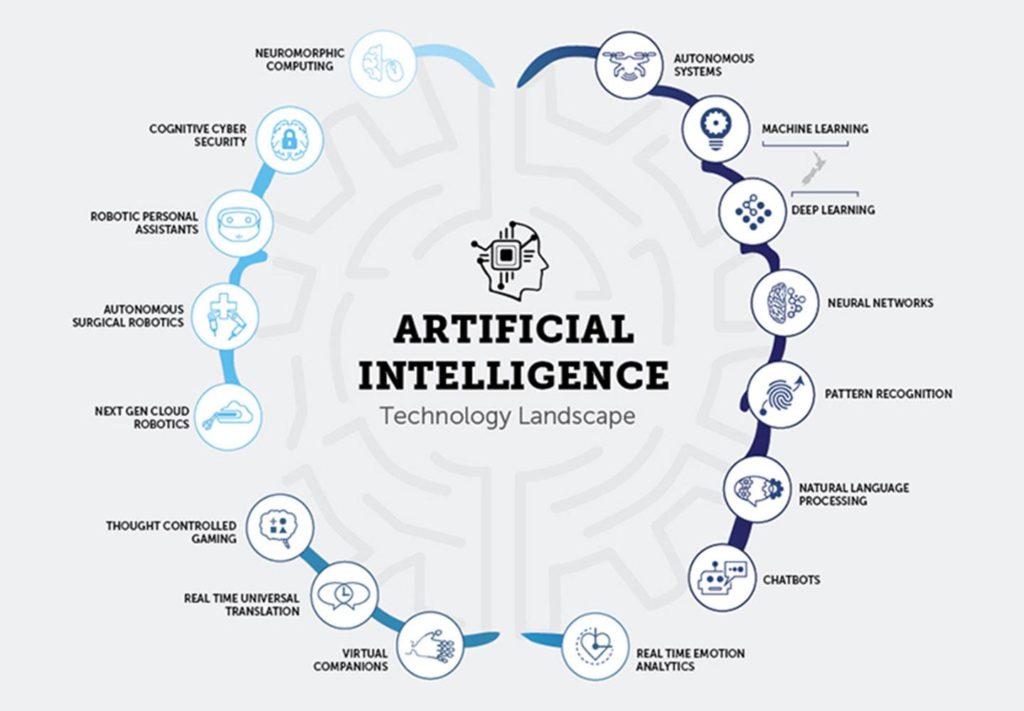
Narrow AI performs a single task without sophisticated programming; think of Siri for Apple, answering questions that are asked of it. Narrow AI is based on machine learning, constructed through a set of algorithms that try to imitate human intelligence. Machine learning uses data and statistics to better “learn” the data to improve its ability to solve the task at hand. Deep learning is a type of machine learning that tries to imitate the human brain, taking the data through a biologically inspired neural network and processing the data to make connections and create patterns.

General AI is more complex and tries to mirror human intellect. It uses its ability to learn and apply knowledge learned to solve problems. We are still in the process of moving from narrow AI to general AI. This is why the field of AI is so exciting to so many people — we are still in the very early stages of what we can do with it.

Chart showing various uses of artificial intelligence across industries and networks

A lot of companies use the term AI in their marketing efforts, but the ways it is used vary widely. Here are some examples of how industries are using AI today:

Medicine: AI aids in producing sharper images more quickly for radiologists by using algorithms, helps to assess heart muscle functions through cardiac ultrasound technology and assists drug discovery by determining if new drugs are more effective than older ones.

Search: AI-powered search technology refines the relevance of search-engine results, powers the ability to chat and helps users compose content. In announcing Bard, a conversational AI service in development, Google’s CEO recently said that AI will “distill complex information and multiple perspectives into easy-to-digest formats.” 

Chatbots: Consumers benefit from AI as it is used to remove frustration from calling customer service centers and enables machines to answer frequently asked questions, take orders, track orders and direct calls.

Maps and navigation: Services use AI to deliver optimal routes, road barriers and traffic congestion through wayfinding apps and services. Using machine learning, algorithms remember buildings, roadways and other landmarks to allow for better visuals on maps.

Facial detection and recognition: AI powers technology that uses facial identification to unlock our devices and enables facial-recognition surveillance efforts by airport security.

Text editing and autocorrect: Algorithms use machine learning and deep learning to identify incorrect usage of language and recommend corrections. Tools such as Grammarly can check our work before we submit papers and check our spelling to make sure there are no errors in emails.

Social media: Applications are using the support of AI to monitor content, suggest connections and advertise to targeted users to ensure that we are plugged in. Social media AI has the ability to understand the types of content that resonate with users and suggest similar content.

Electronic payments: Banks are leveraging AI to facilitate customers’ payment processes — making deposits, transferring money and even opening accounts.

Nearly every part of your day is touched by some form of AI. Automated learning and discovery through data add intelligence to existing products, achieve accuracy through deep neural networks and deep learning, and gets the most out of data. The goal of AI is to provide software that can reason on input and explain on output.

AI will continue to provide humanlike interactions with software and decision support for specific tasks — but it is not a replacement for humans (at least not in the near future)! As it evolves, AI will continue to provide important breakthroughs, especially in the field of medicine, for years to come.

The CD Wealth Formula

We help our clients reach and maintain financial stability by following a specific plan, catered to each client. 

Our focus remains on long-term investing with a strategic allocation while maintaining a tactical approach. Our decisions to make changes are calculated and well thought out, looking at where we see the economy is heading. We are not guessing or market timing. We are anticipating and moving to those areas of strength in the economy — and in the stock market. 

We will continue to focus on the fact that what really matters right now is time in the market, not out of the market. That means staying the course and continuing to invest, even when the markets dip, to take advantage of potential market upturns. We continue to adhere to the tried-and-true disciplines of diversification, periodic rebalancing and looking forward, while not making investment decisions based on where we have been.

It is important to focus on the long-term goal, not on one specific data point or indicator. Long-term fundamentals are what matter.  In markets and moments like these, it is essential to stick to the financial plan. Investing is about following a disciplined process over time.

Sources: AI Time Journal, Bloomberg

Promo for an article titled How to Protect Your Elderly Loved Ones from Financial Scams

This material contains an assessment of the market and economic environment at a specific point in time and is not intended to be a forecast of future events, or a guarantee of future results. Forward-looking statements are subject to certain risks and uncertainties. Actual results, performance, or achievements may differ materially from those expressed or implied. Information is based on data gathered from what we believe are reliable sources.

Using diversification as part of your investment strategy neither assures nor guarantees better performance and cannot protect against loss of principal due to changing market conditions.

Past performance is not a guarantee of future results.

The opinions expressed in this commentary are those of the author and may not necessarily reflect those held by Kestra Investment Services, LLC or Kestra Advisory Services, LLC. This is for general information only and is not intended to provide specific investment advice or recommendations for any individual. It is suggested that you consult your financial professional, attorney, or tax advisor with regard to your individual situation.

Securities offered through Kestra Investment Services, LLC (Kestra IS), member FINRA/SIPC. Investment Advisory Services offered through Kestra Advisory Services, LLC (Kestra AS) an affiliate of Kestra IS. CD Wealth Management and Bluespring Wealth Partners LLC* are affiliates of Kestra IS and Kestra AS. Investor Disclosures: https://bit.ly/KF-Disclosures

*Bluespring Wealth Partners, LLC acquires and supports high quality investment adviser and wealth management companies throughout the United States.

How to Protect Your Elderly Loved Ones from Financial Scams

The elderly lose almost $3 billion every year to scammers. Financial scams targeting seniors have become so prevalent that the question is not whether your parents will be contacted by a scammer, but when — and whether they will be able to recognize the threat. 

Financial scams often go unreported and can be difficult to prosecute, so they are considered a low-risk crime. However, they are absolutely devastating to older adults, often leaving them in a vulnerable position with little time to recoup their losses. It is not always strangers who commit these crimes, either. More than 90% of reported elder abuse is committed by family members.

Scammers are always coming up with new tactics. They often rely on seniors’ desire to have a good retirement or to take care of their family members.

Many of the current scams targeting seniors fall under the broad “impersonator” category, in which the scammer pretends to be someone to gain trust or scare the victim into action.

Among the most common scams: 

The Grandparent Scam: This happens when a scammer pretends to be the victim’s grandchild. The scammer will often make up a distressful situation and ask for financial assistance. To avoid raising suspicions from other family members, they will ask you to keep everything a secret. This is such a devious approach because it preys on one of older adults’ most reliable assets: their hearts. 

Online Romance Scam: These scams occur when someone builds an online romantic (or platonic) relationship with you while using a fake identity and then starts asking for money. The scammers might create complete social media profiles and have full backstories for their identities. It may be a long con game, taking weeks or months to get to know you before asking for anything. The scammers may ask you to invest in a business, send them money or help a family member who is sick in the hospital. Like the grandparent scam, they want you to keep their request for money a secret. 

Texting Scam: Fake text messages have been on the rise since the pandemic. These scammers try to trick you into believing you are communicating with a legitimate representative of Amazon, Apple, PayPal, Netflix or another online company. They tell you that your account has been compromised, suspicious activity has been tracked or a package is delayed. Once you click the link, they try to obtain your valuable personal information and even your credit card information. 

Medicare Scam: These scams target Medicare beneficiaries by claiming to be a Medicare representative and asking for personal and medical information. Once they obtain your information, they will then use or sell it to identity thieves. Every U.S. citizen over the age of 65 qualifies for Medicare, so there is rarely any need for a scam artist to research what private health insurance company older people have to try to scam them.  

Internet or Phishing Scam: Similar to the texting scam, older people are easier targets for automated internet scams. Pop-up browser windows simulating virus-scanning software will fool victims into downloading a fake anti-virus program or an actual virus that will expose whatever information is on the computer.

Promo for an article titled How to Talk with Your Aging Parents About Planning for the Future

Giving your parents stern warnings or demanding to take over their finances may seem like the way to go, but often those tactics come with emotional fallout. Threatening your parents’ independence may play right into scammers’ hands; victims often don’t want to admit they were wrong because they may feel ashamed or vulnerable and don’t want to appear that they are unable to take care of themselves.

So how can you help? 

• Don’t just tell your parent to hang up or throw out the letter. Have a talk about why. They may need help identifying red flags that seem obvious to you. For example: You didn’t win the Ed McMahon sweepstakes. You don’t have to pay a fee for winning the lottery. Government agencies don’t make unsolicited calls and ask for personal information. 

• Do not shame or blame them. Remind them what they taught us years ago: Don’t trust strangers, especially those seeking money or personal information. Remind your parents that you are there to help and that they should not feel ashamed. Show compassion during this stressful time. 

• Stay connected regularly. Talk to them about the risks of sharing their personal information online, over the phone or by mail. If they think they have been scammed, have them contact you immediately. They may be embarrassed that this happened to them, but the longer they sit on it, the worse it can get. 

• Set up alerts. They should receive alerts if their account has been hacked or if the bank detects suspicious activity. Discuss having them give you access to view their bank accounts online. 

• Save copies of their correspondence to share with the authorities, the bank or credit card companies. 

• Teach good digital hygiene. Show them how to spot suspicious emails, texts and websites. They should look over the messaging and the website to make sure it is legitimate.  

• Un-list your parent’s phone number so scammers can’t get it. At the same time, put your parents’ address on opt-out lists with the Direct Marketing Association

To our clients: Please know that we are here to help, too. As your fiduciary, if we recognize any signs of elder abuse, we will notify Kestra, who will in turn notify the proper federal agencies. We are on your team and are ready to help without judgment. We can help buffer with the family and have the conversation in a safe environment. 

We ask that you share this article with your friends and family members in the hopes that your loved ones will not get scammed and will avoid the headache and embarrassment that affect so many.

The CD Wealth Formula

We help our clients reach and maintain financial stability by following a specific plan, catered to each client. 

Our focus remains on long-term investing with a strategic allocation while maintaining a tactical approach. Our decisions to make changes are calculated and well thought out, looking at where we see the economy is heading. We are not guessing or market timing. We are anticipating and moving to those areas of strength in the economy — and in the stock market. 

We will continue to focus on the fact that what really matters right now is time in the market, not out of the market. That means staying the course and continuing to invest, even when the markets dip, to take advantage of potential market upturns. We continue to adhere to the tried-and-true disciplines of diversification, periodic rebalancing and looking forward, while not making investment decisions based on where we have been.

It is important to focus on the long-term goal, not on one specific data point or indicator. Long-term fundamentals are what matter. In markets and moments like these, it is essential to stick to the financial plan. Investing is about following a disciplined process over time.

Sources: AARP, CNBC

Promo for an article titled The Portfolio Changes We'e Making as the Market Evolves

This material contains an assessment of the market and economic environment at a specific point in time and is not intended to be a forecast of future events, or a guarantee of future results. Forward-looking statements are subject to certain risks and uncertainties. Actual results, performance, or achievements may differ materially from those expressed or implied. Information is based on data gathered from what we believe are reliable sources.

Using diversification as part of your investment strategy neither assures nor guarantees better performance and cannot protect against loss of principal due to changing market conditions.

Past performance is not a guarantee of future results.

The opinions expressed in this commentary are those of the author and may not necessarily reflect those held by Kestra Investment Services, LLC or Kestra Advisory Services, LLC. This is for general information only and is not intended to provide specific investment advice or recommendations for any individual. It is suggested that you consult your financial professional, attorney, or tax advisor with regard to your individual situation.

Securities offered through Kestra Investment Services, LLC (Kestra IS), member FINRA/SIPC. Investment Advisory Services offered through Kestra Advisory Services, LLC (Kestra AS) an affiliate of Kestra IS. CD Wealth Management and Bluespring Wealth Partners LLC* are affiliates of Kestra IS and Kestra AS.  Investor Disclosures: https://bit.ly/KF-Disclosures

*Bluespring Wealth Partners, LLC acquires and supports high quality investment adviser and wealth management companies throughout the United States.

The Portfolio Changes We’re Making as the Market Evolves

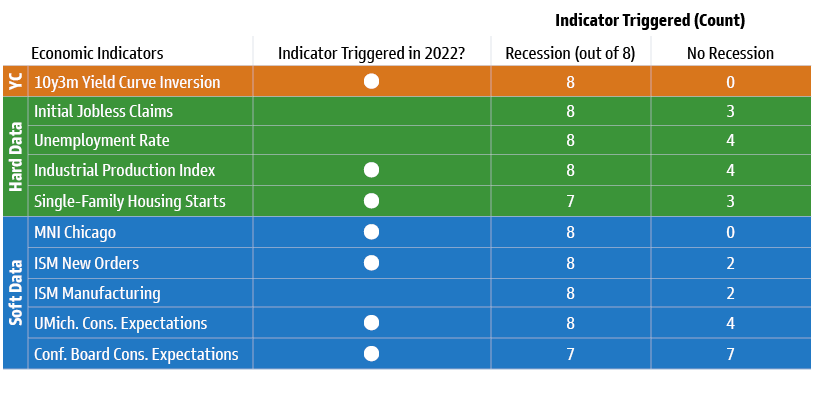
As we near springtime, we find ourselves in a time of transition — is the weather going to be cold or hot? The economy also is in transition, and with lots of contradictions — are we going into a recession or not? Deteriorating economic indicators have had a strong track record of predicting recessions, but many have incorrectly warned of oncoming contractions. Soft and hard data hit recessionary levels in 2022, but the big question is whether the Federal Reserve and other banks will find a way to subdue inflation without causing a recession.

Labor remains strong, and inflation continues to show signs of cooling. Consumers are spending money, as seen in a retail sales increase of 3% month over month in January. Wage growth is slowing but remains fairly high. On the flip side, growth in average hourly earnings has slowed relatively quickly. The Fed has recently indicated concern that inflation in the service sector (not including housing) remains stubbornly high. However, weakening consumer spending suggests price growth will continue to slow. Banks have made it harder and more expensive for consumers and businesses to obtain credit and financing. 

With rates rising for mortgages, credit cards and auto loans, the Fed’s tightening policy is on track to slow consumption and demand. As we have written before, this is one of the two methods the Fed is employing to slow down inflation: reducing demand and increasing unemployment to slow wage growth. 

Global manufacturing has lagged following the pandemic as inventory shortages turned to gluts. Now, however, signs have started to emerge that manufacturing may be bouncing back as surplus inventories are down. Growth in manufacturing would be a good sign for the global economy. The tradeoff, though, is that such a recovery could prevent central banks from cutting interest rates, as many have predicted later this year.

Chart listing economic indicators and their correlation to recessions
Source:  Bloomberg, FRED, GSAM. As of Jan. 31, 2023

With all the conflicting messages and information, we must continue to look ahead. We use leading economic indicators to point to future events; lagging indicators tell us where we have been, helping us confirm a pattern. Both serve a purpose, but the markets are forward-looking, often telling us what may happen ahead of time.

As we reallocate and rebalance our client portfolios to account for where we think the market is heading, we are making the following changes:

1. From a fixed-income perspective, last year we maintained a shorter duration in the portfolio as the Fed remains in a tightening cycle. The very short end of the curve has continued to rise, yielding to higher money market and Treasury rates. We feel that most of the interest-rate change is accounted for in the bond market. At the same time, in taxable accounts, we added a tax-free municipal bond position instead of a taxable bond fund, as municipal bonds offer great value in this market. We are watching the Fed closely for indications of the end of the rate-hiking cycle and will look to adjust the duration of the portfolio when there is further clarity.

2. Last year, we did a significant amount of tax-loss harvesting to take advantage of a down market. As we potentially enter a recession or a market bottom, diversification and active management should play a larger role. In 2022, both stocks and bonds fell together. Cash, some commodities and energy stocks were the lone survivors in an otherwise bad year. We continue to believe in both passive and active funds in the portfolios, depending on the asset class. We are swapping out passive investment in small-cap stocks for an active manager. At the same time, we are adding an exposure to emerging markets. In 2023, China is reopening after several years of lockdowns, and the dollar is weakening. The portfolios are not overweight in either stocks or bonds and have a good mix of growth and value. We feel the portfolios are prepared for either an upside surprise or continued volatility. 

Our focus remains on long-term investing with a strategic allocation while maintaining a tactical approach. Our decisions to make changes are calculated and well thought out. We are not guessing or market timing.

We are anticipating and moving to those areas of strength in the economy — and in the stock market. We will continue to focus on the fact that what really matters right now is time in the market, not out of the market. That means staying the course and continuing to invest, even when the markets dip, to take advantage of potential market upturns. 

We continue to adhere to the tried-and-true disciplines of diversification, periodic rebalancing and looking forward, while not making investment decisions based on where we have been. It is important to focus on the long-term goal, not on one specific data point or indicator. 

Long-term fundamentals are what matter. In markets and moments like these, it is essential to stick to the financial plan. Investing is about following a disciplined process over time.

Sources: Bloomberg, GSAM, Investopedia, Schwab

Promo for an article titled What You Need to Know to Get Ready for Tax Season

This material contains an assessment of the market and economic environment at a specific point in time and is not intended to be a forecast of future events, or a guarantee of future results. Forward-looking statements are subject to certain risks and uncertainties. Actual results, performance, or achievements may differ materially from those expressed or implied. Information is based on data gathered from what we believe are reliable sources.

Using diversification as part of your investment strategy neither assures nor guarantees better performance and cannot protect against loss of principal due to changing market conditions.

Past performance is not a guarantee of future results.

The opinions expressed in this commentary are those of the author and may not necessarily reflect those held by Kestra Investment Services, LLC or Kestra Advisory Services, LLC. This is for general information only and is not intended to provide specific investment advice or recommendations for any individual. It is suggested that you consult your financial professional, attorney, or tax advisor with regard to your individual situation.

Securities offered through Kestra Investment Services, LLC (Kestra IS), member FINRA/SIPC. Investment Advisory Services offered through Kestra Advisory Services, LLC (Kestra AS) an affiliate of Kestra IS. CD Wealth Management and Bluespring Wealth Partners LLC* are affiliates of Kestra IS and Kestra AS.  Investor Disclosures: https://bit.ly/KF-Disclosures

*Bluespring Wealth Partners, LLC acquires and supports high quality investment adviser and wealth management companies throughout the United States.

What You Need to Know to Get Ready for Tax Season

No one likes tax season, but there are some steps you can take to reduce the headaches and make things easier for you and your CPA. Your preparer should tell you when they need all the information to finalize or to extend your return before the deadline. If you are asked to complete a questionnaire, there’s a reason why: Those documents cover most (if not all) of what you will need to provide for your return to be complete and accurate. 

Most of life’s major events seem to have a tax impact: marriage, divorce, births, deaths, home purchase or sale, new business, inheritance, etc. Your preparer’s questionnaire is designed to ensure you don’t forget to include anything important. Be sure to review all the questions they ask, as things change from year to year.

As we approach April 15, here are some ways to make tax season go more smoothly — and a list of documents you might need.

Documentation Reported to IRS 

W-2s: If you work for an employer, you will have a W-2 that shows how much you earned and how much was deducted for taxes and other withholdings.
1099-NEC (MISC): If you are a contract employee, you can expect to receive this form.
1099-INT and 1099-DIV: If you earned interest from savings or investments, you may receive this form. The 1099-DIV reports dividends and distributions from investments. Sources for 1099s include bank interest, brokerage accounts, stock dividends and sales, sale of real estate, Social Security and 529 distributions, to name a few.
Consolidated 1099: This brokerage tax form will show income from dividends, both qualified and non-qualified, as well as any capital gains and losses that occurred during the year.
1099-R: If you take a distribution from your retirement account, you will have a 1099-R that shows the amount of distribution and amount of taxes withheld.
5498: This form reports your total annual contributions to an IRA account and identifies the type of retirement account you have.
1098: If you own a home and pay mortgage interest, you will receive this form from your lender, showing the amount of interest that was paid and that can be deducted.
1098-T: If you have a dependent in college, you will receive this form that reports how much qualified tuition and expense was paid during the year.
K-1: If you have any limited partner investments, you will receive a K-1 that shows each partner’s share of the partnership’s earnings, losses, deductions and credits. Examples include trusts, partnerships, and S Corporations.

Information Not Reported to the IRS That Requires Recordkeeping

• Business income and expenses.
• Charitable contributions, including donor-advised funds and qualified charitable distributions. Remember, when you make a donation to a qualified charity from a donor-advised fund or from your IRA (if you are over age 70½), you are not eligible for a charitable deduction at that time. You received a deduction when you added monies to the donor-advised fund, and you are reducing your taxable income when made from the IRA. 
• Real estate taxes.
• Contributions to 529s, HSAs and IRAs.
• Medical expenses.
• Estimated tax payments.

Old Files You Should Retain

• In most cases, you should plan on keeping tax returns — along with W-2s, 1099s, records supporting itemized deductions and other documents — for a period of at least three years following the date you filed or the due date of your tax return.
• Keeping tax returns for the three-year period is tied to the IRS statute of limitations. The IRS generally has only three years from the filing date or due date of the return to assess additional taxes.
• In some cases, you may need to hold onto your records longer than three years:
— Keep tax forms for retirement accounts, such as IRAs, until seven years after the account is zeroed out.
— If you file a claim for worthless security or bad debt, you must keep those records for seven years.
— If you buy or sell property, you should keep property records until the statute of limitations expires for the year in which you disposed of the property.

Maintaining good records and approaching tax season efficiently can have other benefits; being proactive and comprehensive can help you minimize taxes. Along with your CPA, CD Wealth Management can help you develop tax strategies that will pay off now — and well into the future. Once you have filed your taxes, it is beneficial to provide your financial advisor with a copy of your return. 

Remember, tax planning is not just a once-a-year event. We want to ensure you that we are evaluating the landscape for tax changes and strategies that may help save future dollars and keep money in your pocket.

The CD Wealth Formula

We help our clients reach and maintain financial stability by following a specific plan, catered to each client. 

Our focus remains on long-term investing with a strategic allocation while maintaining a tactical approach. Our decisions to make changes are calculated and well thought out, looking at where we see the economy is heading. We are not guessing or market timing. We are anticipating and moving to those areas of strength in the economy — and in the stock market. 

We will continue to focus on the fact that what really matters right now is time in the market, not out of the market.

That means staying the course and continuing to invest, even when the markets dip, to take advantage of potential market upturns. We continue to adhere to the tried-and-true disciplines of diversification, periodic rebalancing and looking forward, while not making investment decisions based on where we have been.

It is important to focus on the long-term goal, not on one specific data point or indicator. Long-term fundamentals are what matter. In markets and moments like these, it is essential to stick to the financial plan. Investing is about following a disciplined process over time.

Sources: IRS, Carson, Baird

Promo for an article titled The Fed Raised Rates Again — Here's What That Means for Investors

This material contains an assessment of the market and economic environment at a specific point in time and is not intended to be a forecast of future events, or a guarantee of future results. Forward-looking statements are subject to certain risks and uncertainties. Actual results, performance, or achievements may differ materially from those expressed or implied. Information is based on data gathered from what we believe are reliable sources.

Using diversification as part of your investment strategy neither assures nor guarantees better performance and cannot protect against loss of principal due to changing market conditions.

Past performance is not a guarantee of future results.

The opinions expressed in this commentary are those of the author and may not necessarily reflect those held by Kestra Investment Services, LLC or Kestra Advisory Services, LLC. This is for general information only and is not intended to provide specific investment advice or recommendations for any individual. It is suggested that you consult your financial professional, attorney, or tax advisor with regard to your individual situation.

Securities offered through Kestra Investment Services, LLC (Kestra IS), member FINRA/SIPC. Investment Advisory Services offered through Kestra Advisory Services, LLC (Kestra AS) an affiliate of Kestra IS. CD Wealth Management and Bluespring Wealth Partners LLC* are affiliates of Kestra IS and Kestra AS.  Investor Disclosures: https://bit.ly/KF-Disclosures

*Bluespring Wealth Partners, LLC acquires and supports high quality investment adviser and wealth management companies throughout the United States.

The Fed Raised Rates Again — Here’s What That Means for Investors

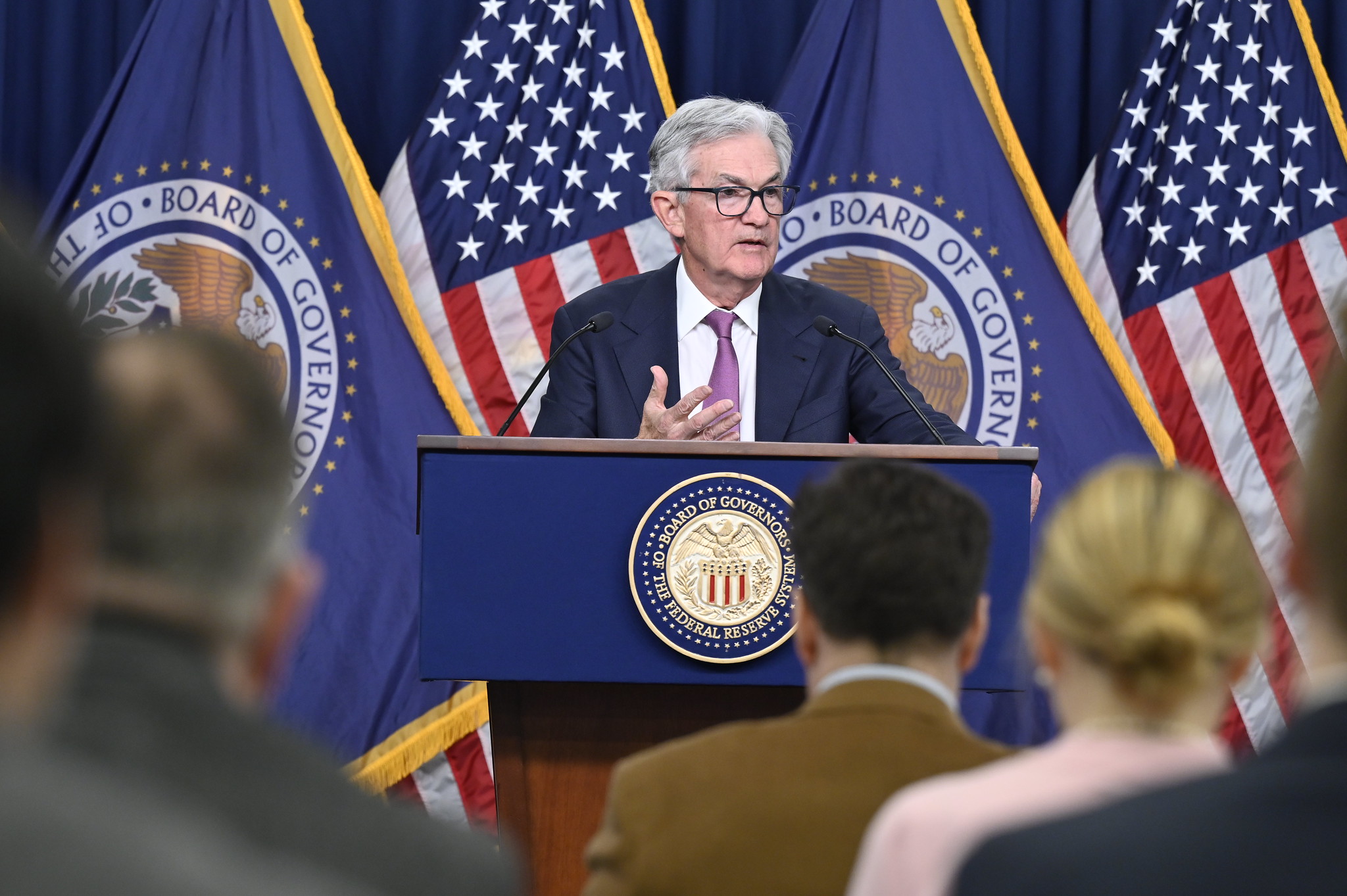
The Federal Reserve announced another rate hike last week, raising the federal funds rate to a range from 4.5% to 4.75%. Though it appears the Fed may be close to the end of its rate-hiking cycle, additional increases are still likely — probably more similar in size to 25 basis points than the more aggressive rate hikes of 75 basis points that we saw last year. The Fed’s statement said that “ongoing increases in the target range” would be appropriate. Fed Chairman Jerome Powell said that “while recent developments are encouraging, we will need substantially more evidence to be confident that inflation is on a sustained downward path.” He also said rate cuts later this year are not likely. 

Some key highlights from the Fed’s take on the economy and next steps:

• The U.S. economy slowed significantly in 2022, but indicators suggest modest growth in the first quarter of the year. (Remember that fourth-quarter GDP was 2.9%.)

• Ongoing increases in the federal funds rate are appropriate, and “history argues against relaxing policy prematurely.”

• Shifting to a slower pace of rate hikes allows the Fed to better gauge how the economy is responding.

• The Fed’s focus is on sustained changes, not short-term moves.

• Regarding the debt ceiling: “Nobody should assume the Fed can save the economy if there is a default.” The only way forward is for Congress to raise the debt ceiling limit.

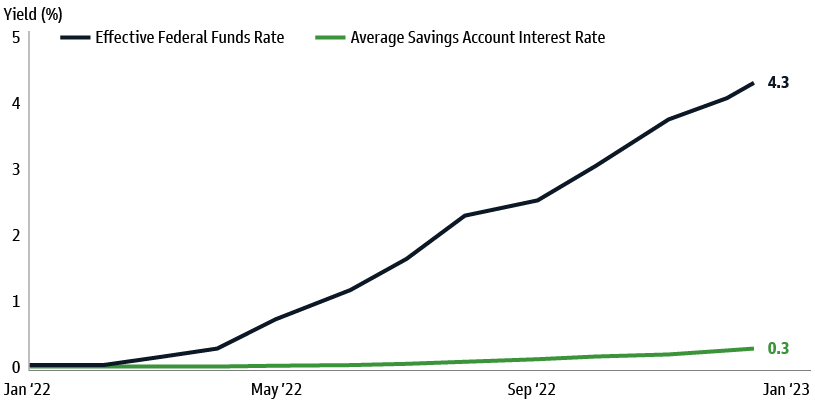
Even as the Federal Reserve raised rates by 25 basis points last week — its eighth hike since 2002 — savings account rates have remained low. With inflation at its highest level in four decades, the cost of holding cash is magnified as investors are left with a reality of negative real savings rates. As the chart below illustrates, the average savings account interest rate is paying .3%, while the effective federal funds rate is now 4.5%. Major banks continue to offer little in the way of savings rates.

More attractive yields exist for those with excess cash, whether in money market funds or short-duration fixed income, such as Treasury bills. To put this in dollar terms, if you have $100,000 in a savings account earning .3% per year, you will earn $300 in interest. That same $100,000 earning 4% in money market or Treasuries earns $4,000 a year in interest income — an increase of $3,700 for sitting in cash! That is a significant number of dollars potentially being left on the table.

Chart showing yield from federal funds rate vs. savings account rate
Sources: Federal Reserve, FDIC and Goldman Sachs Asset Management

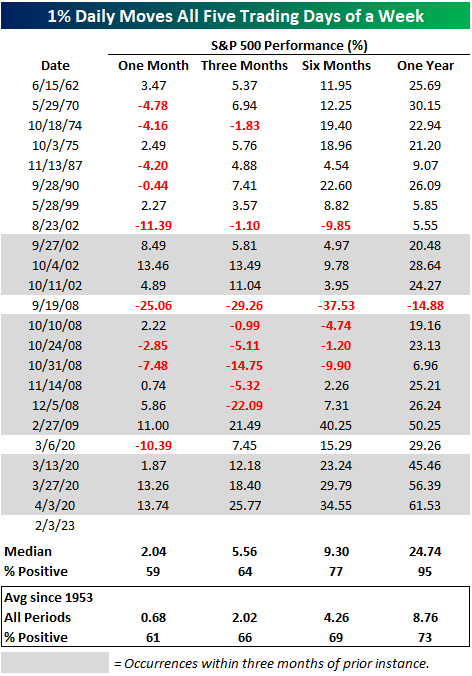
On the back of the Fed announcement and Friday’s very strong job report (517,000 new jobs were created in January, and the unemployment rate fell to a 53-year low of 3.4%), the market (S&P 500) experienced moves of more than 1% all five days last week. This has happened only 23 times since 1953.

The chart below shows that when this has occurred, the average return has been almost 25% one year later. The bond market also experienced volatility, initially moving higher to start the week and then dropping based on the Fed statement, only to rally on Friday and send yields higher after the job report. 

Source: Bespoke Investment Group

The bond market is now pricing in that the Fed may make one more rate hike next month and that it may not cut rates later this year. The recent GDP and labor reports show that this economy is not in a recession. There are pockets of the economy — such as housing — that are in a recession, but the overall economy remains resilient. 

As long as demand (GDP) and employment remain as strong as they are, the Fed will remain hesitant to cut rates and may even continue to raise them past the 5% federal fund target level. Remember, the stock market is a leading indicator, and it should lead the economy as it eventually stabilizes. 

The CD Wealth Formula

We help our clients reach and maintain financial stability by following a specific plan, catered to each client. 

Our focus remains on long-term investing with a strategic allocation while maintaining a tactical approach. Our decisions to make changes are calculated and well thought out, looking at where we see the economy is heading. We are not guessing or market timing. We are anticipating and moving to those areas of strength in the economy — and in the stock market. 

We will continue to focus on the fact that what really matters right now is time in the market, not out of the market. That means staying the course and continuing to invest, even when the markets dip, to take advantage of potential market upturns. We continue to adhere to the tried-and-true disciplines of diversification, periodic rebalancing and looking forward, while not making investment decisions based on where we have been.

It is important to focus on the long-term goal, not on one specific data point or indicator. Long-term fundamentals are what matter. In markets and moments like these, it is essential to stick to the financial plan. Investing is about following a disciplined process over time.

Sources: Bespoke, Goldman Sachs, Schwab

Promo for article titled What Will It Take for Bonds to Bounce Back from a Historic Meltdown?

This material contains an assessment of the market and economic environment at a specific point in time and is not intended to be a forecast of future events, or a guarantee of future results. Forward-looking statements are subject to certain risks and uncertainties. Actual results, performance, or achievements may differ materially from those expressed or implied. Information is based on data gathered from what we believe are reliable sources.

Using diversification as part of your investment strategy neither assures nor guarantees better performance and cannot protect against loss of principal due to changing market conditions.

Past performance is not a guarantee of future results.

The opinions expressed in this commentary are those of the author and may not necessarily reflect those held by Kestra Investment Services, LLC or Kestra Advisory Services, LLC. This is for general information only and is not intended to provide specific investment advice or recommendations for any individual. It is suggested that you consult your financial professional, attorney, or tax advisor with regard to your individual situation.

Securities offered through Kestra Investment Services, LLC (Kestra IS), member FINRA/SIPC. Investment Advisory Services offered through Kestra Advisory Services, LLC (Kestra AS) an affiliate of Kestra IS. CD Wealth Management and Bluespring Wealth Partners LLC* are affiliates of Kestra IS and Kestra AS.  Investor Disclosures: https://bit.ly/KF-Disclosures

*Bluespring Wealth Partners, LLC acquires and supports high quality investment adviser and wealth management companies throughout the United States.

What Will It Take for Bonds to Bounce Back from a Historic Meltdown?

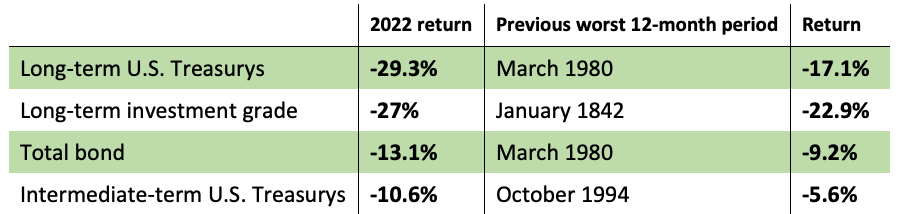
As we all are aware, bonds experienced a significant meltdown in 2022. Historically thought of as the boring, relatively safe part of an investment portfolio, bonds typically are a shock absorber. As we wrote many times last year, bond returns were anything but boring. Edward McQuarrie, a professor emeritus at Santa Clara, said 2022 was the worst year on record for U.S. bond investors; longer-dated bonds like the 30-year U.S. Treasury lost 39.2%. (You would have to go back to the late 1700s to find a worse return!)

Returns on U.S. Bonds Hit New Historic Lows in 2022

Chart showing that returns on U.S. bonds hit new historic lows in 2022
Table: Gabriel Cortes/CNBC. Source: Analysis by Edward F. McQuarrie, professor emeritus, Santa Clara University 

The bond dynamic appears to be shaping up very differently for 2023. The Fed is poised to continue raising rates (even as we write this, the Fed will raise rates again this week). However, the increase is unlikely to be as dramatic as 2022. Strong yields and the prospect of a less hawkish Federal Reserve are breathing new life into bonds. (A hawk is one that supports higher rates, whereas a dove supports lower rates.)

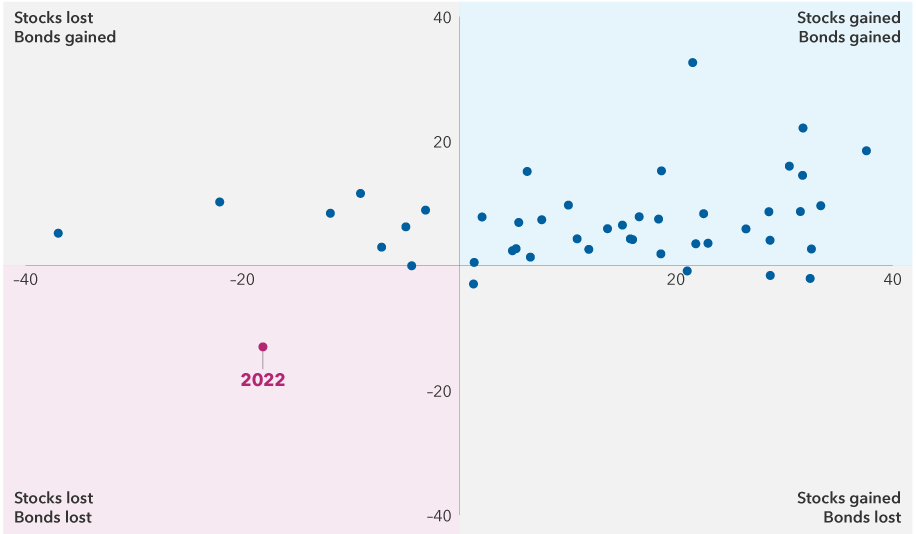
In 2022, there was pessimism in the global markets that was tied to central banks raising rates to rein in decades-high inflation. Both the stock and bond market indexes were down double digits. The losses were unique, with 2022 being the first time in 45 years that both stocks and bonds declined together. The chart below shows stocks and bonds going back to 1977. Notice that 2022 is the only year in the bottom left quadrant, reflecting same-year declines for both.

Annual Returns for Stocks and Bonds Since 1977

Chart showing annual returns for stocks and bonds since 1977
Sources: Capital Group, Bloomberg Index Services Ltd., Standard & Poor’s. Each dot represents an annual stock and bond market return from 1977 through 20222. Stock returns represented by S&P 500 Index. Bond Returns represented by the Bloomberg U.S. Aggregate Index. Past results are not predictive of results in future periods.

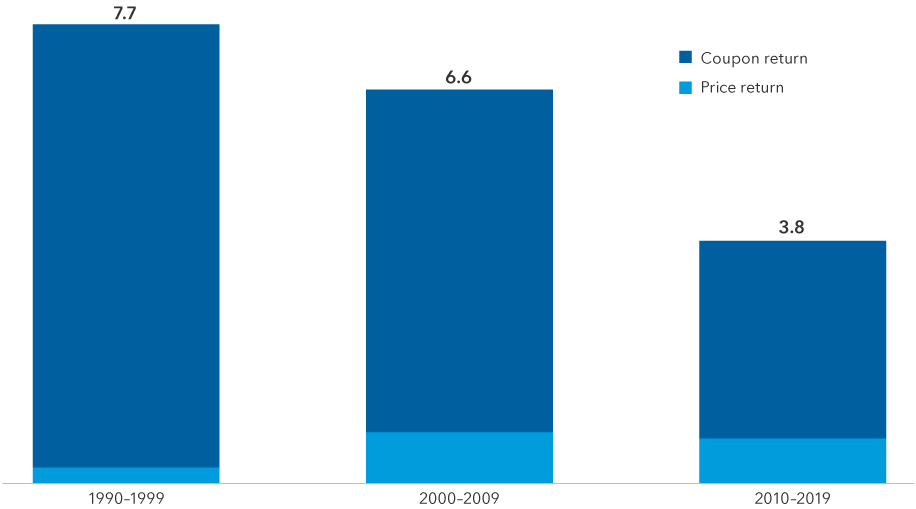
After the Fed hiked rates seven times last year, bonds today offer more income and higher return potential. The yield on the Bloomberg U.S. Aggregate Bond Index, a widely used benchmark for investment-grade bonds, ended the year at 4.68%. This same index ended 2021 with a yield of 1.75%. Bond return comprises both price changes and interest paid. With higher yields, bonds offer more cushion from the income component compared to the start of last year. In the past three decades, bond total returns were driven predominantly from the coupon component, not price changes. If bonds today offer more income and higher coupons due to higher rates, there is a chance for potential higher returns in fixed income.

Total Return Components of the Bloomberg U.S. Aggregate Index

Chart showing the total return components of the Bloomberg U.S. Aggregate Index
Source: Bloomberg Index Services, Ltd. As of 12/30/2022. Past results are not predictive of results in future periods.

Investors are hoping that we do not repeat the same interest-rate volatility that hit bond markets last year. Inflation is moving in the right direction, and the Fed has dialed down the pace of hikes. Signs of a slowing economy have started to appear beyond the softening of housing demand. Consumers have begun to pull back on buying cars, and retail sales softened in December. The Fed wants to see lower inflation and to achieve that, it needs unemployment to rise and GDP — i.e., demand for goods — to fall.

As of now, the market expects the Fed to pivot from rate hikes to rate cuts either later this year or early in 2024. That would be a positive for bond prices as yields would begin to fall. If we happen to enter a recession, Fed policymakers could look to rate cuts sooner, which in turn would boost returns for fixed income even further. 

The CD Wealth Formula

We help our clients reach and maintain financial stability by following a specific plan, catered to each client. 

Our focus remains on long-term investing with a strategic allocation while maintaining a tactical approach. Our decisions to make changes are calculated and well thought out, looking at where we see the economy is heading. We are not guessing or market timing. We are anticipating and moving to those areas of strength in the economy — and in the stock market. 

We will continue to focus on the fact that what really matters right now is time in the market, not out of the market. That means staying the course and continuing to invest, even when the markets dip, to take advantage of potential market upturns. We continue to adhere to the tried-and-true disciplines of diversification, periodic rebalancing and looking forward, while not making investment decisions based on where we have been.

It is important to focus on the long-term goal, not on one specific data point or indicator. Long-term fundamentals are what matter.  In markets and moments like these, it is essential to stick to the financial plan. Investing is about following a disciplined process over time.

Sources: Bloomberg, CNBC, Capital Group

Promo for article titled Worried About the Debt Ceiling? Here's What You Should Know

This material contains an assessment of the market and economic environment at a specific point in time and is not intended to be a forecast of future events, or a guarantee of future results. Forward-looking statements are subject to certain risks and uncertainties. Actual results, performance, or achievements may differ materially from those expressed or implied. Information is based on data gathered from what we believe are reliable sources.

Using diversification as part of your investment strategy neither assures nor guarantees better performance and cannot protect against loss of principal due to changing market conditions.

Past performance is not a guarantee of future results.

The opinions expressed in this commentary are those of the author and may not necessarily reflect those held by Kestra Investment Services, LLC or Kestra Advisory Services, LLC. This is for general information only and is not intended to provide specific investment advice or recommendations for any individual. It is suggested that you consult your financial professional, attorney, or tax advisor with regard to your individual situation.

Securities offered through Kestra Investment Services, LLC (Kestra IS), member FINRA/SIPC. Investment Advisory Services offered through Kestra Advisory Services, LLC (Kestra AS) an affiliate of Kestra IS. CD Wealth Management and Bluespring Wealth Partners LLC* are affiliates of Kestra IS and Kestra AS. Investor Disclosures: https://bit.ly/KF-Disclosures

*Bluespring Wealth Partners, LLC acquires and supports high quality investment adviser and wealth management companies throughout the United States.

Worried About the Debt-Ceiling Drama? Here’s What You Should Know

The clock started ticking last week on the drama surrounding the debt ceiling. The United States hit the $31.4 trillion debt ceiling on Jan. 19, triggering the Treasury Department to start taking extraordinary measures to prevent a default. Although the crisis probably is five to six months away, concern about whether a deeply divided Congress can find a path to raise the debt ceiling will be a critical issue this summer.

What is the debt ceiling?

Established by Congress, the debt ceiling is the maximum amount of money the federal government can borrow to finance obligations that lawmakers and presidents have already approved. It was originally created more than 100 years ago, and it has been modified more than 100 times since World War II alone. Though its original purpose was to make it easier for the federal government to borrow money, the debt ceiling has become a political battleground as a way for Congress to restrict the growth of borrowing. Increasing the debt ceiling does not authorize new spending commitments; it allows the government to meet its existing obligations. 

What would happen if the United States were to default on its debt?

If the government were no longer able to borrow, it would not have enough money to pay its bills, including interest on the national debt. It would probably have to delay payments or default on some of its commitments, potentially affecting Social Security payments and federal workers’ salaries. Thankfully, this has never happened, so no one knows exactly how the Treasury would handle the situation. In a letter to Congress, Treasury Secretary Janet Yellin wrote that the department would begin employing “extraordinary measures” to help delay the point at which the nation might default on its debt.

What are “extraordinary measures”? 

The Treasury has employed measures more than a dozen times in past debt-ceiling battles to prevent a default by allowing lawmakers more time to increase or suspend the limit. These measures include suspending new investments in various retirement accounts for government employees. These funds count against the debt limit and would therefore reduce the amount of outstanding debt subject to the limit, providing the agency with additional capacity to continue funding the government’s operations. No retirees would be affected ultimately, though, as the funds would be made whole once the debt ceiling was agreed upon.

Will Congress raise the debt ceiling?

The closest the United States ever came to default was the summer of 2011, when Standard & Poor’s downgraded the U.S. credit rating for the first time ever and the S&P 500 fell by more than 16%. Congress eventually reached a compromise in early August, raising the debt limit just days before the country would have defaulted. Those conditions are similar politically to what we have today with a Democrat in the White House, Democrats holding a slight majority in the Senate and Republicans holding a slight majority in the House. The drama will play out over the next several months, but ultimately the two parties will have to negotiate a solution. Currently, neither party is in a rush to begin working on a deal. 

What is the potential impact on the markets?

The stock market historically has not reacted until the default deadline is much closer. In 2011, the market downturn started about a month before the deadline and accelerated as the deadline approached. Market volatility increased as the deadline drew closer. At this point, we are five to six months away from a potential crisis point, so the market reaction is expected to remain calm for now. While the path to resolution is uncertain, a default would be an unprecedented event that would have dramatic repercussions in the global financial markets. But this has never happened before; Congress has always managed to reach an agreement, and we think that this time will be no different.

The debt-ceiling situation is only one factor among many that is likely to impact the markets in 2023. The markets continue to focus on the economy, jobs and inflation data, as well as the Fed’s interest-rate strategy.

All of these factors will have a much larger effect on investor sentiment over the next few months than the looming debt-ceiling drama.

As we get closer to the default deadline, we will determine if any changes need to be made to the portfolios. We would like to reiterate that a default has never happened, and we will continue to monitor the issue diligently.

The CD Wealth Formula

We help our clients reach and maintain financial stability by following a specific plan, catered to each client. 

Our focus remains on long-term investing with a strategic allocation while maintaining a tactical approach. Our decisions to make changes are calculated and well thought out, looking at where we see the economy is heading. We are not guessing or market timing. We are anticipating and moving to those areas of strength in the economy — and in the stock market. 

We will continue to focus on the fact that what really matters right now is time in the market, not out of the market. That means staying the course and continuing to invest, even when the markets dip, to take advantage of potential market upturns. We continue to adhere to the tried-and-true disciplines of diversification, periodic rebalancing and looking forward, while not making investment decisions based on where we have been.

It is important to focus on the long-term goal, not on one specific data point or indicator. Long-term fundamentals are what matter.  In markets and moments like these, it is essential to stick to the financial plan. Investing is about following a disciplined process over time.

Sources: Brookings Institute, CNBC, Schwab

Promo for an article titled What Does the Market's Start Tell Us About the Year Ahead?

This material contains an assessment of the market and economic environment at a specific point in time and is not intended to be a forecast of future events, or a guarantee of future results. Forward-looking statements are subject to certain risks and uncertainties. Actual results, performance, or achievements may differ materially from those expressed or implied. Information is based on data gathered from what we believe are reliable sources.

Using diversification as part of your investment strategy neither assures nor guarantees better performance and cannot protect against loss of principal due to changing market conditions.

Past performance is not a guarantee of future results.

The opinions expressed in this commentary are those of the author and may not necessarily reflect those held by Kestra Investment Services, LLC or Kestra Advisory Services, LLC. This is for general information only and is not intended to provide specific investment advice or recommendations for any individual. It is suggested that you consult your financial professional, attorney, or tax advisor with regard to your individual situation.

Securities offered through Kestra Investment Services, LLC (Kestra IS), member FINRA/SIPC. Investment Advisory Services offered through Kestra Advisory Services, LLC (Kestra AS) an affiliate of Kestra IS. CD Wealth Management and Bluespring Wealth Partners LLC* are affiliates of Kestra IS and Kestra AS. Investor Disclosures: https://bit.ly/KF-Disclosures

*Bluespring Wealth Partners, LLC acquires and supports high quality investment adviser and wealth management companies throughout the United States.

What Does the Market’s Start in January Tell Us About the Year Ahead?

The story for investors last year was all about inflation. The 2023 narrative is shifting toward how quickly inflation can cool — and how much cooling will be sufficient to get the Fed to pause its campaign of hiking interest rates.

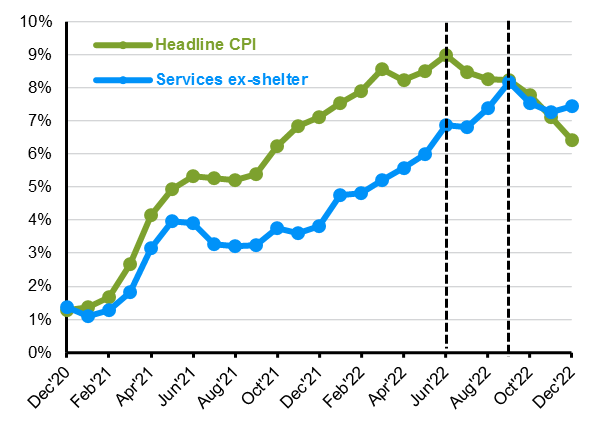
Last week, the December Consumer Price Index (CPI) report marked the fourth consecutive decline in headline CPI on a year-over-year basis. The Fed will want to see further evidence that inflation is cooling, especially in the service sector (see chart below) before it will be comfortable pausing rate hikes. Housing costs are generally the biggest-ticket item on most households’ spending budgets, and shelter costs (rent and mortgage payments) make up roughly one-third of the CPI index. 

Services Ex-Shelter to Keep the Fed Hiking but at a Slower Pace

Year-over-year percentage change, seasonally adjusted

Year-over-year percentage change in headline CPI and services ex-shelter, seasonally adjusted
Sources:  BLS and JP Morgan Asset Management

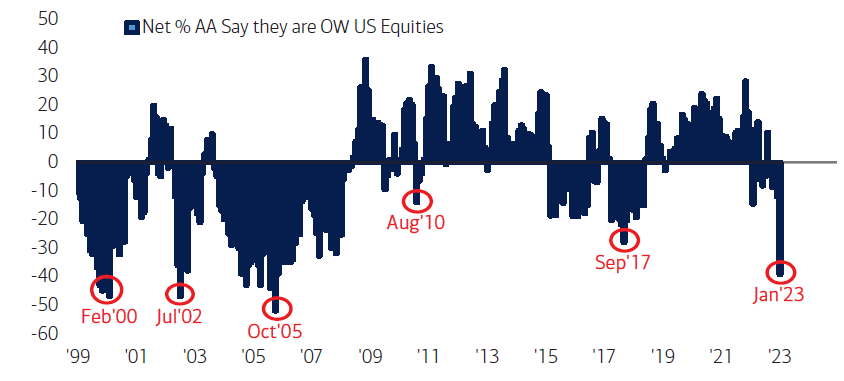
Unfortunately, many retail investors tend to sell low and buy high when investing in the stock market. As a result of the difficult last year in the stock market, investors have pulled more money out of U.S. equities than at any time since 2005. Most of this comes down to behavioral finance: Investors worry more about losing money than they do about making money. 

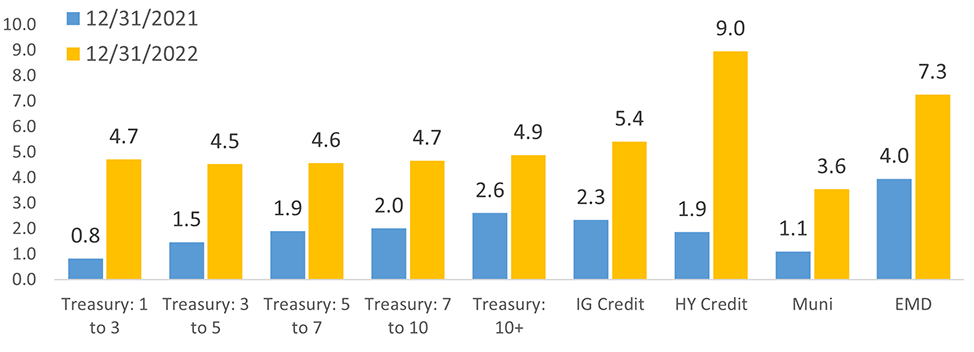
At the same time — and for the first time in many cycles —  cash/money market now offers a better yield than the dividend yield on the S&P 500. This offers a good alternative for those looking for income, but it does not replace the long-term growth that can potentially be achieved in the equity markets. While money market rates and short-term Treasury rates are very attractive for the first time in many years (see the chart below), the rates still do not keep pace with current levels of inflation. 

Many investors think that they are going to move to cash — or to the sidelines — so they can wait out the downside or potential recession, earn interest on their cash, and then get back in when the market has “settled down.” As we have written many times, market timing rarely works, and it’s very difficult for individual investors to remove emotion out of the decision making when the market is falling. This often leads to subpar long-term results, compared to what the results would have been if they had just stayed the course.

January Sees Collapse in U.S. Equity Allocation

Net % say they are overweight U.S. equities

Net % say they are overweight U.S. equities
Source: BofA Global Fund Manager Survey

Yield Comparison

Yield comparison

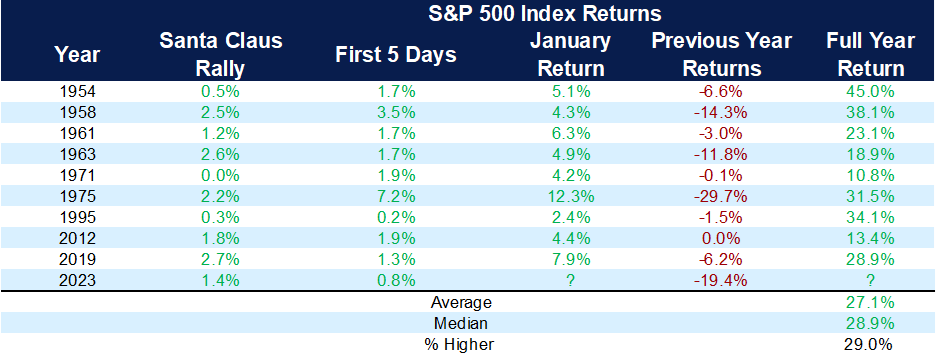
The market ended 2022 on a down note, with the S&P finishing the last four weeks of the year down, but January has started very differently. The Santa Claus rally — which refers to the stock market’s tendency to rally in the last five trading sessions of a calendar year and the first two sessions of the next — did eke out a gain this year. On top of that, the first five trading days also were also positive. When the market finishes positive in January, it finishes the year higher 70% of the time.

The chart below shows that the last nine times that there has been a positive Santa Claus rally, positive results for the first five trading days of the year, the month of January finished higher, combined with a negative prior year, the average return for the year has been 27.1%. (Remember that past returns are no guarantee of future returns, but the negative sentiment that exists for the market may not be warranted.)

If Stocks Are Down the Previous Year, This Trifecta Is Very Bullish

Trifecta of the Santa Claus Rally, first five days of the year and January All Green (1950-present)

Trifecta of the Santa Claus Rally, first five days of the year and January All Green (1950-present)
Source: Carson Investment Research, FactSet Jan. 11, 2022. The Santa Claus Rally is the final five trading days of a calendar year and the first two of the following year.

This is only one indicator, but it’s clearly a sign we should not ignore going forward. Santa Claus did come to town last year, marking the seventh consecutive year stocks were higher during this historically strong period. The Fed will eventually have to acknowledge that price pressures also are easing in a broad manner. The implication is that the Fed does not need to maintain as strict a policy as it has. This is what investors are currently betting will happen, at least in the bond market. We expect more turbulence ahead, but we don’t think investors should wait for the all-clear signal that everything is better before investing in the market.

The CD Wealth Formula

We help our clients reach and maintain financial stability by following a specific plan, catered to each client. 

Our focus remains on long-term investing with a strategic allocation while maintaining a tactical approach. Our decisions to make changes are calculated and well thought out, looking at where we see the economy is heading. We are not guessing or market timing. We are anticipating and moving to those areas of strength in the economy — and in the stock market. 

We will continue to focus on the fact that what really matters right now is time in the market, not out of the market. That means staying the course and continuing to invest, even when the markets dip, to take advantage of potential market upturns. We continue to adhere to the tried-and-true disciplines of diversification, periodic rebalancing and looking forward, while not making investment decisions based on where we have been.

It is important to focus on the long-term goal, not on one specific data point or indicator. Long-term fundamentals are what matter. In markets and moments like these, it is essential to stick to the financial plan. Investing is about following a disciplined process over time.

Sources: Bank of America, Carson Investment Research, JP Morgan

This material contains an assessment of the market and economic environment at a specific point in time and is not intended to be a forecast of future events, or a guarantee of future results. Forward-looking statements are subject to certain risks and uncertainties. Actual results, performance, or achievements may differ materially from those expressed or implied. Information is based on data gathered from what we believe are reliable sources.

Using diversification as part of your investment strategy neither assures nor guarantees better performance and cannot protect against loss of principal due to changing market conditions.

Past performance is not a guarantee of future results.

The opinions expressed in this commentary are those of the author and may not necessarily reflect those held by Kestra Investment Services, LLC or Kestra Advisory Services, LLC. This is for general information only and is not intended to provide specific investment advice or recommendations for any individual. It is suggested that you consult your financial professional, attorney, or tax advisor with regard to your individual situation.

Securities offered through Kestra Investment Services, LLC (Kestra IS), member FINRA/SIPC. Investment Advisory Services offered through Kestra Advisory Services, LLC (Kestra AS) an affiliate of Kestra IS. CD Wealth Management and Bluespring Wealth Partners LLC* are affiliates of Kestra IS and Kestra AS.  Investor Disclosures: https://bit.ly/KF-Disclosures

*Bluespring Wealth Partners, LLC acquires and supports high quality investment adviser and wealth management companies throughout the United States.

Here’s How the Secure Act 2.0 Will Affect Your Retirement Plans

One of the last acts of Congress in 2022 was the Secure Act 2.0, also known as the Securing a Strong Retirement Act of 2022. This legislation is aimed at strengthening the retirement system and bolstering Americans’ financial readiness for retirement.

The highlights include increasing the age at which required minimum distributions (RMDs) must begin from IRA and 401(k) accounts and changes to the size of catch-up contributions. Additional changes allow people to save for emergencies within retirement accounts, enable easier retirement account movement from employer to employer and help younger people save while paying off student debt. Some of the changes are effective immediately, and others will begin over the next few years.

Below are some of the most important changes:

Raising the Starting Age for RMDs 

• On Jan. 1, the threshold age that determines when individuals must begin taking RMDs from traditional IRAs and 401(k)s increased from 72 to 73. Individuals will have an additional year to delay taking a mandatory withdrawal. If you turned 72 in 2022 or earlier, you must continue taking your RMD as scheduled. If you are turning 72 in 2023 and have already scheduled a withdrawal, we need to discuss updating the withdrawal plan. 

• In 2033, the RMD age will increase again from 73 to 75.

• Starting this year, the penalty for failing to take an RMD decreases from 50% to 25% of the RMD amount not taken. This will be reduced to 10% for IRA owners if the account owner withdraws the RMD amount not taken and submits a corrected tax return in a timely manner.

• Roth accounts in employer-sponsored retirement plans will be exempt from RMDs starting in 2024.

Expanded Roth Rules 

• Small business owners can now open and contribute to Roth SIMPLE IRAs and Roth SEP IRAs.

• Employers can match employee retirement plan contributions in their Roth accounts.Previously, matching in employer-sponsored plans was made on a pre-tax basis.Contributions to a Roth retirement plan are made after taxes, allowing earnings to grow tax-free. 

Higher Catch-Up Contributions 

• For 2024, the IRA catch-up contribution limit will be indexed to inflation, allowing it to increase every year, instead of a constant $1,000 extra per year for those over 50.

• Starting Jan. 1, 2025, individuals who are 60 to 63 can make catch-up contributions to a workplace plan up to $10,000 annually, and that amount will be indexed for inflation. The catch-up amount for people 50 and older this year is $7,500.

• One caveat to the rule is that for those who earn more than $145,000 in the prior year, all catch-up contributions at age 50 and older will need to be made into a Roth account in after-tax dollars. 

New Rules for Qualified Charitable Distributions (QCDs)

• Under current law, individuals who are 70½ and older can direct up to $100,000 in distributions per year from a traditional IRA to a qualified charitable organization. Effective in 2024, a new provision will allow the maximum contribution to increase based on inflation.

• In addition, beginning this year, individuals have a one-time opportunity to use a QCD to fund a charitable remainder unit trust, charitable remainder annuity trust or a charitable gift annuity. This amount will count towards the annual RMD. 

529 Plan Updates

• After 15 years, 529 plan assets can be rolled over to a Roth IRA for the beneficiary, subject to annual Roth contribution limits and an aggregate lifetime limit of $35,000.

Changes for Those Who Are Farther from Retirement

• Automatic enrollment and portability: In 2025, businesses adopting new 401(k) and 403(b) plans are required to automatically enroll eligible employees with a contribution rate of at least 3%. This also allows service providers to offer automatic portability for those employees with low balances to a new plan when they change jobs. Currently, lower-balance savers typically cash out their retirement plans when they leave jobs.

• Emergency savings: Defined contribution retirement plans would be able to add an emergency savings account that is a designated Roth account. Employees can contribute up to $2,500 annually, and the first four withdrawals in a year would be tax- and penalty-free. An emergency savings fund could encourage participants to save for short-term and unexpected expenses.

• Student loan debt: Starting this year, employers will be able to match employee student loan payments with matching payments to a retirement account, giving workers an extra incentive to save while paying off student loans.

+++

Overall, the SECURE 2.0 Act provides increased opportunities to save for retirement, but everyone’s financial situation is different. As always, we encourage you to consult with your financial advisor or tax professional to further understand how SECURE 2.0 changes may apply to you and your situation.

The CD Wealth Formula

We help our clients reach and maintain financial stability by following a specific plan, catered to each client. 

Our focus remains on long-term investing with a strategic allocation while maintaining a tactical approach. Our decisions to make changes are calculated and well thought out, looking at where we see the economy is heading. We are not guessing or market timing. We are anticipating and moving to those areas of strength in the economy — and in the stock market. 

We will continue to focus on the fact that what really matters right now is time in the market, not out of the market. That means staying the course and continuing to invest, even when the markets dip, to take advantage of potential market upturns. We continue to adhere to the tried-and-true disciplines of diversification, periodic rebalancing and looking forward, while not making investment decisions based on where we have been.

It is important to focus on the long-term goal, not on one specific data point or indicator. Long-term fundamentals are what matter.  In markets and moments like these, it is essential to stick to the financial plan. Investing is about following a disciplined process over time.

Sources: Fidelity, KIM

Promo for an article titled When Will the Recession Start and End? Here's What We Actually Know

This material contains an assessment of the market and economic environment at a specific point in time and is not intended to be a forecast of future events, or a guarantee of future results. Forward-looking statements are subject to certain risks and uncertainties. Actual results, performance, or achievements may differ materially from those expressed or implied. Information is based on data gathered from what we believe are reliable sources.

Using diversification as part of your investment strategy neither assures nor guarantees better performance and cannot protect against loss of principal due to changing market conditions.

Past performance is not a guarantee of future results.

The opinions expressed in this commentary are those of the author and may not necessarily reflect those held by Kestra Investment Services, LLC or Kestra Advisory Services, LLC. This is for general information only and is not intended to provide specific investment advice or recommendations for any individual. It is suggested that you consult your financial professional, attorney, or tax advisor with regard to your individual situation.

Securities offered through Kestra Investment Services, LLC (Kestra IS), member FINRA/SIPC. Investment Advisory Services offered through Kestra Advisory Services, LLC (Kestra AS) an affiliate of Kestra IS. CD Wealth Management and Bluespring Wealth Partners LLC* are affiliates of Kestra IS and Kestra AS.  Investor Disclosures: https://bit.ly/KF-Disclosures

*Bluespring Wealth Partners, LLC acquires and supports high quality investment adviser and wealth management companies throughout the United States.