Year in Review: Our 10 Most Popular Articles from 2022

We wanted to take this occasion to look back at the content we’ve produced this year and share the 10 most widely read pieces of 2022 in case you missed any of them — or if you want to revisit and share them with friends and family.

Every week, we thoughtfully craft these letters with our clients in mind, broaching subjects we think are relevant and interesting. This is not syndicated content. We want you to find value in these letters — especially in times like these.

1. Before You Sell for a Loss, Make Sure You Know the Wash-Sale Rule

Investors may have seller’s remorse, but capturing losses to offset current taxes or future gains is a prudent strategy | May 5

A young woman is surrounded by monitors & their reflections displaying scrolling text & data.

When you sell an investment that has a loss in a taxable account, you may be eligible for a tax benefit. The wash-sale rule prevents investors from selling at a loss, then buying back the “substantially identical” investment within a 61-day window and being able to claim the tax benefit. This rule applies to stocks, bonds, mutual funds, exchange traded funds (ETFs) and options. Read more >

2. Midterm Elections are Right Around the Corner. What Does This Mean for the Market?

Midterm election years are historically more volatile than the rest of the presidential cycle | July 21

Close-up US midterm election badges with Stars and Stripes in blue and red. The text Midterm Election in the center.

Depending on which party controls Congress, U.S. fiscal policy may change after the election. However, economic fundamentals — and not election results — play the greatest role in stock market performance. Read more >

3. Understanding the Importance of Market Liquidity

As the Fed injects less money into the economy to slow down inflation, liquidity is being reduced, which can lead to outsized market moves | Feb. 10
computer screen showing performance of stocks over time

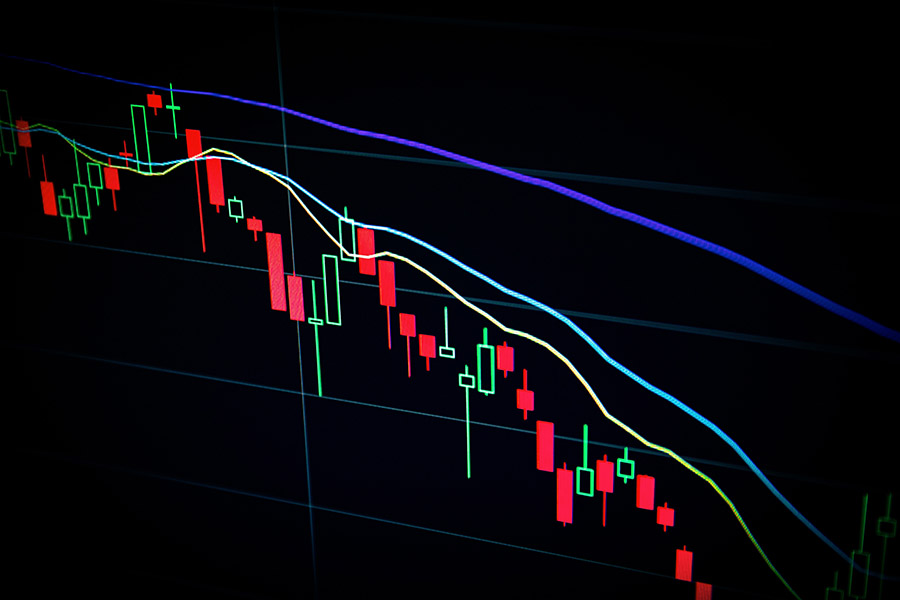
Over the last few years, liquidity has been a major driver in the stock market. In a liquid market — one that is not dominated by selling — the bid price and ask price are close to each other. As a market becomes more illiquid, such as during a sell-off like we saw last month, the spread between the bid and ask prices grows — meaning prices become less stable and transparent. Read more >

4. Here’s Why Today’s Housing Market Is Different from 2008

Home prices are rising, but the underlying drivers of the current market are different from the Great Financial Crisis | July 1

Rooftops of a congested neighborhood

Lending has been in favor of those with much higher credit scores. Household balance sheets are in much better shape, and the percentage of one’s disposable income spent on mortgages is at an all-time low. Read more >

5. The Case for Staying Invested, Even When the Market Declines

The instinct to flee when the market starts to fall can have a major negative impact on the portfolio’s long-term health | Feb. 17

Woman looking at a tablet

Investors who sit on the sidelines risk losing out on periods of market appreciation that follow the downturns. From 1929 through 2020, every decline of 15% or more in the S&P 500 has been followed by a strong recovery. Read more >

6. Don’t Let the Word ‘Recession’ Scare You: Here’s What History Has to Say

Recessions are normal occurrences in the economic cycle. In fact, we’ve already had three this century. Here’s what you should know | June 10

an illustration of the economic cycle

Just because the U.S. economy may have a recession does not mean it will be 2008 all over again and the stock market will experience similar pain. The stock market is a leading economic indicator, but most often it has already started to recover by the time the economy is officially in recession. Read more >

7. You’ve Inherited an IRA. What Happens Next?

The SECURE Act effectively ended the Stretch IRA, but it did not eliminate the need for financial planning when it comes to distributions | April 14

Inherited IRA memo on the color paper and calculator.

Under current law, you have 10 years to deplete the entire value of the IRA. However, if you wait until the 10th year to take the entire distribution and the IRA has experienced significant growth, you may be in the highest tax bracket, having to pay almost 40% in taxes for that one year. Read more >

8. What You Need to Know About Web 3.0 and the Metaverse

Social attitudes and norms are changing and adapting to the new era of the internet | Jan. 20

Man wearing a virtual reality headset

It will take many years for the metaverse to be fully formed and for the experiences to become part of the daily world. However, it appears the train has left the station, with social media and video game companies leveraging their large user bases to build the foundation of the metaverse. Read more >

9. What Does a Stronger U.S. Dollar Mean for You?

For the first time in nearly two decades, the exchange rate between the euro and the dollar is roughly the same | July 14

Benjamin Franklin peeking through euro banknotes

The parity in the two currencies comes after the euro has plunged almost 20% in value over the last 14 months compared to the dollar. This year, the U.S. dollar has gained against most major currencies, as the Fed’s interest rate hikes have made the dollar a safe haven for investors worldwide who are seeking protection against surging global inflation. Read more >

10. An Introduction to NFTs: What You Should Know About Digital Art

Like any collectible, an NFT’s value is based entirely on what someone else is willing to pay for it | Feb. 24

Mona Lisa made from Lego pegs

There are tens of thousands of NFTs in existence, representing a variety of topics, such as music, art and sports. Like any piece of art, beauty is in the eye of the beholder. Read more >

The CD Wealth Formula

We help our clients reach and maintain financial stability by following a specific plan, catered to each client. 

Our focus remains on long-term investing with a strategic allocation while maintaining a tactical approach. Our decisions to make changes are calculated and well thought out, looking at where we see the economy is heading. We are not guessing or market timing. We are anticipating and moving to those areas of strength in the economy — and in the stock market. 

We will continue to focus on the fact that what really matters right now is time in the market, not out of the market. That means staying the course and continuing to invest, even when the markets dip, to take advantage of potential market upturns. We continue to adhere to the tried-and-true disciplines of diversification, periodic rebalancing and looking forward, while not making investment decisions based on where we have been.

It is important to focus on the long-term goal, not on one specific data point or indicator. Long-term fundamentals are what matter.  In markets and moments like these, it is essential to stick to the financial plan. Investing is about following a disciplined process over time.

Promo for article titled Year End Market Predictions: Separating Fact from Fiction

This material contains an assessment of the market and economic environment at a specific point in time and is not intended to be a forecast of future events, or a guarantee of future results. Forward-looking statements are subject to certain risks and uncertainties. Actual results, performance, or achievements may differ materially from those expressed or implied. Information is based on data gathered from what we believe are reliable sources.

Using diversification as part of your investment strategy neither assures nor guarantees better performance and cannot protect against loss of principal due to changing market conditions.

Past performance is not a guarantee of future results.

The opinions expressed in this commentary are those of the author and may not necessarily reflect those held by Kestra Investment Services, LLC or Kestra Advisory Services, LLC. This is for general information only and is not intended to provide specific investment advice or recommendations for any individual. It is suggested that you consult your financial professional, attorney, or tax advisor with regard to your individual situation.

Securities offered through Kestra Investment Services, LLC (Kestra IS), member FINRA/SIPC. Investment Advisory Services offered through Kestra Advisory Services, LLC (Kestra AS) an affiliate of Kestra IS. CD Wealth Management and Bluespring Wealth Partners LLC* are affiliates of Kestra IS and Kestra AS.  Investor Disclosures: https://bit.ly/KF-Disclosures

*Bluespring Wealth Partners, LLC acquires and supports high quality investment adviser and wealth management companies throughout the United States.

Your Wealth Management Checklist to Help You Put 2022 to Bed

We are in the homestretch for 2022. It is the perfect time to review some year-end planning strategies to ensure your wealth plan reflects changes in your circumstances or goals, the current tax environment and the economic landscape. The end of the year is an important time for making financial decisions that can have an impact in the year ahead — and for years to come. 

First, a quick look back at 2022. From a market perspective, this has been a year that won’t be forgotten soon. Here are a few high-level takeaways:

• Bear markets happen. This will not be the last bear market we encounter. The key is to stay invested. Survive the bear market to reap the benefits of the bull markets that follow.

• Things can change quickly. For most of the last decade, we had a zero inflation and zero interest rate environment, but the economy slammed on the brakes — and rates rose drastically. For investors, 2021 was one of the best years and 2022 was one of the worst. However, bull markets can appear just as quickly as a bear markets.

• We went from TINA to TARA. For many years, there was no alternative to stocks (known as TINA, or There is No Alternative). Now, we are seeing TARA (There Are Reasonable Alternatives) with higher interest rates, bonds provide attractive opportunities and money market rates are soon to be over 4%.

• Investing is not easy. We are coming off an incredible decade for the stock market, yet it’s easy for investors to focus on how bad the last 10 months feel. Is that feeling worse than a good 10 years? Greed and fear are timeless. As billionaire investor Seth Klarman commented, “The stock market is the story of cycles and the human behavior that is responsible for overactions in both directions.”

As we prepare to put this year behind us, we recommend that you review the checklist below for planning strategies to consider and discuss.

Income Tax Strategies

Traditional year-end planning focuses on deferring income to a future year and accelerating deductions into the current year.

1. If you anticipate your marginal income tax bracket to increase, you may consider accelerating income into 2022 and deferring deductions to 2023.

2. If you anticipate being in a lower tax bracket next year:
     • Defer income to postpone paying the tax and have that income at a lower bracket, if possible.
     • Bunch your medical expenses in the current year to meet the percentage of your adjusted gross income to claim those deductions if you itemize on your tax return.
     • Make your January mortgage payment in December so you can deduct the interest on this year’s return.

Tax-related Investment Strategies

1. Tax loss harvesting is the strategy of selling securities at a loss to offset a capital gain liability, either for today or in the future.
     • Harvest losses by selling taxable investments. You must wait at least 31 days before buying back a holding sold for a loss to avoid the IRS wash-sale rule
     • Harvest gains by selling taxable investments if you have a tax loss carry forward.

2. Ensure that you have satisfied your required minimum distributions (RMD).
     • If you fail to take your RMD, this may result in a 50% penalty.
     • If you own an inherited IRA, a RMD may be required separately for that account as well.

Retirement Planning Strategies

1. Maximize your IRA contributions. You may be able to deduct annual contributions of up to $6,000 to your traditional IRA and $6,000 to your spouse’s IRA ($7,000 if over the age of 50).

2. Make a Roth IRA contribution if under the applicable income limits.

3. Consider increasing or maximizing your 401(k) contribution. Boosting contributions to your 401(k) can lower your adjusted gross income while increasing your retirement savings.

4. Consider making contributions to a Roth 401(k) if your plan allows.

5. Consider setting up a Roth IRA for each of your children who have earned income during the year.

Gifting Strategies

1. Consider making gifts up to $16,000 per person as allowed under the federal annual gift tax exclusion. You can give up to $16,000 this year to as many people as you want without triggering gift taxes. Payments made directly to educational and/or medical institutions on behalf of your intended beneficiary do not count towards your annual exclusion amount or against your lifetime estate tax exclusion.

2. Create a donor advised fund for an immediate income tax deduction and provide immediate and future benefits to charity over time.

3. If you already have a donor advised fund or want to donate to a charity, consider gifting appreciated assets that have been held longer than one year to get the fair market value income tax deduction while avoiding income tax on the appreciation.

4. If over the age of 70½, consider making a direct transfer from an IRA to a public charity. The distribution is excluded from gross income, and you can give up to $100,000 as a tax-free gift from your IRA that may fully satisfy RMD requirements. 

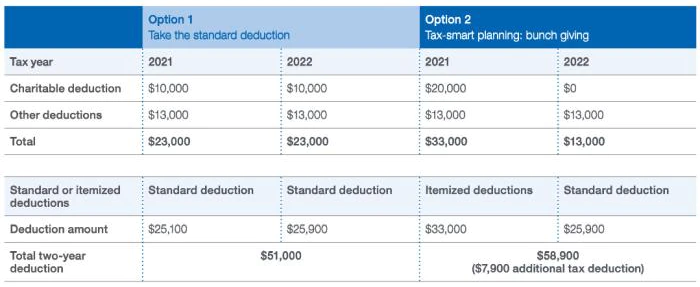
5. Consider combining multiple years of charitable giving into a single year to exceed the standard deduction threshold. This is called “bunching.” The chart below shows how the bunching strategy can reduce taxes if executed properly.

Hypothetical example of a married couple with no children.

Chart explaining the idea of bunching in context of charitable giving
Standard deduction amounts are for married filing jointly status.

Wrapping up 2022 and Planning for 2023

1. Discuss major life events with CD Wealth Management to confirm you have clarity in your current situation.

2. Communicate with your CPA to provide capital gains and investment income information for a more accurate year-end projection.

3. Check your Health Savings Account (HSA) contributions for 2022. If you qualify, you can contribute up to $3,600 (individual) or $7,200 (family) and an additional $1,000 catch up if over the age of 50.

4. Double-check your beneficiary designations for retirement plans, IRAs, Roth IRAs, annuities, life insurance policies, etc.

5. If you do not already have identity theft protection, consider purchasing a service to help protect you and your family.

The end of the year is a perfect time to review your financial planning needs. This includes reviewing the investment portfolio, assessing year-end tax planning opportunities, reviewing retirement goals, and managing your legacy plans. The checklist above includes just some of the items that may apply to you and your family. We are happy to meet to discuss any of the above to ensure that you remain on track with your financial goals.

The CD Wealth Formula

We help our clients reach and maintain financial stability by following a specific plan, catered to each client. 

Our focus remains on long-term investing with a strategic allocation while maintaining a tactical approach. Our decisions to make changes are calculated and well thought out, looking at where we see the economy is heading. We are not guessing or market timing. We are anticipating and moving to those areas of strength in the economy — and in the stock market. 

We will continue to focus on the fact that what really matters right now is time in the market, not out of the market. That means staying the course and continuing to invest, even when the markets dip, to take advantage of potential market upturns. We continue to adhere to the tried-and-true disciplines of diversification, periodic rebalancing and looking forward, while not making investment decisions based on where we have been.

It is important to focus on the long-term goal, not on one specific data point or indicator. Long-term fundamentals are what matter. In markets and moments like these, it is essential to stick to the financial plan. Investing is about following a disciplined process over time.

Sources: BNY Mellon, Baird, CNBC, Schwab

Promo for an article titled Year-End Market Predictions: Separating Fact from Fiction

This material contains an assessment of the market and economic environment at a specific point in time and is not intended to be a forecast of future events, or a guarantee of future results. Forward-looking statements are subject to certain risks and uncertainties. Actual results, performance, or achievements may differ materially from those expressed or implied. Information is based on data gathered from what we believe are reliable sources.

Using diversification as part of your investment strategy neither assures nor guarantees better performance and cannot protect against loss of principal due to changing market conditions.

Past performance is not a guarantee of future results.

The opinions expressed in this commentary are those of the author and may not necessarily reflect those held by Kestra Investment Services, LLC or Kestra Advisory Services, LLC. This is for general information only and is not intended to provide specific investment advice or recommendations for any individual. It is suggested that you consult your financial professional, attorney, or tax advisor with regard to your individual situation.

Securities offered through Kestra Investment Services, LLC (Kestra IS), member FINRA/SIPC. Investment Advisory Services offered through Kestra Advisory Services, LLC (Kestra AS) an affiliate of Kestra IS. CD Wealth Management and Bluespring Wealth Partners LLC* are affiliates of Kestra IS and Kestra AS.  Investor Disclosures: https://bit.ly/KF-Disclosures

*Bluespring Wealth Partners, LLC acquires and supports high quality investment adviser and wealth management companies throughout the United States.

Here’s What You Should Know About Asset Allocations and Volatility

Last Friday, stocks capped off a volatile week of trading after the previous day’s release of the Consumer Price Index (CPI) for September came in hotter than expected. Initially, this weighed on the markets as investors braced for the Federal Reserve to continue aggressively raising rates. After the release of the CPI report on Thursday, the S&P 500 opened down more than 2.4%, but by the end of the day, we had witnessed the fifth-largest intraday reversal from a low. The S&P 500 ended up 2.6% Thursday, reinforcing just how volatile this market is – much like previous bear markets. Then on Friday, the S&P gave back the gains from the day before, ending down 1.55% for the week.

The increase in volatility is not just in the stock market. Volatility has spiked in a range of markets from currencies to bonds, raising concern about the ability of the global economy to cope with higher U.S. rates. If these trends continue, the Fed may moderate its pace of tightening and slow the pace of reducing its balance sheet. The dollar has surged to new all-time highs on a trade-weighted basis, driven by a combination of relatively high U.S. yields and demand for safe-haven assets during global political turmoil. Fed officials have made it clear that financial market volatility alone will not affect their rate decisions.

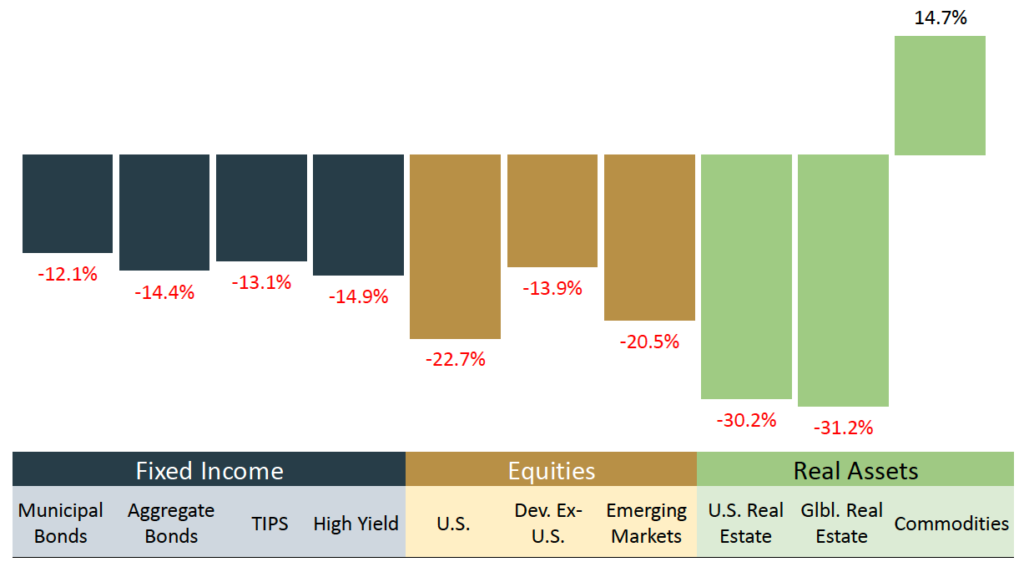
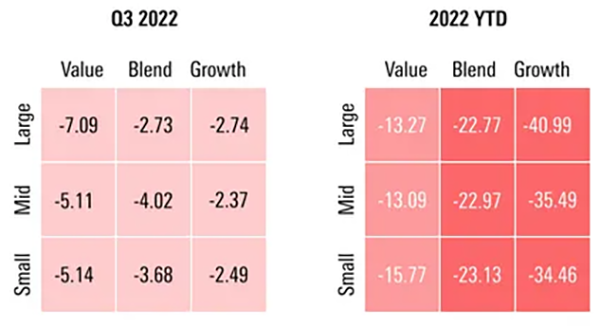
As seen in the bar chart below, the only positive asset class other than cash through the first three quarters of the year has been commodities. (And gold, the most well-known commodity, is down almost 10% year to date.) In some instances, bonds are down as much as stocks this year. This begs the question: Is asset allocation dead? Does the old-style box chart investing —allocating money into growth and value, small cap, mid cap, large cap and international stocks as well as in bonds, as seen in the second chart below — not work anymore? 

U.S. Markets YTD % Returns

Chart showing U.S. Markets year to date returns
Past performance is not a reliable indicator of current or future results. Indexes are unmanaged and not subject to fees. It is not possible to invest directly in an index. Note: Views are from a U.S. dollar perspective. Source: Kestra Investment Management with data from FactSet. Index proxies: Bloomberg Municipal Bond Index, Bloomberg US Aggregate, Bloomberg US Treasury Inflation Protected Notes (TIPS), Bloomberg US High Yield-Corporate, S&P 500, MSCI World ex USA, MSCI EM, Dow Jones US Select REIT, Dow Jones Global X US, and Bloomberg Commodity Index. Data as of September 29, 2022.

U.S. Equity Style Box Performance

Chart showing U.S. Equity Style Box Performance
Source: Morningstar Direct, Morningstar Indexes. Data as of September 30, 2022.

For investors whose experience this year has them questioning asset allocation, the following may provide perspective on why we believe it remains effective.

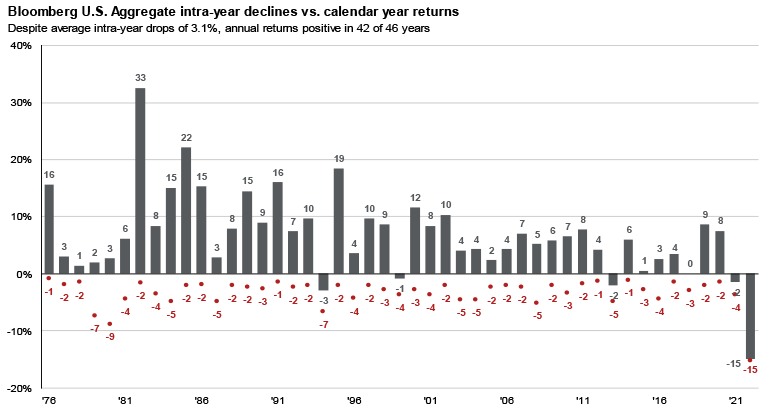
What we have seen in 2022 is unusual. The aggregate bond index (AGG) has been around since 1976. Since that time, the index has been negative four times, the worst being a decline of 2.9% in 1994. In each of those years, the S&P 500 has been higher by an average of more than 20%. This year appears to be an anomaly.

The picture is more complicated on a quarterly basis. Since 1970, the S&P 500 has had 50 negative quarters, and the AGG has been lower in 16 of them. During the worst quarter of 2008, when stocks were down the most, the AGG was up. The third quarter of 1981 had been the worst quarter for the AGG until the second quarter of this year. The chart below shows the AGG’s total return each year. The red dots show the largest peak-to-trough decline each year. The average intra-year decline has been 3.2% versus an average decline of 14% for stocks. Historically, after bad years of performance, bonds tend to deliver strong returns in the years that follow.

Bloomberg U.S. Aggregate Annual Returns and Intra-Year Declines

Chart showing U.S. Aggregate intra-year declines
Sources: Bloomberg, FactSet, JP Morgan Asset Management. Returns are based on total return. Intra-year drops refers to the largest market drops from a peak to a trough during the year. For illustrative purposes only. Returns shown are calendar year returns from 1976 to 2021, over which time period the average annual return was 7.1%. Returns from 1076 to 1989 are calculated on a monthly basis; daily data are used afterwards. Guide to the Markets — U.S. Data are as of September 30, 2022.

Bonds can go down as well as stocks. The historical correlation between the S&P 500 and the AGG is close to zero. Stocks and bonds tend to each go their own ways relative to performance, rather than moving in decidedly opposite directions. It is also important to remember that bonds, like stocks, can and will go down, especially in an environment of rising interest rates. 

Dislocations can create opportunities. We do not think that traditional asset allocation is dead. While all but cash and commodities are negative this year, stock and bond valuations have improved. Diversification within stocks and bonds will continue to add value to a portfolio. Vanguard’s chief economist for the Americas, Roger Aliaga-Diaz, recently commented that “market volatility means diversified portfolio returns will always remain uneven, comprising periods of higher or lower – and, yes, even negative returns.” He went on to add:

“The broader, more important issue is the effectiveness of a diversified portfolio, balanced across asset classes, in keeping with the investor’s risk tolerance and time horizon.”

The CD Wealth Formula

We help our clients reach and maintain financial stability by following a specific plan, catered to each client. 

Our focus remains on long-term investing with a strategic allocation while maintaining a tactical approach. Our decisions to make changes are calculated and well thought out, looking at where we see the economy is heading. We are not guessing or market timing. We are anticipating and moving to those areas of strength in the economy — and in the stock market. 

We will continue to focus on the fact that what really matters right now is time in the market, not out of the market. That means staying the course and continuing to invest, even when the markets dip, to take advantage of potential market upturns. We continue to adhere to the tried-and-true disciplines of diversification, periodic rebalancing and looking forward, while not making investment decisions based on where we have been.

It is important to focus on the long-term goal, not on one specific data point or indicator. Long-term fundamentals are what matter.  In markets and moments like these, it is essential to stick to the financial plan. Investing is about following a disciplined process over time.

Sources:  Kestra Investment Management, Morningstar, CNBC, Vanguard, JP Morgan

Promo for article titled Worried About Retirement in a Down Market? Consider These Strategies

This material contains an assessment of the market and economic environment at a specific point in time and is not intended to be a forecast of future events, or a guarantee of future results. Forward-looking statements are subject to certain risks and uncertainties. Actual results, performance, or achievements may differ materially from those expressed or implied. Information is based on data gathered from what we believe are reliable sources.

Using diversification as part of your investment strategy neither assures nor guarantees better performance and cannot protect against loss of principal due to changing market conditions.

Past performance is not a guarantee of future results.

The opinions expressed in this commentary are those of the author and may not necessarily reflect those held by Kestra Investment Services, LLC or Kestra Advisory Services, LLC. This is for general information only and is not intended to provide specific investment advice or recommendations for any individual. It is suggested that you consult your financial professional, attorney, or tax advisor with regard to your individual situation.

Securities offered through Kestra Investment Services, LLC (Kestra IS), member FINRA/SIPC. Investment Advisory Services offered through Kestra Advisory Services, LLC (Kestra AS) an affiliate of Kestra IS. CD Wealth Management and Bluespring Wealth Partners LLC* are affiliates of Kestra IS and Kestra AS. Investor Disclosures: https://bit.ly/KF-Disclosures

*Bluespring Wealth Partners, LLC acquires and supports high quality investment adviser and wealth management companies throughout the United States.
Worried About Retirement in a Down Market? Consider These Strategies

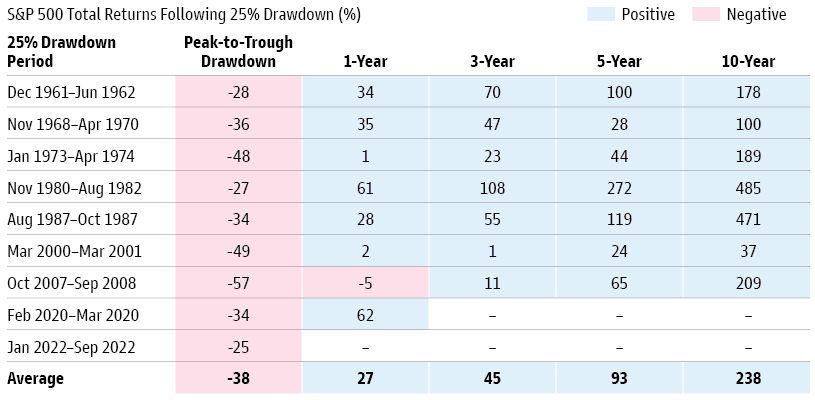
The S&P 500 reached a new low last week, closing 25% down from its January peak. Markets may fall even more from here: Since 1961, the average peak-to-trough decline during drawdowns of 25% or more has been 38%. However, historical drawdowns of 25% or more have delivered a forward one-year return of 27% on average, with longer investment time frames proving even more compelling. 

Timing the bottom of this market is difficult, if not impossible, for those considering going to the sideline and waiting to get back in after the market falls further. History suggests that those who stay the course have been rewarded.  

Chart showing S&P 500 market performance during and after drawdowns of 25% or more since 1961
Source: Bloomberg and Goldman Sachs Asset Management. As of October 6, 2022

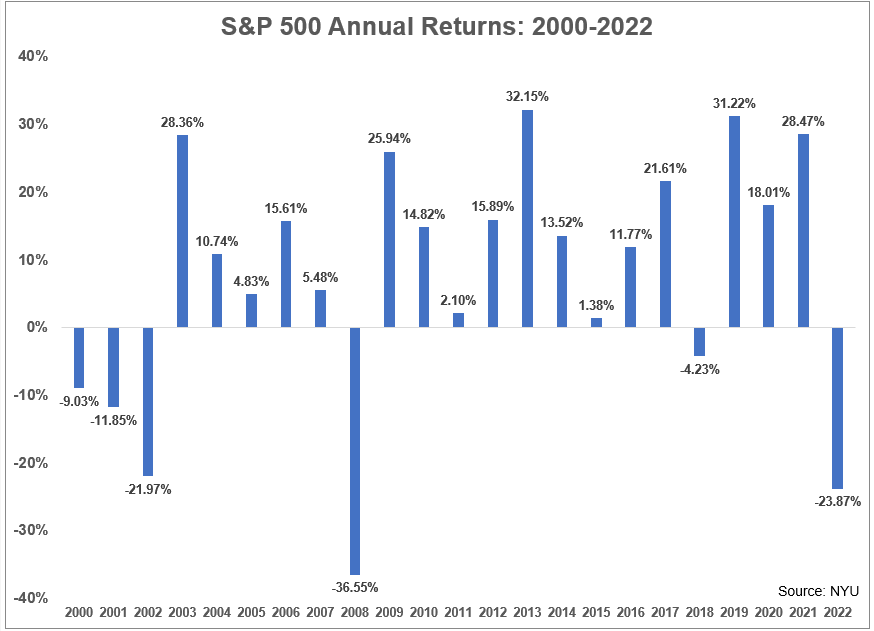
We read a lot about market returns averaging 8% to 10% per year, but as the chart shows below, such returns are not common at all. The 8% to 10% average comes from many years of outsized returns, followed by weak or negative returns and a few years of average returns. If you are not invested in the market or decide to move to the sidelines, it becomes much harder to obtain average returns. We cannot control the sequence of returns – i.e., what the market does on a yearly basis. It’s no secret that investing is not predictable; the market can be up 10% one year and down 10% the next year.

Chart showing S&P 500 Annual Returns from 2000 to 2002

When you are in the accumulation phase, the sequencing of returns does not have a significant impact on your ending balance. However, when you are entering retirement or taking annual distributions from the portfolio, the sequence of returns can make a big difference. A down market early in retirement — on top of taking distributions from the portfolio — can eat into your wealth through no fault of your own, other than bad timing. 

While we can’t control bear markets, we can control how we respond to them. The key to overcoming sequence-of-return risk is to draw down as little as possible during that down period. Here are some strategies for the newly or nearly retired to consider:

Revisit your need for distributions:

Take another look at how you are planning to fund your expenses and consider alternate strategies to minimize how much you take out. For example:

Healthcare expenses: If you funded an HSA account, make sure you use those funds for qualified health expenses before withdrawing from the portfolio.

Charitable giving: Consider making a large gift to a donor-advised fund during an up year in the market. That fund will become your charitable checkbook so that you do not have to tap into the portfolio during down years in the market.

Flexible withdrawals: Consider taking out more during up markets and pulling back when the market is struggling. This could help you ride out the down market by withdrawing as little as possible.

Build up cash accounts

One way to limit how much you need from retirement accounts is to build up liquidity in your cash accounts. By maintaining short-term cash and cash equivalents — such as CDs, fixed income, and money market accounts — you can keep from having to draw down your retirement funds prematurely. For the first time in many years, money market rates and short term bond rates offer attractive yields, and you can get paid to be in cash with those monies.

Be wary of debt

It makes sense to enter retirement with as little debt as possible. Excessive debt in retirement can affect not only your financial health, but also your physical and mental health as well, due to the strain of paying off debt without income from work.

Know your retirement account options

Once you reach a certain age (72) or older and have a traditional IRA or 401K, the IRS requires you to take an annual required minimum distribution (RMD). Roth IRAs do not have RMDs, allowing you to withdraw funds without penalty or tax. It may make sense before retirement to convert some or all of a traditional IRA to a Roth IRA. This does require that you pay tax on the conversion amount at the time of the conversion. During a down market, doing a Roth conversion can reduce the taxes that you will pay since the value of the IRA is down, and it allows a future market recovery to happen in a tax-free account. 

We fully recognize that bear markets are painful and challenging for all investors. Planning for retirement is a long road trip. On most long road trips, you are bound to run into some trouble — unexpected pit stops, flat tires or even a cracked windshield. But these bumps don’t last for the whole trip, and they do not ruin the overall journey. It is more important than ever to keep perspective and realize that these down markets don’t last forever, and good times have historically lasted much longer than the bad.

The CD Wealth Formula

We help our clients reach and maintain financial stability by following a specific plan, catered to each client. 

Our focus remains on long-term investing with a strategic allocation while maintaining a tactical approach. Our decisions to make changes are calculated and well thought out, looking at where we see the economy is heading. We are not guessing or market timing. We are anticipating and moving to those areas of strength in the economy — and in the stock market. 

We will continue to focus on the fact that what really matters right now is time in the market, not out of the market. That means staying the course and continuing to invest, even when the markets dip, to take advantage of potential market upturns. We continue to adhere to the tried-and-true disciplines of diversification, periodic rebalancing and looking forward, while not making investment decisions based on where we have been.

It is important to focus on the long-term goal, not on one specific data point or indicator. Long-term fundamentals are what matter. In markets and moments like these, it is essential to stick to the financial plan. Investing is about following a disciplined process over time.

Sources: Goldman Sachs, Kestra Asset Management, Robert Baird, NYU

Promo for article titled Fourth-Quarter Outlook: Midterms, More Volatility and the Fed

This material contains an assessment of the market and economic environment at a specific point in time and is not intended to be a forecast of future events, or a guarantee of future results. Forward-looking statements are subject to certain risks and uncertainties. Actual results, performance, or achievements may differ materially from those expressed or implied. Information is based on data gathered from what we believe are reliable sources.

Using diversification as part of your investment strategy neither assures nor guarantees better performance and cannot protect against loss of principal due to changing market conditions.

Past performance is not a guarantee of future results.

The opinions expressed in this commentary are those of the author and may not necessarily reflect those held by Kestra Investment Services, LLC or Kestra Advisory Services, LLC. This is for general information only and is not intended to provide specific investment advice or recommendations for any individual. It is suggested that you consult your financial professional, attorney, or tax advisor with regard to your individual situation.

Securities offered through Kestra Investment Services, LLC (Kestra IS), member FINRA/SIPC. Investment Advisory Services offered through Kestra Advisory Services, LLC (Kestra AS) an affiliate of Kestra IS. CD Wealth Management and Bluespring Wealth Partners LLC* are affiliates of Kestra IS and Kestra AS.  Investor Disclosures: https://bit.ly/KF-Disclosures

*Bluespring Wealth Partners, LLC acquires and supports high quality investment adviser and wealth management companies throughout the United States.
Are Alternative Investments Too Good to Be True? Here’s What You Should Know

We have all been there before. You’re at a social event or party where you hear of a great opportunity to invest in some “private” deal or alternative investment. Maybe it is someone starting a business or an inventor with the next great idea — or even a new technology that may change the world. Some people may think these opportunities are like being invited to join an exclusive club for the rich and famous. Others may be searching for different ways to invest money outside of the liquid, public markets. 

Historically, these types of investments have been more accessible for the super-wealthy and made popular by Harvard or Yale endowments. They tend not to be correlated with the stock market and may offer the potential for high returns, but typically with much higher risk.

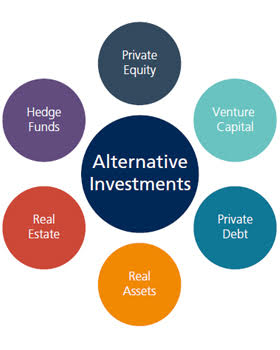
Opportunities such as these are called private investments or alternative investments — financial assets or investments outside the stock and bond market. Examples include private equity, hedge funds, venture capital, real estate, commodities and cryptocurrencies. Here’s a brief description of several alternative investments:

Private equity funds are invested directly into companies rather than into publicly traded stocks or bonds. Private equity firms raise money from investors and institutions and invest those monies directly into non-traded companies. There are several different types of private equity investments, such as distressed funds, leveraged buyouts and “fund of funds,” for example. 

Hedge funds are investment structures that pool monies together to invest in many different asset classes, and they are typically unconcerned with market direction. In its simplest form, a hedge fund is known as Long-Short. They go “long” by buying one stock in an industry, such as Ford, and “short” by selling another stock in the same industry, such as GM. Therefore, they are what is called market neutral.  Hedge funds, like private equity, take on many different types, such as macro, equity, value and distressed.

Venture capital investment typically involves financing startup companies and businesses. This is similar to how private equity works, but venture capital invests more in startup and early-stage businesses, whereas private equity investments are usually in more developed companies. There are different forms of venture capital investments such as seed, early-stage and expansion investments.

Real estate investments such as investment properties, office buildings, apartments or vacation homes also are considered alternative investments, as they are purchased outside of the publicly traded markets. There are many other types of alternative investments within real estate such as hard money loans, private notes, real estate partnerships and opportunity zone investments.  

Commodities are investments that typically are available to investors of all experience levels and easier to purchase than other alternatives, such as gold, silver, oil or natural gas.

Cryptocurrency has become a more recent phenomenon among alternative investments. Investors are putting money into Bitcoin or Ethereum or in the network blockchain, which is a digital ledger to track cryptocurrency movement and ownership. 

Graphic illustrating different investment types

The pros and cons of alternative investments

PROS:

They are not correlated to the stock market. This means that they add diversification to your portfolio while attempting to minimize risk. As we briefly outlined above, there are many different types of alternative investments, and the more investments one owns, the more one can potentially further reduce volatility in the portfolio.

There is a potential for increased returns. As with any risky investment, there are no guarantees or guaranteed returns. Proponents of alternative investments maintain that higher returns can be achieved through these types of investments — but with the potential for higher returns comes higher risk.

CONS:

They lack liquidity. Alternative investments tend to be private, i.e., not publicly traded, and therefore, they are less liquid. This means that they may be difficult to exit, and your monies could be tied up for many years, giving you no access to those funds. During the Great Recession, for example, many alternative investments stopped any redemptions of their funds, and clients who needed the money had no access to those monies.

They have high investment minimums. For many people, higher minimums may make such investments unavailable. If an investment requires a high minimum to participate and that investment makes up a large percentage of your net worth, then it may not be prudent to have that much of your nest egg in one, potentially illiquid investment.

They have higher fees. Most alternative investments carry higher investment fees than publicly traded funds do. At the same time, alternative investment fees are not always transparent, nor are they regulated by the SEC. Fees vary based on the type of investment, so it is important to understand the fee structure and how the fund manager gets paid.

They lack regulation. Alternative investments are not regulated by the SEC and are not subject to reporting requirements. In addition, the underlying assets are often difficult to value, which can be deceptive for pricing and price transparency. Because of the lack of regulation and transparency, this can lead to risk of fraudulent investments. When you buy a stock, index fund, mutual fund or bond, you know that what you are buying is a real asset.

They are complex. Alternative investments are often complex instruments and may require a high level of due diligence. If you are considering an alternative investment, it is imperative to do the research and understand all tax implications as well. For example, you may be a limited partner requiring a K-1, which in turn may delay filing your taxes. If you have several private investments, you may receive several K-1s, and this could lead to increased fees for filing taxes.

In recent years, alternative investments have grown in popularity. During down markets, alternative investments seem to become more popular as investors look to invest in something other than stocks.

Since alternative investments don’t have the same liquidity, transparency and valuation requirements of publicly traded stocks and bonds, investors may think that alternatives offer more security. 

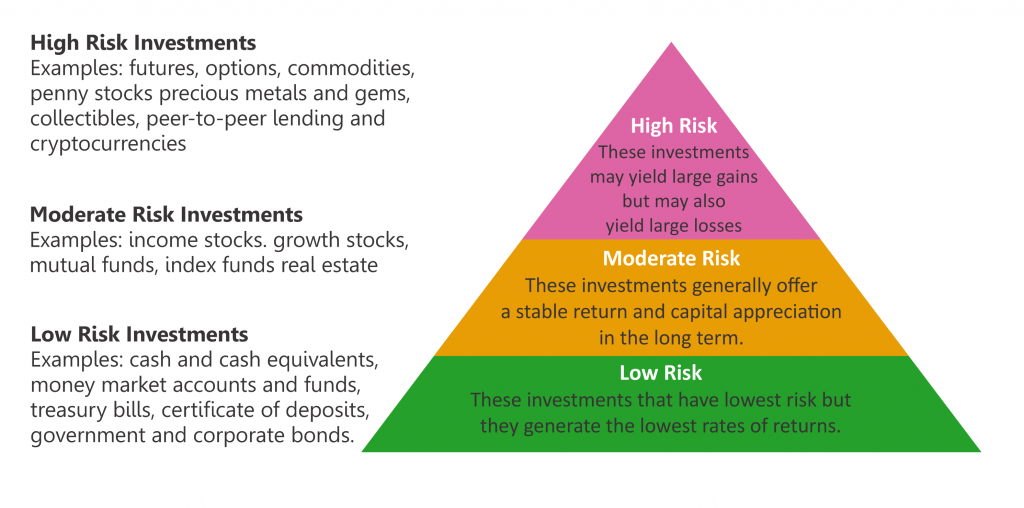
As seen in the pyramid below, alternative investments are higher on the risk scale, and therefore need to be well thought out and researched before investing capital. Please remember: If it sounds too good to be true, it normally is!

Pyramid chart ranking investment types according to risk

The CD Wealth Formula

We help our clients reach and maintain financial stability by following a specific plan, catered to each client. 

Our focus remains on long-term investing with a strategic allocation while maintaining a tactical approach. Our decisions to make changes are calculated and well thought out, looking at where we see the economy is heading. We are not guessing or market timing. We are anticipating and moving to those areas of strength in the economy — and in the stock market. 

We will continue to focus on the fact that what really matters right now is time in the market, not out of the market. That means staying the course and continuing to invest, even when the markets dip, to take advantage of potential market upturns. We continue to adhere to the tried-and-true disciplines of diversification, periodic rebalancing and looking forward, while not making investment decisions based on where we have been.

It is important to focus on the long-term goal, not on one specific data point or indicator. Long-term fundamentals are what matter. In markets and moments like these, it is essential to stick to the financial plan. Investing is about following a disciplined process over time.

Sources: Forbes, Investopedia

Promo for article titled Unpacking the Inflation Reduction Act: How Will it Affect You?

This material contains an assessment of the market and economic environment at a specific point in time and is not intended to be a forecast of future events, or a guarantee of future results. Forward-looking statements are subject to certain risks and uncertainties. Actual results, performance, or achievements may differ materially from those expressed or implied. Information is based on data gathered from what we believe are reliable sources.

Using diversification as part of your investment strategy neither assures nor guarantees better performance and cannot protect against loss of principal due to changing market conditions.

Past performance is not a guarantee of future results.

The opinions expressed in this commentary are those of the author and may not necessarily reflect those held by Kestra Investment Services, LLC or Kestra Advisory Services, LLC. This is for general information only and is not intended to provide specific investment advice or recommendations for any individual. It is suggested that you consult your financial professional, attorney, or tax advisor with regard to your individual situation.

Securities offered through Kestra Investment Services, LLC (Kestra IS), member FINRA/SIPC. Investment Advisory Services offered through Kestra Advisory Services, LLC (Kestra AS) an affiliate of Kestra IS. CD Wealth Management and Bluespring Wealth Partners LLC* are affiliates of Kestra IS and Kestra AS. Investor Disclosures: https://bit.ly/KF-Disclosures

*Bluespring Wealth Partners, LLC acquires and supports high quality investment adviser and wealth management companies throughout the United States.
Understanding the importance of market liquidity

Over the last few years, liquidity has been a major driver in the stock market. In a liquid market — one that is not dominated by selling — the bid price and ask price are close to each other. As a market becomes more illiquid, such as during a sell-off like we saw last month, the spread between the bid and ask prices grows — meaning prices become less stable and transparent.

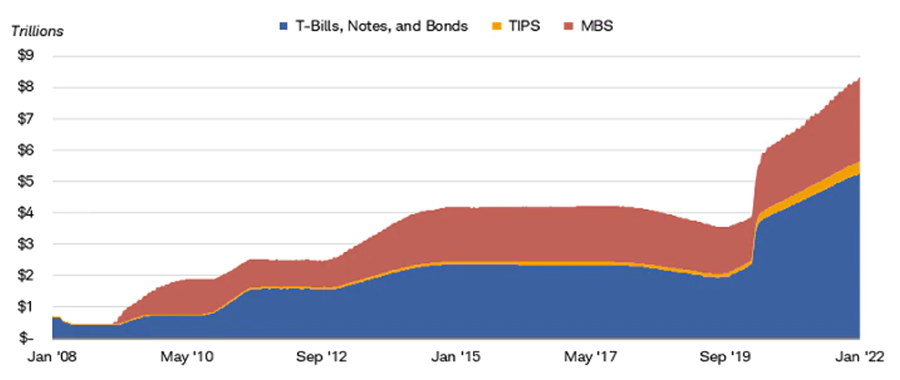
As we have previously written, the Federal Reserve has been buying bonds in an effort to inject liquidity into the market. When the Fed buys bonds, it increases its balance sheet — a list of its assets (such as government securities and loans) and liabilities (including currency in circulation). As seen in the chart below, the balance sheet has reached an all-time high.

The Fed’s balance sheet has ballooned to more than $8 trillion

Chart showing the growth of the Federal Reserve's balance sheet
Source: Bloomberg. Reserve Balance Wednesday Close for Treasury Bills, Treasury Notes, Treasury Bonds, Treasury Inflation Protected Securities (TIPS), and Mortgage-Backed Securities (MBS). Weekly data as of 1/26/2022.

The Fed’s goals include setting monetary policy that stabilizes the nation’s financial system, especially during times of high volatility, and allowing the economy to grow without generating inflation. After a challenging January in which volatility surged, stocks and bonds sold off and major indexes exceeded 10% drawdowns, the Fed now is reducing its bond purchases and soon will begin raising rates.

The Fed’s balance-sheet reduction should not be a near-term issue, as interest rates remain low and servicing the debt remains manageable. However, the speed at which the Fed raises rates will have an impact on the equity markets. (The Fed has not yet outlined a clear plan for how many times it plans to raise rates and how it plans to reduce its balance sheet over time.)

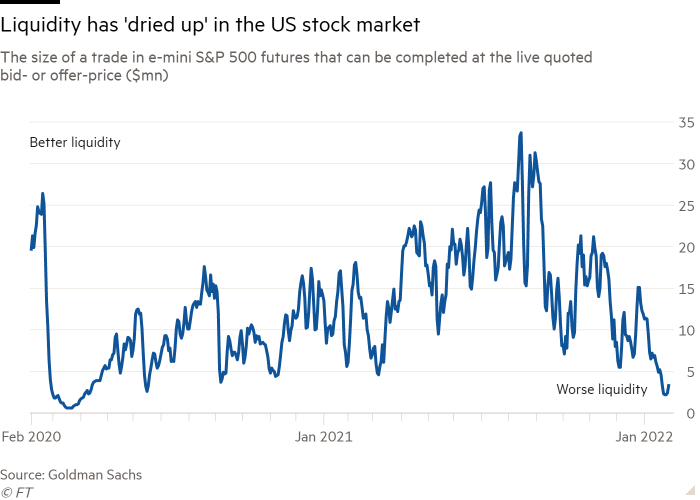
As the Fed injects less money into the economy to slow down inflation, liquidity is being reduced, which can lead to outsized market moves. In the last few weeks, the huge swings in U.S. stocks like Meta (Facebook), PayPal, Netflix and Snap have illustrated what can happen when liquidity dries up. As seen in the chart below, liquidity in U.S. stocks has fallen to levels last seen during the COVID-19 sell-off two years ago. 

Lower levels of liquidity exacerbate market swings and make it harder for investors to execute buy and sell orders at a desired price. One measure of equity market liquidity is the market depth of S&P 500 E-mini futures, which investors use to gain exposure to the U.S. stock market. The E-mini S&P 500 is a futures contract that represents one-fifth of the value of a standard S&P 500 contract. The value of the full-sized S&P 500 contract is too large for most small traders, so the E-mini is used instead for speculation and hedging.

Typically, the volume traded in E-mini contracts is many times larger than the full contract — in other words, it is very liquid. Normal volume is roughly $50 million of value at any given time in the E-mini contracts, while today that number stands closer to $5 million, or 1/10th the size of normal liquidity.

Chart illustrating that liquidity has dried up in the U.S. stock market

So, what can we learn from all this? As we continue to gain clarity from the Federal Reserve on inflation and interest rates, volatility will reduce — and liquidity will return to the markets. Many market dynamics and economic indicators suggest that a strong economy remains possible. Strength in corporate earnings, productivity and innovation continue to drive profit margins higher for most companies in the S&P 500. Market corrections are normal, as nothing goes up in a straight line.

Investing is a disciplined process, done over time. It’s important to remember that panic is not an investing strategy. Neither are “get in” or “get out” — those sentiments are just gambling on moments in time.

From a portfolio perspective, we continue to adhere to the tried-and-true disciplines of diversification, periodic rebalancing and looking forward, while not making investment decisions based on where we have been. Making market decisions based on what might happen may be detrimental to long-term performance. The key is to stay invested and stick with the financial plan. Markets go up and down over time, and downturns present opportunities to purchase stocks at a lower value. As we say each week, it is important to stay the course and focus on the long-term goal, not on one specific data point or indicator.

It all starts with a solid financial plan for the long run that understands the level of risk that is acceptable for each client. Regarding investments, we believe in diversification and having different asset classes that allow you to stay invested. The best option is to stick with a broadly diversified portfolio that can help you to achieve your own specific financial goals — regardless of market volatility. Long-term fundamentals are what matter.

Sources:  FT, Bloomberg, Investopedia, Goldman Sachs

Promo for an article titled After January's Market Volatility, What Can Investors Expect?

This material contains an assessment of the market and economic environment at a specific point in time and is not intended to be a forecast of future events, or a guarantee of future results. Forward-looking statements are subject to certain risks and uncertainties. Actual results, performance, or achievements may differ materially from those expressed or implied. Information is based on data gathered from what we believe are reliable sources.

Using diversification as part of your investment strategy neither assures nor guarantees better performance and cannot protect against loss of principal due to changing market conditions.

Past performance is not a guarantee of future results.

The opinions expressed in this commentary are those of the author and may not necessarily reflect those held by Kestra Investment Services, LLC or Kestra Advisory Services, LLC. This is for general information only and is not intended to provide specific investment advice or recommendations for any individual. It is suggested that you consult your financial professional, attorney, or tax advisor with regard to your individual situation.

Securities offered through Kestra Investment Services, LLC (Kestra IS), member FINRA/SIPC. Investment Advisory Services offered through Kestra Advisory Services, LLC (Kestra AS) an affiliate of Kestra IS. Kestra IS and Kestra AS are not affiliated with CD Wealth Management. Investor Disclosures: https://bit.ly/KF-Disclosures

The importance of liquidity

The stock market’s positive momentum at the start of 2021 looked similar to its movement at the end of 2020, and through the first three weeks of January, the S&P 500 is up 2.4%, led by energy stocks. Among the reasons for the market’s recent performance: the potential for additional stimulus, low interest rates, an inflation target of 2% driven by the Federal Reserve and a tremendous amount of cash on the sidelines, waiting to be invested.

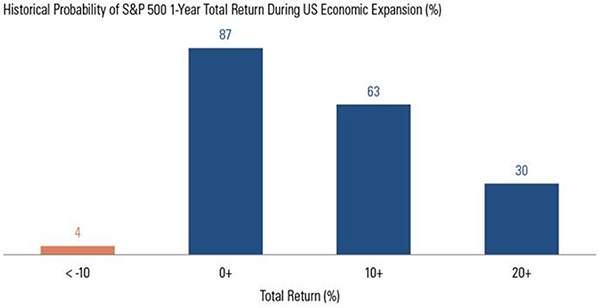
The S&P 500 has recovered over 70% from its March 2000 low. While investors may be concerned about the markets following this strong rally, history suggests there is more room to run. During past U.S. economic expansions, investors have enjoyed positive one-year returns 87% of the time. Drawdowns of greater than 10% occurred far less often — only 4% of the time.

We understand why investors might look for reasons for the market to fall or correct itself; it can be tough to avoid the negative messages that constantly bombard us in today’s world. In all of our weekly newsletters, we discuss the importance of staying the course and sticking to your financial plan. With money market rates close to zero for an extended period of time, cash may not be a viable long-term investment, even with inflation below 2%.

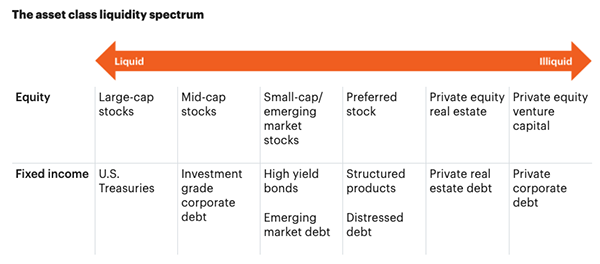
Understanding what liquidity is and how it can impact portfolio returns can help you make more informed decisions. Liquidity is defined as the ease with which an investment can be bought or sold without significantly impacting the value of the underlying securities. Investments that can be easily bought or sold are said to be liquid. Traditional investments — like stocks (mutual funds, index funds and individual stocks) and bonds — can be bought and sold easily, so they are considered to be highly liquid. Illiquid assets are harder for investors to sell, harder to value and harder to control over how the assets are managed. For example, if you decide to sell your home today, you must go through a process to obtain your money. The house may not sell for months, and then you may have to reduce the asking price. Similarly, if you invest in a hedge fund or private equity investment, you may not have access to your funds on demand. There is a process to cash out, and it may take some time to liquidate — plus, the amount you receive could change based on market conditions.

Our focus in managing our clients’ portfolios is in the publicly traded liquid markets. We provide access to those markets with a combination of individual stocks and bonds, index funds or exchange traded funds and mutual funds. If a crisis occurs and investors begin selling in mass, this can cause assets that are not as liquid to lead to further reduced value, as those investments are forced to sell into a market with a shortage of buyers. Liquidity, like volatility, needs to be managed in a portfolio, and by focusing on holdings that are extremely liquid, we look to reduce value disruption that may occur in market downturns.

So, what can we learn from all this? Having a well-balanced, diversified, liquid portfolio and a financial plan are keys to successful investing. The best option is to stick with a broadly diversified portfolio that can help you to achieve your own specific financial goals – regardless of market volatility. Long-term fundamentals are what matter. From an investment perspective, we use the above insights to help with the strategic and tactical asset allocation based on where we see the portfolio heading over the next five to seven years, with short-term adjustments along the way. We are not trying to time the market, but we will try to take advantage when we see where the market heading. 

Sources: FS Investments, GSAM

_____

This material contains an assessment of the market and economic environment at a specific point in time and is not intended to be a forecast of future events, or a guarantee of future results.  Forward-looking statements are subject to certain risks and uncertainties.  Actual results, performance, or achievements may differ materially from those expressed or implied.  Information is based on data gathered from what we believe are reliable sources.

Using diversification as part of your investment strategy neither assures nor guarantees better performance and cannot protect against loss of principal due to changing market conditions.

Past performance is not a guarantee of future results.

The MSCI Europe Index is a free float-adjusted market capitalization weighted index that is designed to measure the equity market performance of the developed markets in Europe. The MSCI EAFE Index (Europe, Australasia, Far East) is a free float-adjusted market capitalization index that is designed to measure the equity market performance of developed markets, excluding the US & Canada. The MSCI World Index is a free float-adjusted market capitalization weighted index that is designed to measure the equity market performance of developed markets. The MSCI Emerging Markets Index is a free float-adjusted market capitalization index that is designed to measure equity market performance of emerging markets. The MSCI AC (All Country) Asia ex Japan Index is a free float-adjusted market capitalization weighted index that is designed to measure the equity market performance of Asia, excluding Japan. The Dow Jones Industrial Average is a popular indicator of the stock market based on the average closing prices of 30 active U.S. stocks representative of the overall economy. S&P 500 Index is an unmanaged group of securities considered to be representative of the stock market in general. NASDAQ Composite Index measures all NASDAQ domestic and international based common type stocks listed on The NASDAQ Stock Market. The Russell 2000 Index measures the performance of the small-cap segment of the U.S. equity universe. It is not possible to invest directly in an index.

The opinions expressed in this commentary are those of the author and may not necessarily reflect those held by Kestra Investment Services, LLC or Kestra Advisory Services, LLC.  This is for general information only and is not intended to provide specific investment advice or recommendations for any individual.  It is suggested that you consult your financial professional, attorney, or tax advisor with regard to your individual situation.

Securities offered through Kestra Investment Services, LLC (Kestra IS), member FINRA/SIPC. Investment Advisory Services offered through Kestra Advisory Services, LLC (Kestra AS) an affiliate of Kestra IS. Kestra IS and Kestra AS are not affiliated with CD Wealth Management.