What kind of growth can investors expect in 2022?

In all, 2021 was a solid year for the financial markets. The economy’s ability to adapt to the pandemic, the vaccine rollout, additional financial stimulus and easy monetary policy all supported strong performance. Growth in large-cap U.S. equities was primarily driven by gains among the S&P 500’s largest tech holdings. Severe supply-chain bottlenecks and a surge in energy prices supported a strong commodity performance. Small-cap U.S. equities trailed their large-cap counterparts but still produced returns greater than their 20-year average of 11%.

Outside the U.S., equities in developed markets had another strong year. Emerging markets, on the other hand, were hurt after a correction in the Chinese stock market and continued lockdown measures. Finally, U.S. fixed income decreased as long-term interest rates ended the year higher than where they started.
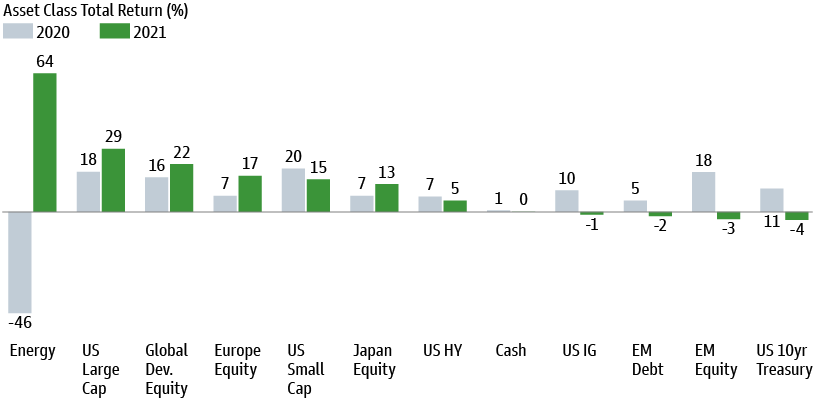
Chart showing 2021 returns by asset class


The Chinese stock market had a correction in 2021, and questions remain about the Chinese economy. The property market downturn, triggered by the collapse of Evergrande, is a large drag on China’s economic growth. In the past, downside growth risks in China have been quickly countered by monetary and fiscal stimulus. This time may be different as signals point toward Chinese leaders being worried about excessive leverage in the property sector. With China’s 2022 growth projections being around 5%, this may take some pressure off global inflation.

In 2022, the central narrative will be how markets react to the Federal Reserve and other major central banks transitioning away from an extraordinary 18-month period of stimulus. Return and income-seekers will need to navigate a backdrop of favorable but moderating growth, high valuations, low and rising yields, and ongoing COVID-related question marks — in particular, an uncertain path for inflation.

The U.S. economy is poised for a year of moderating but above-trend economic growth. Robust household income and accumulated savings leave the consumer in a strong position heading into the year. Businesses have record levels of cash on hand, which may lead to record levels of investment. Unemployment is at 4.2%, and wages are up. Excess cash has been moving into the equity markets, and in 2021, inflows into equities were more than the past 19 years combined.
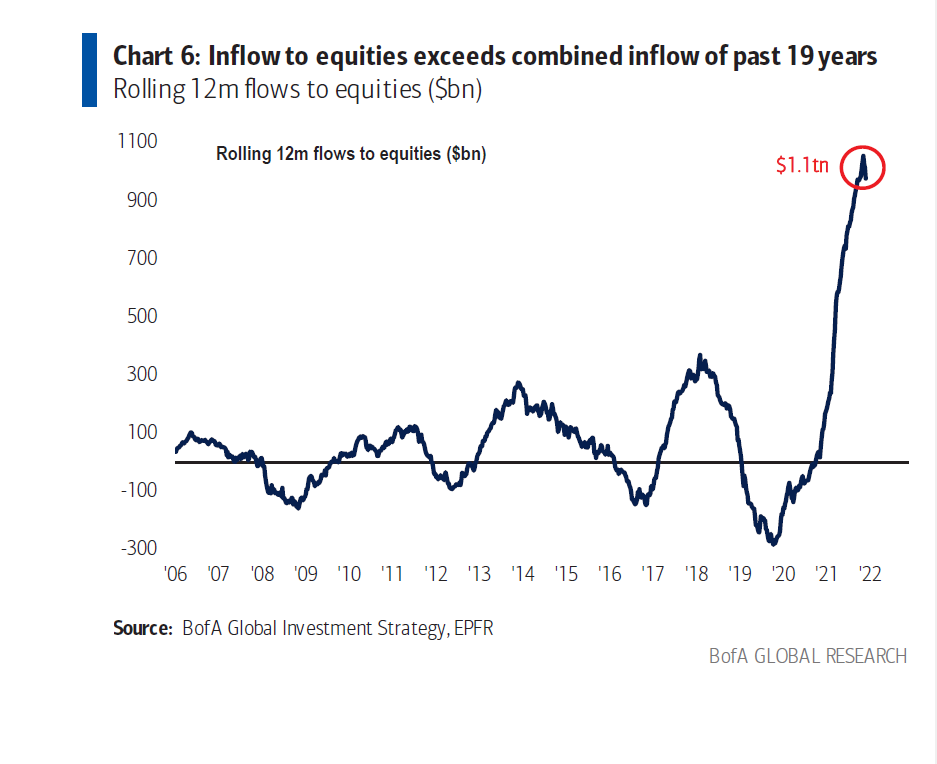
Chart showing inflow to equities


Inflation remains the primary focus for most investors. Moderating demand, rebalancing demand from goods to services and healing the supply side should allow inflation to rates to reduce in the second half of the year. Wage inflation and strong labor demand are the key risks to this scenario. At the same time, we are keeping a close watch on fiscal policy. For now, President Biden’s Build Back Better plan is on ice. If this plan were to be resurrected, we would watch closely and keep you informed every step of the way.

So, what can we learn from all this? We are hopeful that 2022 will be a turning point in the global pandemic and that policy makers will wean economies and markets off fiscal and monetary stimulus. Vaccine manufacturing continues to ramp up, and new therapeutics to fight COVID continue to be available in the U.S. and abroad. Inflationary pressures should ease but still settle at an elevated level than the recent past. We believe that diversification and the discipline to stay invested over the long-term are more important than ever. We are optimistic for a successful 2022!

From a portfolio perspective, we continue to adhere to the tried-and-true disciplines of diversification, periodic rebalancing and looking forward, while not making investment decisions based on where we have been. Making market decisions based on what might happen may be detrimental to long-term performance. 

The key is to stay invested and stick with the financial plan. Markets go up and down over time, and downturns present opportunities to purchase stocks at a lower value. As we say each week, it is important to stay the course. and focus on the long-term goal, not on one specific data point or indicator.

It all starts with a solid financial plan for the long run that understands the level of risk that is acceptable for each client. Regarding investments, we believe in diversification and having different asset classes that allow you to stay invested. The best option is to stick with a broadly diversified portfolio that can help you to achieve your own specific financial goals — regardless of market volatility. Long-term fundamentals are what matter.

Sources: BofA Global Investment Strategy, Blackrock, Bloomberg, JP Morgan, Russell Investments

Promo for article on the formula for wealth

This material contains an assessment of the market and economic environment at a specific point in time and is not intended to be a forecast of future events, or a guarantee of future results. Forward-looking statements are subject to certain risks and uncertainties. Actual results, performance, or achievements may differ materially from those expressed or implied. Information is based on data gathered from what we believe are reliable sources.

Using diversification as part of your investment strategy neither assures nor guarantees better performance and cannot protect against loss of principal due to changing market conditions.

Past performance is not a guarantee of future results.

The opinions expressed in this commentary are those of the author and may not necessarily reflect those held by Kestra Investment Services, LLC or Kestra Advisory Services, LLC. This is for general information only and is not intended to provide specific investment advice or recommendations for any individual. It is suggested that you consult your financial professional, attorney, or tax advisor with regard to your individual situation.

Securities offered through Kestra Investment Services, LLC (Kestra IS), member FINRA/SIPC. Investment Advisory Services offered through Kestra Advisory Services, LLC (Kestra AS) an affiliate of Kestra IS. Kestra IS and Kestra AS are not affiliated with CD Wealth Management. Investor Disclosures: https://bit.ly/KF-Disclosures

Investment outlook: What will move the markets in 2022?

We are excited for 2022 and are looking forward to a great year ahead. It’s hard to believe we are nearly two years into the pandemic. It has been a balancing act on a global scale as governments and central banks gauged how much fiscal and monetary stimulus was needed to boost economies without creating runaway inflation. 

We see many positives for the financial markets heading into 2022:

1. Global growth continues to be positive.
2. Monetary and fiscal policy are still supportive of growth, even in the face of tapering and possible interest rate hikes in 2022.
3. Congress recently passed legislation to raise the debt ceiling for all of 2022.
4. There is potential for peak inflation and lower inflation for the second half of 2022.
5. The easing of supply chain issues should help both emerging and developed international markets.
6. Consumer spending is strong, and balance sheet savings rates are higher.

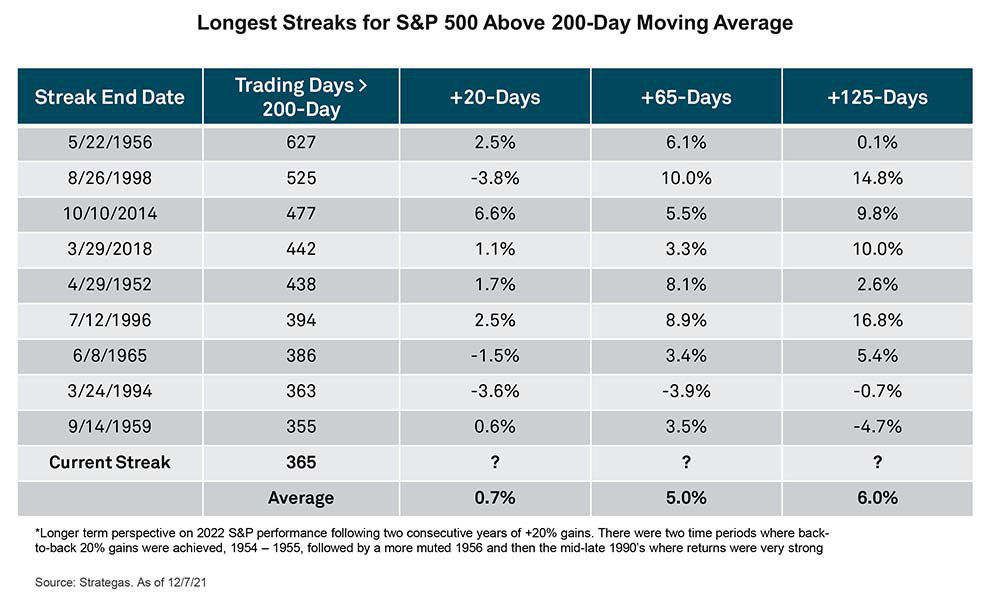
The S&P 500 has traded above the 200-day moving average for all of 2021. The chart below suggests that when the S&P 500 is above its 200-day moving average, forward returns are often favorable. 

Chart showing the longest streaks for S&P 5-00 above the 200-day moving average

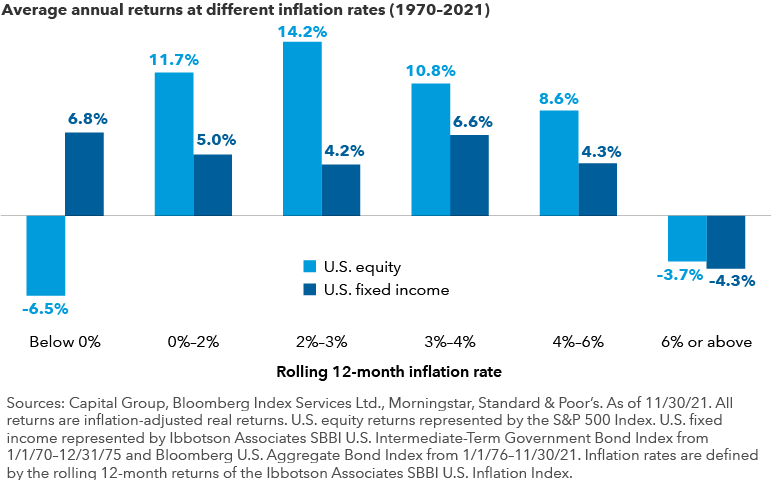
Clearly, inflation and its effect on the stock market are on the top of everyone’s mind. Remember that some inflation can be healthy for companies because it allows them to raise prices and increase profitability. Also, as seen in the chart below, stocks and bonds have generally provided solid returns, even during times of higher inflation. It is during the extremes that the markets often tend to struggle, but as inflation moderates, stocks and bonds can have strong years.

Chart showing average annual returns at different inflation rates from 1970 to 2021

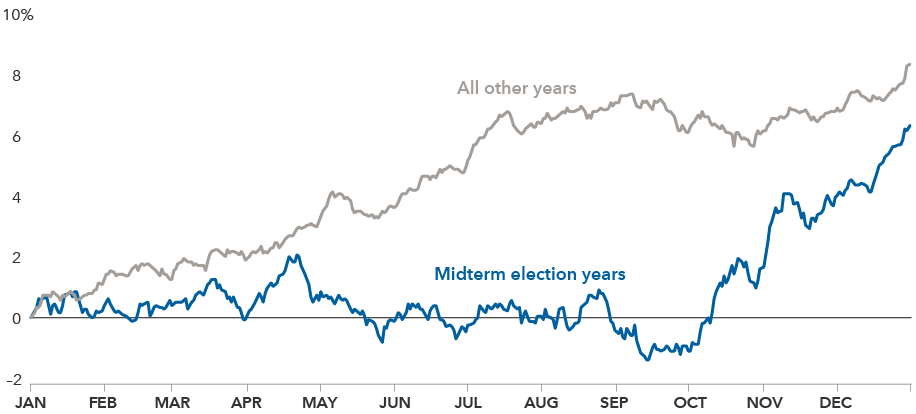
Political uncertainty often has a noticeable short-term effect on the markets. An analysis of more than 90 years of equity returns reveals that stocks tend to have lower average returns and higher volatility for the first several months of midterm election years. The trend often reverses, and markets have tended to return to their normal trajectory. Remember, the numbers below are just averages; it is important not to try to time the market. Elections generally create a lot of noise, so it is important to look past the short-term highs and lows and focus on the long-term picture instead.

S&P 500 Index average returns since 1931

Chart showing S&P 500 Index average returns since 1931

The markets and the global economy are not without risks. History shows us that the biggest risks in a typical year are hiding in plain sight, not suddenly appearing out of nowhere. Risk appears when there is a high degree of confidence among market participants expecting a specific outcome that doesn’t pan out. If we look to identify the unexpected, we see the following as potential risks to the global markets in 2022:

1. Supply chain shortages turn into gluts: Whether it’s semiconductors, used cars or a variety of products, any potential supply glut in 2022 may lead to a fall in inflation. Excess inventory would promote price cuts and pose risks to industries that have thrived on pricing boosts from shortages.
2. Rate hikes slower than expected: Surging inflation has led the Fed to anticipate three rate hikes in 2022. If inflation eases, the expectations for the number of rate hikes may change as well.
3. China: The World Bank cut its forecasts for China’s economy in 2022 after the nation’s continued attempts to restrict business, break up large technology companies and remove bitcoin mining.
4. COVID outbreaks and new strains: Investors may have grown confident in trading rotation in and out of stocks depending on the seasonality and COVID flare-ups. If the current and future waves have less impact on the overall economy, the stocks that have led us out of the economic doldrums may not have the same effect going forward.
5. Geopolitical surprises: The biggest worry could be a military conflict, whether that is China and Taiwan, an invasion of Ukraine by Russia or even a regional conflict in the Middle East. 

History doesn’t always repeat itself, but similarities often exist. While inflation on a year-over-year basis is high, this is not the runaway inflation of the 1970s. Today’s inflation is more akin to the 1920s and 1950s, when we witnessed booms in productivity and innovation and the rebuilding of an economy boosted by a new generation of household spending, along with new infrastructure spending. The markets may experience elevated volatility in the coming year as the above risks test the markets. We will continue to keep you informed and invested through the ups and downs of 2022.

Promo for an article titled 2021 in the Rear-view Mirror: COVID, meme stocks and more


So, what can we learn from all this? We are hopeful that 2022 will be a turning point in the global pandemic and that policymakers will wean economies and markets off fiscal and monetary stimulus. Vaccine manufacturing continues to ramp up, and new therapeutics to fight COVID continue to be available in the U.S. and abroad. Inflationary pressures should ease but still settle at a level higher than the recent past. We believe that diversification and the discipline to stay invested over the long term are more important than ever. We are optimistic for a successful 2022!

From a portfolio perspective, we continue to adhere to the tried-and-true disciplines of diversification, periodic rebalancing and looking forward, while not making investment decisions based on where we have been. Making market decisions based on what might happen may be detrimental to long-term performance. The key is to stay invested and stick with the financial plan. Markets go up and down over time, and downturns present opportunities to purchase stocks at a lower value. As we say each week, it is important to stay the course, focusing on the long-term goal and not on one specific data point or indicator.

It all starts with a solid financial plan for the long run that understands the level of risk that is acceptable for each client. Regarding investments, we believe in diversification and having different asset classes that allow you to stay invested. The best option is to stick with a broadly diversified portfolio that can help you to achieve your own specific financial goals — regardless of market volatility. Long-term fundamentals are what matter.

Sources: Capital Group, Charles Schwab, BNY Mellon

Promo for article on the formula for wealth

This material contains an assessment of the market and economic environment at a specific point in time and is not intended to be a forecast of future events, or a guarantee of future results. Forward-looking statements are subject to certain risks and uncertainties. Actual results, performance, or achievements may differ materially from those expressed or implied. Information is based on data gathered from what we believe are reliable sources.

Using diversification as part of your investment strategy neither assures nor guarantees better performance and cannot protect against loss of principal due to changing market conditions.

Past performance is not a guarantee of future results.

The opinions expressed in this commentary are those of the author and may not necessarily reflect those held by Kestra Investment Services, LLC or Kestra Advisory Services, LLC. This is for general information only and is not intended to provide specific investment advice or recommendations for any individual. It is suggested that you consult your financial professional, attorney, or tax advisor with regard to your individual situation.

Securities offered through Kestra Investment Services, LLC (Kestra IS), member FINRA/SIPC. Investment Advisory Services offered through Kestra Advisory Services, LLC (Kestra AS) an affiliate of Kestra IS. Kestra IS and Kestra AS are not affiliated with CD Wealth Management. Investor Disclosures: https://bit.ly/KF-Disclosures
2021 in the rear-view mirror

As 2021 comes to an end, let’s reflect on the rollercoaster ride we took together.

In January, while we were still in the midst of the global pandemic, we witnessed an insurrection at the Capitol. Thankfully, our government was able to usher in a smooth presidential transition and we quickly returned to business as usual.

Throughout the year, different market themes arose — and some repeated themselves often. Some of the trends and headlines seemed transformational, but in hindsight, the market continued marching on — so much so that you may not even remember some of the issues that captured our attention. 

Promo for an article titled This Year-End Financial Checklist Will Help You Plan and Save.

• Special-purpose acquisition companies — better known as SPACs — became one of Wall Street’s hottest trends, accounting for more than two-thirds of Nasdaq’s initial public offerings in January.

• “Meme stocks” — including GameStop, AMC Entertainment and Blackberry — made headlines with excessive trading volume from investors who targeted them on social media.

• COVID continues to weigh heavily on the minds of investors, from the availability and adoption of vaccinations and boosters to the emergence of variants.

Inflation – from transitory to the highest inflation reading since the early 1980s — caused some investors to worry about a market correction.

• The cost of shipping a container spiked, and supply-chain bottlenecks sent a ripple effect through the economy.

• Commodity prices — such as lumber and used car prices — rose and fell.

• Housing prices reached record-setting levels, thanks to the pandemic and a move toward a remote workforce.

• The pandemic intensified discussions about sustainability and the financial markets, bringing Environmental, Social and Governance (ESG) investing more into the mainstream.

Promo for article on the formula for wealth

So, what can we learn from all this? COVID is still taking a terrible toll on the U.S. and the world. Even with the new Omicron variant, the U.S. economy looks solid and supply-chain bottlenecks may be easing. We think investors need to be ready to ride the COVID rollercoaster for years to come. 

Panic is not a strategy when dips occur. When the market falls and volatility rises, the plan is to stay the course and consider those opportunities as buying chances, not as a time to panic and sell.

We gladly welcomed clients back to our office in 2021, and we look forward to seeing you again in our office in 2022. We continue to stay connected with you through Zoom or in person. Our team continues to have our daily internal meetings every morning and night via Zoom to ensure we stay connected and work together.

Our No. 1 priority is to take care of you, our clients, and we are proud of the work we have done this year. We are grateful for you!

————

This material contains an assessment of the market and economic environment at a specific point in time and is not intended to be a forecast of future events, or a guarantee of future results. Forward-looking statements are subject to certain risks and uncertainties. Actual results, performance, or achievements may differ materially from those expressed or implied. Information is based on data gathered from what we believe are reliable sources.

Using diversification as part of your investment strategy neither assures nor guarantees better performance and cannot protect against loss of principal due to changing market conditions.

Past performance is not a guarantee of future results.

The opinions expressed in this commentary are those of the author and may not necessarily reflect those held by Kestra Investment Services, LLC or Kestra Advisory Services, LLC. This is for general information only and is not intended to provide specific investment advice or recommendations for any individual. It is suggested that you consult your financial professional, attorney, or tax advisor with regard to your individual situation.

Securities offered through Kestra Investment Services, LLC (Kestra IS), member FINRA/SIPC. Investment Advisory Services offered through Kestra Advisory Services, LLC (Kestra AS) an affiliate of Kestra IS. Kestra IS and Kestra AS are not affiliated with CD Wealth Management. Investor Disclosures: https://bit.ly/KF-Disclosures
Here’s why market volatility doesn’t change our outlook

Last week, the stock market pulled back in a very volatile week as investors grappled with the potential impact of the Omicron COVID variant and commentary from Fed Chair Jerome Powell that the risk of inflation has increased. Powell also said the Fed may consider speeding up its bond purchase tapering plans and hinted at potential earlier rate hikes in 2022.

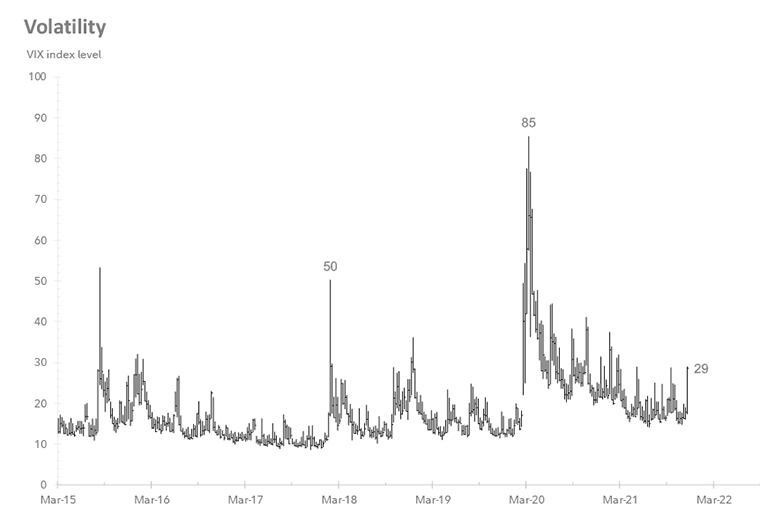
As a refresher, the VIX index is a measure of forward-looking stock market volatility for the next 30 days. The VIX is known as the fear gauge; it reflects the market’s short-term outlook for stock price volatility as derived from option prices on the S&P 500. On Monday, the VIX topped out at 35, after having traded at below 20 for most of October and November — that’s a 75% increase in the volatility index in a very short period. As the chart below shows, we have had many short-lived, volatile market movements over the past 20 months. In hindsight, the spikes in volatility have allowed investors to continue to “buy the dip” in the accompanying market sell-offs. As volatility then wanes, the market recovers.

Chart showing the VIX volatility index from 2015 to today

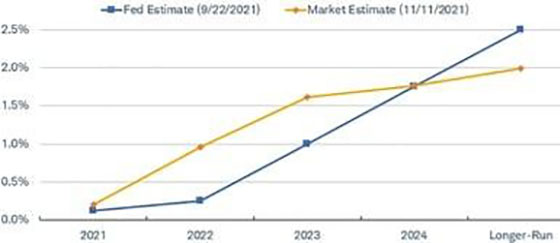
One of the primary causes of the recent increase in volatility is inflation. The Fed belatedly acknowledged inflation risks, and we expect it to start raising rates next year. What matters is not that they are going to raise rates, but the rate trajectory and where they end up next year and going forward. The chart below shows the Fed estimate as well as the market estimate for interest rates. Both the market and the Fed predict that short-term rates will be around 1.75% in 2024, which would be a slow, steady increase from where they are now: 0-0.25%.

The Fed’s view of the path of rate hikes vs. the market’s view

Chart showing the Fed's view of interest rates versus the market's view from now until 2024 and beyond

Note: The 12/15/2027 eurodollar futures rate was used for the Longer-Run market rate. Source: Bloomberg. Fed estimate as of 9/22/2021. The market estimate of the federal funds rate using eurodollar futures (EDSF). As of 11/10/2021.

Also weighing on the markets and causing increased volatility is the work Congress still has to do before the end of the year, with several large issues to resolve: 

* Defense spending bill: Congress is near agreement to authorize $770 billion in military spending.

* Keeping government open: President Biden signed a stopgap spending bill that will keep the Federal Government running through Feb. 18.

* Social spending bill: The Build Back Better Plan could also drag into next year as negotiations on how to fund the bill continue.

* Raising the debt ceiling: The estimated deadline is Dec. 15. Raising the debt ceiling does not allocate new spending; it only authorizes the Treasury to make good on current obligations.

This year’s series of events has no historical parallel: a growth surge from a global pandemic, a supply-driven spike in inflation and a change in Federal Reserve monetary policy that is being tested in real time.

The COVID shock was more like a natural disaster than the economic restart from a global financial crisis. Economic activity surged, and corporate profits rebounded at a rapid pace. 

Demand for goods — rather than services — along with supply-chain bottlenecks have driven prices higher. We expect that prices eventually will be higher than pre-COVID levels, but supply and demand ultimately will determine where they settle. As supply-chain bottlenecks open and more goods are available to the public, prices will come down as demand decreases. At the same time, the service industry also will begin to see increased demand, which may reduce the demand for goods, in turn reducing prices as well. 

Promo for an article titled How We're Handling the Market Sell-Off and Talk of Inflation

So, what can we learn from all this? COVID is still taking a terrible toll on the U.S. and the world. Even with the new Omicron variant, the U.S. economy looks solid and supply-chain bottlenecks may be easing. We think investors need to be ready to ride the COVID rollercoaster for years to come. Panic is not a strategy when dips occur. When the market falls and volatility rises, the plan is to stay the course and consider those opportunities as buying chances, not as a time to panic and sell. 

From a portfolio perspective, we continue to adhere to the tried-and-true disciplines of diversification, periodic rebalancing and looking forward, while not making investment decisions based on where we have been. Making market decisions based on what might happen may be detrimental to long-term performance. The key is to stay invested and stick with the financial plan. Markets go up and down over time, and downturns present opportunities to purchase stocks at a lower value. As we say each week, it is important to stay the course and focus on the long-term goal, not on one specific data point or indicator.

It all starts with a solid financial plan for the long run that understands the level of risk that is acceptable for each client. Regarding investments, we believe in diversification and having different asset classes that allow you to stay invested. The best option is to stick with a broadly diversified portfolio that can help you to achieve your own specific financial goals — regardless of market volatility. Long-term fundamentals are what matter.

Sources: Bloomberg, Blackstone, Fidelity

Promo for article on the formula for wealth

This material contains an assessment of the market and economic environment at a specific point in time and is not intended to be a forecast of future events, or a guarantee of future results. Forward-looking statements are subject to certain risks and uncertainties. Actual results, performance, or achievements may differ materially from those expressed or implied. Information is based on data gathered from what we believe are reliable sources.

Using diversification as part of your investment strategy neither assures nor guarantees better performance and cannot protect against loss of principal due to changing market conditions.

Past performance is not a guarantee of future results.

The opinions expressed in this commentary are those of the author and may not necessarily reflect those held by Kestra Investment Services, LLC or Kestra Advisory Services, LLC. This is for general information only and is not intended to provide specific investment advice or recommendations for any individual. It is suggested that you consult your financial professional, attorney, or tax advisor with regard to your individual situation.

Securities offered through Kestra Investment Services, LLC (Kestra IS), member FINRA/SIPC. Investment Advisory Services offered through Kestra Advisory Services, LLC (Kestra AS) an affiliate of Kestra IS. Kestra IS and Kestra AS are not affiliated with CD Wealth Management. Investor Disclosures: https://bit.ly/KF-Disclosures
How we’re handling the market sell-off and talk of inflation

Last Friday, news of a COVID-19 variant identified in South Africa and new travel restrictions sent markets tumbling and injected volatility into the markets. The Dow Jones Index slid 900 points to suffer its worst day since October 2020. The news was exacerbated in the stock markets, as the Friday after Thanksgiving is typically a low-volume trading day and a shorter trading day due to the holiday. Oil prices fell more than 12% in one day, with news of potential lockdowns across the globe, though President Biden reiterated that the U.S. will not initiate economic lockdowns or new travel restrictions.

The market has continued its sell-off this week as Moderna and Regeneron separately commented on the effectiveness of the current vaccines against the new variant. At the same time, Fed Chairman Jerome Powell told the Senate that he expects tapering could wrap up a few months sooner than anticipated and that it is time to stop describing inflation as “transitory,” opening the possibility for the Fed to raise rates in early 2022.

The chart below reflects the overall market returns through Nov. 26. While the markets have had a strong year, most underlying holdings are trading in a correction mode. This further supports that the underlying market may not be as expensive as many people fear.

Chart showing year to date return and drawdown numbers for major indexes

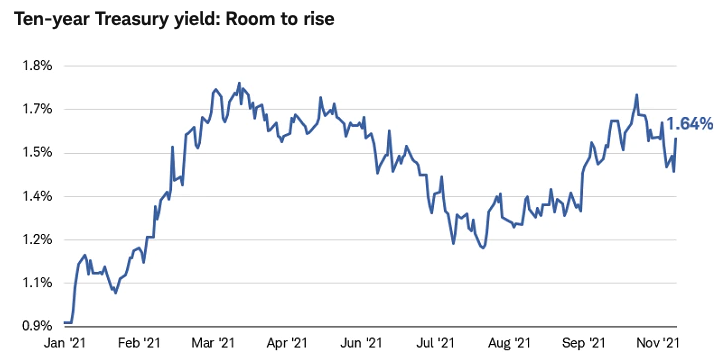
It hasn’t been the smoothest of sailing for fixed income investors in 2021. Bond yields have ridden waves of optimism and pessimism about the economic outlook for most of the year. The chart below reflects the year’s big swings in the 10-year Treasury. As we near the end of the year, short-term yields have moved up in anticipation of tightening monetary policy — while the 10-year Treasury has fallen back from the levels seen in October, despite inflation.

Chart showing the 10-year Treasury yield

With more discussion of inflation — and more economists predicting that rates will rise next year — we recently made a portfolio reallocation within our fixed income portion of the portfolio:

1. We are shortening the duration of the fixed income portion of the portfolio. As a refresher, duration is a measure of how long it takes for a bond to repay the principal using both income and principal. In an environment of rising interest rates, we are hopeful that a shorter duration will protect against falling principal compared to longer-duration bonds. 

2. We are maintaining similar credit quality within fixed income but adding a short-duration position to hedge against rising rates. We removed our longer-duration investment grade corporate bond position. 

3. We also increased the weighting in our strategic income holding to produce additional income in a low interest rate environment. 

Our focus remains on long-term investing with a strategic allocation while maintaining a tactical approach. Our decisions to make changes are calculated and well thought-out, looking at where we see the economy and rates heading.

We are not guessing or market timing. We are anticipating and moving to those areas of strength in the economy. We strategically have new cash on the sidelines and buy in for those clients on down days or dips in the market, as one does in a 401(k) every other week. We speak with our clients regularly about staying the course, not listening to the economic noise and trading memo stocks.

So, what can we learn from all this? Hoping that an outcome will or will not occur is not a strategy. In light of new COVID variants, we think investors need to continue to be ready to ride the rollercoaster for years to come. With the most recent quarter’s record earnings, the overall valuation of the market has come down. That does not mean we won’t experience dips and corrections, but when they happen, the plan is to stay the course and consider those opportunities as buying chances — not a time to panic and sell. 

From a portfolio perspective, we continue to adhere to the tried-and-true disciplines of diversification, periodic rebalancing and looking forward, while not making investment decisions based on where we have been. Making market decisions based on what might happen may be detrimental to long-term performance. The key is to stay invested and stick with the financial plan. Markets go up and down over time, and downturns present opportunities to purchase stocks at a lower value. As we say each week, it is important to stay the course and focus on the long-term goal, not on one specific data point or indicator.

It all starts with a solid financial plan for the long run that understands the level of risk that is acceptable for each client. Regarding investments, we believe in diversification and in having different asset classes that allow you to stay invested. The best option is to stick with a broadly diversified portfolio that can help you to achieve your own specific financial goals — regardless of market volatility. Long-term fundamentals are what matter.

Sources: CNBC, Schwab

promo for an article about the. upcoming RMD deadline

This material contains an assessment of the market and economic environment at a specific point in time and is not intended to be a forecast of future events, or a guarantee of future results. Forward-looking statements are subject to certain risks and uncertainties. Actual results, performance, or achievements may differ materially from those expressed or implied. Information is based on data gathered from what we believe are reliable sources.

Using diversification as part of your investment strategy neither assures nor guarantees better performance and cannot protect against loss of principal due to changing market conditions.

Past performance is not a guarantee of future results.

The opinions expressed in this commentary are those of the author and may not necessarily reflect those held by Kestra Investment Services, LLC or Kestra Advisory Services, LLC. This is for general information only and is not intended to provide specific investment advice or recommendations for any individual. It is suggested that you consult your financial professional, attorney, or tax advisor with regard to your individual situation.

Securities offered through Kestra Investment Services, LLC (Kestra IS), member FINRA/SIPC. Investment Advisory Services offered through Kestra Advisory Services, LLC (Kestra AS) an affiliate of Kestra IS. Kestra IS and Kestra AS are not affiliated with CD Wealth Management. Investor Disclosures: https://bit.ly/KF-Disclosures

Energy prices, interest rates and inflation: Your questions answered

What’s driving interest rates higher? What is inflation — and is it transitory or here to stay? What is stagflation? What are real rates versus nominal rates? Why does everyone keep talking about inflation and interest rates? Why are energy prices so high?

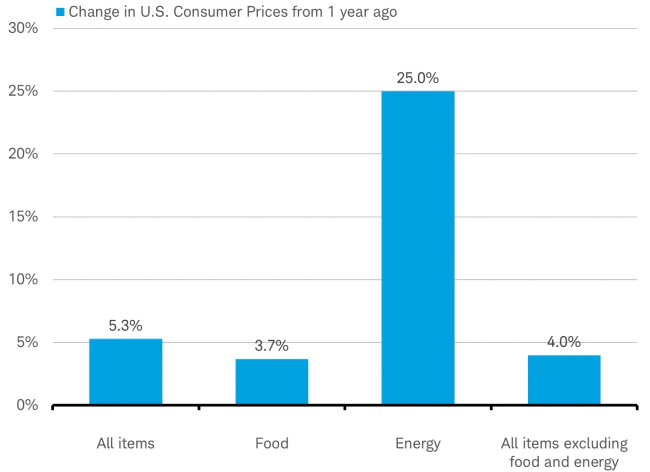
With so many unanswered questions, the noise in the financial markets remains at a high level. The energy world has changed drastically since April 2020, when we wrote about the negative price of a barrel of oil! West Texas Crude oil prices are now over $80 a barrel. Energy prices, as measured by the CPI index, are up 25% over the last year, as seen in the chart below. If you remove food and energy from the CPI calculation, the year-over-year change in consumer prices is only 4%, not the reported 5.3%. A perfect storm of energy shortages and high demand has made the outlook uncertain for energy prices globally. Prices are surging for oil, natural gas and coal, along with other commodities such as lumber, used cars and shipping costs — and there are supply chain disruptions as well. The demand for energy is outpacing the supply, and when that happens, prices will rise to meet the demand. 

For those who want to compare this oil surge to the 1970s, there are several critical differences:

* The energy intensity of gross domestic product (GDP) is half of what it was in the 1970s.

* Fracking wasn’t available in the 1970s, and now, it can rapidly increase production.

* The U.S. is now an exporter of oil versus being a major importer 50 years ago.

Chart showing changes in consumer price index

All these factors are making economists question how transitory inflation is. What if we have inflation with lower growth, which we call stagflation? Stagflation refers to an economy that is experiencing a simultaneous increase in inflation and stagnation of economic output (slow or negative economic growth). Investors have had little experience with stagflation in recent decades. Only 41 quarters since 1960 (17% of the time) have been in a stagflation environment, and most of those occurred in the 1970s. We believe the equity market should continue to be strong as investors gain confidence that the current pace of inflation is transitory and not permanent. 

As shipping costs come down, the supply of goods increases, prices will drop and some of the inflationary pressures that we feel today will dissipate. Eventually, the boats that are floating at sea full of goods will be offloaded, and those goods will make their way into the economy. Therefore, the Fed continues to say that the inflation we are experiencing today is transitory and expected to level off — even if it takes a year or two to do so.

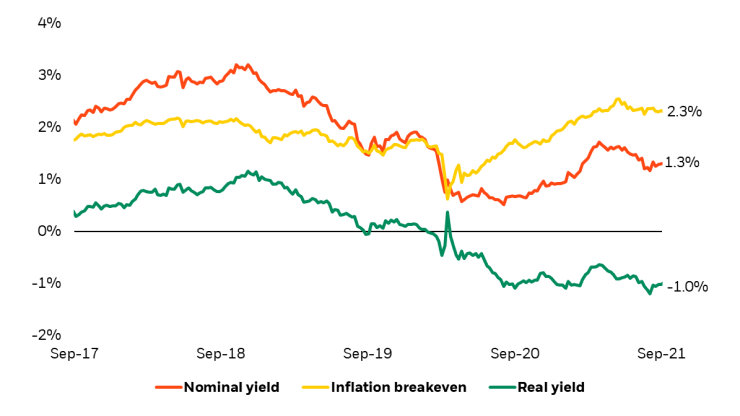
So what’s driving interest rates higher? Interest rates are largely impacted by two factors: policy decisions made by the Fed and investor expectations of those decisions over the long run. The Fed would like to moderate the speed at which Treasury yields rise through its tapering of asset purchases. The Fed is maintaining a dual mandate of price stability and maximum employment before it considers raising short-term rates. The chart below reflects the difference between nominal rates and real rates. 

Nominal rates are the rates we commonly discuss and read about — the 10-year Treasury rate, for example. Real rates are the interest rates that an investor receives after adjusting for inflation – the real yield you receive from owning an asset. If a Treasury bond were to pay you 5% nominal yield per year, but inflation is 3% per year, you would have a real rate of only 2%. As seen in the chart below, if the 10-year Treasury rate is 1.3% and inflation is running around 2.3%, then the real yield is now a -1%. This means investors who are buying Treasuries now are essentially expected to earn a negative 1% in real yield annually.

Chart showing nominal yield versus real yield

So, what can we learn from all this? More and more noise is creeping into the markets today: worries about inflation, higher energy prices, slower growth and possible stagflation. The amount of liquidity in the markets remain at record levels. There still exists a chance that we will see additional stimulus into the economy through an infrastructure package. While questions exist about the state of the economy, there remain many reasons to be optimistic. As we say each week, it is important to stay the course and focus on the long-term goal, not on one specific data point or one indicator.

From a portfolio perspective, we continue to adhere to the tried-and-true disciplines of diversification, periodic rebalancing and looking forward, while not making investment decisions based on where we have been. Making market decisions based on what might happen may be detrimental to long-term performance. The key is to stay invested and stick with the financial plan. Markets go up and down over time, and downturns present opportunities to purchase stocks at a lower value. 

It all starts with a solid financial plan for the long run that understands the level of risk that is acceptable for each client. Regarding investments, we believe in diversification and having different asset classes that allow you to stay invested. The best option is to stick with a broadly diversified portfolio that can help you to achieve your own specific financial goals — regardless of market volatility. Long-term fundamentals are what matter.

Sources: Blackrock, CNBC, Horizon, Schwab

Promo for article on the formula for wealth

This material contains an assessment of the market and economic environment at a specific point in time and is not intended to be a forecast of future events, or a guarantee of future results. Forward-looking statements are subject to certain risks and uncertainties. Actual results, performance, or achievements may differ materially from those expressed or implied. Information is based on data gathered from what we believe are reliable sources.

Using diversification as part of your investment strategy neither assures nor guarantees better performance and cannot protect against loss of principal due to changing market conditions.

Past performance is not a guarantee of future results.

The opinions expressed in this commentary are those of the author and may not necessarily reflect those held by Kestra Investment Services, LLC or Kestra Advisory Services, LLC. This is for general information only and is not intended to provide specific investment advice or recommendations for any individual. It is suggested that you consult your financial professional, attorney, or tax advisor with regard to your individual situation.

Securities offered through Kestra Investment Services, LLC (Kestra IS), member FINRA/SIPC. Investment Advisory Services offered through Kestra Advisory Services, LLC (Kestra AS) an affiliate of Kestra IS. Kestra IS and Kestra AS are not affiliated with CD Wealth Management. Investor Disclosures: https://bit.ly/KF-Disclosures

October can be scary for investors, but there’s no reason to panic

September held true to its history of being the worst month for performance on average since the S&P 500’s inception in 1928. The month ended with increased volatility (as measured by the VIX index) and negative market sentiment. Its negative market returns marked the first time in eight months that the S&P 500 ended a month in negative territory. There was no shortage of risks working against the financial markets, including debt ceiling negotiations, fiscal policy uncertainty, monetary policy uncertainty, global supply chain bottlenecks, slowing economic growth projections from the Delta variant and ongoing inflation fears.

How does the VIX index work? Read “Coping with Volatility in the Market.”
 
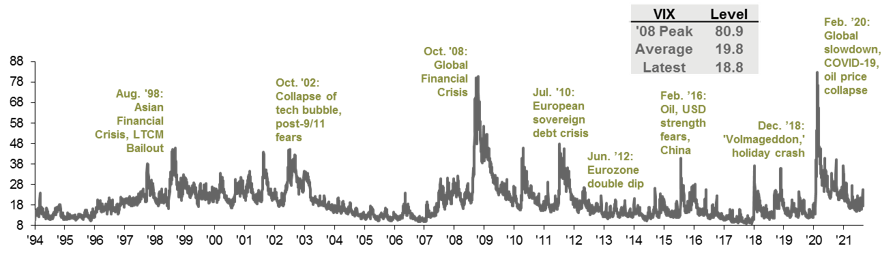
The chart below depicts the VIX index over the last 27 years. Volatility has risen recently, reflecting the possibility of a broader distribution of potential market outcomes based on many of the risks listed above. We are a far cry from volatility levels seen during the financial crisis of 2008 or the global pandemic in 2020, however; the VIX index remains below average heading into the fourth quarter of the year.

Chart showing stock market volatility over the last 27 years, up until October 2021

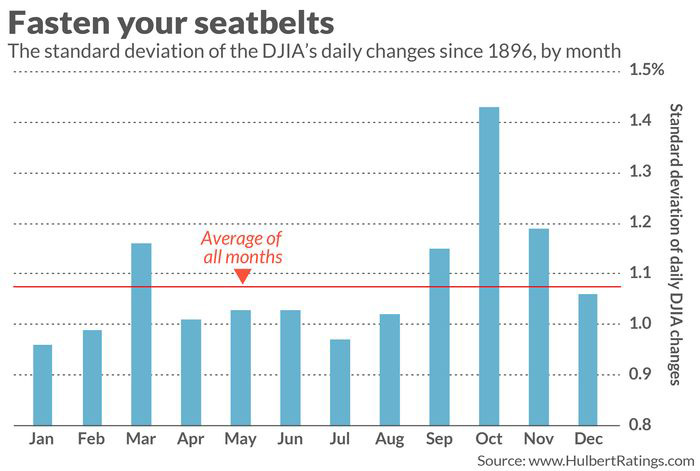
October remains the most volatile month of the calendar, as you can see from the chart below. October’s above-average volatility isn’t a function of any one year or a presidential cycle; it has been consistent over decades and market cycles. As volatility increases, it doesn’t necessarily mean that the market will go down more — but it does mean that the ranges of market movements increase. Often, with increased volatility comes increased emotion accompanying the ups and downs. The feeling of panic when the market is moving down feels greater than the relief or joy feels when the market is moving up.

Chart showing stock market volatility by month, with the highest being found in October

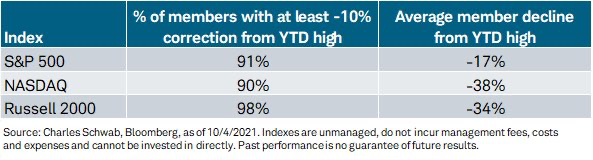
As we wrote last week, more than 90% of the S&P 500 holdings have had at least a 10% correction from their highs this year. The same now holds true for both the NASDAQ and Russell 2000 (small cap stock index). Looking further under the hood of each index below, the average stock decline is far greater than the 10% correction. 

Chart showing year-to-date correction for three indexes

So, what can we learn from all this? With many stocks already in correction mode and potential increased volatility on the horizon, it is important to remember that investing is a disciplined process and not a game of timing when to get in or when to get out of the market. “Buy the dip” continues to be a prominent strategy among many investors and one of the reasons market pullbacks have not been as prominent in 2021. The larger dips we have seen recently as volatility has increased have led to some larger declines, followed by stronger bounce backs. As we say each week, it is important to stay the course and focus on the long-term goal — not on one specific data point or indicator.

From a portfolio perspective, we continue to adhere to the tried-and-true disciplines of diversification, periodic rebalancing and looking forward, while not making investment decisions based on where we have been. Making market decisions based on what might happen may be detrimental to long-term performance. The key is to stay invested and stick with the financial plan. Markets go up and down over time, and downturns present opportunities to purchase stocks at a lower value. 

It all starts with a solid financial plan for the long run that understands the level of risk that is acceptable for each client. Regarding investments, we believe in diversification and having different asset classes that allow you to stay invested. The best option is to stick with a broadly diversified portfolio that can help you to achieve your own specific financial goals — regardless of market volatility. Long-term fundamentals are what matter.

Sources: JP Morgan, MarketWatch, Schwab

Promo for article on the formula for wealth

This material contains an assessment of the market and economic environment at a specific point in time and is not intended to be a forecast of future events, or a guarantee of future results. Forward-looking statements are subject to certain risks and uncertainties. Actual results, performance, or achievements may differ materially from those expressed or implied. Information is based on data gathered from what we believe are reliable sources.

Using diversification as part of your investment strategy neither assures nor guarantees better performance and cannot protect against loss of principal due to changing market conditions.

Past performance is not a guarantee of future results.

The opinions expressed in this commentary are those of the author and may not necessarily reflect those held by Kestra Investment Services, LLC or Kestra Advisory Services, LLC. This is for general information only and is not intended to provide specific investment advice or recommendations for any individual. It is suggested that you consult your financial professional, attorney, or tax advisor with regard to your individual situation.

Securities offered through Kestra Investment Services, LLC (Kestra IS), member FINRA/SIPC. Investment Advisory Services offered through Kestra Advisory Services, LLC (Kestra AS) an affiliate of Kestra IS. Kestra IS and Kestra AS are not affiliated with CD Wealth Management. Investor Disclosures: https://bit.ly/KF-Disclosures

Here’s why the market’s climb is a bumpy ride

Although the stock market has experienced a steady climb this year, the TRIP is always an interesting ride — and rarely a steady one. Along the journey, the market typically faces many hurdles; currently, those speed bumps are Taxes, Rates, Inflation and Prices (valuation). 
 
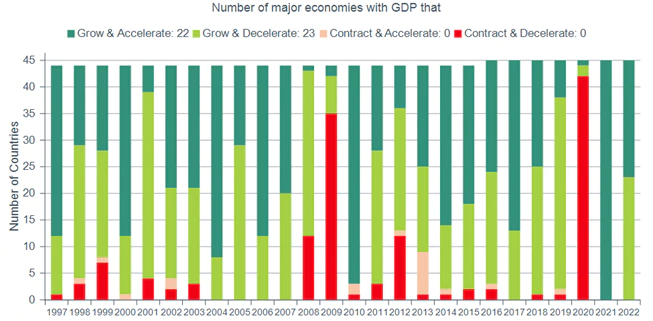
Global stocks will always have a myriad of worries, despite favorable longer-term economic forecasts and bright spots. The Organization for Economic Cooperation and Development forecasts that every one of the 45 major economies in the world should be growing next year, with about half experiencing slower growth than last year. Global economic growth is expected to be 6% for this year and 4.9% for 2022, according to the International Monetary Fund. For context, growth above 4% is understood to be an economic boom, whereas growth below 2% is considered a global recession. 

chart showing global gdp over time

The fundamental strength of the economy remains intact, powered by vaccines and the U.S. consumer. The global growth slowdown is expected following the strong reopening trade in the wake of the global pandemic. Price remains a major speed bump for the economy, both in the labor markets and in the supply chain. Firms need workers; there are more jobs available than there are workers right now. Therefore, companies are paying more for employees, which will disrupt profits. 

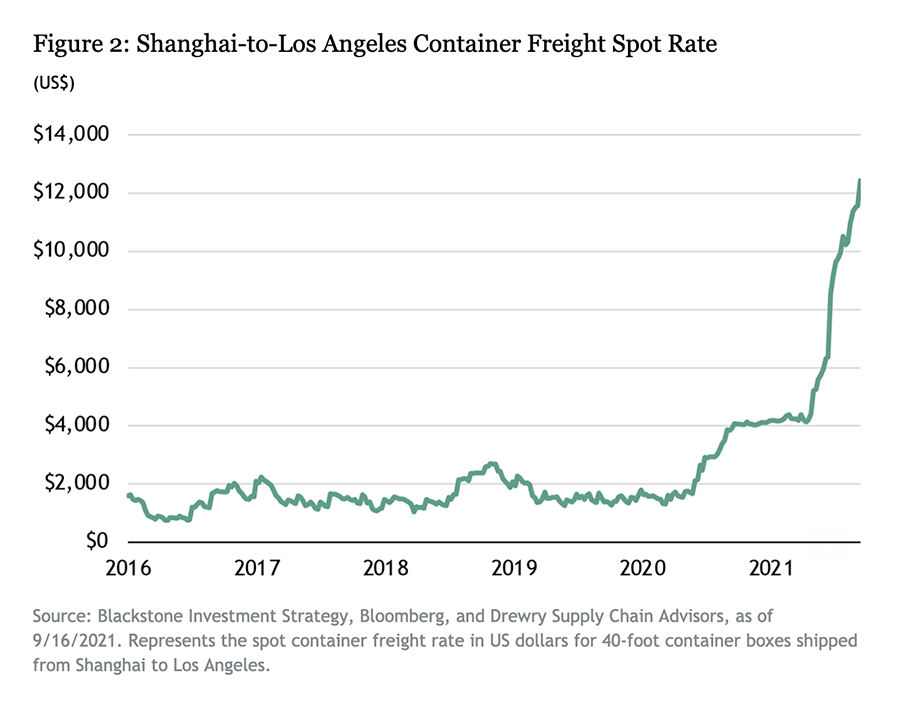
Shipping capacity remains too limited to satisfy the rebound in consumer demand, and cargo prices are through the roof (as seen below). Eventually, supply and demand will equalize, which will reduce costs, but until that time, shipping and other supply chain costs will soften corporate profits.

chart showing increasing shipping costs

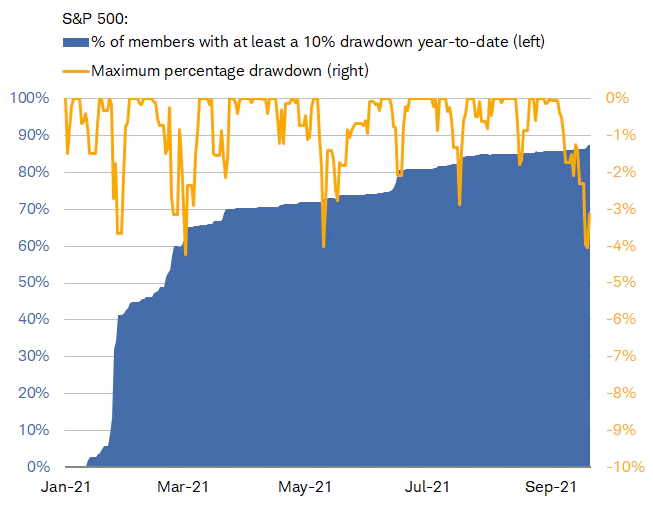
Throughout the year, we continue to see underlying movement between different sectors in the S&P 500. For example, Treasury rates rise, leading to investors selling technology stocks and buying financials and oil stocks — or instead, the 10-year Treasury falls, and the big-cap technology sector comes roaring back. Under the surface of the rally, many stocks in the S&P 500 already have reached correction territory this year, as seen in the chart below. Nearly 90% of the stocks in the S&P 500 have had at least a 10% correction at some point in 2021. The fact that so many stocks have had close to a 10% drawdown reflects what we have discussed recently: that there are some fundamental challenges in the economy, and now we have disagreements in Washington over the debt ceiling and potential government shutdown.

chart showing market drawdowns over time

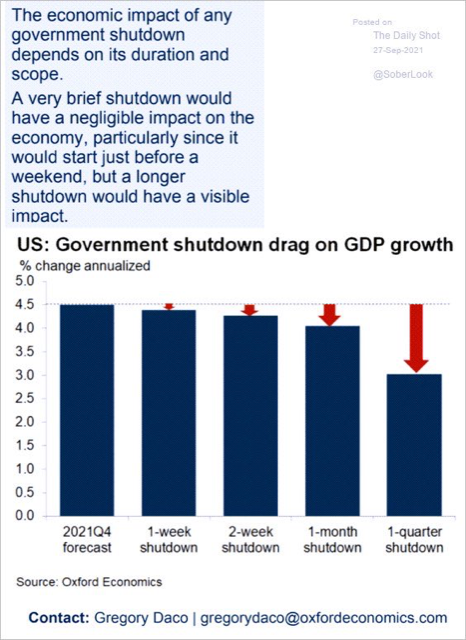
As we reach the end of September, Congress is faced with a pileup of legislative issues that have stock market implications. The most immediate deadline facing Congress is a potential government shutdown on Oct. 1. A tentative deal is in the works to temporarily fund through early December, but it is not a done deal. The chart below projects the economic impact of any government shutdown. The longer a shutdown occurs, the larger the impact on the U.S. economy. Markets also are watching the standoff over raising the debt ceiling. To date, Congress has never failed to raise the debt ceiling before the country would technically go into default.

chart showing impact of government shutdowns

So, what can we learn from all this? The current TRIP of the economy may not be the smoothest road. Please remember: While we may hit some speed bumps along our TRIP, we have been down this road before. Whether it’s tax increases, inflation, interest rates, equity valuations or government shutdowns, history has always shown that markets tend to move past these bumps. It is important to focus on the long-term goal and not on one specific data point or indicator.

From a portfolio perspective, we continue to adhere to the tried-and-true disciplines of diversification, periodic rebalancing and looking forward, while not making investment decisions based on where we have been. Making market decisions based on what might happen may be detrimental to long-term performance. The key is to stay invested and stick with the financial plan. Markets go up and down over time and downturns present opportunities to purchase stocks at a lower value. 

It all starts with a solid financial plan for the long run that understands the level of risk that is acceptable for each client. Regarding investments, we believe in diversification and having different asset classes that allow you to stay invested. The best option is to stick with a broadly diversified portfolio that can help you to achieve your own specific financial goals — regardless of market volatility. Long-term fundamentals are what matter.

Sources: Blackstone, The Daily Shot, Schwab

Promo for article on the formula for wealth

This material contains an assessment of the market and economic environment at a specific point in time and is not intended to be a forecast of future events, or a guarantee of future results. Forward-looking statements are subject to certain risks and uncertainties. Actual results, performance, or achievements may differ materially from those expressed or implied. Information is based on data gathered from what we believe are reliable sources.

Using diversification as part of your investment strategy neither assures nor guarantees better performance and cannot protect against loss of principal due to changing market conditions.

Past performance is not a guarantee of future results.

The opinions expressed in this commentary are those of the author and may not necessarily reflect those held by Kestra Investment Services, LLC or Kestra Advisory Services, LLC. This is for general information only and is not intended to provide specific investment advice or recommendations for any individual. It is suggested that you consult your financial professional, attorney, or tax advisor with regard to your individual situation.

Securities offered through Kestra Investment Services, LLC (Kestra IS), member FINRA/SIPC. Investment Advisory Services offered through Kestra Advisory Services, LLC (Kestra AS) an affiliate of Kestra IS. Kestra IS and Kestra AS are not affiliated with CD Wealth Management. Investor Disclosures: https://bit.ly/KF-Disclosures

The market’s moving: Keeping up with China, Washington and COVID

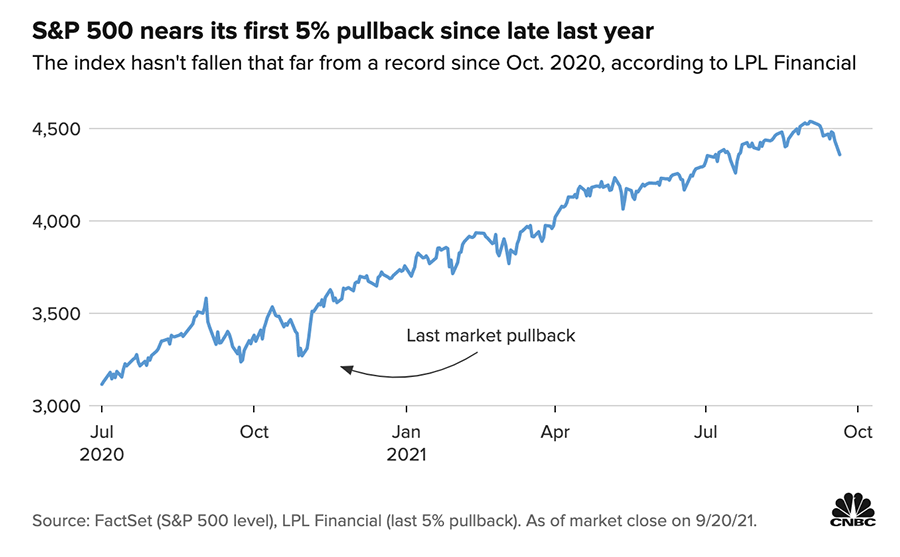
Global stocks started the week with the worst daily performance since May as investors digested the news over the weekend about the troubled Chinese property market. China Evergrande Group, the world’s most indebted property developer, is at risk of default this week on its debt payments. The potential long-term fallout from Evergrande’s liquidity crisis is unknown — as is any potential spillover to other financial markets. We also do not know how the Chinese government may act to bail out the real estate behemoth. Monday’s sell-off briefly pushed the S&P 500 to 5% below its last record on an intraday basis for the first time since October 2020 (see chart below). 

Chart showing stock market performance since July 2020

Several other factors also are affecting the current market environment, and we will address each of them below:

1. Angst in Washington over the upcoming expiration of the borrowing limit (debt ceiling) and a potential government shutdown

2. New proposed tax increases

3. Lingering inflationary worries and when the Fed’s tapering may start

4. The effect of the Delta variant on the economy

Angst in Washington

If Congress fails to raise the borrowing limit, the U.S. government would default for the first time. “The U.S. has never defaulted. Not once,” Treasury Secretary Janet Yellen said. “Doing so would likely precipitate a historic financial crisis that would compound the damage of the continuing public health emergency.” The deadline to avoid both a government shutdown and the debt ceiling issue is a moving target. Raising or suspending the debt ceiling does not authorize additional spending, but it increases the spending limit, similar to a credit card. 

Proposed Tax Increases

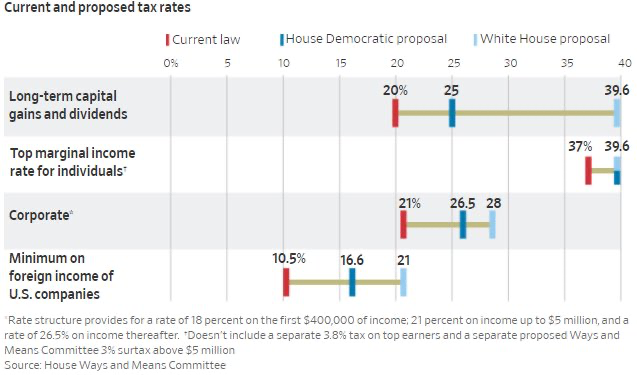
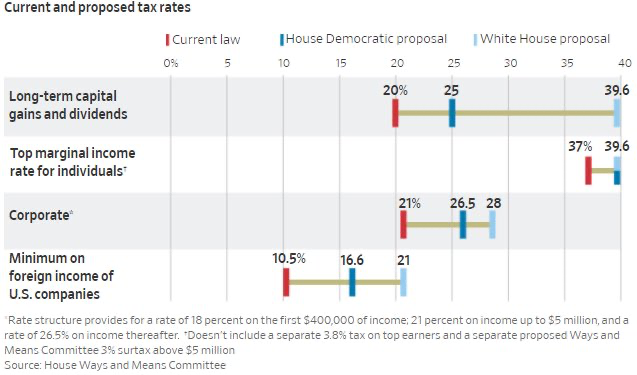
As we wrote about last week, the House Ways & Means committee proposed tax increases on the wealthy to help fund a $3.5 trillion economic package. Remember, these are just proposed tax increases and not law.  The main tax increases in the proposal are: 

* Raise the top individual tax rate from 37% to 39.6%.

* Apply a 3% surtax on incomes greater than $5 million.

* Raise the long-term capital gains tax rate to 25% for couples making more than $450,000.

Chart showing details of tax rate pproposals

Inflation

Inflation remains on the forefront of consumers’ minds as prices of many goods and services continue to rise due to lack of inventory and empty shelves caused by shipping delay and costs out of China. The Federal Reserve Chairman, Jerome Powell, has stated on numerous occasions that the Fed believes inflation to be transitory – meaning temporary. His reasoning is as follows: 

* It’s not broad based. Inflation is concentrated in a few sectors that were hit hardest by the pandemic.

* The biggest price surges already are receding. Lumber and used car prices are now stabilizing or dropping after rocketing higher.

* Wages are rising, but not faster than productivity gains.

* Globally, price pressures are downward with an aging population and advancements in technology. 

The Federal Reserve concludes its two-day meeting this week and the focus remains on when the Fed will begin to taper its purchases. As we wrote about recently, “tapering” is a term that describes the process of gradually stopping asset purchases. When the Fed begins to taper, it purchases fewer bonds, which reduces additional money flowing into the economy, in hopes of slowing economic growth. All of this is done with the focus on controlling inflation and the economy. The Federal Reserve Bank tries to signal its intentions and be transparent with the hope that the impact to the financial markets is minimized.

COVID

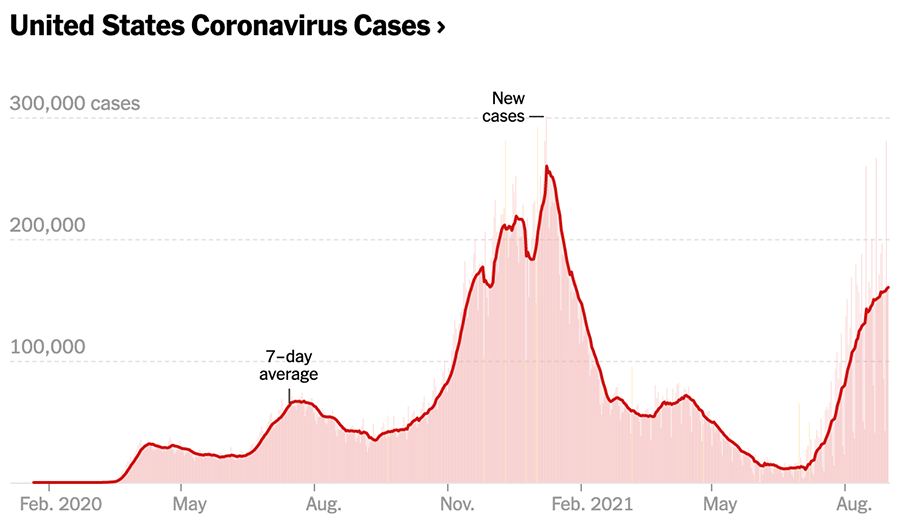
Chart showing U.S. COVID cases since February 2020

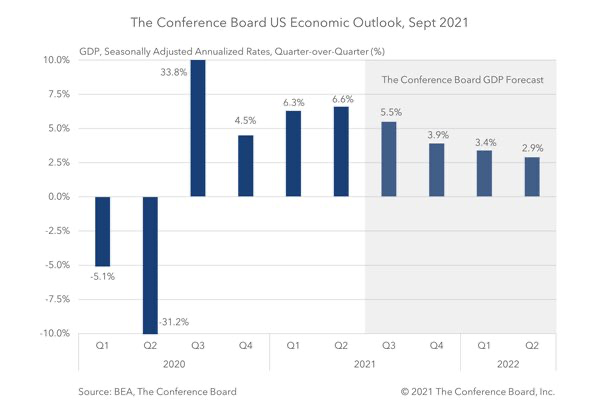
Due to the Delta variant, COVID cases remain near January levels. As colder weather approaches and flu season ramps up, the fear is that COVID variants could continue to slow economic growth. Future GDP forecast is expected to decline from recent highs — but it’s not expected to be derailed by COVID. 

So, what can we learn from all this? The current stock market continues to digest a multitude of economic messages: a potential default by China Evergrande group, inflationary pressures, proposed tax hikes, the Federal Reserve’s plans to start tapering and increase rates, and the ongoing global pandemic. It is important to focus on the long-term goal — and not to focus on only one data point or indicator. 

From a portfolio perspective, we continue to adhere to the tried-and-true disciplines of diversification, periodic rebalancing and looking forward, while not making investment decisions based on where we have been. Making market decisions based on what might happen may be detrimental to long-term performance. The key is to stay invested and stick with the financial plan. Markets go up and down over time, and downturns present opportunities to purchase stocks at a lower value. 

It all starts with a solid financial plan for the long run that understands the level of risk that is acceptable for each client. Regarding investments, we believe in diversification and having different asset classes that allow you to stay invested. The best option is to stick with a broadly diversified portfolio that can help you to achieve your own specific financial goals — regardless of market volatility. Long-term fundamentals are what matter.

Sources: CNBC, Reuters, Schwab, BEA Conference Board

Promo for article on the formula for wealth

This material contains an assessment of the market and economic environment at a specific point in time and is not intended to be a forecast of future events, or a guarantee of future results. Forward-looking statements are subject to certain risks and uncertainties. Actual results, performance, or achievements may differ materially from those expressed or implied. Information is based on data gathered from what we believe are reliable sources.

Using diversification as part of your investment strategy neither assures nor guarantees better performance and cannot protect against loss of principal due to changing market conditions.

Past performance is not a guarantee of future results.

The opinions expressed in this commentary are those of the author and may not necessarily reflect those held by Kestra Investment Services, LLC or Kestra Advisory Services, LLC. This is for general information only and is not intended to provide specific investment advice or recommendations for any individual. It is suggested that you consult your financial professional, attorney, or tax advisor with regard to your individual situation.

Securities offered through Kestra Investment Services, LLC (Kestra IS), member FINRA/SIPC. Investment Advisory Services offered through Kestra Advisory Services, LLC (Kestra AS) an affiliate of Kestra IS. Kestra IS and Kestra AS are not affiliated with CD Wealth Management. Investor Disclosures: https://bit.ly/KF-Disclosures
Here’s what we’re watching after the market’s stumble

The Dow Jones and S&P 500 suffered five straight days of losses, the worst weekly performance since June. Different factors may have caused the selling last week: the Delta variant and its impact on slowing economic growth, the Federal Reserve’s tapering and how it may handle inflationary pressures, current stock valuations and potential tax hikes proposed by the Biden administration. Typically, it is something investors don’t see coming — such as a pandemic or global financial crisis — that causes the larger market selloffs, not something that investors already expect. 
 
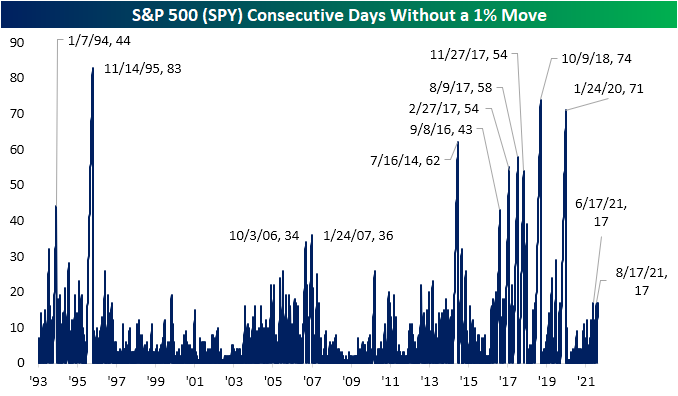
Market pullbacks should be expected, especially since the largest drawdown year-to-date has been 4.2%. The “textbook correction,” in which stocks pull back at least 10%, is natural and healthy market functioning and behavior. As seen in the chart below, the S&P 500 has been in a recent trading lull, going many sessions without a 1% move — but the lull has been nowhere near what we have seen in the last few years.

Chart showing consecutive trading days without a 1% move since 1993

Contributing to the recent market jitters is the current state of inflation and concerns over how to pay for potential additional infrastructure spending. Prices for consumer goods rose less than expected in August, a sign that inflation may be starting to cool. The consumer price index (CPI), which measures a basket of common products as well as various energy goods, increased 5.3% from a year ago. That’s less than the expected increase of 5.4% and a smaller increase month over month. Energy prices accounted for much of the recent inflation increase; energy is up 25% from a year ago, and gasoline prices have surged 42% over the same period. 
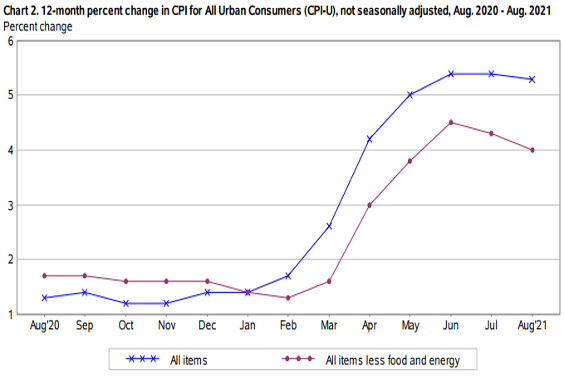
Chart showing percent change in CPI over a 12-month period

This week, the House Ways and Means Committee released a more detailed overview of potential tax changes to help pay for the proposed infrastructure and expansion of social programs. The highlights of the current plan are as follows: 

* Top marginal tax rate increase from 37% to 39.6%; also, a 3% surtax on individuals with adjusted gross income greater than $5 million.

* Capital gains rate increase from 20% to 25% for “certain high-income individuals.”

* Changing the corporate tax rate from a flat tax to a tiered tax rate, with the proposed top rate at 26.5%.

* Estate and gift tax exemptions would drop back to $5 million (plus inflation adjustments), down from the current $11.7 million per person.

* Eliminating Roth conversions for IRAs and workplace plans for married couples earning more than $450,000 (and for individuals earning more than $400,000).

Chart showing current and proposed tax rates

Remember, these are proposed tax changes that still have a long way to go before becoming law. Changes can and will occur as negotiations continue over the infrastructure spending package. In our opinion, concern about changes in estate tax law is a good reason to consult with estate attorneys to discuss the current plan. Similarly, avoiding potential higher capital gains rates may be a good idea if it makes sense in the context of your overall financial plan. It is important to remember that the proposed tax changes are just that: proposals, not laws. We will be ready and proactive if tax law changes occur for capital gains and Roth IRA contributions.

So, what can we learn from all this? The stock market continues to digest mixed economic messages as well as the impact of the Delta variant, inflationary pressures, and the Federal Reserve’s response to tapering, rates and potential tax hikes. It is important not to focus on one data point or one indicator, but to look at the big picture. 

From a portfolio perspective, we continue to adhere to the tried-and-true disciplines of diversification, periodic rebalancing and looking forward, while not making investment decisions based on where we have been. Making market decisions based on what might happen may be detrimental to long-term performance. The key is to stay invested and stick with the financial plan. Markets go up and down over time, and downturns present opportunities to purchase stocks at a lower value. 

It all starts with a solid financial plan for the long run that understands the level of risk that is acceptable for each client. Regarding investments, we believe in diversification and having different asset classes that allow you to stay invested. The best option is to stick with a broadly diversified portfolio that can help you to achieve your own specific financial goals — regardless of market volatility. Long-term fundamentals are what matter.

Sources: CNBC, The New York Times, Forbes, House Ways and Means Committee, U.S. Bureau of Labor Statistics

This material contains an assessment of the market and economic environment at a specific point in time and is not intended to be a forecast of future events, or a guarantee of future results. Forward-looking statements are subject to certain risks and uncertainties. Actual results, performance, or achievements may differ materially from those expressed or implied. Information is based on data gathered from what we believe are reliable sources.

Using diversification as part of your investment strategy neither assures nor guarantees better performance and cannot protect against loss of principal due to changing market conditions.
Past performance is not a guarantee of future results.

The opinions expressed in this commentary are those of the author and may not necessarily reflect those held by Kestra Investment Services, LLC or Kestra Advisory Services, LLC. This is for general information only and is not intended to provide specific investment advice or recommendations for any individual. It is suggested that you consult your financial professional, attorney, or tax advisor with regard to your individual situation.

Securities offered through Kestra Investment Services, LLC (Kestra IS), member FINRA/SIPC. Investment Advisory Services offered through Kestra Advisory Services, LLC (Kestra AS) an affiliate of Kestra IS. Kestra IS and Kestra AS are not affiliated with CD Wealth Management. Investor Disclosures: https://bit.ly/KF-Disclosures